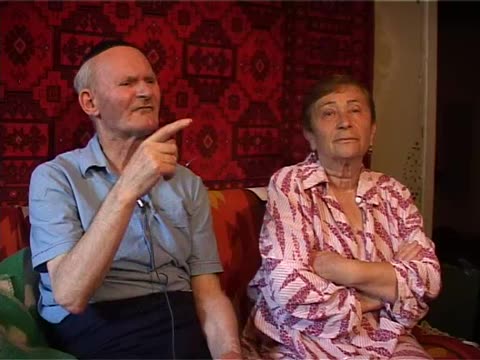
Episodes from his family’s in prewar Jewish religious life in Rîbniţa, Moldova
From the machine transcript
Shor recalls his earliest childhood memory: as a child he fell seriously ill, and his mother's brother took him to a revered Jew in Rîbniţa, who helped after the doctors in Chişinău could not. He then tells a family story about his father's richer younger brother. The brother's wife and Shor's mother quarrelled over a synagogue seat before Rosh Hashanah and drew lots, and the wife later died.
The passage also contains the story of the dispute over a synagogue seat.
Prewar Jewish religious life in Orhei, Moldova
From the machine transcript
Answering Kerler, Shor describes Orhei as a Jewish town, 90 per cent or so Jewish (?), where people traded and lived well in Moldova's good climate. His mother's brother lived in a village with large wine-making holdings. Shor remembers sowing tobacco and wheat there, and says the estate was later dispossessed under Soviet rule.
Gives the town's size, wine-making and the uncle's village estate.
Dialectological questions. Before the war and the wine region.
From the machine transcript
Kerler asks the meaning of the word 'papshoi' (maize/corn), and Shor explains that it is maize, from which mamaliga is made. They discuss mamaliga and the lack of maize flour where they are now.
Dialectological questions. Childhood
From the machine transcript
Shor says he studied with a melamed who came to the house, because there were no Jewish schools; he went to a Moldovan school and learned to pray from the prayer book. He says the synagogue was closed in 1939 and gives the number of synagogues in Orhei as about twenty. Kerler asks about the difference between a shul, a kloyz and a beys-medresh, and Shor says he does not remember. Shor says his wife knows a lot about kashrut and holidays.
Covers private tutoring at home, the number of synagogues and the 1939 closing of the shul.
Jewish holidays
From the machine transcript
Kerler asks about Jewish holidays, and Shor and a woman name some, such as Rosh Hashanah and Purim. Shor recalls that the community paid a lot to bring a top cantor from Chişinău or Bucharest for the High Holidays. Kerler asks the Yiddish word for a person with a good voice, and the answer is not clear.
Jewish cultural life in Orhei before the war
From the machine transcript
Kerler asks about klezmers and Jewish weddings in Orhei. Shor recalls a wedding of his mother's sister's husband's relative (?) with a huppah and musicians, but cannot recall a badkhn.
Childhood friends and memory about Jewish holidays like Shabbos and Chanukah
From the machine transcript
Shor says that only one non-Jew lived near them in Orhei and he spoke Yiddish fairly well. Asked about Hanukkah, he remembers Hanukkah money and playing dreidel. He describes Sabbath at home: his mother baked challah, made a meat soup with noodles, and bought fish and stuffed it.
Also covers the one non-Jewish neighbor who spoke Yiddish and the Sabbath fish and soup.
Dialectological questions
From the machine transcript
Shor says he spoke good Yiddish at home. Kerler asks a few questionnaire items, such as the Yiddish for the prophet Elijah and the drinking at the seder. Shor cannot recall them, and others in the room chip in.
Efim shares information about Yiddish-speakers of the region.
From the machine transcript
A man in the room says there is an older Yiddish speaker in the area, over eighty and born in Orhei (?) or nearby. Shor says he was born in 1925 and that man is a year older.
Names a possible surname, Skablitski (?), and gives Shor's birth year.
Yiddish-speakers in the region
From the machine transcript
A man in the room mentions an older Yiddish speaker in the area, over eighty, and Shor gives his own birth year as 1925, a year younger than that man. The transcript is partly garbled.
Dialectological questions and life after the war, in particular about the Jewish cemetery in Uriev
From the machine transcript
Kerler puts a long series of dialect questionnaire items, including attic, sun, son, tooth, book, deaf, bluish, 'a lot of Jews' and Purim pastries. Shor answers some and says he has forgotten others. In the middle Shor says that after the war he went to Orhei when his mother's sister died aged 85, and describes the Jewish cemetery, where the dead are laid on boards, not in a coffin. He also gives the meaning of 'golem' and answers questions on Purim food.
Includes the postwar visit to the Orhei cemetery and the burial custom with boards.
The team concludes the interview with Shor, while the camera collects footage of Shor's apartment and neighborhood.
From the machine transcript
Fragmentary, largely unintelligible talk at the end of the Shor session. The transcript shows no clear topic beyond scattered words about a synagogue and a visit, and no footage description.
The camera cuts to the Vaismans's interview. They chat, before the team begins the formal interview with them.
From the machine transcript
Kerler chats with the Vaismans before the formal interview begins. He says they are in the Skvyra synagogue, confirms that both come from Berdychiv and that they grew up in the same courtyard, and gives the date as 10 July 2002. He explains how he will take notes and then ask them to talk.
Kerler states the date and the setting (the Skvyra synagogue) and the plan of the interview.
Isaak and Bella provide personal information. She also speaks about her family. Bella's father was born in Warsaw, Poland.
From the machine transcript
The Vaismans give personal information to Kerler: his name Yitskhok ben Yoysef (Isaak Iosipovich), the surname Vaisman, her name Beyle Mindl, and her maiden name Reinsdorf. Her father came from Warsaw; she says she was born in August 1925, and she praises her husband. She mentions that they grew up in the same courtyard in Berdychiv, and that she travelled to Kharkiv to her grandparents after finishing eighth class.
Gives the maiden name Reinsdorf and her husband's patronymic.
Bella addresses her life before the war. She explains that she finished eight years of schooling at a Russian school and went to visited Kharkiv with her uncle. They had to evacuate from Kharkiv in July 1941. Bella also addresses her family's fate in Berdychiv during the war. Bella then speaks about her life after the war. She took classes in Kharkiv, before moving back to Berdychiv in order to get married. Bella also speaks about her family. Their daughter lives in America.
From the machine transcript
Vaisman recalls that the war caught her away from home, so she could not return; her parents stayed in Berdychiv with her older and younger sisters. After the war she studied in Kharkiv, and her husband took her away a year later to marry. She speaks warmly of her husband and mentions that their children and grandchildren are in America.
Adds her statements about her husband and the family in America.
Isaak talks about his life before the war and addresses his family. His father, who was also born in Berdychiv, was a tailor and passed away in 1928. Bella also speaks about her family, particularly her father's career and work as a musician. Bella's father was a chief accountant.
From the machine transcript
Isaak Vaisman says he was in Berdychiv before the war. His father, a tailor born in Berdychiv, died in 1928. Beyle Vaisman describes her father, born in Warsaw, who came to Russia as a child and graduated from two institutes. He knew many languages, played the violin, worked as chief accountant and was killed in the war. She kept some of his documents.
Adds her father's languages, his institutes and his killing.
Isaak addresses his childhood memories of Jewish Berdychiv. He also speaks about his mother's observance. Isaak attended a Yiddish school for four years until 1938. He explains how he continued to study in the same building, which was turned into a Russian school.
From the machine transcript
Isaak Vaisman recalls his religious mother, who took him to synagogue on holidays; he says Kaddish for his father on the yortsayt. Asked about Berdychiv's synagogues, they name several. He attended a Yiddish school until the Yiddish schools were closed in 1938, after which pupils were moved to a Russian school, and the couple note that schools now teach in Ukrainian.
Gives the state's role in closing the Yiddish schools and the later Ukrainian language of teaching.
Isaak speaks about his education at a Yiddish school. He then speaks about his childhood and poverty, before Bella addresses her childhood, particularly her education. Bella attended a Russian school. She also addresses her father's education and career as chief accountant. Bella then addresses her life shortly before the outbreak of World War II, when she traveled to Kharkiv with her uncle.
From the machine transcript
Isaak Vaisman recalls Yiddish school lessons, including Hebrew, and the family's poverty; his mother worked at a factory. Beyle Vaisman says her father foresaw the closing of Yiddish schools and sent her to a Russian school. She describes a trip to Kharkiv with her uncle just before the war, his evacuation, and her father's last month in Berdychiv under the Germans.
Bella and Isaac briefly speak about their lives during the war. Bella then talks about her family, including her father's religious education. She grew up with two sisters. She then turns to her childhood memories of her father's fiddl playing and holiday celebrations at home. They then discuss Jewish life in Berdychiv during the war and mention Vasily Grossman.
From the machine transcript
The Vaismans briefly discuss the early war, when people believed the Germans would not touch them and many stayed. Beyle Vaisman names her two sisters, Esther and Zisl, and describes her father's observance, Yom Kippur and violin playing at brisn in the courtyard. Kerler asks about Vasily Grossman, a Berdychiv writer; they know the name and say he was Jewish.
Adds the Grossman question and the sisters' names.
Isaac talks about prewar Jewish life in Berdychiv and states that Party members were not allowed to attend synagogue. According to Bella, her father refused to join the Party. Bella then talks about holiday celebrations at home before the war, including food customs. In particular, she recalls Passover and Sabbath, as well as the local kosher butcher. Bella remembers her father's story telling about Jewish history, before she describes her family's oven where they cooked latkes (potato pancake).
From the machine transcript
The Vaismans say that Party members were not allowed into the synagogue and that her father refused to join the Party. Kerler asks about the Sabbath at home before the war. Beyle Vaisman recalls baking in the kitchen oven, with latkes, challah and cholent, and Passover seder, a shoykhet, and her father's stories of Jewish history.
Adds Party exclusion from synagogue, the shoykhet, and the oven and cooking details.
Bella recalls her mother's recipe for gefilte fish and speaks about prewar Sabbath celebrations. According to Bella, her father worked on Sabbath, but not on Yom Kippur. Isaak and Bella then address prewar religious life, including synagogues and secret circumcision ceremonies, in Berdychiv. They then speak about their traditional wedding.
From the machine transcript
Beyle Vaisman starts to answer how her mother made fish for the Sabbath. She says her father worked on Sabbaths but not on Yom Kippur, when the whole town knew. They discuss synagogues in Berdychiv, including craftsmen's shuls, and circumcision, which was done in secret and was very strict. They then say they had a traditional chuppah wedding with klezmer.
Adds synagogues, secret circumcision and the wedding with klezmer.
Bella speaks about her father's religious customs and praying. She also addresses his education, before Issak speaks about prewar holiday celebrations at home and his childhood memories. Bella and Isaak state that they had mezuzot (doorposts) at home and then describe their childhood memories when they lived across from each other in the same courtyard. Bella remembers how Isaak's mother borrowed money from her family.
From the machine transcript
Beyle Vaisman describes her father's daily prayer with tallis, his learning, and a university degree finished the year the war began. Isaak Vaisman says Passover was kept without bread, and Kerler asks whether a mezuzah was allowed. They say they lived in the same courtyard on a street whose name is garbled in the transcript (Makhnovka(?)), and that his mother often borrowed money from her family.
Adds the street name, mezuzah question and the borrowing of money.
Bella and Isaak address their lives in the 1930s, particularly during the Great Hunger and Stalinist persecution.
From the machine transcript
The Vaismans discuss the 1930s, including the Great Hunger of 1933, which Isaak was too young to remember well; there was little bread, and many Jews and non-Jews died of hunger. They then describe the arrests of the later 1930s, when people were taken at night. Beyle Vaisman says her father kept a rucksack ready, and others in their courtyard were taken.
Adds the arrests and the family's fear in the courtyard.
Bella and Isaak speak about prewar Jewish life in Berdychiv, as well as mention Yiddish newspapers and writers. They recall Yiddish spoken on the street. According to Isaak, 60,000 Jews lived in Berdychiv out of a total population of 80,000. Bella then speaks about family letters, written in Yiddish.
From the machine transcript
The Vaismans talk about prewar Berdychiv as a Jewish town, saying there were around 60,000 Jews among 80,000 inhabitants, that Yiddish was spoken openly on the street and that some non-Jews spoke it. They discuss the Yiddish newspaper Shtern (?), Yiddish reading, Sholem Aleichem and a street named for him. Beyle Vaisman mentions letters in Yiddish from her parents in Kharkiv.
Adds the non-Jewish Yiddish speaker, the Yiddish newspaper Shtern (?) and the street named for Sholem Aleichem.
Bella speaks about antisemitism during the Soviet period, as well as present-day Jewish life.
From the machine transcript
The Vaismans talk about antisemitism in Soviet times, when Jews were not taken for work, and about how few Jews are left in the town. Beyle Vaisman says that after the war, when away, she gave Kiev or other places as her home rather than Berdychiv, because she was afraid to say where she was from.