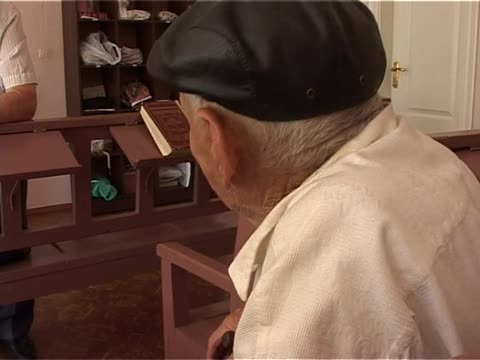
Katz asks Lifshitz for his name, patronymic, birth year and place, Russian form of his name, surname and current Chernihiv address. Lifshitz says he was born in 1912 in Snovsk.
Lifshitz says he lived in Snovsk until 1936, when he went to Birobidzhan. His father was a tailor who traveled to villages, and his mother helped him. His mother wanted him to go to cheder but he did not, and the family lived poorly. His father was away from home for months at a time.
Adds his father's long absences and the family's poverty.
Lifshitz says there were two synagogues in Snovsk, an old and a new one, which no longer exist. Katz asks what he remembers of services and of Yiddish songs.
Lifshitz recites or sings fragments of a song about being drawn to Palestine and Zionism versus staying in Russia, and a second song about the landlord and America. He then speaks of his brother, who was shot at some point in Birobidzhan by non-Jews or police, and says he had to work hard for years.
Lifshitz says he had no schooling. Asked about Soviet hostility to religion, he gives a hard-to-follow answer about suffering and about non-Jews. Katz then turns to Hanukkah.
Lifshitz recalls Passover as a child: his mother cooked and matzah was eaten. Jews saw to it that each family had matzah. He mentions his siblings, some of whom died, and that the family was poor. He says both parents were Jewish.
Lifshitz answers Katz's questions on non-Jews who became Jews or Jews who converted, saying non-Jews were friendly to Jews. He is asked about trades in the shtetl and answers briefly about millers (?).
Katz and Kerler ask Lifshitz Yiddish words, for example belly, skin and a word for ear, the last of which he does not recognize. Kerler ends by turning to Birobidzhan.
Lifshitz describes Birobidzhan and the Jewish kolkhoz at Bergefeld (Birefeld), where the family was given a house, a cow and chickens. He says life was hard but better than in the surrounding villages. There was a Yiddish school, and he recalls no Yiddish songs. He left after the war and came to look for his parents, his father having died before the war.
Kerler tries to establish when Lifshitz left Birobidzhan; Lifshitz says he arrived in 1936, was drafted into the war, and left in 1947 (?). He repeats that his brother was shot by police, in the taiga in 1945, because he was Jewish. The sequence of events remains unclear.
Lifshitz tells how, at thirteen, he went with his mother to a village to trade, and when people tried to rob them he struck an attacker on the head with a stone. The telling is partly garbled and includes a Russian passage.
Katz asks Bielaia for personal information: her name (Nina, Yiddish Nekhame), family name Bielaia, address and telephone, and birth in 1915. She says she lived in Chernihiv until the war.
Bielaia says she attended the Yiddish school in Nezhe for seven years. She names a teacher and the director Rebelsky, who was a graduate of Kyiv University, and describes the subjects. Katz then asks about Hanukkah.
Bielaia recalls Hanukkah and other holidays at home, her father being very religious and attending synagogue on Friday and Sabbath. Katz asks about Purim and the Hanukkah top, but she has forgotten its name.
Bielaia remembers the Passover seder led by her father, with a handsome table and matzah. Her mother blessed the Sabbath candles and Bielaia, the youngest child, helped. She mentions the war and her husband's not returning.
Bielaia says there were no Hasidim in her town and has trouble explaining what a rebbe is. She mentions Sovetish Heymland, and says there was no professional Yiddish theater but amateur drama, in which her husband acted in Chernihiv before the war. She worked in Chernihiv and left in 1943.
Bielaia says her father Motl was a shoemaker and her mother Dveyre-Rokhl did not work, having many children. She herself worked before the war in a Jewish kindergarten as a teacher, 1936 to 1941, and was evacuated to the Urals.
Adds her own work in the kindergarten and evacuation.
Bielaia lists trades, including shopkeepers, tailors, shoemakers and others. She remembers a wedding at a neighbor's house as a child, and carrying a bench for her mother to the synagogue. Katz then asks the meaning of Yiddish words such as a golem.
Katz asks Bielaia the meaning of certain Yiddish words, one of which she does not know, and a word for bridge and a phrase for calamity. She answers with the word for face.
Bielaia talks about her prewar life: she married in 1937, her husband acted in a Yiddish drama circle and she went to rehearsals and acted too. She worked at a Jewish institution until the war, when she was evacuated, borrowed Yiddish books from the library, and had a small daughter.
Bielaia says little was sung or spoken in Yiddish because of politics, and people were afraid to be known as Jews. She contrasts this with today, with the Hesed and synagogue.
Katz asks Bielaia for Yiddish forms (you are, honest, a cross, headache, to hurt, to tell). She also asks him where he comes from. Her answers are mostly in Yiddish.
Bielaia says her father Motl, a shoemaker with eight children, prayed in the synagogue. She finished the seven-year Yiddish school in Nezhe, where all subjects but Russian and German were taught in Yiddish, and there was a drama circle. Religion was not taught, and she worked in a Yiddish kindergarten in Chernihiv until the war. She says her parents did not survive the war. She also mentions carrying a bench for her mother to the synagogue.
Adds her father's family size, the school curriculum and the fate of her parents.
Bielaia says her mother-in-law spoke Yiddish with her, but her daughter does not know it. She names latkes made of grated potatoes with flour for Hanukkah and hamantashn for Purim, which her mother baked. She finds the past hard to recall and says she is now learning Yiddish by herself.
Kerler asks Bielaia Yiddish words for flower, well, to climb into the attic, vodka, thousand, and sentences with prepositions, such as going on the street and being near. Her age is also mentioned.