People › Mikhail Iosifovich Skop › conversation

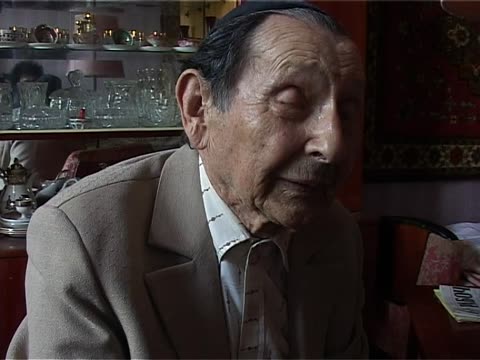
Mikhail Iosifovich Skop

Korosten' 26 May 2003 Interviewed by Dov-Ber Kerler, Dovid Katz 2.0 h · 2 parts on 2 tapes uncertain
Loading the player…
  1. MDV 540 0:00–58:10 · 58 min · not online — MCO
  2. MDV 541 0:00–1:02:09 · 62 min · not online — MCO
Passages
MDV 540 0:00–58:10

0:00

Jewish holidays

From the machine transcript

Katsman talks about his parents' home: the grandfather, who is named, and Sabbath customs, including his mother's gefilte fish and challah. Kerler stops to ask how to say a term and what the dish tasted like, and Katsman answers. He describes the Passover seder and Shavuot dairy food. He recalls sleeping in the family sukkah and sending Purim gifts of food to ten houses as a child. At the end he starts a story about a sanatorium in Kislovodsk.

includes Kerler's questions about how to say things in Yiddish, Shavuot food and the sukkah

12:51

Simchat Torah celebration in Caucasus

From the machine transcript

Katsman tells of a Simchat Torah evening after the war, when he was a doctor at a sanatorium in Kislovodsk in the Caucasus. A Jew from Leningrad arranged the rental of a restaurant for the Jews of the sanatorium, where they ate together and heard Yiddish songs. He recalls a Jewish artist from Odessa who performed. Kerler asks whether they danced hakafot; Katsman says no.

names the Leningrad Jew and the Odessa artist, and Kerler's question about hakafot

17:10

Dialectology

From the machine transcript

Dialectological questions from the Yiddish questionnaire, with Kerler and Katz asking and Katsman answering. They cover the meaning of 'a good Jew' versus a holy man or tsadik, and of dibbuk, golem and shlimazl. Words are elicited for a book, house, group, skin, mouse, window pane, color terms, illness and sickness, ear, and a ladder. Several items are given in Russian for translation into Yiddish, and some sentences are tried. A second voice repeats the question about the good Jew.

31:27

Concluding the interview

From the machine transcript

Kerler thanks Katsman and concludes the formal interview. Katsman mentions a Kyiv rabbi and then says in Russian that he served as chief doctor of a partisan brigade and has been photographed for a Holocaust museum in Los Angeles. Kerler asks him to say it in Yiddish.

includes the Kyiv rabbi and the Los Angeles museum

32:30

Life during the war as doctor for partisans

From the machine transcript

Prompted by Kerler to speak Yiddish, Katsman tells of his war: he was in the Minsk underground for several months, then chief doctor of a partisan brigade in Belarus, treating partisans and villagers. He later served in the army as a doctor and was wounded. He says the partisans blew up railway tracks and took people out of the Minsk ghetto, about twenty-seven of them, young people, some of whom may still be alive. Kerler promises another interview within a year.

37:19

Meeting Skop

Informal MDV 540 · MCO
From the machine transcript

Kerler meets the new interviewee, Skop, introduces himself and learns that Skop was born in Korosten' about eighty years earlier. They look for a place to sit while waiting for others to arrive.

37:56

Setting up interview and personal information

From the machine transcript

Katz sets up the interview, giving the date, 26 May 2003, and place, Korosten'. Skop gives his name as Moyshe (Mikhail Iosifovich) and surname Skop. Katz begins to ask for his address.

40:11

Family

From the machine transcript

Skop talks about his family. His father Yosl, who was born in a small town (Polonne?), was a gravestone maker, and his mother Reyzl came from near Moscow. His parents stayed in town during the war, and the local police killed his mother while the Germans commanded. He names his six brothers. Five of the seven brothers were killed in the war and one died earlier.

44:45

Early childhood memories and holiday celebration

From the machine transcript

Skop recalls early childhood: his parents were very observant and not rich. He talks about paying for kosher meat, Sabbath and the holidays, and strangers coming. He loved going to synagogue with his father and was carried there as a small child. He did not attend cheder but a Jewish school.

46:51

Education

From the machine transcript

Skop describes his eight classes at the Yiddish school and the writers taught there, among them Sholem Aleichem, Itsik Fefer, Abraham Goldenberg and David Bergelson. He recalls Sholem Aleichem plays staged in the local Yiddish theater. The school was closed in 1937 and he moved to a Russian school, finishing ten classes with no Yiddish or Hebrew taught. He says antisemitism began to show then, and that the war began when he was fifteen or sixteen.

50:02

Life during the war

during the war World War II (general) MDV 540 · MCO
From the machine transcript

Skop talks about being taken in 1940 with other Jewish children to a vocational school to learn a trade, and then, aged seventeen, being sent to Siberia. He was drafted into the army at eighteen. He fought at Stalingrad, in the Donbas, at Kursk and Dnipro, then in Poland, Hungary and Czechoslovakia.

53:44

Shabbat celebration before the war and religious life in prewar Korosten

From the machine transcript

Katz asks Skop about the Sabbath and the town before the war. Skop recalls cooking cholent, baking their own bread and buying milk, and the family trading in meat. He names five synagogues in Korosten', including one for the wealthy, a shoemakers' and a tailors' synagogue and a kloyz near the railway station open day and night. Travelers came from Korosten' and other towns, among them Berdychiv and Kasrilevke.

MDV 541 0:00–1:02:09

0:00

Religious life and holiday celebration

From the machine transcript

Skop says that until 1937 everything was as before, then schools were closed and synagogues turned into warehouses. Katz asks about childhood prayer, and Skop recalls Hanukkah money and the dreydl, Purim noisemakers, asking the Four Questions at his father's seder, and the labor of baking matzo. He then speaks of Lubavitch Hasidim, who were beloved in Korosten', and of a well-known rebbe whom people from far away, Jews and non-Jews, visited, with trips to a tsadik's grave and how it was spoken of. Katz asks about the Litvaks, and Skop describes the Yiddish of Vilna and Belarusian Jews as hard to understand and tells of his parents speaking Yiddish with Germans. The passage ends with healing practices and a story of a blind child brought to a rebbe.

Covers Litvak speech, the Germans and healers, and visits to the Lubavitch tsadik's grave, which the catalogue label does not mention.

24:20

Chavne

From the machine transcript

Katz asks about clever men of the town of Chavne (Polesskoye), and Skop speaks of a respected wise man there and of another man with a nickname. The transcript is garbled, so the names are not reliable.

27:11

Jewish weddings and songs

From the machine transcript

Katz asks about prewar songs and weddings. Skop remembers weddings and the wedding canopy, and answers questions about the wedding jester (badkhn) and matchmaker (shadkhn), then a question about the dybbuk.

A single song is attempted and the passage moves on to wedding roles and the word dybbuk.

29:38

Yiddish linguistics

From the machine transcript

Dialectological questionnaire with Katz and Kerler. Skop explains words such as dybbuk and golem, then gives Yiddish equivalents for vodka, blood, house, skin, cat and mouse, dove, window pane, blue, building, ear, hair colour and illness, along with the cross, ladder and forms of address. Skop notes that Yiddish in Korosten' was like Belarusian Yiddish, and says the Litvak speakers talk differently.

46:00

Life before the war and dialectology

From the machine transcript

Skop gives the prewar population of Korosten' and says where its Jews came from (figures partly garbled). The questionnaire continues with words for floor/ceiling, fence, face, back, wealthy man, 'another story', one and a half, attic and shopkeeper. Katz then asks him to recall stories of prewar Korosten'.

Gives the prewar population of Korosten' and its Jewish share.

Questions put in this conversation

Items of the dialect questionnaire asked here; each link plays the moment.