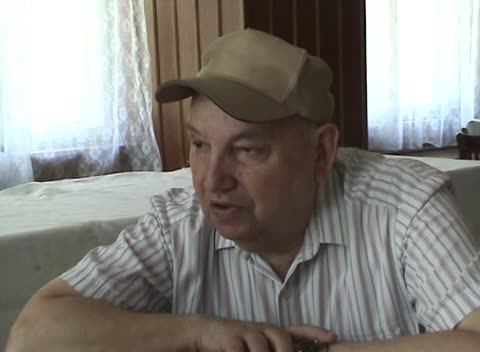
The formal interview with Shvartz begins. He provides personal information and talks about his family. Shvartz grew up with three sisters and three brothers. His parents were also born in Bîrlad (Yiddish: Berlad). Shvartz's father was a glazier. Shvartz moved to Iaşi in 1987. Shvartz worked as tailor at a factory in Bîrlad.
From the machine transcript
Shvartz gives his name and says he was born in Bîrlad in 1931. He names his parents and grandmother, all from Bîrlad, and says his father was a glazier and his mother did not work. He names three brothers and a sister, and says the siblings later went to Israel. He says that after the war he worked as a tailor in a factory.
names parents and siblings; the sibling names are partly uncertain
Shvartz speaks about his family and then his life before the war. He raised one daughter. Shvartz attended a Romanian school and then a Romanian Jewish school for four years until 1941. He recalls his Yiddish and Hebrew classes. Shvartz then speaks about prewar Jewish life in Bîrlad.
From the machine transcript
Shvartz says he was expelled from the Romanian school, then attended the Jewish community school in Bîrlad up to the fourth grade. There he was taught Yiddish and Hebrew, mostly Yiddish, and he later forgot his Hebrew under the Communists. He says he went on to the eighth class in a Romanian school. He is asked how many Jews lived in Bîrlad; he gives only vague figures, and says Bîrlad was a small town.
Shvartz talks about his life during World War II.
From the machine transcript
Shvartz says he was a child during the war and cannot say how many Jews lived in Bîrlad then. His father worked away from town. He says his friends spoke and read Romanian rather than living in a Yiddish world, and he mentions the Holocaust. Lemster then asks about the Yiddish school he attended.
Shvartz addresses his school education, as well as prewar Jewish life in Bîrlad, including synagogue structure. He then speaks about holiday celebration at home before and after the war. Shvartz also addresses food customs on Sabbath and recalls the kosher butcher.
From the machine transcript
Shvartz talks about his schooling and Hebrew reading, and recalls his cheder teacher who kept a goat. Asked about Jewish life in Bîrlad, he says there were eight synagogues, named by trade, and a large temple, and describes holiday attendance. Several voices then discuss Passover foods and baking and synagogue matters, but the transcript is largely unclear.
Shvartz speaks about prewar Yiddish culture, particularly theater performances. He also lists prewar Zionist youth organizations, including Gordonia, HaNoar HaTzioni and Mishmar. Shvartz attended meetings at Gordonia. He also mentions Maccabi and the postwar anti-Israel party Comitetul Democratic Evreiesc (Jewish Democratic Committee).
From the machine transcript
Shvartz says he belonged to the Zionist youth organization Gordonia, where young people put on entertainments in the evenings. He says he could not attend every day because he worked, including on Sabbath. He then mentions a postwar organization, the Jewish Democratic Committee, which opposed emigration to Israel.
the transcript for the passage's first half is missing; it covers only Gordonia and the postwar committee
Shvartz speaks about prewar religious life in Bîrlad, including important local figures and institutions. He briefly addresses contemporary Jewish life in Bîrlad and answers questions about cultural terminology. Shvartz recalls how Jews and non-Jews would attend the local Jewish bathhouse.
From the machine transcript
Shvartz names the local rabbi and the shoykhet, and a Hasidic-looking elder who prayed in the synagogue and read from the Torah. He says about a dozen Jews remain in Bîrlad. Asked about the expression "a good Jew", he says there were good Jews who helped his family, and he mentions a doctor who was president of the community. He describes the Jewish bathhouse, which non-Jews also used.
Shvartz talks about prewar and postwar cultural life. He then speaks about food and drinking customs, particularly gefilte fish and holiday dishes.
From the machine transcript
Shvartz says Yiddish books were not read in Bîrlad, only prayer books, and he does not remember Sholem Aleichem being read there. He then discusses gefilte fish: his mother made it, sweetened with sugar, but he did not like it. He also mentions latkes made from potatoes or matzo meal, vareniki, and his father's drinking of brandy.
Shvartz talks about folk and healing customs. He remembers that his mother practiced healing customs to avert the evil eye. Shvartz then addresses prewar traditional weddings and mentions wedding songs. Shvartz played the drum together with gypsy musicians at weddings.
From the machine transcript
Asked about folk healing, Shvartz says old women would whisper charms and that his father drank. He mentions the practice of pouring molten metal. He then describes Jewish weddings in Bîrlad: the chuppah in the synagogue and the meal at home, with Gypsy musicians. He says he himself played the drum, and he sings a short wedding song.
Shvartz speaks about burial customs. He also answers questions about cultural terminology. Shvartz then speaks about his family. His parents moved to Israel after the war. He visited them five times.
From the machine transcript
Shvartz describes burial customs in Bîrlad and answers questions about words for the cemetery and for what is said at the grave. He says his parents died in Israel and that he visited them five times, but could not afford more visits. He then fails to recall Yiddish words Lemster asks about.
Shvartz speaks about Jewish life after the war, as well as contemporary religious life in Iaşi. Shvartz is the synagogue caretaker.
From the machine transcript
Shvartz says Yiddish was spoken mainly at the community and the synagogue. He describes the Iași synagogue, now with few Jews because most left for Israel. He says he goes to synagogue and lives next to it; he worked in a factory with a good income.
names the Iași synagogue and the emigration of its congregation
Shvartz answers dialectological questions from the AHEYM Yiddish linguistic questionnaire.
From the machine transcript
Shvartz answers Lemster's dialectological questionnaire: greetings, thanks, wishes at weddings and circumcisions, words for house, rooms and window, building, body parts, adverbs, verbs (come, run away, sleep) and short sentences. Other people in the room often add their own versions, and Shvartz often says he has forgotten or does not know the Yiddish word. The transcript is heavily garbled, with some Romanian asides.
Shvartz recalls two brothers who converted to Christianity, as well as a Christian who converted to Judaism for his wife. He then continues to answer dialectological questions from the AHEYM Yiddish linguistic questionnaire.
From the machine transcript
Shvartz tells about two brothers from Bîrlad who converted to Christianity, and about a Christian who converted to Judaism to marry a Jewish bride and had a Jewish wedding. The questionnaire then continues, with words for convert and mountain, verbs, short sentences and numbers.
the conversions and the Christian who became Jewish for a bride
Shvartz answers dialectological questions from the AHEYM Yiddish linguistic questionnaire.
From the machine transcript
Shvartz answers questions from the dialectological questionnaire put by Lemster. The items cover kinship and everyday words, such as a word for grandmother, the street, water, the attic, a bridge and a room. They also cover adverbs and verbs such as 'suddenly', 'often', 'back', 'to leave' and 'to use', and a sentence to translate about sitting at the table. Shvartz often gives Romanian or Russian equivalents and says which words were or were not used in his Yiddish. He mentions that only Jews lived on his street and complains of poor eyesight and hearing.