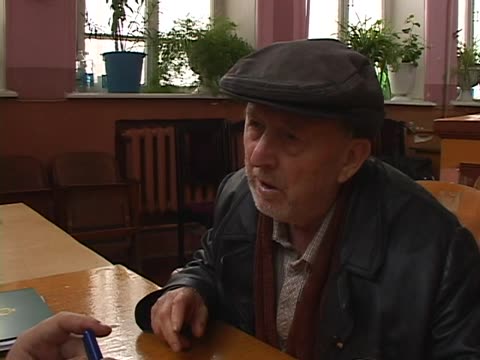
The formal interview with Kishlyansky begins. He provides personal information and talks about his family. His father was a leather worker. Kishlyansky grew up with one sister and one brother. He worked as commodity deliverer.
From the machine transcript
The formal interview with Kishlyansky opens with the date and his name; his Yiddish name was Hersh and his father's was Velvl. He was born in February 1930 in Briceni, about a hundred kilometres from Bălți, and his father was a leather worker. He gives his mother's name and approximate birth years for his parents, and says he was named after his grandfather. He had a brother and a sister and later worked bringing goods to a shop.
Adds the sibling names and his work delivering goods to a shop.
Kishlyansky discusses his childhood memories of Jewish Briceni. He speaks about prewar religious life, prayer customs and his family's observance. In particular, he addresses Sabbath celebrations at home.
From the machine transcript
Kishlyansky recalls Briceni as a Jewish town, his observant mother who kept meat and milk separate, and the several ritual slaughterers and a rabbi. He recalls the circumcision custom of reading the Shema, and a few prayer words. He describes Friday and Sabbath at home, with challah, a blessing by his father, and cholent kept in the oven.
Kishlyansky speaks about his life during World War II. He recalls beatings and mentions the forced marches toward Ukraine. He then returns to Jewish life before the war. Kishlyansky attended a religious school (cheder). He also lists local synagogues.
From the machine transcript
Kishlyansky first speaks briefly about the outbreak of war: robbery, killings and beatings, then being driven in a column toward Ukraine. At Katz's request he returns to prewar life: Passover and burning the leaven, a cheder, a talmud torah, and the melamed Shaye. He lists the town's prayer houses, including the tailors' synagogue and the shoemakers' synagogue.
Kishlyansky addresses prewar Sabbath celebrations, including food customs. He then shares his recipe for gefilte fish, before speaking about prewar Rosh Hashanah celebrations. He specifically addresses childhood games, including playing nuts and with chestnuts.
From the machine transcript
Kishlyansky describes how his mother lit Friday-evening candles and what was eaten on Sabbath, and then explains how gefilte fish was made. He talks about Rosh Hashanah in the prayer house and children's games of throwing nuts into small holes and playing with chestnuts. He adds a remark on other children's games.
Kishlyansky talks about prewar Jewish life in Briceni and recalls poverty. He then speaks about prewar Yom Kippur and Sukkot celebrations.
From the machine transcript
Kishlyansky speaks of the hard life of the poor in Briceni and how people were helped, and about fasting on Yom Kippur. He recalls building a sukkah and mentions Purim. He reflects on Yiddish and Jewishness, saying the language should not be abandoned and many Jews no longer know it.
Kishlyansky sings a Yiddish song about the birth of a child, before singing a song about a struggling tailor, called "Zeydenu her oys" (Listen, dear grandfather). He then sings "Vu nemt men a bisele mazel" (Where can I take some luck).
From the machine transcript
Kishlyansky sings songs at Katz's request: first a lullaby-like song about a newborn child and the brevity of life, then the song about a dying man who asks for his tailor, 'Zeydenyu her oys', then 'Vu nemt men a bisele mazl'. Katz asks for the first line of a song and praises his voice.
Kishlyansky sings a Yiddish song about Petrograd. He then speaks about his family. His mother was a tailor. He then sings a Yiddish song about a couple in love, he remembered from his mother. Kishlyansky then shares anecdotes from prewar Jewish life.
From the machine transcript
Kishlyansky sings a song about Petrograd and speaks of his mother, a tailor, who sang at her sewing machine. He sings a love song she sang. He tells a joke or anecdote about a rich man in Briceni and a poor suitor for his only daughter, then says he can't recall other Yiddish jokes.
Kishlyansky addresses prewar Jewish life, including occupational structure, in Briceni. He then sings a Yiddish song about a kosher butcher. He then speaks about cultural life and recalls performances by Sidi Tal and Anna Gintsburg, before addressing Hasidic life.
From the machine transcript
Kishlyansky answers questions about non-Jews who spoke Yiddish and says there were no conversions. He lists trades in Briceni and sings a song about a butcher. He recalls the visiting Yiddish troupes and the performers Sidi Tal and Anna Gintsburg, and says there were many cantors but no Hasidim. He says people knew of the Stefanesti rebbe and travelled to ask him questions.
Adds non-Jews speaking Yiddish and the question about conversion.
Kishlyansky answers questions about cultural terminology, before mentioning traditional weddings. Kishlyansky then speaks about prewar folk and healing customs, before returning to answer questions about cultural terminology.
From the machine transcript
Kishlyansky answers Katz's terminology questions: a cemetery, a fence, the word tsadik, and a Lithuanian Jew. He mentions the Jewish wedding canopy and says he does not recall wedding songs. He describes how a woman charmed away the evil eye, with three women sitting on a stone, and is asked about dybbuk and golem, which he doesn't know well.
Kishlyansky speaks about his life during World War II and the invasion of the Romanian army. Kishlyansky describes the forced march, via Sokolon 42:18, he was on toward Ukraine and recalls shootings and beatings. In Sokolon, Kishlyansky describes how he was imprisoned in the Sokolon ghetto and non-Jews from Bricani sold food to prisoners once a week. After staying in Sokolon for six months, he continues, the prisoners went further toward Ukraine. Kishlyansky worked on a kolkhoz and slaughtered pigs until his liberation by the Red Army.
From the machine transcript
Kishlyansky tells of the war's start in Briceni in June 1941: robbery and killings, then Romanian soldiers marching the Jews on foot toward the Dniester. Shootings and rain on the field are recalled. He was held about half a year in the Sokolon ghetto behind wire, where peasants sold food once a week. In October they were sent on to Ukraine, where many died of illness; he worked herding pigs on a kolkhoz. After the Red Army arrived his father was taken and shot.
Adds that he herded pigs, his father cooked for them and was shot after the Red Army arrived.
Kishlyansky speaks about his family's life and return after the war.
From the machine transcript
Kishlyansky recalls the return after the war, finding the house where the family had lived and speaking Yiddish with a neighbour. He grieves for the murdered Jews and asks where God was. He says he is now old.
Kishlyansky sings again the Yiddish song about the birth of a child, from his childhood.
From the machine transcript
Kishlyansky sings again the song about the birth of a child, at Katz's suggestion. He says he can't recall other songs, including those his mother sang at her sewing machine.
Kishlyansky talks about his life and work after the war. He was married in 1946. He also speaks about his family. Kishlyansky's son lives in Canada. Kishlyansky then addresses his life today.
From the machine transcript
Kishlyansky speaks of the hard postwar years: his mother was widowed and sewed to raise her children. He married about fifty years ago, and his wife Mara is from Zhytomyr; a sister lives in Israel, and his son is a mathematics teacher in Canada. He says life today is hard and describes the support he receives from Germany.
Adds his wife from Zhytomyr and the support he receives from Germany.
Kishlyansky remembers how people in costumes went from one house to the next. He also sings the beginnings of a Purim shpiel.
From the machine transcript
Answering questions about Purim and Simchat Torah, Kishlyansky recites the opening lines of a Purim play. He recalls Simchat Torah children's flags with an apple and costumed Purim players going door to door. Kerler asks him to repeat the lines on camera. He says people neither prayed nor sang in the camp, only wept.
Kishlyansky addresses prewar folk customs among non-Jews.
From the machine transcript
Kishlyansky answers questions about the evil eye and its cure by incantation: three women on a stone, melting wax, and extinguishing coals, which he says were practised by non-Jews. He says he knows no Jewish equivalent. Katz then prepares to ask for Yiddish equivalents of Russian words.
Kishlyansky answers dialectological questions from the AHEYM Yiddish linguistic questionnaire.
From the machine transcript
Questionnaire session: a Russian prompt is read out for each item and the interviewee gives the Yiddish. Items include greetings, the time from which a greeting may be used, thanks, body parts, house and animal words, adjectives and adverbs with comparatives (cold, high, fast, near), and 'earlier' and 'later'. There are also short sentences to translate (he came today, he knows everything, he fled from the Germans) and words for 'honest' and 'pious'. Katz asks follow-up questions about usage.
The team concludes the interview with Kishlyansky.
From the machine transcript
Katz and the interviewee exchange thanks and good wishes to close the interview, with a remark about recorded songs.