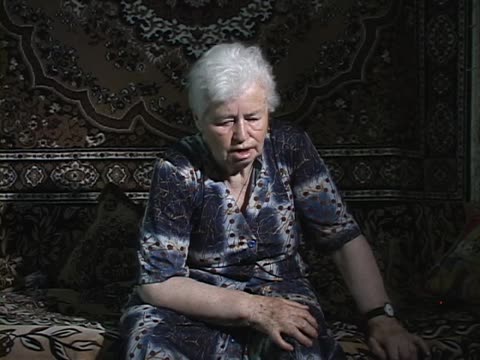
This tape consists of a formal interview with Sonya (Sure) Petrovna Yarmolnik (née Gravits), born in 1929 in Khmel'nyts'kyy. She grew up in a Jewish family that celebrated all the holidays. Her maternal grandfather, Shloyme, was a blacksmith. He had twelve children who moved all over the world to Germany, America, as well as many nearby towns. Yarmolnik also states that her father was born in 1918 [sic].
From the machine transcript
After identifying herself by her Yiddish name Sure Gravits, Yarmolnik gives her birth year as 1929 and birthplace as Proskuriv, and says she was born into a Jewish family. She says her maternal grandfather Shloyme was a blacksmith with twelve children, who spread to Germany, America and a nearby town, so that she remained alone. She says her father was born in Podvolochisk and married in 1924, and mentions his time in German captivity.
Adds her birthday, the father's birthplace and marriage, and his German captivity.
Yarmolnik begins a story she heard from her mother about a pogrom in 1921 in Khmel'nytskyy led by Petliura’s troops. Integrated into this narrative are details from her family’s experiences during the Great Patriotic War. Yarmolnik lists the deaths of numerous family members throughout her lifetime, commenting that she is now all alone. [00:08:31] During the evacuation to Uzbekistan, Yarmolnik worked in a war factory as much as eighteen hours a day.
From the machine transcript
Yarmolnik starts a story about a Petliura-era pogrom that her mother's family experienced in Proskuriv, and then recounts the German arrival in July 1941, when her father got the family away just before the Germans entered. She tells how an aunt's non-Jewish husband's relative, a policeman, handed over the aunt and her two children, who were killed in the ghetto. She lists the deaths of her brother, husband and son, and describes working in a wartime munitions factory in evacuation up to eighteen hours a day.
Adds the 1941 flight and the aunt's fate in the ghetto.
Yarmolnik briefly discusses pre-war Khmel'nytskyy. There were Yiddish schools in the town, but they were already closed by the time Yarmolnik could attend, so she was educated in a Russian-language institution. After the war, Yarmolnik found the house she had lived in ruined. She then talks about the reparation funds she tried to receive from Switzerland. Yarmolnik worked 51 years as an economist and accountant after the war.
From the machine transcript
Yarmolnik says that the Yiddish schools were closed before she was old enough to attend, so she went to a Russian school. After the war she found the family house wrecked, and says she wrote to Switzerland about restitution money. She worked for 51 years as an economist and bookkeeper after finishing ten classes and a technical college.
Yarmolnik does not remember her grandmothers, at least one of whom died before she was born. She tells a story about her grandfather who went blind, survived a flood and had an operation, after which he regained his sight. Her father fought in the war and was killed on May 16th, 1945, exactly a week after victory. Her mother died in 1968.
From the machine transcript
Yarmolnik answers Lemster's and Kerler's questions about her grandparents. She does not remember her paternal grandfather; her maternal grandfather Shloyme went blind, was caught in a flood, and regained his sight after an operation. Her father was killed shortly after the war's end in May 1945, and her mother died in Proskuriv in 1968 (?).
Adds a flood story and her mother's death.
Yarmolnik spoke Yiddish at home in her childhood, but spoke mostly in Russian with the other children in her school. She sings fragments from “Bay mir bistu sheyn” and “Papirosn,” and recites the lyrics of another song about two lovers discussing their respective families.
From the machine transcript
Yarmolnik says that Yiddish was spoken at home, while at her Russian school she spoke other languages with friends. Asked about Yiddish songs, she sings a fragment of "Bay mir bistu sheyn" and recites a dialogue song about two lovers weighing each other's families, and she sings "Papirosn". Her account breaks off with her mother baking secret matzo.
In the postwar period, Yarmolnik would secretly bake matzo with her mother. Her mother frequently attended synagogue after the war.
From the machine transcript
Yarmolnik says her mother baked matzo at home in secret and went to synagogue often after the war, and Kerler clarifies the period she means. She starts to describe the building where the synagogue and technical school stood.
Yarmolnik describes the two-story synagogue she went to in Khmel'nytskyy before the war. She recalls the observance of Yom Kippur, which was attended by “more people than a parade,” and concluded with a feast.
From the machine transcript
Yarmolnik describes a large synagogue with women upstairs and recalls Yom Kippur, with crowds outside bigger than at a parade and food prepared at home after. She says that now she has no one.
She briefly discusses her family’s life during the evacuation in Uzbekistan.
From the machine transcript
Yarmolnik says that in evacuation in Uzbekistan she spoke Yiddish with her mother, while her father and brother were in the army. She gives her brother's name as Misha and her father's name, and Lemster mentions acquaintances named Gravits in Bessarabia.
Yarmolnik’s husband was from Medzhibozh. She talks about the one remaining Jew in the town, who recently passed away. She comments on the tourist infrastructure that is now in place there with new hotels and rebuilt synagogues. Yarmolnik was once taken to Medzhibozh by her husband to see the Besht’s grave.
From the machine transcript
Yarmolnik says her husband came from Medzhibozh, home of the Besht (the Baal Shem Tov). She says one Jew lived there recently, now dead, and that a street was named for Sholem Aleichem, with a hotel and a rebuilt synagogue. Her husband once took her to the Besht's grave.
Adds the street named for Sholem Aleichem and a talk of a hesed.
In the postwar period, Yarmolnik reports, few people knew about the Besht or his gravesite but her husband, Misha/Monia Borisovich, told her about it. Yarmolnik lived with her husband for forty-six years. Their one son was circumcised in a private home by a local rabbi, an action she was unafraid to take, although she knew it was risky. (“Why should we have been afraid? I was not a Party member, my husband was not a Party member”). Yarmolnik states that she was not afraid of being sent to jail or of what the non-Jews might think or say. Professor Kerler also asks Yarmolnik about her use of a particular Ukrainian-language expression in her Yiddish.
From the machine transcript
Yarmolnik says people in the Soviet postwar years knew little about the Besht's grave, though her husband told her; she lived 46 years with him. She says her son was circumcised in a private house by a rabbi, and she and her husband were not afraid, not being Party members. Kerler asks her about a Ukrainian-sounding expression she uses ("tishkom-nishkom") and she says neighbors would not tell on them.
Adds her use of the phrase explained as non-Jewish language.
Before the war, Yarmolnik lived on a Jewish street, where non-Jews also lived. She recites a few fragment of “Itsik hot shoyn khasene gehat” and “Lomir zikh iberbetn”.
From the machine transcript
Yarmolnik says she lived on a Jewish street before the war, with some non-Jewish neighbors, and Kerler asks what terms for non-Jews she uses. Lemster prompts her for songs, and she recites fragments of "Itsik hot shoyn khasene gehat" and "Lomir zikh iberbetn". She says people feared speaking Yiddish earlier and now can do so freely but no one remains who knows it.
Yarmolnik shares a story she heard from her mother about the pogrom in Khmel'nytskyy, about a priest who was killed for protecting Jews in his church.
From the machine transcript
Yarmolnik retells a story from her mother about the pogrom in Proskuriv, in which a priest who sheltered Jews was killed when he would not give them up. Kerler asks whether the priest was Orthodox.
Yarmolnik states that there were many non-Jews who spoke Yiddish in Khmel'nyts'kyy since, on her street for instance, non-Jews were a minority. Yarmolnik speaks briefly about her maternal aunt, whose husband was a Party official and registered her as an ethnic German.
From the machine transcript
Yarmolnik says that non-Jews on her street spoke Yiddish because Jews far outnumbered them. She then tells of her mother's sister, whose husband, an official, registered her as a German to hide her Jewishness, and what happened to her and her children.
Yarmolnik spoke only in Yiddish with her husband and son. Her grandson understands but does not speak Yiddish. Her grandson finished the local Jewish school.
From the machine transcript
Yarmolnik says she spoke only Yiddish with her husband and son, and that her grandson attended a Russian school, understands Yiddish and cannot speak it. She says she herself attended the Yiddish school, and Lemster asks about Hebrew teaching.
Adds a remark about Russian school for the grandson.
The research team begins their questionnaire related to Yiddish sociolinguistics and dialectology.
From the machine transcript
Lemster and Kerler begin the questionnaire, asking whether she knows words like golem and dibbuk and the Yiddish for face, mother tongue and proverbs. Yarmolnik knows dibbuk and says she has no one to speak Yiddish with. Lemster then asks about relatives.
Yarmolnik mentions her estranged family members in Israel and states that she is all alone except for her grandson.
From the machine transcript
Yarmolnik says she has relatives in Israel who no longer contact her, and she does not know what city they live in. She states she is alone but for one grandson.
Yarmolnik spoke in Yiddish to her son and he would go to synagogue with his father on all the Jewish holidays. Before the war, Yarmolnik’s brother graduated from the Yiddish school in Khmel'nyts'kyy before it was closed.
From the machine transcript
Yarmolnik says she spoke Yiddish with her son, who went to synagogue with his father on holidays. She says her brother finished a Yiddish school, and there were two Yiddish schools in Proskuriv, closed when she was to attend, and many synagogues.
Adds the location of the schools.
The research team returns to their linguistics questionnaire.
From the machine transcript
The interviewers put questionnaire items to Yarmolnik: words for sick, thank you, a holy place and a good Jew, and dream, with a question about gefilte fish at the end. She explains that a good Jew stays good and a bad Jew stays bad, and says she lacks certain terms.
Yarmolnik shares her recipe for “gefilte fish” and reports that she made traditional Jewish foods for a recent wedding in the community. She then shares her recipe for “fludn” (a sweet pastry).
From the machine transcript
Yarmolnik gives her gefilte fish recipe (ground fish, eggs, onion, and boiling for about two hours) and tells of being asked to bake fludn for a recent community wedding. She describes the pastry's layers of dough, jam, nuts and lemon, and the interviewers compare other versions. Lemster asks about dialect words for kneaded bread.
Adds the wedding anecdote and other dialect comparisons.
The team returns to the linguistics questionnaire.
From the machine transcript
The questionnaire continues with items about the dibbuk, possessive pronouns, greetings, a polite request, the word for a house, idioms of comparison (healthy as a house, beautiful as the stars) and the word for crazy. She also answers questions on stuffed ducks and geese and a type of pastry.
Yarmolnik briefly discusses customs and foods related to khanike (Chanukah) and shvies (Shavuot).
From the machine transcript
Asked about Hanukkah, Yarmolnik mentions the dreydl and says her mother cooked a good broth and bought a duck or goose, and that latkes were made, and at Shavuot cheese pancakes. Lemster asks about potato latkes and Kerler asks for a name of a food.
The team returns to the linguistics questionnaire.Cities and towns mentioned on this tape: Khmel'nyts'kyy (Proskurov), Bila Tserkva, Medzhibozh.
From the machine transcript
The questionnaire resumes with items on honest, pious and believing, a cross, a headache, where someone is from, and sentences like "my father was a believing man". Yarmolnik answers some in Yiddish, tells about evil eye and its cure, and describes Germans being beaten at the war's end. She also gives kinship words for grandmother and a phrase about sitting at the table.
Adds war recollection about defeating Germans within the questionnaire; cities named in the catalogue are not clearly heard.
This very short tape consists of the last few minutes of a formal interview with Sonya (Sure) Petrovna Yarmolnik. The research team asks her several questions from Professor Kerler’s survey about sociolinguistic and dialectological issues.
From the machine transcript
After a brief Russian exchange about a bag left in the car, Kerler puts several questions from his sociolinguistic and dialectological survey to Yarmolnik. They cover how to say a sentence about Jews living on a street, the words for the attic and the ceiling, and what a well or water pump is called, with the Ukrainian equivalents mentioned. Yarmolnik answers some questions hesitantly, saying at one point that she does not know. Kerler then thanks her and apologises for the trouble.
Besides the survey questions, it includes opening talk about a bag in the car and Kerler's closing thanks.