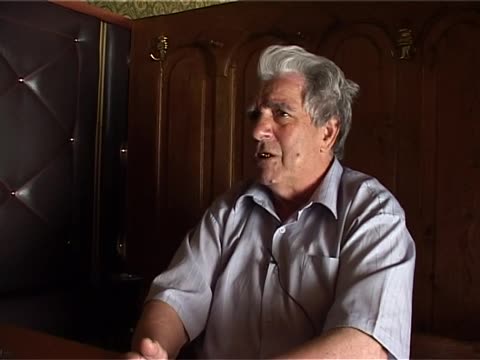
The formal interview with Golfeld begins. He provides personal information and speaks about his family. Golfeld grew up with two siblings.
From the machine transcript
The interview with Golfeld begins, and Kerler introduces him. Golfeld, born in Tul'chyn, gives his mother's name as Eydye and his father's as Nakhum, who went to war and did not return. His mother was left with three children, and he mentions the arrival of the Germans in 1941.
Adds the parents' names and the father's absence at the front.
Golfeld speaks about his life during World War II. He remembers the assembly and prior disinfection of local Jews in Tulchyn, after the Germans entered town in 1941. Golfeld then describes how he was driven out of Tulchyn in December 1941 to a kolkhoz in Torkiv, where he spent the night. He eventually reached the Pechera concentration camp. Golfeld then describes the journey and arrival in Pechera.
From the machine transcript
Golfeld recalls how the Jews of Tul'chyn were gathered after the Germans' arrival and driven to a disinfection in a bathhouse. They were kept in school no. 2 and then driven out in groups in the rain and winter of 1941, spending a night in a kolkhoz stable, where the first people died. He was nine or ten years old and was driven with his mother some thirty kilometres to the Pechera camp. The camp is a former sanatorium with a gate and bare plank beds.
Adds the kolkhoz stable, a doctor's name, and the thirty-kilometre march.
Golfeld talks about the living conditions in the camp and remembers shootings from the Germans. He also describes what kind of food was available in the camp and mentions that he became sick. Golfeld then describes how the Germans came into the camp and took inmates for forced labor. Golfeld recalls violence from the Ukrainian police.
From the machine transcript
Golfeld describes the starvation, cold and shooting in the Pechera camp, where Jews were killed by guards for going to the river. He tells of Germans taking inmates to forced labor and killing small children. He recalls Ukrainians throwing food over a fence, eating raw beets, falling ill with fever and walking long distances through the villages in winter.
Adds the killing of children and the food thrown over the fence.
Golfeld speaks about episodes when he snuck out of the camp in search for food in the villages. He encountered a rebbe in Chechelnyk and joined him for services. Golfeld also addresses his mother's observance. He then remembers a Ukrainian who brought a Torah scroll from the Tulchyn community into the Pechera concentration camp.
From the machine transcript
Golfeld recalls leaving the camp to find food in the villages. In Chechelnyk he met a rebbe (whether Hasidic or a teacher he does not know) who took him in for a service and gave him alms. He then tells how a Ukrainian, Mishka Kotsap (?), hid the Tul'chyn Torah scroll and brought it into the Pechera camp. His mother, who could read Hebrew, is mentioned, and Golfeld praises the man.
Adds the Ukrainian rescuer's name and the mother's ability to read Hebrew.
Golfeld speaks about his mother's observance and religious dexterity. He recalls prayer services at home. Golfeld then talks about his family.
From the machine transcript
Golfeld speaks about his mother's piety, which the police also respected. She gathered Jews at home for prayer on holidays and had copied out a prayer book in Hebrew. He gives his mother's name as Eydye and her father's as Mordkhe, and starts to speak of other family.
Adds the maternal grandfather's name and a word for 'pious'.
Golfeld speaks about his life after the war. In particular, he addresses secret private religious services, he organized in his home. Golfeld also mentions secret matzo baking.
From the machine transcript
Golfeld talks about religious life after the war: services held secretly in a private house for a fee, out of fear of the authorities, and matzo baked in secret. The young did not attend and the old people urged them to learn from them.
Also mentions fear of the authorities and the young not attending.
Golfeld talks about his life before the war and private Yiddish-language education. He attended a Russian school. Golfeld then speaks about his family.
From the machine transcript
Golfeld recalls an old man, Leybish Kishke (?), teaching him the Hebrew alphabet privately, and then attending a Russian school. He remarks that nobody wanted the Yiddish school, and that his son later studied at a polytechnic institute after the Yiddish schools were closed.
Names the private teacher and mentions his son's studies.
Golfeld addresses again the episode when he encountered the rebbe Yosef Pinkovitch in Chechelnyk. Golfeld recalls the rebbe's blessings, who collected charity for him. Golfeld then describes his escape from village to village, including how he received food from a priest.
From the machine transcript
Answering Kerler, Golfeld recalls the rebbe Yosef Pinkevich (?) of Chechelnyk, who gave him money and shoes and collected charity for him. He then tells of walking long distances while fleeing from Pechora, falling into a pit, and being pulled out. A man whose words he reports gave him food, with talk of dumplings and a holiday, and he mentions a camp acquaintance.
Adds the pit episode and the rescuer's reaction.
Golfeld shares an episode from his life today, when he met a survivor from the camp, who lives in America. He then speaks about his life after the war. Golfeld worked at a shoe factory for forty-nine years. He raised a son.
From the machine transcript
Golfeld tells of meeting at Pechora a man from America who had been in the camp with him, and of later phone calls from him. Kerler then asks about his work after the war: he worked 49 years at a factory and raised a son, who studied at a polytechnic institute and now lives in Sverdlovsk. He discusses the cost of telephone calls and travel.
Adds the American survivor's visit and the cost of phone calls and travel.
Golfeld addresses his education, as well as childhood memories of Tulchyn before the war. He also addresses Ukrainian antisemitism, before addressing the fate of local Jews in the Tulchyn ghetto. Golfeld remembers the help of non-Jews.
From the machine transcript
Golfeld talks about his limited Hebrew schooling and childhood in Tul'chyn, which was happy before the war. He mentions the bandits and killings of Jews, and says Tul'chyn was somewhat better than elsewhere. Asked about the ghetto and Pechora camp, he says that rich people could buy their way out and that non-Jews saved many, expressing gratitude.
Golfeld returns to discussing the help of the rebbe in Chechelnyk. Golfeld then recounts postwar Jewish life in the region. He also shares an episode about Leybish Kishke in the Tulchyn ghetto, before addressing the moment when the Germans entered Tulchyn.
From the machine transcript
Golfeld speaks again of the Chechelnyk rebbe and of the town after the war, when no Jews remained and houses were wrecked and occupied by Gypsies. He mentions Jews remaining in Bershad' and a friend from there who writes in Yiddish. He tells how Leybish Kishke was killed by the Germans in 1941, which he saw himself, and what happened when the Germans entered Tul'chyn.
Adds Bershad' and a Yiddish-writing friend.
Golfeld speaks about his work for a German soldier in the ghetto. He then speaks about acquiring food in the ghetto.
From the machine transcript
Golfeld tells of washing a German soldier's vehicle in the ghetto, in return for bread and other food, until his hands froze. He says the German spoke Russian and knew he was a Jew. He talks about the constant hunger and the struggle for food.
Golfeld talks about prewar holiday celebration at home before the war, including food customs. He mentions that he fasted during his military service. Golfeld served for four years in the Kamchatka territory. He also briefly talks about his life after the return from military service.
From the machine transcript
Golfeld mentions his army service of four years after the war in Kamchatka, where he was the only Jew, and his return to Tul'chyn to work. He recalls prewar holidays at his mother's home, including Passover, Yom Kippur and Shavuot, a holiday with red apples (Simchat Torah, with a flag), and potato pancakes.
Golfeld talks about his family. His mother was born in Tulchyn and his father was born in Olhopil.
From the machine transcript
Golfeld says his mother was from Tul'chyn and his father from Olhopil (?), and talks about the synagogue where she grew up. He once went to find his grandfather there but cannot recall his name.
Golfeld answers questions about cultural terminology, before answering dialectological questions from the AHEYM Yiddish linguistic questionnaire. Golfeld also discusses Yiddish dialects.
From the machine transcript
Golfeld answers questions about cultural terms (dybbuk, golem), greetings and thanks, and says what he knows of Lithuanian Yiddish and Israeli speech. He insists that Yiddish is Yiddish and that his own Yiddish differs from Lithuanian.
Golfeld discusses his childhood memories, before addressing prewar Jewish life in Tulchyn. He also addresses the local synagogue structure. Golfeld continues to answer dialectological questions from the AHEYM Yiddish linguistic questionnaire.
From the machine transcript
Golfeld speaks about childhood language, with Yiddish at play and Russian at school, and about the many synagogues of Tul'chyn, with different trades having their own. He then answers a long run of questionnaire items: building and household words, body and colour words, adverbs of time and place, comparatives, animals, 'where are you from', adjectives of taste and illness, numbers, and terms for relatives. He translates Russian sentences into Yiddish with Kerler and the second person helping.
Adds the long run of questionnaire items and the translation work.
Golfeld talks about the prewar infrastructure of Tulchyn, before he continues to answer dialectological questions from the AHEYM Yiddish linguistic questionnaire.
From the machine transcript
Golfeld talks about prewar Tul'chyn, with its Jewish-run shops and houses built on Turkish-style vaults. He continues with questionnaire items, including the words for 'everyone', as the speaker and S2 compare 'ale' and a variant, and also flowers, and sentences to translate.
Adds the dialect variants for 'all'.
Golfeld remembers folk and healing customs after the war. He explains how a non-Jewish woman practiced the custom of "rolling an egg," in the attempt to heal him. He then continues to answer dialectological questions from the AHEYM Yiddish linguistic questionnaire.
From the machine transcript
Golfeld tells how, after taking a drug and falling into a deep sleep, a non-Jewish woman rolled eggs over him to heal him. This is followed by more questionnaire items, with Kerler asking for translations of Russian sentences, singular and plural forms, and number expressions. Kerler closes with thanks.
Adds the translation exercises and closing thanks.