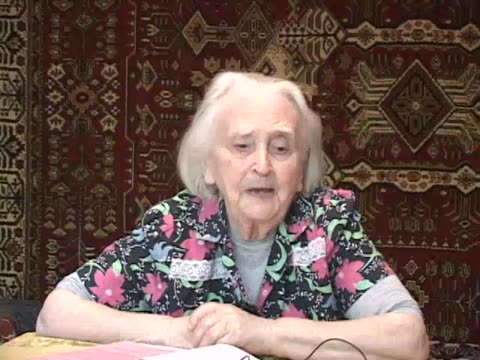
Goldman speaks about her life today during the postwar Soviet period and her family.
From the machine transcript
Goldman talks about her life today and her earlier work buying and selling goods to support her son, daughter-in-law and grandchild. She notes how few Jews remain in Chișinău. Kerler then begins the formal interview, giving the date and introducing her.
Also includes Kerler's spoken introduction and the remark that few Jews remain in Chișinău.
The formal interview with Goldman begins. She provides personal information and speaks about her family. Goldman's father was also born in Chişinău and worked as driver during the Romanian period and as railway constructor. Goldman grew up with one sister and one brother. Her sister died before the war and her brothe was killed during the war. Goldman moved to Romania in 1938.
From the machine transcript
Goldman gives personal and family information: her Yiddish name, her father (Chișinău-born, a driver in Romanian times, later in railway work) and her mother Perl, a housewife. There were three children: an older girl who died young, Goldman, and a brother killed in the war. She went to her parents in Romania in 1938 after finishing professional school.
Gives the mother's name and occupation and the brother's death.
Goldman speaks about her family and briefly her life before the war. She also addresses her life during World War II. She moved to Bukarest in 1938. Goldman evacuated to the North Caucasus, where she reunited with her brother, and stayed there until 1942. Goldman then explains how she evacuated further. Her father was injured and her mother was killed during evacuation.
From the machine transcript
Goldman tells how the family was caught by the arrival of the Soviets in 1940 and evacuated to the Caucasus in 1941, where she met her brother again. He was drafted and trained somewhere in the east. On the road her mother was killed in Makhachkala during bombing and her father was wounded. The family later learned of the brother's death in 1944 and the father died too.
Gives details of the mother's death, the brother's call-up and the later news of his death.
Goldman speaks about her family. Her paternal uncle moved to Israel. She also touches upon her life before the war. After graduating from professional school in 1938, Goldman lived in Bukarest, Romania, to find work and stayed two years.
From the machine transcript
Goldman describes her paternal relatives: her grandfather Nahum, grandmother Gitl, and the father's brothers, one who fled to Paris, a wealthy one in Bucharest with a factory, and one who moved to Palestine/Israel. She tells of working as a tailor in Bucharest for two years after the Yiddish professional school, and of her mother's relatives, including a family of Portuguese origin. She says her relatives mostly remained and were killed.
Adds the wider family of uncles, relatives in Paris and Odessa, and her tailoring job in Bucharest.
Goldman discusses her education before the war. She attended a Romanian primary school for four years, before studying at a Yiddish professional school to become a tailor. She then describes her studies at the professional school, as well as visiting her uncle's house on Sabbath.
From the machine transcript
Goldman recalls her childhood schooling: four years in a Romanian primary school from age seven, then a Yiddish professional school where she learned reading and writing in Yiddish and trained as a tailor. She describes the school, its building later turned into a museum, and staying with an uncle named Yisroel and his family, with Sabbath candle-blessing there.
Adds the uncle's household and Sabbath customs there.
Goldman speaks about her return to Chişinău in 1944 and life after the war. She recalls the living conditions in town and also provides information about her work at a printing press.
From the machine transcript
Goldman describes returning to Chișinău after the war, with no Jews, no water and hard living conditions. She tells of getting work at a printing house, rising to a planning post, receiving a medal for labor and the question of work-record months, and carrying stones to rebuild. Parts of the transcript are garbled or hallucinated.
Adds living conditions, rebuilding and the details of her work and medal.
Goldman returns to teaching schedules at the Yiddish professional school.
From the machine transcript
Goldman recalls subjects at the Yiddish professional school: arithmetic, history, geography and Yiddish language and literature, taught by a teacher whose name is unclear. She mentions Sholem Aleichem and a work on an orphan, which Kerler identifies as Motl Peyse the cantor's son. She says she cannot recall Yiddish poets or school songs.
Goldman speaks about her family. In particular, she addresses her father's observance and artifacts. She also talks about a contemporary Jewish museum in Chişinău. Goldman then provides more information on the professional school.
From the machine transcript
Goldman discusses her father's religious observance: his synagogue attendance, his prayer shawl and tefillin, and how she donated family portraits and items to a new Jewish museum in Chișinău. She then answers Kerler's questions about the professional school: it was not religious but socialist/communist in spirit, run by two women, and taught Yiddish literature but little Jewish history.
Adds Kerler's questions about the school's character and heads.
Goldman talks about her life before the war and mentions the streets she lived on. Goldberg worked in Bukarest, Romania, as tailor for two years, until 1940. She then describes her life in Bukarest. Goldman raised a son.
From the machine transcript
Goldman names the streets on which her family lived and notes the changes in their names. She worked as a tailor in Bucharest until 1940, recalls fear of violence against Jews there, and a Romanian landlord who protected them. She says she always preferred Chișinău.
Adds the landlord episode and her preference for Chișinău.
Goldman discusses her childhood memories and recalls how her mother koshered meat. She also mentions her family.
From the machine transcript
Goldman recalls helping her frail mother at home as a child and describes how her mother koshered meat by salting. She mentions her grandparents' portraits in the museum and the uncle who moved his factory and later settled in Israel, saving his two daughters.
Goldman remembers holiday celebration and food customs, including Sabbath. She points out the difficulties to observe holidays during the postwar Soviet era.
From the machine transcript
Goldman describes Sabbath in her parents' home: cholent, no fire lit, candle-blessing, and how observance and synagogue-going became forbidden under the Soviets. She mentions the synagogue and a rabbi, and a woman colleague at the printing house who emigrated to Israel with her journalist husband.
Adds a colleague who emigrated to Israel.
Goldman addresses contemporary religious life, before she talks about her work as tailor. Goldman's brother published a book.
From the machine transcript
Goldman and others comment on contemporary Jewish life: few Jews attend synagogue and non-Jews stand by the Torah, with remarks on who counts as Jewish. Asked about songs she sang while sewing, she recalls few; she names what she sewed. She mentions a book by her brother and her husband's wish to speak.
Adds remarks on Jewish identity and a book by her brother.
Goldman addresses prewar religious customs and Passover celebrations. She also addresses prewar religious life.
From the machine transcript
Goldman answers questions about prewar religious customs: girls did not bless candles before marriage, and the seder with the Elijah cup and hidden matzah. She recalls the morning prayer, her father's synagogue, and how matzah was supplied after the war.
Goldman speaks about traditional weddings. She was married in 1948.
From the machine transcript
Goldman says she married in 1948 with a simple wedding and a chuppah in the synagogue, with no music or ring. Asked by Kerler and Lemster about prewar weddings, she recalls little, mentions matchmakers, and says she was not matched.
Adds her own 1948 wedding.
Goldman remembers Hanukkah and Purim food customs before the war. She then speaks about prewar Yiddish cultural life, particularly theater. Goldman also describes a drama circle at the Yiddish professional school.
From the machine transcript
Goldman answers questions about Hanukkah foods (latkes), Purim customs and the purim-shpil, and Yiddish theater before the war. She recalls amateur theater in the Yiddish professional school and a Soviet-era Yiddish company led by Levin. She had no time or money for theater in Bucharest, and mentions her mother's songs.
Goldman answers questions about cultural terminology. She then addresses her father's observance, as well as her reading preferences. Goldman also lists Yiddish writers.
From the machine transcript
Goldman answers questions about the term 'a good Jew' and about her father's observance: tefillin and Passover practice after the war. She describes borrowing Yiddish and Romanian books from the library, naming Yiddish writers such as Sholem Aleichem, Peretz and Mendele. Kerler asks about buying Yiddish books from her.
Adds the terminology questions and the list of Yiddish writers.
Goldman speaks about her mother's preparation of gefilte fish on Sabbath and beetroot soup on Passover.
From the machine transcript
Goldman describes how her mother prepared gefilte fish, chopped by hand, and notes that Sabbath fish was salty rather than sweet. She describes red beetroot soup for Passover, and answers questions about other foods and drink.
Adds noodles, drink and the grandmother's household.
Goldman answers questions about cultural terminology, before addressing folk and healing customs.
From the machine transcript
Goldman answers questions about the meaning of dybbuk and golem and about folk remedies and sayings against the evil eye, recalling little. Kerler then announces a change of cassette.
Adds the change of cassette.
Goldman speaks about prewar Jewish life in Chişinău, particularly recalling a kosher butcher shop. Goldman also address different Yiddish dialects.
From the machine transcript
After a short exchange about a photograph, Goldman tries to recall the name and location of a big kosher butcher shop and sausage store in prewar Chișinău, on a street she names as Aleksandrovskaya (formerly Lenin Street), which operated until about 1940. She and Kerler discuss the quantities bought, the shoykhet and home kosher slaughter. Kerler asks whether there were Lithuanian Jews, and Goldman says many Polish Jews came, and describes how the Yiddish of Polish Jews and of Caucasus Jews, who have no Yiddish, differs from the local speech. They also compare local usage with Galician, Polish and Lithuanian Jews and touch on the word for Passover, before Kerler begins asking about the place of the cantor in the synagogue.
The passage also covers the Yiddish of Polish and Caucasus Jews and the question of Lithuanian Jews in Chișinău, and opens with a photograph.
Goldman answers questions from the AHEYM Yiddish linguistic questionnaire.
From the machine transcript
Goldman answers Kerler's Yiddish dialectological questionnaire. The items include words for the rich man and the dead (a blessing for the deceased), man and boy, table, plug/fire extinguishing, vehicle terms (wagon and plural forms), 'on the road' and 'on this road', and everyday phrases and greetings (good day, pleased to meet you). They also cover Hanukkah dreidels, Tisha b'Av and the burrs thrown then, verbs like leave/abandon, ill and sleepy, and 'back'. Further items are room, suddenly, the difference between 'honest' and 'pious', enemy, the cross, plural nouns such as shoykhet and matchmaker, and what to say at different times of day.