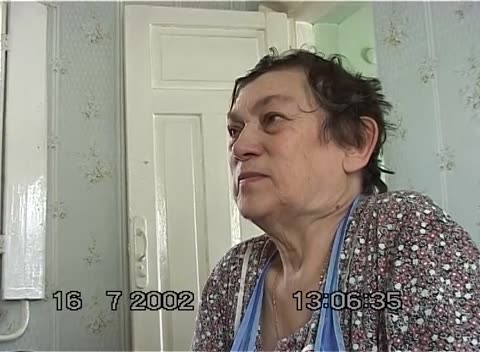
Murovanaia talks in Russian about the contemporary community, as well as charity.
From the machine transcript
Informal talk at the start, partly in Russian, about common acquaintances, travel plans and the team's arrival. Kerler asks whether there is a Hesed in town. The visitors are described as a rabbi from Canada, a university historian in America, and a colleague; a grandchild or others offer food, and the kitchen and flat are shown. Kerler asks to call her 'Aunt Mira' and then asks how she makes gefilte fish.
The transcript shows mostly small talk about visitors, food and the flat; charity is only touched by a question about the Hesed.
Murovanaia shares her recipe for gefilte fish. She also speaks about her family.
From the machine transcript
Murovanaia explains how she makes gefilte fish: onions, ground fish, matzo meal, sugar and salt. She mentions American relatives who visited from Detroit or Boston and were served it, and that a son-in-law is about to come.
Also mentions American visitors and a coming son-in-law.
Murovanaia provides personal information.
From the machine transcript
Kerler takes down her name, patronymic and surname, and her address (a street named Korolenko, number 11).
The formal interview with Murovanaia begins. She addresses speaking Yiddish with her family.
From the machine transcript
Formal interview begins. Murovanaia says she can hardly speak Yiddish now for lack of people to speak it with, and that she was taught it from childhood. Her grandson introduces himself; Kerler states the date and place of the recording and begins collecting her details.
Also includes the grandson's introduction.
Murovanaia provides personal information and speaks about her family. Murovanaia's family moved to Haysyn shortly after her birth. Her father was born in Kiblych and separated from her family. He was a colonel in the Red Army and taught at the military institute for electronics near Moscow. Murovanaia's mother was born in Haysyn and was the president of a tailor artel, before the war. Murovanaia grew up as an only child.
From the machine transcript
Murovanaia gives personal information and speaks of her family: born in Nikolaev in 1926 and taken to Haysyn as a baby. She learned fish-making from her mother-in-law from Haysyn. Her father Mordkhe, born in Kiblych, was a military officer who taught at a military school in Moscow; her mother Golde, daughter of Tevye, was born in Haysyn and headed a tailors' artel. She mentions a half-sister who died young and a Russian-language remark about the proportion of Jews in Haysyn.
Includes her mother-in-law teaching her, a half-sister, and a remark on Jews in Haysyn.
Murovanaia addresses her childhood memories of Haysyn. She finished seven grades at a Russian school, before her evacuation to Central Asia. She then addresses her return to Haysyn in 1944, when she worked as statistician. Murovanaia continues that she studied pharmacy between 1945 and 1947 and became an assistant pharmacist. She worked in the same pharmacy for fourty-five years. Murovanaia's daughter also worked in the same pharmacy, before her immigration to Germany.
From the machine transcript
Murovanaia recalls finishing seven grades before the war and being evacuated; she was seventeen on returning to Haysyn at liberation and worked briefly as a statistician. She studied pharmacy in 1945–47 and worked in the same pharmacy until 1990. Her daughter worked there and then left for Germany. Kerler asks her to explain terms in Yiddish.
Details Kerler's requests for Yiddish equivalents of terms.
Murovanaia discusses food customs for Passover, as well as other dishes. She then speaks about a childhood friend from before the war, before talking about her family. Murovanaia raised two daughters.
From the machine transcript
Murovanaia speaks about Passover dishes (kneidlach, stuffed fish, kugel) and a childhood Jewish friend, now in Moscow, with whom she spoke Russian. Her two daughters' ages are given, along with a silver wedding in August. Murovanaia says her mother was a Communist yet believed in God; she compares Yiddish speaking in the family with Russian schooling.
Includes her daughters' ages and the language used with her friend and relatives.
Murovanaia addresses postwar holiday celebration at her in-law's house. Murovanaia states that she went to celebrate Jewish holidays at her in-law's house and they came to visit on Soviet holidays. Murovanaia mentions that she learned Jewish cooking from her mother-in-law. She then addresses postwar Passover celebrations, including food customs.
From the machine transcript
Murovanaia says that after her marriage she celebrated Jewish holidays at her in-laws', whose father was a Communist but whose mother observed the holidays, without prayer, while Soviet holidays were kept at her own home. She learned cooking from her mother-in-law and describes the Passover foods. Later she mentions a grandson's seder in Moscow, and that her family is secular; Kerler asks about the Yiddish word for religious.
Murovanaia answers dialectological questions from the AHEYM Yiddish linguistic questionnaire.
From the machine transcript
Answers Kerler's dialectological questionnaire, translating Russian words and descriptions into Yiddish: greetings, please, crying, hunger, cold and warm, the verb 'to do', mountain, bed, numbers of people, luck, high, late, later, gravestone, thanks, and a non-Jew. The interviewer also explains why he wants everyday speech rather than literary Yiddish.
Murovanaia continues to answer dialectological questions from the AHEYM Yiddish linguistic questionnaire.
From the machine transcript
Murovanaia answers Kerler's dialectological questions: how particular Yiddish words are said, including words for a pigeon, a mouse, stuffed cabbage, breathing and a deaf person. She also describes baking matzo and a spinning toy, and begins to speak about Hanukkah.
Includes talk of matzo baking and the Hanukkah toy.
Murovanaia sings the Hanukkah song "Khanike Oy Khanike," before she addresses postwar Hanukkah celebrations, including food customs. Murovanaia then continues answer dialectological questions from the AHEYM Yiddish linguistic questionnaire.
From the machine transcript
Murovanaia recites or sings the Hanukkah song she learned from her aunts. She recalls Hanukkah money, the latkes, and Hanukkah with children and neighbours. Kerler then continues the questionnaire with words such as tsadik, hell, face, and a few others.
Kerler's questionnaire items follow, and she recalls Hanukkah in her own childhood as well as the postwar period.
Murovanaia talks about members of the Horovitz and Kerler family in prewar Haysyn. She then talks about her family, particularly her husband.
From the machine transcript
Asked about the Horovitz and Kerler families of prewar Haysyn, Murovanaia talks about a Horovitz born in the same year as her husband, a relative who writes from Brooklyn, and what she knows of the Kerler family. She then gives her husband's name, his work at a factory warehouse, his religious family and his parents' names.
Adds her husband's work and religious family, and the contact in Brooklyn.
Murovanaia speaks about her life today, as well as the contemporary local community. She has relatives in Israel. Murovanaia also talks about her travels to Israel.
From the machine transcript
Murovanaia speaks about her life today in Haysyn, her pension and her children's help. She mentions the few remaining Jewish friends and says she has relatives in Israel and does not wish to leave. She describes her roughly 45-day visit to Israel, her impressions of it and the climate, and children who live in Germany.
Adds why she stays, her pension and the question of Germany.
Murovanaia talks about her life during World War II, which she spent in evacuation. Murovanaia mentions how she walked seventy kilometers in the Caucasus region. She then talks about her family, before addressing her return to Haysyn. Murovanaia raised two daughters, one of whom lives in Germany. Murovanaia briefly explains how she moved into her childhood home after the war, which was originally her grandfather's. The team then concludes the formal interview with Murovanaia.
From the machine transcript
Murovanaia talks about her children and about moving back into her grandfather's house after the war, though the war and evacuation material is largely garbled. Kerler thanks her, mentions the vareniki she served, and the formal interview ends.
The transcript supports little of the evacuation account in the catalogue entry.
The camera cuts to the interview with Burshtein. The team greets him and his wife Fanye outside their house.
From the machine transcript
At Burshtein's house, the interviewers are greeted by him and his wife Fanye, mostly in Russian. Kerler then explains the project in Yiddish, saying that it collects material on the language, folklore and history of Yiddish, and introduces the team.
The formal interview with Burshtein begins. He addresses his childhood memories and education in prewar Sobolivka. Burshtein attended a Yiddish school for four years. He explains that his class received a new teacher in grade three, who did not know how to write and read in Yiddish. Burshtein attended a Ukrainian school from fifth grade onward.
From the machine transcript
Burshtein explains that Jews no longer read or write Yiddish. He attended a Yiddish school for four years. A new teacher, who knew only Ukrainian, then turned the class into a Ukrainian school, and in fifth grade he moved to the Ukrainian school.
Burshtein provides personal information and talks about his family. Burshtein's great-grandfather was born in Germany.
From the machine transcript
Burshtein gives his birthplace, Sobolivka in the Teplyk district, and his birth year, 1928, and says his passport name is Arkadii Libovich Burshtein. He says the family is of German origin, an ancestor having come from Germany, and names his grandfather Mendel. He gives his address in Haysyn in Russian.
Burshtein talks about his life before the war, as well as his family. Burshtein's father was also born in Sobolivka and worked as tailor.
From the machine transcript
Burshtein says he lived in Sobolivka with his parents until the Germans came. His father, Leyb Mendels, was born in Sobolivka and worked as a tailor, and his grandfather was also from Sobolivka. Kerler's explanations of the project and chat in Russian and English interrupt the account.
Much of the passage is side talk about the project and the interviewers.
Burshtein addresses his return to Haysyn after the war. According to him, it was embarrasing to speak Yiddish. He then mentions non-Jews who spoke Yiddish in Sobolivka before the war; particularly his grandfather's friend.
From the machine transcript
Burshtein explains that after the war Jews were embarrassed to speak Yiddish in public, though they spoke it privately and with a colleague at work. Asked why, he compares it to hearing a foreign language spoken in public. He contrasts this with prewar Sobolivka, where Jews and non-Jews spoke Yiddish openly, and recalls a non-Jewish neighbour of his grandfather who spoke it and whom he remembers. He also mentions the porch at each Jewish home where people sat and talked in the evening.
Adds the prewar porch custom and the contrast with the postwar embarrassment.
Burshtein speaks about prewar Jewish life and emigration from Sobolivka. According to him, five hundred Jews lived there. He then addresses postwar Jewish life in Sobolivka, as well as contemporary Jewish life in Teplyk.
From the machine transcript
Burshtein says that many young Jews left Sobolivka after the revolution, and that about four hundred remained, of whom he says three hundred were shot in the war. After the war a few elderly Jews returned, and now no Jews are left in Sobolivka. He gives the number of people in Teplyk and the distances between the places, and mentions a woman from Sobolivka who works as a teacher.
Gives his figure of about four hundred who stayed and three hundred shot, which the catalogue entry puts differently.
Burshtein talks about his family.
From the machine transcript
Burshtein names his mother, Rivke (Rebecca) Gadl Weinstein, and says her father was Gadl.
Holiday celebration and life after the war.
From the machine transcript
Krasner says a few words about the seder in the late 1940s (?) and before the war. She says the family house stood nearby and was ruined and plundered by Romanians. Kerler and Katz then arrange the trip to the cemetery.
Adds the plundering of the family house and the arranging of the cemetery trip.
Neighborhood and town footage.
From the machine transcript
Footage from the van and the street in Shpykiv. Krasner points out the former ghetto and houses where Jews once lived, some now occupied by non-Jews, and says only a handful of Jews remain in town. Katz asks about this and about the number of people in Shpykiv. Kerler has a long exchange with her about how a mother counted guests, and she describes the former synagogue. The stretch is full of Russian chatter, banter about the camera and Americans, and speech that is hard to follow.
Adds the ghetto site, the count of Jews in town today and the counting question.
Arrival and tour of the Jewish cemetery.
From the machine transcript
The team arrives at the cemetery in the dusk and walks over a bad path. Krasner shows the graves of her mother and aunt. Katz reads the inscriptions with her and says kaddish for her mother and aunt, whose names are only partly clear. Krasner says the aunt was cremated and buried elsewhere. The speech is partly garbled.
Adds the reading of the inscriptions and the aunt's name.
Family and dialectology.
From the machine transcript
At the cemetery Krasner speaks about graves and burials: a tombstone, her brother who made it, relatives who died in camps, and a neighbor. Katz and Kerler read gravestone inscriptions, including a rebbe's tomb, with a death date in the early 1920s (?), and ask about word forms, such as the plural of tsadik.
Adds the rebbe's grave and the word questions.
Murovanaia shows how to make varenikis.
From the machine transcript
The tape changes to a kitchen in Haysyn with Murovanaia. She and Kerler talk about making vareniki, and she tells how she makes the dough and filling by hand. The talk is interrupted by Russian talk about calling the head of the community.
Family.
From the machine transcript
While making vareniki, Murovanaia talks about people she knows in America and Cleveland, and about the Kerler family, who were neighbors in Haysyn. Kerler says he lives in Bloomington, Indiana. She mentions a daughter in Nuremberg and a grandson in Moscow. They discuss the similarity of Yiddish and German and its place in the world as an international language.
Adds Murovanaia's family in Nuremberg and Moscow and the talk about Yiddish as an international language.
Education and prewar Jewish life.
From the machine transcript
Murovanaia talks about the Soviet Yiddish school in Haysyn and some of its teachers, though she herself attended a Russian school. She recalls that there were three synagogues, which stood until the Germans came. After the war a shoykhet and a minyan existed, and the family held memorials for grandparents.