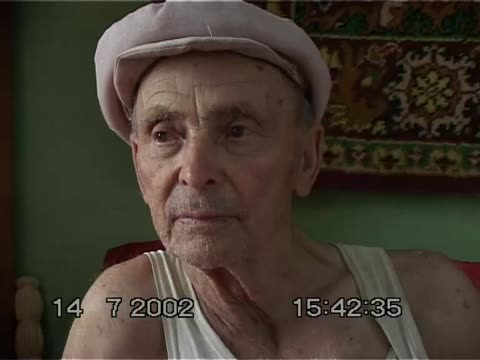
The team meets Kupershmidt and his wife Rakhil (Rukhl) Natanovna Kupershmidt, nee Reznik, and they chat, before setting up the formal interview. He talks about his family in Israel. Rakhil, who is his second wife, was also born in Bratslav.
From the machine transcript
Greetings and chat with Kupershmidt before the interview. Kerler explains that the team came looking for Jews from Bratslav and had hired a car and driver. Kupershmidt asks about their origin and mentions that a son and grandchildren are in Israel and that a daughter-in-law or relative married a doctor there. Kerler mentions his father's family origin, and Kerler then asks the couple to sit down for the interview.
Kerler explains how the team found them and mentions his own father's origin, which the catalogue does not say.
The formal interview with Kupershmidt begins. He provides personal information. He also recites prayers and addresses his religious education.
From the machine transcript
Formal interview begins with the date and Kupershmidt's name. He says he can still pray, having learned with a poor father about seventy years earlier, and Kerler asks him to repeat some of it. He remembers Hebrew Bible study (khumesh, gemara), and Kerler asks him to say the opening of Genesis. He then recalls that before the war Bratslav had a shoykhet, a rabbi and many learned men, and that after the killings few were left.
Adds a prompted attempt to recite the start of Genesis and a short note on the town's rabbi and shoykhet before the war.
Kupershmidt talks about prewar Jewish life in Bratslav. He then provides personal information.
From the machine transcript
Kupershmidt gives his Hebrew name as Moyshe ben Aaron and the name of his wife Rakhil ben Naftoli. He then gives his official Russian name and patronymic, Mikhail Aronovich, and says his own surname is Kupershmidt while his wife's maiden name was Reznik. Kerler asks about the wife's Russian patronymic and then about their address.
The catalogue's prewar Jewish life topic is not evident here; the passage is mostly names and address.
Kupershmidt provides personal information and talks about his family. His parents were also born in Bratslav.
From the machine transcript
Kupershmidt says he was born in Bratslav and so was his wife, and that his parents and his grandfather Meir were also born there. He was not born in a house of his own but in a two-room dwelling on the lower floor. Kerler explains that the project collects Yiddish and memories of earlier life. Kupershmidt begins to say that what he lived through in the war would take three days to tell.
Includes Kerler's explanation of the project and Kupershmidt's introduction to his war experiences.
Kupershmidt speaks about regional Jewish life during the war, before speaking about his family's fate during the war. Kupershmidt's mother was evacuated and his father was killed in Bratslav.
From the machine transcript
Kupershmidt describes seeing thousands of naked Jewish prisoners kept under German guard, and says memory of this must be passed on. He says his father was killed by the Germans in Bratslav, while his mother was evacuated and sent to the Pechera camp, where he says Romanians rather than Germans were in charge. He describes Germans taking young people to be shot and sons forced to load their parents onto trucks. Kerler then asks how he saved himself in Zhytomyr.
Adds the description of mass killings seen by Kupershmidt and his insistence on remembering them; the catalogue's evacuation of the mother is unclear in the transcript.
Kupershmidt talks about his life during World War II. Before the war, Kupershmidt worked at a driving school and was then drafted as chauffeur in Finland in the early war years. He describes the situation after he returned from Finland and was caught to be executed. Kupershmidt then talks about his escape to Zhytomyr from a massacre. Kupershmidt was caught again with non-Jewish prisoners and volunteered to drive to Zhytomyr. He explains how another prisoner informed on Kupershmidt that he is Jewish. He continues to talk about his life in hiding and with non-Jewish forced labor group, as well as in a prisoner of war camp in Rivne. Kupershmidt also mentions how he dressed up as a non-Jew.
From the machine transcript
Kupershmidt explains that he was a driver, worked at a driving school before the war and was in the Finnish war. On returning he drove a military vehicle, was stopped by Germans when the war began and was identified as a Jew from his papers. He was taken to dig a pit and fled when Soviet prisoners mocked him, was recaptured and driven to Zhytomyr, and denied or admitted being Jewish at different moments. He describes the Jewish prisoners held naked in the camp, hiding in a barracks attic, and joining a non-Jewish work group of Tatars and Georgians. He was then taken to a prisoner camp in Rivne, where he feared recognition by someone from Bratslav and gave a false Ukrainian name.
Gives the order of events: the pit near Zhytomyr, the capture and driving to Zhytomyr, the naked Jewish prisoners, a work group of Tatars and Georgians, and a false name in Rivne.
Kupershmidt shares an episode of his life during the war, when he was with a non-Jewish forced labor group that received permission to move around between local districts. He describes the daily life and escapes, before he was caught near Bratslav and sent to the Pechera camp, via Bratslav and Nemyriv ghettos. Kupershmidt also mentions his work assignments, including driving service. He states that he was allowed to drive to the Bratslav and used it to look for his family in the ghetto. Before Kupershmidt was liberated and drafted in the Red Army, he was imprisoned in the Mohyliv-Podilskyy ghetto.
From the machine transcript
Kupershmidt describes a non-Jewish forced labor group of about a hundred men that was released to the districts and warned to avoid Jews. He fled from this group and returned to Bratslav, where he worked in a garage for a German firm, with papers allowing him to move about, and drove a German to Vinnytsia. He used the driving to look for his family in the Bratslav ghetto. One day he found his wife, child and parents gone to the camp at Pechera, and he tried to get them food. He describes false documents and the camp under Romanians, flight to Mohyliv-Podilskyi, and being in its ghetto before his draft into the army.
Adds that he drove for a German firm, how he used the permit to look for his family, and the documents he used in the Romanian-run camp.
Kupershmidt addresses the moment when he was drafted in Mohyliv-Podilskyy. He served in the Red Army for one and a half years. Kupershmidt talks about his life and family after the war. His first wife died in 1947; and his son lives Israel. Kupershmidt maintains that his family was prepared to immigrate to America.
From the machine transcript
Kupershmidt recalls being drafted in Mohyliv-Podilskyi, where he drove a vehicle and served in the army for another year or so. After the war his wife died in 1947 and their son later died as well. He says relatives had papers to leave for America. Another relative went to Israel, a nephew named Naftoli who is known as Talia (?), who phones every week. Kupershmidt says he and his wife stayed alone, receive some support, and are cared for by the people around them.
Names the relative in Israel and says what he and his wife receive in support today; the transcript is unclear about the son who died.
Kupershmidt talks about his life during the war, in particular the moment when he evaded massacres. He then briefly talks about life in Bratslav before the war, including the relationship between Jews and non-Jews. Kupershmidt then discusses his family. His father was a coach man.
From the machine transcript
Kupershmidt recalls surviving the grave, then answers Kerler's question about non-Jews who spoke Yiddish and says Jews and non-Jews lived together well before the war. He describes his father's work with horses and a cart, hauling loads, and gives his father's death as 1952 (as heard from INF2).
Adds the question of non-Jews speaking Yiddish and the father's death date.
Kupershmidt provides personal information and talks about his family. He grew up with two brothers and one sister; and his family owned a cow.
From the machine transcript
Kupershmidt gives personal and family details. He was named after someone from Bratslav, his mother was a housewife who kept a cow, and he gives the names of his brothers and sister. Of six children, four grew up, and the family had lived in the town for generations.
Adds the naming of the siblings and that the family lived in the town for generations.
Kupershmidt addresses prewar Jewish life in Bratslav, including Hasidic visitors from Uman. He attended a Yiddish school for four years. Kupershmidt also addresse holiday celebration in town.
From the machine transcript
Kupershmidt remembers prewar Bratslav in answer to Kerler's questions. He lists the matchmakers, rabbis, study house, kloyz and synagogue, and says he attended Yiddish school for four years. He describes who prayed where, notes Hasidim in the kloyz, and says Hasidim came from Uman.
Adds the question of who prayed in the synagogue, kloyz and study house.
Kupershmidt talks about postwar Jewish life. He then mentions his oldest brother who was active in Zionist circles.
From the machine transcript
Kupershmidt says no Hasidim were left after the war; the last shochet was in a camp and his sons were killed. Many who returned from Russia died or emigrated, and he has not heard of mitnagdim. He then says his eldest brother was a Zionist who had Zionist friends, and that the authorities jailed Zionists.
Adds the shochet's fate and the arrest of Zionists.
Kupershmidt addresses holiday celebration, specifically Sabbath, at home before the war. He then talks about life today.
From the machine transcript
Kupershmidt talks about prewar Sabbath at home, with his mother's blessing and the cholent kept warm. The conversation turns to Kerler's own background and where he and the others live, and Kupershmidt says Poles also killed Jews and speaks of the ghetto. The passage ends on an apology that is not clearly explained in the transcript.
Adds the chat about where the interviewers live and the remark about Poles and the ghetto.
Kupershmidt talks about antisemitic acts in Ukraine. He then speaks about the contemporary Jewish community in Bratslav.
From the machine transcript
Kupershmidt describes the current mood towards Jews in Ukraine as calm for now, but says Jewish graves in the fields have been desecrated. He says only about five Jewish families remain in Bratslav and that many Jews live with non-Jews, and he speaks of conflict among Jews. He also mentions a Hasidic man in Vinnytsia who runs a Jewish school and an old rabbi hidden in the area.
Adds the Jewish population today and the Hasidic school in Vinnytsia.
Kupershmidt speaks about prewar religious life, before answering questions about cultural terminology.
From the machine transcript
Kupershmidt and Kerler talk about a non-Jewish helper who understands Yiddish, and Kerler asks how to say that someone is a believing person. The interviewers explain the project, and Kerler begins questions with a Russian prompt. Kupershmidt chats about where the visitors are from and about the town of Medzhybizh.
Adds the explanation of the AHEYM project and the discussion of Medzhybizh.
Kupershmidt answers dialectological questions from the AHEYM Yiddish linguistic questionnaire.
From the machine transcript
Kupershmidt and Rakhil answer Kerler's dialectological questionnaire, with Katz asking for repetitions. Items include water, a later hour, near and nearer, cold, to run away, luck, and the words for a non-Jew and for breathing. Others include a book, a ship, a deaf person, fast, back, and a face. Kupershmidt also gives the local phrase for a stingy person (from Nemyriv rather than Haivoron).
Rakhil provides personal information and talks about her family's fate during World War II. She grew up with two sisters. She then briefly talks about her life during the war when she evacuated to Kyrgyzstan. Rakhil then discusses her childhood memories of Jewish Bratslav, as well as her home. She attended a Ukrainian school. Rakhil also speaks about ther family and her father's religious teachings.
From the machine transcript
Rakhil, born 1919, speaks of her family's fate in the war. Her mother and two sisters were in a camp and her mother brought them back, her father was shot, and she herself was evacuated to Kyrgyzstan. She remembers prewar Bratslav, its streets, her Ukrainian school, and her father, a learned man who taught her Hebrew words.
Adds the wartime fate of her parents and sisters, her evacuation to Kyrgyzstan, and her father's Hebrew teaching.
Rakhil speaks about prewar holiday celebration at home. She specifically recalls the Passover seder at her uncle's house. He was a rabbi.
From the machine transcript
Rakhil answers questions about how holidays were celebrated before the war. Sabbath was a day of rest on which cooking was forbidden. She recalls the Passover seder at the house of her uncle, a rabbi, and the opening of the door for Elijah. The passage includes some confusion between speakers and a Russian-language stretch.
Adds the Sabbath rest and the detail of the open door at the seder.
Kupershmidt recites the morning prayer "modeh ani." He then speaks about his journalist activities for the local Jewish newspaper; before answering dialectological questions from the AHEYM Yiddish linguistic questionnaire.
From the machine transcript
Kupershmidt tries to recite the morning prayer at Kerler's request and recalls only a few words. He says he reads Yiddish a little and subscribes to a Jewish newspaper, and Kerler puts a few more terminology questions. Kerler asks to be shown the graves of the tsadikim, and Kupershmidt agrees but worries about the road.
Adds the request to be shown the graves of the tsadikim.
The camera focuses on the interior of his house with its newly placed mezuzahs. Exterior shots of courtyard. Street scenes of Bratslav. Researchers speaking and taking photos with the informant outside his home. Street scenes of Bratslav. Kupershimdt leads the team to the Bratslav cemetery where Reb Nosn haTsadik is buried and tells them about the shtetl along the way. Scenes of the Bratslav cemetery. Scenes of Sharhorod. The researchers begin a formal interview with Mikhail (Motya) Isaakovich Yerikhman, who was born in Sharhorod in 1939. (Part 1 of 3. See MDV 658 and MDV 659) He starts his interview talking about his family, including his son, now in Israel, and his nephew, who still lives in Sharhorod, who has became religious. Yerikhman remembers Sharhorod as being a Jewish shtetl into the 1990s, where all the non-Jews spoke Yiddish. During the war, Yerikhman tells the interviewers, only two Jews died in the town, both of whom, a deaf man and a woman, were killed by accident. He also describes the town’s wartime ghetto population as being almost exclusively women and children, as most of the local men were drafted into the Red Army and were thus on the front. Yerikhman also talks about the Pechera camp where Jews from the whole region were killed.
From the machine transcript
Kupershmidt takes leave of the team in Bratslav and gives directions to the field and the tsadik's grave. He points out former Jewish houses, a Jewish blacksmith named Rozenberg (?), the wartime ghetto and its camp, a visiting Hasid from Israel, and the old mill. Kerler and Katz then discuss the route to Uman and Rebbe Nakhman of Breslov, who was born in Medzhybizh. On arrival in Sharhorod they begin an interview with Yerikhman, who says he was born in 1939 and names his parents and his brothers, one of whom died in Moscow. He describes a relative with a non-Jewish wife who observes the Sabbath, the sale of the family house, and the Jewish town of about 7,000 where Yiddish was spoken, still with 3–4 thousand Jews until the 1990s. He recalls that only two or three Jews died in the war, accidentally, among them a deaf man shot by a German. He also says the ghetto held mostly women and children while the men were in the Red Army, and discusses the Pechora camp and who was killed there.
The transcript shows the end of Kupershmidt's Bratslav part and the talk with Yerikhman in Sharhorod, but not the footage the catalogue describes.