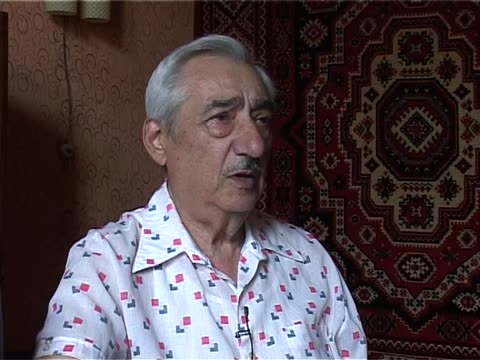
The second part of the tape is a formal interview with Froim Kalmanovich Bukshtein, born 1923 in Novoselitsa. Bukshtein provides personal information and talks about his life before the war in Novoselitsa until 1940. He studied at a religious school (cheder) for six years and also attended a Romanian school.
From the machine transcript
Bukshtein, born in Novoselitsa on 28 December 1923, gives his name and address and telephone number. He says he lived in Novoselitsa until 1940. He studied in a Yiddish cheder for about five or six years in the afternoons and in a Romanian school in the mornings.
Names the Romanian school and gives address details.
Bukshtein talks about his family and contemporary religious life. Bukhstein serves as assistant rabbi. He then discusses the history of the region and prewar Jewish life in Novoselitsa. Bukhshtein recalls many non-Jews speaking Yiddish. He then lists Zionists organizations, including Hashomer Hatzair, Betar, and Poale Zion. Bukshtein was a member of the youth organization Hashomer Hatzair and recalls its activities to prepare chalutzim (young pioneers preparing aliyah to live in agricultural settlements). Bukhstein’s cousin made aliyah in 1935.
From the machine transcript
Bukshtein talks about his grandfather, the old Leyzer, who prayed before the ark, and says that he helps the rabbi as a baal tefilah today. He explains how Bukovina became Soviet in 1940. He recalls that Novoselitsa was a Jewish town and that non-Jews spoke Yiddish. He lists the Zionist organizations, and tells of the hakhshara preparation and his cousin, who left in the 1930s.
Adds the grandfather Leyzer, and the town's non-Jewish population and Zionist movements.
Bukshtein talks about the Sovietization of Ivano Frankivsk in 1940 and his life during this period. He worked as a tailor and was sent on a work assignment to Mykolayiv at a 51:28 construction site. Bukshtein explains how he and other tailors were called away by the Jewish director of a tailoring factory. He maintains that most workers at the factory were Jewish and the young workers were called to a meeting in 1940, held in Yiddish. Bukshtein states that his plans for returning home for vacation were interrupted as World War II broke out.
From the machine transcript
Bukshtein talks about 1940 after the Soviets came. He signed up for work at a construction trust in Mykolayiv, where the tailors were called away by the Jewish director of a clothing factory. Most of the factory's workers were Jewish. A meeting for young workers was held in Yiddish because they knew no Russian. He was planning a trip home when the war began in 1941.
Adds the Yiddish-language meeting and the Jewish composition of the factory.
Bukshtein talks about his life during the war. His family was imprisoned in the Stanislav ghetto and Bershad ghetto. His mother, sister, and brother survived the war because they were imprisoned in the Romanian-occupied Bershad ghetto, according to him. The leadership of the tailoring factory in Mykolayiv was evacuated to Siberia. The workers were responsible for their own evacuation. Bukshtein describes how he followed with his friend the echelons with factory evacuees, including factory machinery, and traveled for one month to Novosibirsk, Russia. He further evacuated to Bolotnoye, where the tailoring factory was reestablished for the Soviet war effort. Bukshtein was drafted into the Red Army in Novosibirsk at the end of 1941. Bukshtein states that he joined his Jewish friend, who volunteered as a “westerner” and was sent to the military authority in Siberia 59:25, whereas the other draftees became soldiers. He explains how the military commander was upset about their visit because they were not allowed to serve as minors in the Red Army.
From the machine transcript
Bukshtein recounts that his father was shot and the rest were in the ghetto; his mother, sister and brother survived in Bershad under the Romanians. He followed the factory by echelon to Novosibirsk with a friend, and the tailoring factory was set up again to sew for the army. He was drafted at the end of 1941, but the commanders sent him and his friend away because they were not yet eighteen.
Adds the father's death on the way to the ghetto and the commanders' refusal on grounds of age.
Bukshtein talks about his life during the war, when he was drafted in Siberia in 1942. He stayed in Siberia until 1944. He talks about the letter he wrote to his non-Jewish neighbor in Novoselitsa in order to learn about his family’s fate. Her neighbor informed him about his burned down house. He then exchanged letters with his mother, who returned to Novoselitsa from the Bershad ghetto. During his military service in Siberia, he met his Jewish wife Lucye.
From the machine transcript
Bukshtein recalls writing home to a non-Jewish neighbor in Novoselitsa after the liberation of the area, and learning that the family's house had burned down. He then received a letter from his sister, who had returned home, and learned that his mother, brother and younger sister had survived, while his father had been killed on deportation. In the army in Siberia he met his Jewish wife Lucye, whose family came from the Poltava region and had lived in Leningrad; he answers Kerler's questions about her.
Gives details of the wife's origins in Leningrad and the Poltava region.
Bukshtein talks about his life after the war. After his military service in 1947, he returned to his wife to Siberia and worked there until 1953. Bukshtein and his wife moved to Ivano Frankivsk, joining his sister and mother. In 1957 his mother and sister left for Poland and due to antisemitism in Poland in 1960, they left for Brazil. Bukshtein exchanged letters with them at the beginning, but he explains how he did not want to endanger his daughter’s studies by publicizing his relatives abroad. He only received a letter from his sister after Perestroika. Bukshtein saw his sister and aunt in Brazil in 1989 for the first time in 32 years. He stayed there for three months. Bukshtein recalls the Yiddish singing with his relatives in Brazil.
From the machine transcript
Bukshtein describes his return to Siberia after army service in 1947 and his move to Ivano-Frankivs'k in the early 1950s to join his mother and sister. They left for Poland, and he explains that he feared writing to relatives abroad because of his daughter's studies. After perestroika his sister wrote to him, and he visited Brazil via Frankfurt, seeing his sister after 32 years, and an aunt in São Paulo who was over a hundred years old. He recalls Jews gathering to sing Yiddish songs and the relatives' children speaking Yiddish and Portuguese.
Adds the São Paulo setting, the aunt Malke aged over a hundred, and the language of the relatives' children.
Bukshtein sings a Yiddish song about the joy of the Yiddish language, he composed the melody for. He then talks about contemporary Yiddish literature and reads a story by Avrum Karpinovich, published in “Vilne, mayne Vilne” [Vilna, my Vilna].
From the machine transcript
Bukshtein recites the words of a Yiddish song about Yiddish being spoken everywhere in the world, for which he composed the melody. Kerler asks where the text was published, and they discuss the newspaper. Bukshtein then reads a humorous story by Avrom Karpinovitsh (from his book on Vilna) about a doctor who has a patient complain in Yiddish instead of bad Polish. They talk about who reads Yiddish literature, and about the Hesed newspaper he receives from Kyiv.
Adds that the performance is a recitation of the song text, that the story is read aloud, and the discussion of the Hesed newspaper.
Bukshtein talks about his family. His father was a saddlemaker and born in the Novoselitsa region, living in Lipcani and Edinet. Bukhstein’s paternal aunt immigrated to America in 1937. Bukshtein then discusses his work during and after the war. The director of the tailoring factory ordered Bukshtein to take classes in mechanics. After completing his courses in Moscow, Bukshtein worked in this profession at the main mechanics factory in Siberia. After the war, Bukshtein returned to the tailoring profession and worked as a tailor’s cutter.
From the machine transcript
Bukshtein gives his parents' names and background: his father, a saddler (harness maker), was born in the 1880s in the Novoselitsa region and lived in Edinet and Lipcani. A paternal aunt left for America in 1937. He tells how, in the war, he was kept out of the army and trained as a mechanic at a clothing factory, with courses in Moscow. After the war he went back to tailoring and became a cutter, and Kerler asks about the Yiddish word for cutter.
Adds the exchange about the Yiddish word for cutter and the name of his grandfather and his own Israel status.
Bukshtein talks about his family. His maternal grandparents raised twelve children. His mother was a tailor and born in Edinet. The majority of his family was murdered during the war. Bukshtein then states how important it is to cultivate the Yiddish language and discusses Yiddish dialects. He continues to share information about his family. He grew up with four siblings. He then talks about his brother’s fate in a Romanian-occupied ghetto during the war, he learned from his mother. In particular, Bukshtein tells a story when his brother looked for food and he fell into icy water.
From the machine transcript
Bukshtein names his mother Khaye, a tailor from Edinet, and his maternal grandfather, who had twelve children. Most of the family were killed in the war. He discusses how important it is to keep Yiddish alive and compares dialects with Transcarpathian and Lithuanian Yiddish. He names his four siblings and recounts what his mother told him of his brother Shloyme's time in the Bershad ghetto, where the boy's feet froze after he fell through ice while going to get food from a non-Jewish villager. Kerler asks about a Yiddish word for Christmas.
Adds the discussion of Yiddish dialects, a question about the word for Christmas, and the siblings' names.
Bukshtein talks about contemporary Jewish life and food customs, before he discusses childhood memories of Edinet, specifically education. He describes how he went to religious school (cheder) during winter in Edinet and then in Novoselitsa. His family moved to Novoselitsa in 1928, where his grandfather and uncle lived. Bukshtein sings the well-known Yiddish song “Afn Pripetchik,” he calls from his childhood. Bukshtein studied at a Tarbut school for one month. He explains that the school’s director Greenberg encouraged his parents to pay for Bukshtein’s studies, instead of continuing his studies at the Yiddish Tarbut school. His parents could not afford a private school, so Bukshtein attended a Romanian school instead.
From the machine transcript
Bukshtein speaks about the small Jewish community in Novoselitsa today, then about food (brinza, mamaliga) in a poor family, with a toast and a chat about food at the table. He recalls his first cheder in Edinet at age four, walking through the snow, and then the cheder of Rebbe Mendl after the family moved to Novoselitsa in 1928. He sings a cheder song (Afn pripetshik), attended the Tarbut school for a month until the teacher Grinberg demanded fees, and then went to a Romanian school.
Adds the food chat and toast, the Rebbe Mendl cheder, and the Romanian school's director.
Bukshtein talks about his work as a tailor. He moved to Chernivtsi in 1937 in order to continue his tailor apprenticeship, he started in Novoselitsa. He studied for three years and recalls his foreman singing. Bukshtein then sings a Yiddish-Russian drinking song and talks about contemporary performances.
From the machine transcript
Bukshtein tells of his tailor's apprenticeship in Novoselitsa with Usher Roytman, who was also a cantor, and his fellow apprentices. In 1937 he moved to Chernivtsi to work for his sister's husband, a ladies' tailor, and learned some German there. He sings a Yiddish-Russian drinking song (the toast 'Lekhaim, mayne yidn') and tells how he set the words to a melody for a Jewish community event led by Meir Markovitsh.
Adds Roytman as a cantor, the fellow apprentices, and the background of how the melody was composed.
Bukshtein talks about life in the 1930s under fascist Romanian occupation, before he turns to life today and his family.
From the machine transcript
Bukshtein states that only Yiddish and Romanian were spoken in Novoselitsa. He recalls the Cuza government in the 1930s and the antisemitic pressure on shopkeepers and customers to speak Romanian, with a joke about a woman buying figs. He then tells about a visit by a cousin from Israel and his wife Mila, a Yiddish speaker from Vashkivtsi, and an anecdote of Mila speaking Yiddish with Hasidim on a plane. He also tells about a Chabad visitor who knew a relative, and about an older sister who went to Palestine after the war.
Adds the cousin's visit from Israel, the plane anecdote and the Chabad encounter; the description turns on the 1930s Romanian government.
Bukshtein talks about his family and visits to Israel, where his daughter lives.
Bukshtein discusses and sings Yiddish songs he remembers from his childhood, from his tailoring apprenticeship, and Sidi Tal. He also talks about prewar Yiddish culture. Bukshtein then sings a Yiddish song about emigration called “Papirene kinder” (children out of paper), before he sings a couple of Zionist songs in Hebrew and Yiddish, he remembers for Hashomer Hatzair.
Bukshtein sings a Romanian tango and a number of well-known Yiddish songs.
Bukshtein discusses prewar Jewish life and holiday celebrations in Novoselitsa. He describes synagogue activities and holiday celebrations, in particular for Passover and Purim.
Bukshtein explains how he celebrated Passover during evacuation in Bolotnoye, Russia, with a family from Leningrad. He then describes Passover celebrations at home and talks about contemporary religious life. Bukshtein discusses contemporary memorialization and his wife’s family.
Bukshtein discusses holiday celebrations and food customs. He then talks about prewar Yiddish culture and press and sings a Yiddish song about happiness.
Bukshtein talks about the Zionist youth organization Hashomer Hatzair, he was a member of.
Bukshtein discusses cultural life before the war and sings a Purim shpiel. He mentions the local bathhouse and tells an episode about his mother, who consulted the rebbe of Stefanesti about antisemitism.
From the machine transcript
Bukshtein begins with a remark in Russian about a gift of caviar from relatives in Israel, then recalls a Russian film and a young Jewish man. Kerler asks about Purim plays, and Bukshtein recalls Purim as the happiest holiday and a family that staged Purim shows (a nickname that is unclear). He also recalls Jews walking in the street in prayer shawls without anyone mocking them, and the bathhouse with its mikveh, and bathing in the river Prut. He names the rebbes of Sadagora and Stefanesti, and tells how his mother, after a non-Jewish landlord's son attacked relatives, consulted the Stefanesti rebbe, who reassured her. Kerler then asks how far Mekhebush (?) is from Donetsk.
The catalogue says the mother consulted the rebbe about antisemitism, but the transcript shows an attack by a non-Jewish landlord's son.
Bukshtein talks about contemporary religious life. He then talks about his encounter with the local rabbi before the war and answers questions about cultural and food terminology. Bukshtein also talks about traditional weddings and recalls one Jewish shiker (drunk) in his hometown.
From the machine transcript
Bukshtein recalls organising a minyan for a rebbe's descendant at the grave of an ancestor near the Lviv border, then contrasts a rabbi (rov) with a hasidic rebbe, and describes the town rabbi inspecting the kashrut of a slaughtered hen. Kerler asks about terms such as good Jew, honest, a good place in the cemetery, misnaged, Litvak and badkhn. Bukshtein recalls Jewish weddings, klezmer music and tunes shared with Ukrainian and Romanian songs, whether Jews drank vodka, and the town's one Jewish drunkard. He explains the pastry fladn, gefilte versus chopped fish, a dybbuk and a golem, and begins to recall a funeral from sixty years earlier.
Bukshtein also recalls organising a minyan at a rebbe's ancestor's grave and the start of a funeral account.
Bukshtein talks about traditional burial ceremonies before the war.
From the machine transcript
Bukshtein describes a Jewish funeral from his youth: the cortege stops at each synagogue, the burial society carries the bier on shoulders, and the cry of charity saving from death is heard. He mentions the charity box for buying cemetery land. Kerler asks about how the dead are invoked and then announces that he will put questions in Russian for translation into Yiddish.
Bukshtein answers dialectological questions from the AHEYM Yiddish linguistic questionnaire and remembers Yiddish drinking songs and a Zionist song.
From the machine transcript
Kerler puts Russian words and sentences to Bukshtein for translation into Yiddish: greetings, everyday words, adjectives and comparatives, words for house, mouse, window, sour and deaf. He also asks about sickness, piety, dialect words for bridge, brook and potato, and the sense of his answers. Bukshtein sings a short Zionist song and mentions a Yiddish poet's booklet. He says Jews at home would not drink and recalls drinking songs.
The passage covers a long run of translation items and the Zionist song, but the transcript shows only a brief mention of drinking songs.
The first part of the tape includes the conclusion of a formal interview with Froim Kalmanovich Bukshtein. The camera records footage of the courtyard from Bukshtein’s apartment, while he describes the inhabitants of this building before the war.
From the machine transcript
Conclusion of the Bukshtein interview, mostly in garbled transcript. The talk concerns the courtyard and building where he lived: prewar residents, a rich Jewish lawyer, and Jews, Poles and Ukrainians living in different parts of town. Little else can be made out.
The transcript is largely garbled, with the lawyer and the town's mixed population the only clear content.