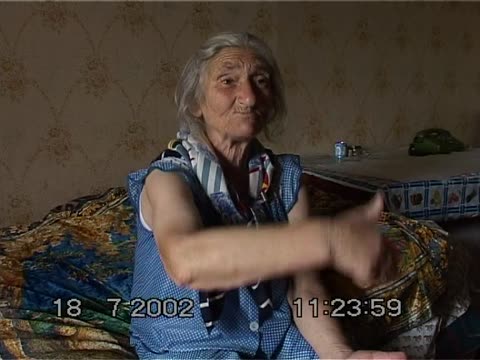
Interview
From the machine transcript
Kerler opens with the date and Kozak's address, then she gives personal details: her Yiddish name Sheyndl (Zhenya in her passport), her birth in Bershad and her maiden and married names. She names her parents, Avrom Hershkovich and Blume Shlomovna, and their birth years; her father was a furrier who worked in the villages, and her mother was a homemaker and, after the war, a baker selling bread at the market. She recalls her siblings, a Ukrainian eight-year school, evacuation to the Caucasus and Central Asia, and her return in 1944 to find strangers in their home. She then describes prewar Bershad as a Jewish town, her grandmother the midwife and her grandfather's death after a rescue in the snow, and the town's water-carrier, shoykhet and mohel. Kerler asks about weddings and klezmer musicians, a relative's wedding in Khust (?), Sabbath cholent and challah, fish dishes, latkes, Passover and Sukkot, and the old synagogue. She ends by singing two Yiddish songs, one of passionate love and elopement and one about a poor orphan boy.
The catalogue label is only 'Interview'; the transcript shows personal details, family, evacuation and return, prewar town life, weddings, food and holidays, and two sung songs.
Kozak sings a Yiddish song about a child living in poverty.
From the machine transcript
Kozak sings a Yiddish song about an orphan child in poverty who has no shoes, and the poor mother's sacrifice. Kerler then asks about Hanukkah songs and songs mixing Yiddish and Russian. Kozak says she knows songs in both languages and mentions a Russian-language song.
Kerler's questions about Hanukkah and mixed Yiddish-Russian songs
Kozak briefly speaks about her life during evacuation. She then addresses food customs, in particular shares her mother's recipe for gefilte fish.
From the machine transcript
Kozak briefly recites a bilingual rhyme (a Yiddish-Russian song) set in Odessa. She answers Kerler's questions about how a kind of pastry (varnitshkes, name uncertain) was made. She then describes her mother's gefilte fish in detail: ground fish with onions, boiled for two hours, with pepper and little sugar, not a sweet version. She also mentions holiday dishes such as horseradish, stuffed fish and kezelekh.
gefilte fish recipe and Odessa rhyme
Kozak addresses prewar cultural life in Bershad, particularly Yiddish theater performances. She then touches upon her life in evacuation during World War II.
From the machine transcript
Kozak recalls a Yiddish theater troupe from Belz (?) that visited Bershad' before the war, performing plays in the synagogue hall; she does not recall plays or songs. She then speaks of evacuation, with hardship and lack of Passover observance, and a cooking-pot story.
Kozak talks about prewar holiday celebration at home, particularly Hanukkah, Shavuot and Purim.
From the machine transcript
Answering Kerler's questions about prewar holiday customs at home, Kozak recalls Hanukkah (candles, grandmother's gelt, no memory of the dreydl), Shavuot (cheese-filled pastries) and Purim (hamentashn). Near the end she offers to show photographs.
Hanukkah gelt and Shavuot cheese pastries
Kozak speaks about prewar religious life in Bershad. She describes the local rabbi's family.
From the machine transcript
Kerler asks about prewar Bershad' and the local rabbi. Kozak names him as Yankl Lipman(?), a rabbi rather than a rebbe, with a fine beard. She says his second wife's daughter lived in Odessa, that he died around 1958, and gives her own parents' death years.
rabbi's wife and daughter, death dates
Kozak answers dialectological questions from the AHEYM Yiddish linguistic questionnaire. She also briefly addresses Passover celebrations (23:00).
From the machine transcript
Kerler works through the dialectological questionnaire with Kozak: Russian prompts to render in Yiddish (illness, bed, crying, 'good day', 'thank you', cold, gentile, peasant, vineyard), words for non-Jews, and Lithuanian Jews. She also talks about Passover dishes (kezelekh, fish with horseradish) and about separating dishes for Passover. The recording captures many uncertain items.
Passover dishes and terms for non-Jews
Kozak shows a religious artifact. She also addresses her life today.
From the machine transcript
Kozak shows Kerler a vessel from the old synagogue that she took home for safekeeping so that it would not be stolen, and discusses what it is made of and its name, 'kurt'(?). Kerler then asks the Russian terms for it (kruzhka, kvarta) and moves on to the questionnaire.
the object shown is a synagogue vessel
Kozak continues to answer dialectological questions from the AHEYM Yiddish linguistic questionnaire.
From the machine transcript
Kerler continues the questionnaire with Kozak: verbs for plastering or decorating a house, a grand house (moyer or tsimer), words for a rich man (gvir), breathing, 'came from another town', 'book', mouse/mice, groats, dove and bouillon with kneydlekh.
Kozak addresses food customs and continues to answer dialectological questions from the AHEYM Yiddish linguistic questionnaire.
From the machine transcript
Kozak briefly describes making mandlekh (soup nuts), baked in the oven and served in soup, before questionnaire items on the word for a deaf person continue.
how mandlekh were made
Kozak speaks about folk and healing customs before the war. She then continues to answer dialectological questions from the AHEYM Yiddish linguistic questionnaire.
From the machine transcript
Kozak speaks about folk and healing customs: going to a female healer, cupping glasses (bankes), and a spell against illness. Kerler asks whether she remembers an incantation (the three-women rhyme), which she does not. Questionnaire items on time and place words follow.
cupping glasses and an incantation
Kozak speaks about prewar Tisha B'Av celebrations and answers dialectological questions from the AHEYM Yiddish linguistic questionnaire. She also talks about prewar religious life and her family.
From the machine transcript
Kozak describes children throwing burrs at one another on Tisha B'Av as a game, then answers questionnaire items (face, grown together, tooth, ten). Asked about rabbi versus rebbe, she does not know, and says her grandfather was a pious man who died in 1924 (?), a story her mother used to tell.
Tisha B'Av children's game and her grandfather
Kozak addresses prewar Sabbath food customs. She then sings snippets of two Yiddish wedding songs.
From the machine transcript
Kozak says what was baked and eaten for Sabbath: challah, a good soup and tsimes, and not chopped fish. Kerler then asks for songs; Kozak and a second voice give a few lines of wedding songs (Itsik's marriage, the in-laws, a bad daughter-in-law).
wedding-song snippets with a second voice
Vygodner talks about contemporary Jewish life in the region.
From the machine transcript
Conversation among Kerler and the local hosts about the region's small towns, Jewish cemeteries and a rebbe's grave, and the many Hasidim once in Bershad. Kerler explains that the team is recording for an archive. He asks to be taken to a household where a husband and wife still live. Kerler also speaks Russian by phone to someone named Yuzik (?) Moiseevich, asking whether the visiting scholars may call on him.
Includes a Russian phone call arranging a visit and talk of Hasidim, which the catalogue sentence does not mention.
Kozak shows the team family photographs. Kozak raised two sons and was married in 1958.
From the machine transcript
Kerler and the woman look at family photographs. She identifies a son abroad (in Germany), a daughter-in-law and the children, and mentions her marriage in the late 1950s (?). They also look at a photograph from a prayer group. The hosts and the team exchange thanks.
Also includes a photograph of a minyan and a son living in Germany.
The team moves outside and continues to chat with Kozak and Vygodner. They discuss contemporary Jewish life. Kozak then talks about her family. They then discuss the contemporary local community and Kozak's life today.
From the machine transcript
The group moves toward and into the old synagogue and talks about its roofless state, the need for money to repair it, and Jewish life in town today. There is an offer of food, and talk of costs and travel to the old synagogue. A Russian aside explains that the team should only interview people who spoke Yiddish from childhood, and Kerler asks to be taken to such a person. Mostly informal talk with hosts.
Covers the synagogue's condition and a Russian aside about finding a good Yiddish speaker.
Kozak speaks about her life during World War II and describes her evacuation. She states that her family evacuated on foot for two hundred kilometers, and eventually reached Central Asia. Kozak also recalls her return to Bershad.
From the machine transcript
She recalls the start of the war: a month in town, then bombing, evacuation and a long stay of a year away, and a return to Bershad in March 1944 with no house left. Kerler asks about a dialect word for 'back' or 'returned' and whether the speakers know it.
Bershadskaya joins the conversation and provides personal information. They chat about regional geography, as well as prewar religious life.
From the machine transcript
A woman, Bershadskaya, joins the talk. They discuss where the team has been traveling from (Uman and another town), how the place names are said in Yiddish, and the fact that she speaks Yiddish and Ukrainian. She speaks of religion, the synagogue and how older people go there. There is talk of terror attacks in Tel Aviv, and the surname Bershadskaya. Kerler mentions an actress called Bershadskaya who left for Israel and a family named Kazakov who emigrated.
Covers place-name pronunciation, Tel Aviv attacks and the emigrant Kazakov family.
Bershadskaya addresses prewar Jewish life in Bershad and also talks about her family. She raised a son. She then speaks about her education and work. Bershadskaya attended a Russian secondary school and worked as teacher at a Ukrainian school. She also speaks about her life before the war.
From the machine transcript
Bershadskaya says Bershad was a purely Jewish town and that few young Jews remain. She speaks about a son of about 40 who works at a factory and knows no Yiddish. She attended a Russian school and later worked at a Ukrainian school, though she understands Yiddish from home. She also mentions living in Chernyatka.
Bershadskaya talks about her life during the war. She was imprisoned in the Bershad ghetto. Kozak and Bershadskaya remember violence and beatings in the ghetto.
From the machine transcript
Bershadskaya recalls the Bershad ghetto, where it lay, and the night killings of people accused of being partisans. She describes being bombed and thrown down while running. Kerler arranges an interview with her later. She gives her name as Elizaveta Konstantinovna, with the Yiddish name Leyke.
Includes her given names and the arrangement of an interview.