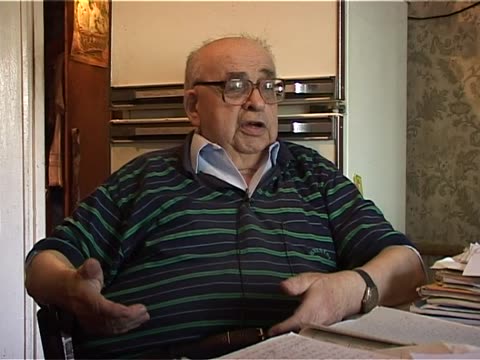
People › Motl Isaakovich Derbaremdiker › conversation

Motl Isaakovich Derbaremdiker

Kyiv or Polonne 3 May 2003 Interviewed by Dov-Ber Kerler, Jeffrey Veidlinger 2.0 h · 2 parts on 2 tapes proposed
Loading the player…
  1. MDV 508 0:00–59:49 · 60 min · not online — MCO
  2. MDV 509 0:00–58:45 · 59 min · not online — MCO
Passages
MDV 508 0:00–59:49

0:00

Continuation of retelling Peretz’s story “Three Gifts.”

From the machine transcript

Derbaremdiker finishes retelling Peretz's story of the little soul that must bring three gifts to heaven. The three gifts are a bit of blood-stained earth from a murdered Jew, a drop of blood from a Jewish girl in a German town, and a thread from a skullcap spattered with a Jew's blood in Russia. He then says he has reread the story and comments on it.

8:21

Friends at school and learning Russian.

From the machine transcript

Derbaremdiker names a Yiddish teacher, evidently from Poland, who was taken away in the 1930s, and other teachers and classmates who studied in Yiddish. He says he spoke only Yiddish as a child and knew a little Ukrainian from the market. He explains how he taught himself Russian at about fifteen by reading Pushkin aloud, and that he could soon take exams in mathematics and physics. He also notes that children from the new town were more Russified.

Adds a Yiddish teacher taken away in the 1930s and the Pushkin method of learning Russian.

12:47

Text books in Yiddish and school education.

From the machine transcript

Derbaremdiker recalls Yiddish school textbooks translated from Russian for physics, arithmetic, algebra and geometry, many printed in Berdychiv. He mentions a history textbook and says he tutored others from it. He says he still does arithmetic in Yiddish, and introduces the literary circle at the Berdychiv city library.

Adds Yiddish-language textbooks and printing in Berdychiv.

15:23

Literary circle in Berdychiv and Yiddish literature.

From the machine transcript

Derbaremdiker remembers a brother of Sholem Aleichem visiting the Berdychiv library literary circle when he was about fifteen, and the circle's leader. He talks about teaching Yiddish at an institute and a colleague who learned it. Kerler asks what Yiddish literature was taught in school, and he says Soviet-era Yiddish literature. He mentions a poem he wrote and where it was printed.

Adds Kerler's questions about the Yiddish literature taught and Derbaremdiker's pension and teaching of Yiddish.

19:56

Talking about his work and Yiddish literature.

From the machine transcript

Derbaremdiker speaks about his published folklore series and the translation work he did for the son of a Yiddish writer. He recites at length his poem dedicated to the memory of Dovid Hofshteyn, about Russian fields. He then answers Kerler's questions about Yiddish readers and discusses writers such as Peretz, Markish and Gildin, reciting lines from a poem he learned in school.

Adds the poem recitations and the discussion of Markish, Peretz and the school readers.

30:53

Public library in Berdychiv and his encounter with Solomon Mikhoels.

From the machine transcript

Derbaremdiker describes the Berdychiv city library's many Yiddish books and the world literature he first read in Yiddish translation. He recalls seeing Mikhoels in Berdychiv in 1935 and later in Leningrad on tour. S2 asks about the performance, and he talks about a Mendele character and a mixed-up language joke.

Adds the world literature read in Yiddish and the discussion of a Mendele performance.

35:51

Yiddish literature and family.

From the machine transcript

Derbaremdiker talks about Mendele and Sholem Aleichem in school and at home. He describes how his father kept a collection of Yiddish periodicals from 1912 and later newspapers, and mentions his own articles and another Yiddish teacher. He then recites two of his own poems, one about the cow and the rope, answering Kerler's questions about his father's reading.

Adds his father's Yiddish periodicals and the recitation of his own poems.

46:29

Meaning of "Derbaremdiker."

From the machine transcript

At Kerler's request Derbaremdiker talks about his family and the origin of his surname, naming his paternal great-grandfather (?) and tracing the Berdychiv Derbaremdikers back to Levi Yitskhok. He tells the legend of an official asking the rabbi his family name while he was praying, which led to the name. He also mentions relatives in the United States and a poem by an ancestor.

Adds the genealogy and legends of his surname, and that the antireligious campaign is deferred.

52:08

Prewar cultural life.

before the war Cultural life (general) MDV 508 · MCO
From the machine transcript

Derbaremdiker describes the Club of the Heretics in Kyiv, a former synagogue building, and its Yiddish library and drama circles, and recalls the Berdychiv theatre built before the revolution. He mentions klezmer musicians at weddings and prewar prayer in secret. He says that in 1933 a rabbi secretly prepared him and his brother for bar mitzvah.

Adds the Club of the Heretics, its library, and klezmer musicians at weddings, with the bar mitzvah taking place in secret.

MDV 509 0:00–58:45

0:00

Speaking Yiddish today and Yiddish in Berdychiv

From the machine transcript

Derbaremdiker explains why he speaks Berdychiv Yiddish yet tried to speak literary Yiddish after reading a lot. He says the Berdychiv dialect differed from Zhytomyr's. He mentions articles on dialects and conferences in Weinberg's collections, his work on a history of the Berdychiv Jewish community, and an article of his on Yiddish after the revolution. He and Kerler also discuss the fate of Yiddish and Hebrew in Soviet times and the Spanish forced converts.

Also covers his own writing on Berdychiv history and Soviet-era Yiddish, not only the language today.

10:46

Dialectology

From the machine transcript

Kerler puts dialectological questions on Berdychiv Yiddish to Derbaremdiker, who often answers with a literary form and recalls what was said at home. Items include greetings and the phrase 'God help', polite requests and thanks, the bat, adverbs of time and degree, 'very ill', 'beautiful', 'to run away', 'stone wall', sour, 'little', the headache, the street, mill, 'all people', numbers of people, bread, vodka, sugar sweets, praying, and 'taste'. The last part turns to rabbi/rebbe terms. Derbaremdiker also mentions a Stolin Hasid, Dov Bleich, whose children speak Yiddish.

43:38

Footage of Derbaremdiker’s apartment and concluding the interview

Footage MDV 509 · MCO
From the machine transcript

The Kyiv interview wraps up as Derbaremdiker introduces his wife, née Rabinovich, and gives his address for the archive. He mentions his brother, his correspondence with a professor, the Vilnius institute, and the plan that parts of the interviews might later go online. Kerler thanks him and takes leave.

Also covers addresses, the archive's plans and goodbyes.

46:17

Personal information and family

From the machine transcript

In Polonne, Kerler introduces the recording, giving the date and place, and asks the woman for her name and details. She gives her maiden name Goldenberg, her Russian name Frida Leizerovna, and says she was born in Polonne in 1920. Kerler starts to ask her address.

54:16

Life and education before the war

From the machine transcript

Zak says she finished ten grades at a Jewish secondary school in Polonne, with instruction in Yiddish including physics, mathematics and chemistry. She then took courses and worked in a Jewish orphanage in Letychiv. She begins telling how the war started while she was on vacation and the family fled fifteen kilometers on foot to Miropol'.

55:34

Life during the war

during the war World War II (general) MDV 509 · MCO
From the machine transcript

Zak continues her wartime account: the family caught the last train out of Miropol' and ended up in evacuation, working in a kolkhoz with little to eat. Her father died of hunger there. They returned to Polonne in 1944, where she worked in an orphanage speaking Yiddish with the children, and in 1945 she was asked to organize a children's library, where she worked until her retirement in 1988.

Questions put in this conversation

Items of the dialect questionnaire asked here; each link plays the moment.