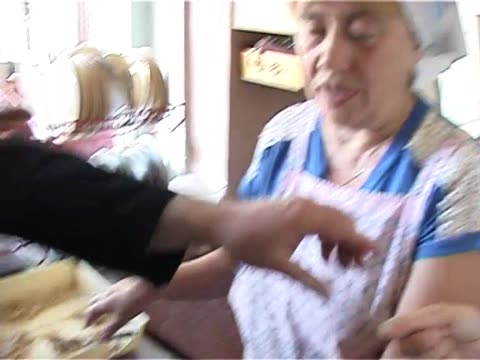
Footage of the Jewish community in Berdychiv
From the machine transcript
At the Berdychiv Jewish community there is singing by a man, followed by talk in Yiddish and Russian around the community kitchen, where food such as dumplings is made and tasted. Kerler then talks with people present, including a woman. He asks about their birth in Berdychiv, the family, a grandchild who attends a Jewish school, and whether they remember Yiddish being heard on the streets.
Town footage of Berdychiv and Jewish cemetery
From the machine transcript
Mixed, poorly recorded material at and around the Berdychiv cemetery: talk in Yiddish and Russian, a man saying he was born in Berdychiv, and a long prayer-like text delivered by Kerler. Others discuss a building damaged some years earlier, antisemitism in Ukraine, and Jews emigrating. A name and dates on a gravestone are discussed, and someone photographs. Much of the speech is garbled and the attributions are uncertain.
(Not described)
From the machine transcript
Informal chat as the interview in Vinnytsya is prepared: jokes about age and looks, the couple's marriage in 1947 (?), and Russian talk about lamps and lighting. Kerler then begins the formal start of the interview.
Setting up interview. Introduction
From the machine transcript
Kerler opens the interview with the place and date, 11 July 2002, in Vinnytsya, and asks for the official names of the couple, Lyudmila and Grigorii Shor. They talk about whether the name Shor is known in Berdychiv and Zhytomyr. An address in Vinnytsya is given in Russian.
Gives the interview's date and the couple's names and address, and mentions Berdychiv and Zhytomyr.
Kapaygerod before the war and introduction
From the machine transcript
Shor says he was born in Kopayhorod in 1925, and the couple recall that Jews outnumbered non-Jews there before the war. The Yiddish name of the town is discussed and the later district reorganisation. He studied in the Jewish school for seven grades, then in a Ukrainian school until the ninth grade. The war and occupation by the Romanians, life in the ghetto and camp, liberation in 1944 and his call-up to the army follow.
Adds the town's Yiddish name, the district reorganisation and the talk about the family names given to the archive.
Red Army
From the machine transcript
Shor describes his Red Army service, which lasted until 1971, and says he held the rank of lieutenant colonel, deputy to a regimental commander for the technical side. His wife interjects admiringly, and Kerler comments on his Yiddish.
Family and his father Yosl in 1930s
From the machine transcript
Shor names his father Yosl and mother Dobresh. His father was a ritual slaughterer who also led services, officiating as a cantor after the war in a Vinnytsya synagogue. Liudmila's father Yidl sold flour in a shop; in the 1930s the family was dispossessed and expelled from their home and moved to Verkhovka, where he learned hairdressing. Shor recalls his own mother and children being evicted in the rain and the creation of a Jewish kolkhoz.
Adds Dobresh, Liudmila's father Yidl who sold flour, and the cantor's synagogue in Vinnytsya.
Hunger
From the machine transcript
Shor says a Jewish kolkhoz called the Jewish Peasant was established in Kopayhorod. He describes the famine of 1932–33: his mother was a kolkhoz worker, grain was searched out and taken from peasants, the family became swollen, and many Jews and non-Jews died. Officials survived through special rations.
Adds the kolkhoz name and the account of death by hunger and privileges for officials.
Leye’s and Yosl’s family, Israel
From the machine transcript
Liudmila names her mother Dvoyre, who ran the household, and her brother Itsik, who died in Israel a year earlier. Shor names his siblings, a sister Hana Sore and a brother Leyb, both in Israel, with the sister in Karmiel. Their own children do not live with them, and they cannot travel because of Shor's heart attack.
Adds named siblings, their places in Israel and the couple's health and travel limits.
(Not described)
Introducing AHEYM project. Early childhood memories of Jewish Kapaygerod
From the machine transcript
Kerler explains that the recordings will go to a university archive, and the Shors are invited to begin telling about Kopayhorod. They place the houses near a river and describe a wholly Jewish town with a rabbi and several ritual slaughterers. Liudmila recalls seeing the rabbi praying as a girl and says she spoke both Yiddish and Ukrainian with her mother. Grigorii says four synagogues were reduced to two, closed in 1925 and 1926 (?), and they discuss a bakery and the street named after the synagogue.
Adds the closing of two synagogues in the mid-1920s, the rabbi, and the language with her mother.
His education
From the machine transcript
Grigorii says he began studying at age seven in the building of the former large synagogue, which had been turned into a Yiddish school. Kerler checks that it was a Yiddish Soviet school.
Synagogue architecture and service on holidays
From the machine transcript
Grigorii describes the wooden synagogue: a women's gallery upstairs, seats paid for and assigned along the walls, the central reading platform, the Torah ark and the decoration. He recalls his father taking him on holidays, and the Torah being carried and kissed. He says it was closed in 1935 or 1936 (?), and the Yiddish school building was later wrecked under the Romanian occupation.
Adds the women's gallery, seat purchase and decoration of the wooden synagogue.
During Romanian occupation
From the machine transcript
Under the Romanian occupation the former synagogue became a Romanian administrative office. Pressure began on the rabbi, the Torah scribe and the cantor to renounce religion, and it was announced in the district newspaper; those who refused were sent away. People then secretly gathered to pray.
Religious practice late 1930s and under Romanian occupation
From the machine transcript
After 1936, Jews prayed in private homes and asked that the authorities not know. Liudmila recalls her mother gathering women on holidays and reading to them in Yiddish from a prayer book, and being sent out when they wept. The couple name the Jewish holidays, then recall matzo baking in the war years, with Liudmila's mother ill, and communal baking by several families after the sale of machine matzo stopped.
Adds matzo baking and the mother's gatherings of women.
Shabbat celebration before the war
From the machine transcript
Asked about the Sabbath, they describe Friday evening: the father going to synagogue, the mother lighting candles, the welcome of the angels, and the meal with chicken soup with noodles or dumplings. They discuss sweet fish with sugar, and pepper and challah blessings.
Drinking customs and Jewish population before the war
From the machine transcript
Questions turn to drinking and wine, which Jews did not make themselves. Grigorii and Liudmila then describe the town: the poverty, the inn yard owned by their grandfather Hershl with its shops, and the smiths, tailors, shoemakers and leather workers. Several Jews were repressed in 1928, others fled, and those who remained lost their voting rights. Kerler and the couple also discuss occupational terms such as tailor, patch-tailor and leather cutter.
Adds the inn yard, Jewish blacksmiths and tailors, and the repressions of 1928 and loss of voting rights.
Life today
From the machine transcript
Liudmila says that today they speak mostly Russian with each other, because her husband served in the army after the war and the children do not speak Yiddish. She says their two children live in Israel and Germany, and Kerler wishes them good health.
Adds the children living in Israel and Germany.
Dialectology
The Shors answer dialectological questions from the AHEYM Yiddish linguistic questionnaire.
From the machine transcript
The Shors answer Kerler's questionnaire items, including words for 'sad', 'such things', 'breathe', and 'only Jews live here'. An anecdote follows about a schoolmate who stood outside the window to listen to the lessons, and a rhyming couplet in a school class is mentioned.
Includes an anecdote about a boy outside a school window.
Liudmila speaks about Yiddish chastooshkas and then sings the Yiddishs song "Yosl, Yosl, Yosl."
From the machine transcript
Kerler asks about Yiddish chastushkas, and the Shors say there were few. Liudmila sings a short rhyme about Yosl, said to be from Odessa, and says that its author is unknown.
Sets the song in Odessa, as the Shors describe it.
The Shors continue to answer dialectological questions from the AHEYM Yiddish linguistic questionnaire, as well as questions about Yiddish terminology.
From the machine transcript
The Shors answer questionnaire items such as 'pleasant', 'attic', 'potato' (including bulbe), and what Hanukkah latkes were made from. They say the latkes were made from potatoes, not buckwheat flour. They also say they have not spoken Yiddish for fifty years and rely on a dictionary. Other items include words for 'blue' and 'belly'.
Covers Hanukkah latkes and the couple's remark that they have not spoken Yiddish for fifty years.
Liudmila sings a Yiddish song about aging and bad luck, before she sings the same song in Russian.
From the machine transcript
Liudmila sings the beginning of a Yiddish song about the years passing without joy, then says she does not remember the rest. She continues with a Russian version of it and says she knows many songs her mother sang.
The Shors continue to answer dialectological questions from the AHEYM Yiddish linguistic questionnaire.
From the machine transcript
Questionnaire items continue, covering the words for 'deaf', 'groats' and 'golem'. Kerler asks about the interviewee's father as shoykhet and about the bime, and about the words 'bentshn' and 'gomel'. A last item asks for the word for a well.
Grigorii sings a Yiddish song by Itzik Feffer, he remembers from Yiddish school. He then recalls other Yiddish poets and poems and remembers how his school class performed together.
From the machine transcript
One of the Shors recalls songs sung at Yiddish school, including one about a well, and names the poets Itsik Fefer and Leyb Kvitko. They speak partly in Russian and recall class singing hours, though they are unsure of the details.
The speaker is probably INF2, not Grigorii, and the passage mentions Leyb Kvitko.
The Shors continue to answer dialectological questions from the AHEYM Yiddish linguistic questionnaire.
From the machine transcript
Questionnaire items about Hanukkah games (dreidel, Hanukkah money), and the words for 'soon', 'then' and 'rich man'. Kerler also asks what was eaten on Purim, and the answer leads into a song.
Liudmila sings a Yiddish song about Purim.
From the machine transcript
Liudmila sings a short Yiddish Purim song about a woman who goes to market to buy flour to bake hamantashn.
The Shors continue to answer dialectological questions from the AHEYM Yiddish linguistic questionnaire.
From the machine transcript
The Shors answer questionnaire items such as 'wagon', 'important', 'young man' (including 'mantsbul') and 'in-laws'. They say the word for 'in-laws' leads to a song.
Liudmila sings the well-known Yiddish song "Makhteyneste mayne."
From the machine transcript
Liudmila sings the Yiddish in-laws' song, in which a mother leaves her daughter with the family of her new husband.
The Shors continue to answer dialectological questions from the AHEYM Yiddish linguistic questionnaire.
From the machine transcript
The Shors answer questionnaire items including 'probably', 'near' (nave, nahent), floor and floorboards, 'cloth' and 'face'. They also say a few things in Russian and discuss the word for 'floor' and the swearing sense of 'tsire' (?).
Liudmila remembers a Yiddish song from her mother about a bright future.
From the machine transcript
Liudmila sings a Yiddish song she remembers from her mother, a girl's wish for a sweet life and a wedding canopy. She says she never heard it recorded and learned it only from her mother.
The Shors continue to answer dialectological questions from the AHEYM Yiddish linguistic questionnaire.
From the machine transcript
Questionnaire items on 'various', 'dinner', 'mountain', 'must', 'knock' and the word for Hanukkah latkes. Between items, Liudmila sings a short Sabbath-eve song fragment.
Liudmila sings the well-known Chanukka song "Oy Chanukkah." They then answer questions about cultural terminology. She remembers her father-in-law's work as rebbe. They also discuss prewar religious life.
From the machine transcript
Liudmila sings the Hanukkah song 'Oy Hanuke'. Kerler then asks terminology questions about words for a cross, 'litvak', the difference between rov and rebbe, hasidim and the silent prayer. The Shors say there were no hasidim in the shtetl but that people travelled to the good Jews of Bratslav and Uman, and that her husband's father was consulted by people as a rabbi (?). The passage ends with the start of a coachman's song.
Adds the rabbi-versus-rebbe question, the Litvak dialect remarks, and the Bratslav and Uman travel.
Liudmila sings a Yiddish coachman's song about traveling and women. She remembers it from her father.
From the machine transcript
Liudmila sings a Yiddish coachman's song about driving horses, a tavern, and a wife and child at home. She says her father sang it and that she heard it from no one else, and she offers to sing more songs.
Religious customs and Yiddish song
From the machine transcript
Shor recalls that her mother taught her the morning prayer and that she remembers little beyond it. At Kerler's request she sings Yiddish songs learned from her parents, including a song about a wagon driver and his horses on the road to a tavern, a lullaby-like song about life passing, and others. Kerler asks her to repeat a song so the words can be written down, and she says she wants her parents' songs passed on only to her own children.
The catalogue says religious customs and Yiddish song; the transcript shows mostly song performances, with the recall of her mother teaching her a prayer and a request not to give the songs away.
Life today
From the machine transcript
Shor talks about her activities today. She chairs the women's club, whose members meet on Saturdays to sing Yiddish and Russian songs and review the press. She has also organized a Yiddish choir that is preparing for a festival in Kyiv in October. Kerler asks about the club's address, the Hesed centre and whether he may come and photograph the group, and S3 helps with details.
The transcript shows the women's club and choir, with a Kyiv festival and Hesed, in more detail than a generic 'life today' label.
Setting up interview and photographs
From the machine transcript
A new interview begins with Poberevskii. She looks at family photographs and identifies her father Shloyme, her mother, a brother who is the youngest and a doctor, and her husband. The names of her mother and brother are unclear in the transcript. She says she lived in Stanislavchyk and is 88 years old. Kerler wishes her good health and explains to the others that the interview is for the archive's camera.
The transcript shows the start of the Poberevskii interview with her identifying family members in photographs, beyond a bare setup.
Personal information and family
From the machine transcript
Kerler records the basic data for the tape: place and date of the interview, Poberevskii's surname, her Russian first name and patronymic, her father's name Shloyme, and the beginning of a question about her address.
(Not described)
From the machine transcript
Poberevskii gives her birthplace as Stanislavchyk, a small town eight kilometers from a nearby town whose name is garbled in the transcript. Her parents came from there. Her father was the rabbi, and her mother, called the rebbetsin, did not work and had eleven children. She names several siblings, among them Bentse, Nokhum, Note and Rusya, and says some died young.
Early childhood memories of Stanislaftchik
From the machine transcript
Asked about her earliest memories of Stanislavchyk, Poberevskii says there were many children in the family. The family left in 1921 for Zhuryn and then moved on to Zhmerynka. She also mentions studying in Russia at an institute, and Kerler explains in Russian why such interviews are done.
Education in a Jewish school and institute
From the machine transcript
Poberevskii gives her birth date in July 1914 and says that Yiddish birthday greetings were brought to her by acquaintances. She finished the Jewish school in 1930 at sixteen and then worked as a typist in the court and procuracy. Her father, known as the Stanislavchyk rabbi, preached in Zhmerynka. She names an uncle Elye who was a ritual slaughterer in Moldova and later worked in a kolkhoz. She remembers Stanislavchyk as a Jewish shtetl with Jewish craftsmen and a market, where Christians worked the fields and her mother made ovens. Her father travelled to Proskurov and came back with accounts of a terrible pogrom there. She says there was no pogrom in their own town and relations with neighbours were good. The family left because her father wanted to go to Romania and sold the house cheaply, but they ended up buying a small house in Zhmerynka.
Beyond the school, the transcript shows her work as a typist, her uncle Elye the slaughterer, the Proskurov pogrom, relations with neighbours and why the family left Stanislavchyk.
Religious customs and holidays in Zhmerynka
Jewish culture
From the machine transcript
Poberevskii recalls visits to the Yiddish theatre in Moscow, naming Mikhoels and Zuskin, and discusses Mikhoels as an actor, including the role of Tevye. Asked about Yiddish writers visiting Zhmerynka, she does not remember any. She says she was a good pupil in the Jewish school, which was closed in 1937 when people were arrested. Kerler then asks how her parents kept the Sabbath.
Shabbat celebration before the war (00:38:13)
From the machine transcript
Poberevskii describes Sabbath before the war. Her mother lit the candles and went to synagogue, and on holidays and fasts as well. She says there were four or five synagogues in town, including the butchers' synagogue, the main synagogue and the beys-medresh, where women prayed upstairs. Her father died in 1937 and had given sermons in the beys-medresh. Kerler then says he will ask a few words.