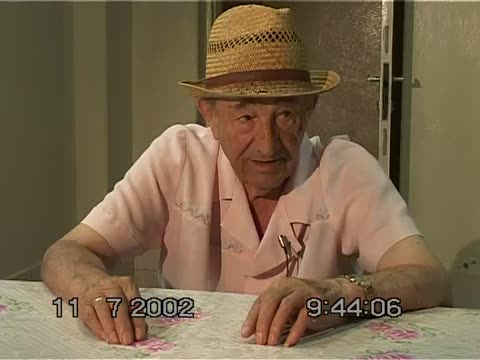
Skobilitskii provides personal information and speaks about his family. He then speaks about his life before the war, when he was drafted into the Red Army in 1939 to train as officer. He served for two years and achieved the rank of lieutenant. Instead of being demobilized, Skobilitskii explains, the was sent to the front as commander of a battalion of tanks in an artillery division. He then describes his army service during World War II.
From the machine transcript
Skobilitskii gives his Hebrew name Tsvi and his father's name, and says he was born in Berdychiv in 1919 and lived there until 1939. He was then drafted, trained as an officer and became a lieutenant. At the outbreak of the war he was sent toward Stalingrad as commander of an artillery battery with four guns drawn by horses.
Gives the Hebrew name Tsvi and the father's name, and adds the horse-drawn battery at Stalingrad.
Skobilitskii talks about his family. His mother was born in Chervone and his father was born Poland, near Warsaw. His father was a metalworker. Skobilitskii grew up with four brothers. He also addresses his family's fate during World War II.
From the machine transcript
Skobilitskii names his mother as Khane, daughter of Nakhmen, and speaks of the Kalushner rebbe in Chervone, where there was a sugar factory. His father came from Poland near Warsaw and was a metalworker. His mother did not work and there were five sons, whose names he gives; the youngest, Motele, was killed by the Germans.
Adds the sugar factory in Chervone, the brothers' names and the killing of the youngest brother.
Skobilitskii speaks about his army service for ten years. He finished ten years of schooling. Skobilitskii then speaks about his childhood, as well as education at a cheder (religious school) and Yiddish school, which he attended for four years. He explains how he studied in both schools every day. Skobilitskii then addresses his religious education and prayer customs.
From the machine transcript
Skobilitskii says he was an officer, having finished ten classes of school. He describes his early education: cheder from age eight, mornings from nine to twelve, then Yiddish school number four in the building of a rich man named Magazanik. He says what he learned in cheder, namely two chumashim and prayers, and recites some prayers from memory. Katz and Kerler ask about the chumash portions and he looks for glasses and a prayer book.
Skobilitskii talks about his cheder education. He then briefly talks about prewar religious life in Berdychiv, particularly remembering cantors visiting. According to Skobilitskii, the community collected money in order to invite a cantor from Kyiv for holiday celebrations after World War II. He then speaks about the synagogue building.
From the machine transcript
Skobilitskii names his cheder teacher as Leybl and says there were about twenty children, in the later 1920s. Every synagogue had a cheder. He recalls that cantors used to come, and that after the war the community collected money to bring a cantor from Kyiv for holidays. Katz asks what the synagogue building was called before the war, since it stood for over a hundred years.
Adds the teacher's name, the class size and the question about the building's prewar name.
Skobilitskii discusses his cheder education, before he talks about his life and work after the war. Skobilitskii was an agronomist and worked at a warehouse for thirty-five years. He was demobilized in 1949 and return to his hometown Berdychiv.
From the machine transcript
Skobilitskii says children in cheder learned to pray, and that his teacher was a good man. He then speaks of his work after the war as an agronomist, and of his demobilization in 1949 and return to Berdychiv. He worked for over thirty years at a warehouse, under several directors, and says who the best was.
The camera cuts to another scene, where Rabbi Shlomo Breuer slaughters chickens for the community.
From the machine transcript
The camera is elsewhere in the synagogue; the passage is mostly Russian and background talk among people present, with some Yiddish. The transcript does not show the slaughtering of chickens clearly. Kerler's earlier thread is not continued.
The transcript shows mainly Russian chatter and no clear slaughtering scene.
The camera returns to Skobilitskii's interview. He provides personal information.
From the machine transcript
Kerler thanks Skobilitskii and asks for his address and telephone number.
Skobilitskii addresses his schooling routine before the war. He also recalls a non-Jewish friend who spoke Yiddish with him after the war. Skobilitskii then discusses Yiddish spelling.
From the machine transcript
Skobilitskii describes his school routine: cheder from nine to twelve, then the four-class Yiddish school from twelve to three. Some non-Jewish pupils spoke Yiddish well, and one later became a director and still spoke Yiddish with him after the war. He talks about the Yiddish alphabet and spelling and recites the letters when asked. Katz and Kerler ask about the "good and bad tsadik" letter forms, and he turns to the killing of his parents and the mass grave at the airfield.
Adds the Yiddish friend who became a director, the alphabet recitation and the airfield mass grave.
Skobilitskii speaks about his family's fate and local Jewish fate during World War II. He also addresses local memorialization.
From the machine transcript
Skobilitskii speaks of the killing of Jews at the airfield, where many thousands lie buried, and says visitors to Berdychiv should go to the memorial there. His son visits it. Katz and Kerler ask him to read the memorial prayer, and he looks in the prayer book, with spelling questions along the way, before beginning to say the prayer for his mother.
Adds the memorial at the mass grave and the start of a prayer for his mother.
Skobilitskii recites the funeral prayer "El moley rachamim." He then talks about his Yiddish school education, including addressing Yiddish writers. He then remembers the well-known Yiddish song "Belz, mayn shtetele Belz."
From the machine transcript
Skobilitskii recites the prayer for the dead. Kerler returns to the Yiddish school and asks about textbooks; he names Peretz and Sholem Aleichem and recognises other writers such as Markish, Kvitko and Halkin. He remembers hearing the song about the town of Belz and some Yiddish songs, but has forgotten most of it.
Skobilitskii addresses contemporary religious life, including Sabbath celebrations. He then returns to his Yiddish school education, including subjects.
From the machine transcript
Skobilitskii speaks of the present-day yeshiva in Berdychiv, where Yiddish songs are sung, the Torah is read and Jews are invited for cholent on Sabbath. He mentions American support of five dollars a month and Kerler asks whether it is Chabad; he says it is Skvira. He then returns to the Yiddish school, where subjects such as physics, geometry and botany were taught in Yiddish. The books were destroyed by the Germans, and he still has some prewar Yiddish books.
Skobilitskii recalls prewar holiday celebrations, particularly Hanukkah and Passover. Skobilitskii recalls snippets of the Four Questions, before he returns to his school and cheder education. Skobilitskii states that he attended a cheder and a Yiddish school every day until 1928.
From the machine transcript
Skobilitskii recalls that on Hanukkah his father gave each child money, and that nuts were played with outdoors. He does not remember the song Khad gadya. Asked about the four questions, he says the children asked them at the seder while the father sat on a cushion, among four brothers, and he gives the first question. He repeats that he attended cheder until 1928 and then moved to the Yiddish school, where everything was taught in Yiddish.
Adds Hanukkah money and games and the seder with four brothers, besides the Four Questions.
Bella and Isaak speak their life today and relations to their non-Jewish neighbors. According to them, they lived in a Jewish apartment complex after the war. Isaak sells soda water on the market during the day, which he began after his retirement.
From the machine transcript
The Vaismans talk about life today in Berdychiv. They mention the few remaining Jews and the neighbours' attitude toward them. One of them sells soda water at the market, and there is talk of working despite age and poor health. Kerler comments on their names.
also covers the neighbours' attitude and Kerler's remarks on their names
Isaak provides personal information. Bella then talks about their lives after the war. She also discusses her family, as well as contemporary Jewish life. The team then concludes the formal interview with Bella and Isaak.
From the machine transcript
Isaak's name and his marriage are discussed. He recalls living in Kharkiv after the war before returning to Berdychiv. The talk turns to a grandchild or relatives who went to America, and to the lack of Jewish children and a Jewish school in Berdychiv today. The interview ends with thanks and good wishes, with a mention of the rabbi.
adds the return from Kharkiv, relatives in America and the absence of a Jewish school
Recording cuts to a prayer service at the Berdychiv synagogue.
From the machine transcript
A prayer service in the synagogue is recorded. The transcript has almost no intelligible speech there, with only music noted and a few fragments. Near the end Kerler says in Yiddish that a colleague is a professor in America and that they work together.
The camera records a formal interview with Fania and an unidentified community member.
From the machine transcript
Kerler begins an informal interview with Fania in Yiddish. She is a native of Berdychiv and speaks Yiddish at home. Her father was imprisoned under Stalin, in the 1930s (?), leaving her mother with four children. She says non-Jews, including a friend whose father was also imprisoned, spoke Yiddish before the war, and that Jews did not marry non-Jews. Her husband is an invalid.
adds Fania's Yiddish speech, her friend and mixed marriages
Fania talks about life today, as well as her family.
From the machine transcript
Fania speaks about Israel and the Arab conflict, then gives personal information. Kerler asks for her name and the names of her parents (father Hershl, mother Hinde). She was named Feyge Leye and her documents were altered.
Fania speaks about her life today, as well as her family. Her mother was born in Pidhorodne and her father was born in Berdychiv. Fania grew up with three siblings. Fania raised two daughters. She also speaks about her aunt, a Yiddish singer.
From the machine transcript
Fania talks about her husband's illness and the poor medical care he receives. She says her mother was born in a village (Pidhorodne?) and her father in Berdychiv, and that she has two children, one named Rosa. She speaks of her aunt Roze Gopiner, a Yiddish singer who performed in Berdychiv and on the radio and was killed by the Germans. Her brother Semyon went to a Jewish school but she did not.
Fania discusses holiday celebrations before the war. Her father was imprisoned, as she explains.She then turns to contemporary Jewish life.
From the machine transcript
Fania describes how her mother observed Jewish holidays such as Passover and kept to tradition. Her father was jailed as a party man. She went to the synagogue with her mother, who said such observance would die out with the older generation, and contrasts this with the young today.
adds the father's imprisonment as a party man and the mother's view that observance would die out
Jewish holidays and religious customs
From the machine transcript
The interview with Fania is wrapped up. Talk about being photographed and filmed and greetings follow.
the transcript shows closing chat and greetings rather than holiday talk
After the team concludes the formal interview with Fania, they chat with other community members.
From the machine transcript
The team chats with other people in the courtyard. Fania says she has already been interviewed. People talk about the rabbi and kosher food. Some Russian is heard, and Kerler introduces himself as coming from Israel or America. Kerler asks about the Yiddish for 'thank you' and the speakers' family names.
Discussions outside the synagogue. Family information
The team meets Skobilitskii and chats with him informally. He provides personal information and talks about his family. Skobilitskii raised a son and his grandchild lives in Israel.
From the machine transcript
Kerler meets Skobilitskii and chats with him informally. Skobilitskii says he is 83 and was born in Berdychiv. His father was born near Warsaw and his mother in Berdychiv. His son is an architect, and a grandchild lives in Israel. He attended cheder as a child.
adds father's birthplace near Warsaw and the cheder
Skobilitskii speaks about his education before the war. He also addresses prewar Jewish life in Berdychiv, before talking about his career in the Red Army during World War II. His division went all the way to Berlin.
From the machine transcript
Skobilitskii speaks about his schooling before the war, including Polish and Russian schools. He then describes serving as an officer from 1939 for ten years, the whole war, from Stalingrad to Berlin. He was an artillery battery commander whose division helped liberate Berlin, Austria, Hungary and Czechoslovakia. He gives his surname for the record.
adds schooling, battery command and the liberated countries
Skobilitskii discusses his family and childhood.
From the machine transcript
Skobilitskii recalls that his parents spoke Hebrew (the holy tongue) so the children would not understand, and that he spoke it with his mother. The group then moves to sit down. He mentions a book of Yiddish stories by Berdychiv Jews that can be bought.
The formal interview with Skobilitskii begins. Skobilitskii mentions a book about Jews of Berdychiv, which includes an article about him. He then mentions Yiddish writers.
From the machine transcript
The formal interview begins. Skobilitskii mentions a Russian-language book on the Jews of Berdychiv that includes an article about him. They discuss where to buy it. He names Yiddish writers he has read (Sholem Aleichem, Mendele, Peretz and others). Sholem Aleichem is his favourite, and he talks about Mendele's character Motl. He reads Israeli newspapers in Russian.
adds the named Yiddish writers and his reading of Israeli papers
Skobilitskii speaks about his army service, as well as his family. In particular, he talks about his mother's observance and prewar religious life. Skobilitskii's maternal grandfather was a rabbi.
From the machine transcript
Skobilitskii says he can read and write Yiddish and wrote to his mother in Yiddish from the army. His mother Khane was the prayer leader (zogerin) in the women's synagogue of Berdychiv, where women repeated after her. She was a rabbi's daughter and had studied in a women's yeshiva. His maternal grandfather was a rabbi in Chudniv (?). Only Yiddish was spoken at home. He says there were twenty synagogues in Berdychiv.
Skobilitskii discusses his childhood, including education. He recalls non-Jewish students studying at a Yiddish school. He then provides personal information.
From the machine transcript
Skobilitskii recalls attending a Yiddish school where eight to ten Russian pupils also studied, and that Yiddish was spoken better than Russian. Kerler gives the date as 11 July 2002 and the place as Berdychiv and begins recording personal details. Skobilitskii gives his Russian surname and says his Yiddish name is Khayim.
adds the date Kerler states and his Yiddish name
Skobilitskii continues to speak about his childhood, including the local school system. He recalls how he attended synagouge with his father on Sabbath.
From the machine transcript
Skobilitskii says that the cheder was not closed. On Sabbath he went to synagogue with his father, since Sabbath was a day off from the Yiddish school and Sunday was a school day. He and Kerler discuss the schools in Berdychiv: thirteen in all, eight of them Yiddish, plus Polish, Ukrainian and Russian ones. Exams and certificates were in Russian. Kerler then announces some word questions.
The catalogue entry does not mention the count and types of Berdychiv schools or the Sunday schooling.
Skobilitskii answers dialectological questions from the AHEYM Yiddish linguistic questionnaire.
From the machine transcript
Skobilitskii answers Kerler's questionnaire items, including words for a head or tumour and for a Jewish versus non-Jewish cemetery, and an illness name he links to Bila Tserkva. Katz and Kerler then ask him to recite from the prayer book. He recalls that in cheder they washed their hands and said Modeh ani.
The transcript shows the word questions, the cemetery terms, and the request to recite prayers.
Skobilitskii briefly addresses his religious school education, before he recites the morning prayer "Modeh ani," as well as other prayers and blessings.
From the machine transcript
Skobilitskii recites Modeh ani and other morning prayers and blessings, including the blessing over tefillin. Katz and Kerler ask for Aleinu and other prayers, but he declines and says that is enough. The recitation is garbled in the transcript.
Skobilitskii addresses prewar holiday celebration at home, particularly Sabbath preparations.
From the machine transcript
Skobilitskii describes preparing for Sabbath at his parents' home. His mother lit the candles and put the cholent in the oven, sealing it with clay. She baked large round loaves herself, and there was white Sabbath bread (challah) alongside the dark weekday bread. He mentions that bread was also sold in shops.
Skobilitskii recites the prayer "Aleinu leshabei'ach," which is recited at the end of each prayer service. He then continues to answer dialectological questions from the AHEYM Yiddish linguistic questionnaire, as well as recalls terms in "loshn-koydesh" (mix of Hebrew and Aramaic).
From the machine transcript
Skobilitskii answers questionnaire items on words for 'to make', street, washing and a ball. He explains words in loshn-koydesh that his parents used so the children would not understand, such as one for apples, for a watchman and for a non-Jewish woman. Kerler asks for the Yiddish for the cup of Elijah and for the afikoymen, and mentions a break.
The Aleinu recitation is not clearly heard here; the transcript shows the loshn-koydesh terms and the Passover questions.
Skobilitskii speaks about his Red Army career and fighting at the front. He also mentions fellow Jews in his artillery division, as well as his injuries and military awards. He explains how he advanced from the Stalingrad front, through Bryansk, Sandomierz, Austria, Hungary, Germany, all the way to Berlin. After he helped to liberate Berlin, he became the senior lieutenant of the German town Tiefenbach. Skobilitskii continues that he was in charge for two years and his wife joined him there.
From the machine transcript
Skobilitskii recounts his ten years of army service. He finished an artillery officers' school, fought at Stalingrad, and was wounded in 1942, spending two months in hospital in Saratov. He went back to his division and entered Bryansk, where he received decorations. His route took him through Sandomierz, Austria, Hungary and Germany to Berlin. He then served as commandant of a town named Tiefenbach (?) on the Austrian border, where his wife joined him for two years. He mentions Jewish colleagues in the unit.
The transcript specifies the route and the commandant post, and notes the wound in 1942 and the hospital stay.
Skobilitskii speaks about his family, before returning to his army duties in the artillery division.
From the machine transcript
Skobilitskii says his wife Rive, born in Berdychiv, died in Germany at 54 and is buried in Berdychiv, where he made her a large monument paid for by their son. He then describes his artillery duties: calculating fire, using a map and compass, and correcting aim. Kerler asks about a Russian word for a compass, and then starts further word questions.
The transcript names the wife and her monument, and covers the artillery work.
Skobilitskii answers dialectological questions from the AHEYM Yiddish linguistic questionnaire. He also speaks about his family, including his relatives' occupations (21:00).
From the machine transcript
Skobilitskii answers many questionnaire items: words for a Jewish street, 'to count', pulse, to knock, to ask or request, and a board. He tells of his mother's brother, a cantor in a Moscow synagogue, and of his grandfather Nakhmen, a rabbi with eight children, including his mother Khane and her siblings. The grandfather's family kept shops and sold goods in villages. Katz notes words he recalls from Skobilitskii's mother.
The transcript shows the grandfather rabbi's eight children and their names, and a cantor uncle in Moscow.
Skobilitskii shows a book by Viktor Korzhuk who writes about Skobilitskii's military service. He then continues to answer dialectological questions from the AHEYM Yiddish linguistic questionnaire.
From the machine transcript
Skobilitskii shows a book by a writer (the catalogue names Korzhuk) that mentions him as a battery commander. He also says that he bought copies and sent them abroad. Kerler and Katz then return to questionnaire items, such as words for a child's loud crying and for a non-Jew who converts to Judaism, as well as 'a good name'.
Skobilitskii discusses prewar Jewish life in Berdychiv, as well as answers questions about cultural terminology and linguistic questions.
From the machine transcript
Skobilitskii says that small children in cheder were not taught tales of the Baal Shem. He discusses the shrine built over the site connected with the tsadik Levi Yitskhok of Berdychiv, with Katz and Kerler asking what it was called. They discuss words for a pious grave-site building and for 'going to the tsadik', and continue the questionnaire with items such as ears, book, mouse, luck, and pigeon.
The transcript shows the discussion of the tsadik Levi Yitskhok's site and its name.
Skobilitskii briefly speaks about Yiddish literature, before he answers dialectological questions from the AHEYM Yiddish linguistic questionnaire.
From the machine transcript
Skobilitskii mentions a book by Y. L. Peretz that ought to be in the synagogue, then answers Kerler's questionnaire questions with the second voice joining in. The items include the word for a deaf person, the name for the one who recites the closing blessing, a Torah reader, and the blessing said after recovering from illness or danger, with a story about a man who escaped a machine; the word for galoshes is also asked.
The catalogue mentions only literature and questions; the transcript also shows talk of the synagogue and the thanksgiving blessing.
Skobilitskii discusses his childhood memories and remembers how his maternal grandfather practiced kosher slaughter. He then answers questions about cultural terminology and linguistic questions.
From the machine transcript
Skobilitskii recalls his maternal grandfather's slaughtering knife, apparently used for slaughtering. He then answers questions about the Hanukkah top and what it was called, the word for a fool, colour words such as grey and sallow, and adverbs such as "quickly" and "then", with the second voice commenting. Toward the end he returns to a Yiddish book and to the writers Peretz and Sholem Aleichem.
The transcript also shows the closing talk about Peretz and Sholem Aleichem.
Skobilitskii discusses Yiddish literature, before continues to answer dialectological questions from the AHEYM Yiddish linguistic questionnaire.
From the machine transcript
Skobilitskii talks about a Yiddish literary work, apparently Sholem Aleichem's story "Motl Peysi the Cantor's Son", which he describes as an allegory narrated by a child. Kerler then continues the questionnaire: wagon and wagons, a ship's cargo, "each thing", the word for "near", cotton wool and padded garments, and "probably".
The transcript shows the literature discussion as a story summary and a long run of word-by-word items.
Skobilitskii addresses prewar cultural life, including theater performances, in Berdychiv. He then speaks about cultural life after the war. Skobilitskii explains how the community collected money to hire an opera singer from Kyiv to perform after synagogue services.
From the machine transcript
Asked about Yiddish actors and plays in Berdychiv, Skobilitskii recalls good artists, and says that Yiddish troupes came after the war but he does not remember before the war; he names Zuskin and talks of Mikhoels. He says plays were staged by the community in the synagogue before the war. He tells how after the war the Jews collected money to bring an opera singer from Kyiv to sing Yiddish songs after services, and Kerler asks about singers such as Epelbaum and Zinovii Shulman.
The transcript also shows Zuskin and Mikhoels and a possible synagogue-based amateur play before the war.
Skobilitskii continues to answer dialectological questions from the AHEYM Yiddish linguistic questionnaire.
From the machine transcript
Skobilitskii answers more questionnaire items from Kerler, with the second voice contributing: ceiling, floor and a clay floor, how his mother's and father's speech differed, and how the town name Berdychiv was pronounced by old Jews. Further items are "put away", "back", "suddenly" and an expression for someone not thinking clearly. At the end the talk turns to the books the team bought and some thanks.
The team then visits the town market in Berdychiv with Rabbi Shlomo Breuer in order to film Isaak Iosipovich Vaisman selling seltzer water. They also discuss the contemporary community.
From the machine transcript
The team goes to the town market to film a man selling seltzer water. The transcript is largely garbled; the speakers, including Kerler, converse with those at the stall and an elderly community member, with a few words about the water and its syrup.
The transcript is too garbled to confirm the rabbi or what is said of the community.
The camera switches to the next scene, which takes place at the soup kitchen of the Jewish community center. The team chats with members.
From the machine transcript
In the soup kitchen of the community center, the team talks with members and staff. The talk touches on the blessing said after meals and a Russian-language text for the blessing before eating, on the community's office, and on a doctor who visits on Sundays for the old people.