People › Efim Grigoryevich Skobilitskii › conversation

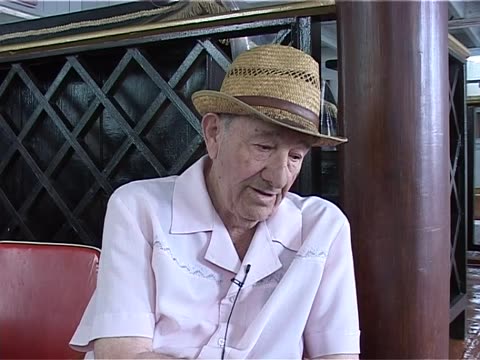
Efim Grigoryevich Skobilitskii

Berdychiv 22 May 2003 Interviewed by Dov-Ber Kerler, Dovid Katz, Moisei Lemster 2.0 h · 2 parts on 2 tapes proposed
Loading the player…
  1. MDV 347 0:00–59:12 · 59 min · not online — MCO
  2. MDV 793 0:00–58:59 · 59 min · not online — MCO
Passages
MDV 347 0:00–59:12

0:00

Family

From the machine transcript

Skobilitskii gives details on his family: his father came from near Warsaw and was a rabbi in a village near Andrushivka in the Zhytomyr region. The names of his paternal grandparents, his mother and his brothers are given, and one brother was killed by the Germans. Kerler also briefly arranges a further interview in town.

Also covers a brief arrangement for another interview with someone at the town centre.

3:29

Work and education before the war

From the machine transcript

Skobilitskii says he studied before the war but worked in a museum, writing picture captions in Yiddish and Russian, and also retouched glass photographic plates. He attended cheder for about three and a half years and then Yiddish school no. 9, on a street now named after Sverdlov, formerly Makhlevka (?). He begins to speak of anti-religious agitation at factories.

5:46

Anti-religious activities and Jewish cultural life

From the machine transcript

Skobilitskii recalls anti-religious propaganda that called religion an opiate, and that school subjects were taught in Yiddish. He remembers mocking plays about Jews staged at school, with Yiddish songs. He also mentions a Jewish theatre troupe that performed Sholem Aleichem, cantors in the Koch shul, and the Jewish owner of the fire brigade with white horses.

Also covers Yiddish theatre, cantors in the Koch shul and the Jewish-owned fire brigade.

9:26

Yiddish newspapers

From the machine transcript

Skobilitskii names the Yiddish newspapers and magazines read in Berdychiv in his youth, including papers from Birobidzhan. He says a photo and a story of his war service were printed in one. He mentions a booklet of Berdychiv stories that contains an article of his and refers to him as a battery commander.

10:54

Hasidism in Berdychiv before the war

before the war Hasidism and rebbes MDV 347 · MCO
From the machine transcript

Skobilitskii explains what Hasidim were and how they differed from ordinary people. He says that Hasidim travelled to a rebbe and that a Hasidic rebbe was called 'a good Jew'. He talks about the grave of Levi Yitskhak, which before was only a mound of earth with a brick border and no monument, and about money for its rebuilding.

12:07

Religious life today

From the machine transcript

Skobilitskii describes his part in the rebuilding of the tsadik's site, a small wall. At a factory, he used a bucket and wooden sticks to hammer out the letters on the fence. He then says he liked physics and history best in the Yiddish school.

13:19

Jewish secular school and dialectology

From the machine transcript

Skobilitskii says that good teachers of physics and history helped him become an artilleryman, and is asked the Yiddish word for north, east and so on. There are elicitation items such as 'a good place' for a grave, a Galitsianer and a Litvak, and the word misnaged. He then recalls Jewish weddings with a badkhn.

The catalogue entry mentions a secular school, but the passage also covers the army, word-list items and the badkhn at weddings.

17:12

Dialectology

From the machine transcript

Questionnaire on Yiddish words and expressions: golem, 'a clay goat', phrases about the dead praying for the living, greetings and good-day phrases, thanks, mouse, luck and schlemazl, book, house, window pane, colours, and words for building and living. At the end Kerler asks about the yeshiva in Berdychiv.

24:00

Dialectology and prewar Jewish life

From the machine transcript

A long dialectological word-list: stones, ear, cold, high, late, near, sleep and sick, and the difference between 'honest' and 'religious'. There are discussions of Belaya Tserkov in Yiddish, converts, mixed marriages and Yiddish expressions for 'I ask', 'young' and 'right'. Other items include the midwife, 'to pray', the word for a shop and its wares, potatoes and flowers, and sentence-translation items. Berdychiv usage is compared with Litvak usage, and a Haifa anecdote is mentioned. The passage includes a few Russian prompts.

Besides dialect items, the passage touches converts to Judaism, mixed marriages and a Haifa anecdote.

46:45

Town footage and chat at a restaurant

FootageInformal MDV 347 · MCO
From the machine transcript

The team is in the van, with a Russian remark that there were eight Jewish schools in town before the war and a comment that the town was largely Jewish. Skobilitskii speaks about the old synagogue and the school building no. 9. The passage then turns to the difference between 'honest' and 'pious' in Yiddish and an anecdote about being asked about his beard. Someone says he is a professor of Yiddish, and then a speaker begins to tell of a family wedding.

49:22

Jewish wedding in Hungarian town Pápa in 1948. Red Army service

after the warduring the war Marriage and weddingsArmy service MDV 347 · MCO
From the machine transcript

A speaker recalls a Jewish wedding in a Hungarian town, Pápa, in 1948. The speaker's mother had been there, and Hungarian and Hebrew were spoken. The passage mentions a stay in Austria in Tiefenbach (?), where Jews who spoke Yiddish lived. It ends with Jewish dishes such as gefilte fish from carp. It is unclear whether the speaker is Skobilitskii or an interviewer.

The catalogue speaks of Red Army service, but the transcript shows a wedding in Hungary and Jews in Austria.

51:51

Food customs

From the machine transcript

A conversation about making gefilte fish just as mothers did: sugar, salt, oil, pepper, and sweetener tablets instead of sugar.

54:17

Town footage

Footage MDV 347 · MCO
From the machine transcript

Tour of Berdychiv by van with Skobilitskii: Makhlevka (now Sverdlov street), signs in English and Hebrew, a hotel building bought by Menlovich (?) for visitors from America, Chabad and its relations with the Skver rebbe, a monastery, and the ghetto monument. Jewish houses and the Lubavitch house are pointed out, and the group says it will return to see the synagogue of Feygele Magazanik (?).

MDV 793 0:00–58:59

0:00

Jewish Berdychiv before the war.

before the war Local Jewish history MDV 793 · MCO
From the machine transcript

Skobilitskii points out the house of a wealthy local businessman (named something like Magazanik, uncertain). He ran a large farm with cattle, sent dairy products to Zhytomyr and Kyiv, and owned a leather factory that exported to Czechoslovakia. Many Jews lived in his buildings and worked for him. Skobilitskii also mentions a four-year Jewish school after the revolution, an old ornate door, and a visitor from Canada who no longer knew Yiddish.

4:59

Town footage of Berdychiv.

Footage MDV 793 · MCO
From the machine transcript

Camera and walking footage of Berdychiv streets. The guide points out the synagogue, a children's polyclinic, and an old journalists' building, and the group finds a gate closed and rings to be let in. They then reach a newly built yeshiva complex, where a mikveh is being built. Its funding is attributed to a rich man living in America, named something like Mendelevich (unclear). Much of the speech is garbled.

8:57

Yeshiva of Berdychiv.

Tour life today Religious education MDV 793 · MCO
From the machine transcript

The team enters the Berdychiv yeshiva building and sees the prayer room, a Torah scroll and the dining hall. They briefly speak with students, who say they study mostly in Russian with Russian translation and that Yiddish plays only a small role. Kerler remarks on the former building being bought and taken away, and on the 'great miracles' of Jewish children studying there again.

12:08

Jewish Soviet war memorial.

From the machine transcript

At the mass-grave site and memorial near the old airfield, Russian voices say where Jews were shot and where the pits and the obelisk are. Skobilitskii recites Kaddish and discusses how many Jews were killed in the area. The figure is heard as roughly eighteen thousand six hundred (uncertain). Most of the Yiddish here is garbled.

17:06

Town footage of Berdychiv.

Footage MDV 793 · MCO
From the machine transcript

Skobilitskii shows the house on Kachenivka street where he lived and his younger brothers were born. It belonged to a rich man whose family name sounds like Krupnik (?), and tenants paid him rent. He remembers sledding in winter, and describes the large synagogue that stood nearby, with a mikveh and bath fed by the river. He mentions friends from Berdychiv now in Haifa and Netanya, the mostly Jewish surroundings, and walking to synagogue on Shabbat.

24:08

The team concludes the interview with Skobilitskii.

From the machine transcript

The Berdychiv visit ends with farewells. Skobilitskii points out his third-floor flat. The talk turns to Ruzhyn (Ruzhene) and Jews still living there, and to a plan to visit again, including his grandfather Nachman, a rabbi. Both sides express thanks and good wishes.

25:18

Dovid Katz joins the team.

Informal MDV 793 · MCO
From the machine transcript

Katz joins the team in Zhytomyr and says he arrived there that day. He greets people, including the chief rabbi of Zhytomyr.

25:48

Jewish life in Zhytomyr today.

From the machine transcript

Geller, in the Zhytomyr synagogue, says he comes from Pyatka, a small town between Berdychiv and Chudniv. He talks about the Zhytomyr rabbi and his Russian, about Jews living in Zhytomyr as if in exile, and about the lack of proper Jewish burial for a 93-year-old man. He also describes young visitors who know no Yiddish, a dictionary he gave one, and who in Zhytomyr still speaks Yiddish. The rabbi's trip to Polonne, where a wall for a tsadik was built from gravestones, leads to a note on a Pyatka word for a small wall.

Adds Pyatka's location, burial difficulties, and the rabbi's trip to Polonne.

35:12

Childhood in Piotke [needs verification] and Jewish lore.

From the machine transcript

Geller says he left Pyatka in 1936 and that his father worked in the fields. He recalls the Yiddish heard in Vinnytsia region and Zhytomyr, then tells a folk tale about a matchmaker, three daughters and a suitor made to chop wood, which he performs in a rhyming refrain. He did not attend cheder. The Yiddish school became a Ukrainian one with the same director, Frenkl, and he learned a little from his older brother. He also mentions grandfathers killed in earlier violence (details unclear).

Adds a folk tale about a matchmaker and three daughters, and his schooling.

41:50

Personal information and family.

From the machine transcript

Geller gives his Yiddish name as Binyomin, nicknamed Mime, and says he is nearing eighty. His father Yankl was a glazier until 1932, and his mother and her family's names are discussed, including a grandmother Etshi and another named Mintsi. His parents had no child for ten years until the rebbe promised one, and his mother lived to 93. A relative of his grandmother had 23 children. His mother was taught by a tutor, studied two gymnasium classes, and loved Pushkin and Tolstoy.

46:02

Early childhood memories from Piotke.

From the machine transcript

Geller describes childhood games in Pyatka, mainly the spinning top (tsurke) marked with letters and scored by the steps taken, and rolling a hoop. He also recalls a cyclist from Petersburg in 1929 whom the children chased. He compares this with today's children and telephones and television. Kerler asks for local Yiddish words for the games.

Adds the cyclist from Petersburg and comparison with today's children.

51:15

Jewish life and architecture in Piotke before and during the war.

before the warduring the war Local Jewish historyWorld War II (general) MDV 793 · MCO
From the machine transcript

Geller describes the prayer houses of Pyatka: a shul, a beys-medresh and a kloyz. He explains the differences when Katz asks, saying the kloyz was small and used for a minyan. In 1941, 169 people were gathered from the kloyz and driven to the river and killed. The beys-medresh was closed around 1931–32, was used as a carpentry shop, and was then burned, with a local man named Itsik the Krimer blamed. The shul stood until the war, and a wooden building from it was taken to Berdychiv.

Adds Katz's question on shul, beys-medresh and kloyz, and the burning of the beys-medresh.

56:18

Celebration of holidays in Piotke.

From the machine transcript

Geller recalls Sabbath in Pyatka. He discusses terms for tidying up and for taking the candles off the table, and a child's memory of carrying his grandfather's tallit and a neighbour's request on Shabbat. He also tells an anecdote about forgetfulness after a wedding held in a restaurant. Kerler asks about local words for these things.

Adds the Sabbath anecdotes, the Yiddish word questions, and a wedding anecdote.

Questions put in this conversation

Items of the dialect questionnaire asked here; each link plays the moment.