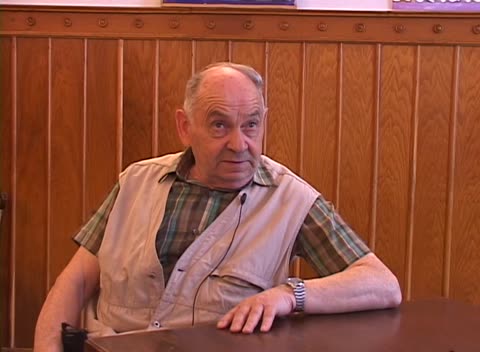
The team chats with community members.
From the machine transcript
Opening chat among the team and people present in the room, partly about speaking Yiddish and about an American organization; the speech is fragmentary and the date of the recording is stated at the end.
Gives talk about Yiddish speaking and America, and the date, rather than just chat.
The formal interview with Resh begins. He provides personal information and speaks about his family. Resh's father was born in Rădăuţi and worked as accountant in the Chernivtsi town hall. His mother was born in Pshevorsk, Poland. Resh grew up with two sisters and two brothers. Three of his siblings moved to Israel after the war. Resh's older brother lives in America.
From the machine transcript
The formal interview begins with Lemster introducing the expedition in Iași. Resh gives his Jewish name and birth year 1924, and speaks about his parents: his father, from Rădăuți (the transcript says Radovets, Bukovina), was a bookkeeper at the Chernivtsi town hall and secretary of the Maccabi football team, and his mother was born in Przeworsk, Galicia. He names his grandparents, his siblings, and relatives in Israel and America.
Adds the father's bookkeeper work and Maccabi role and names several siblings and grandparents.
Resh speaks about his life after the war. He was drafted into the Red Army during the war and was demobilized in 1946. Resh explains that he left the Soviet Union and immigrated with his family to Iaşi after his military service. After the war, Resh worked in the local meat industry for thirty-nine years as director.
From the machine transcript
Resh speaks about his life after the war. He served about one and a half years in the Soviet army, then emigrated with his family to Iași. He worked thirty-nine years as director in the Iași meat industry and retired in 1986 (?).
Resh discusses his childhood memories, including games, and education. He attended a Romanian school. He also addresses prewar life in Chernivtsi and remembers how a private tutor would come to his house to educate him in religious matters. Resh then studied at a religious school (cheder) for one year.
From the machine transcript
Resh recalls his childhood in Chernivtsi: Romanian-language schooling, the ethnic makeup of the town, and the Soviet arrival, which ended his schooling. He says he went to a Jewish cheder for about a year after a private tutor had come to the house, and describes children's games (nuts, buttons, football) and the town's many languages. He also mentions deportation to Transnistria.
Adds the town's ethnic composition and multilingualism.
Resh speaks about prewar holiday celebrations at home, as well as his parents. He also addresses food customs and shares his recipe for gefilte fish.
From the machine transcript
Resh describes prewar holidays in his parents' home: a kosher household with pork not allowed inside, his father blowing the shofar and going to synagogue on holidays, his pious mother and her candle-blessing. He explains Sabbath food, including cholent kept warm, and gives the recipe for Jewish gefilte fish, which he still makes himself, as well as how his mother salted meat.
Adds Sabbath candles, kosher home and salting of meat.
Resh talks about prewar Purim celebrations and good relations between Jews and non-Jews.
From the machine transcript
Resh talks about Purim in his childhood and the good relations with non-Jewish neighbors before the war, who visited at Purim while Jews visited them at their holidays. He says there was no antisemitism in Chernivtsi, describes masking and singing at neighbors, and Simchat Torah processions with flags in the synagogue. Lemster asks about Purim songs and a purim-shpil, which Resh does not recall, and then about Yiddish theater.
Adds Simchat Torah customs and the absence of a purim-shpil.
Resh speaks about prewar cultural life, in particular Yiddish theater performances. He then addresses Sukkot, Shavuot and Hanukkah celebrations and food customs before the war. Resh got married at the age of 37.
From the machine transcript
Resh names actors of the Yiddish theater in Chernivtsi and retells a humorous anecdote about a rich man's invitation. Asked by Lemster about holidays, he speaks about the sukkah, dairy dishes at Shavuot, and potato dishes in Hanukkah and in general in Bukovina. He says he married late, at 37.
Adds Yiddish actors and an anecdote, and Hanukkah and Shavuot food.
Resh talks about his life during World War II. He was confined to the Mohyliv-Podilskyy (Yiddish: Mohlev Podolsk) ghetto. He then speaks about his life and work after the war, before addressing postwar Jewish life in Iaşi. In particular, Resh describes his oldest sister's difficult journey to Palestine in 1948.
From the machine transcript
Resh says he was in Transnistria (near Mohyliv) during the war and then was drafted into the Soviet army; after demobilization in 1946 he returned home to Chernivtsi and the family left for Romania. He worked in the Iași meat industry as director for thirty-nine years (?). He speaks about Jewish Iași, its large prewar Jewish population and the 1941 pogrom, emigration to Israel after 1947, and his oldest sister's attempt to reach Palestine in 1948 when the British stopped her ship and she swam for hours.
Adds the Iași pogrom, emigration after 1947 and the sister's sea journey.
Resh lists prewar Jewish organizations in Chernivtsi, including Maccabi, Borochov and Hasmonea. He then speaks about prewar life and holiday celebration. Resh recalls non-Jews who spoke Yiddish.
From the machine transcript
Answering Lemster, Resh lists Jewish organizations in Chernivtsi (Maccabi, Borochov, Hasmonea, student and Zionist groups), but says he was too young to know writers. He speaks about children's games and about non-Jewish children who spoke Yiddish, the rarity of conversion, and good relations. He is asked about a Jewish fire brigade; the passage ends with his mention of the ghetto.
Resh speaks about Jewish life in Chernivtsi during the war. He was confined to the Chernivtsi ghetto, before his deportation to Transnistria. Resh then speaks about the local sports organization Maccabi, where his father was actively involved as referee and general secretary of the club. Resh also lists the soccer clubs of other ethnic minorities.
From the machine transcript
Resh says that all Jews of Chernivtsi were in the ghetto, where he stayed two months before deportation to Transnistria. He then describes Maccabi's sports sections and the football teams of the other nationalities in Chernivtsi, naming the German, Romanian, Polish and Ukrainian clubs, and says his father was referee and general secretary of the Maccabi team and his brother-in-law also played for it.
Adds the football clubs of other ethnic groups and the father's referee role.
Resh speaks about prewar press and cultural life. He then addresses prewar religious life and answers questions about cultural terminology.
From the machine transcript
Resh answers questions about prewar Jewish culture in Chernivtsi: he recalls German but not Yiddish newspapers, mentions a Jewish theater, libraries, hospital and the Jewish street, and says there were no Yiddish or Hebrew books at home. He says there were Hasidim and many synagogues, and mentions Rabbi Marcus, shot by the Germans in 1941. Lemster then asks about terms such as a good place and a good Jew; Resh defines a good Jew as one who helps others.
Adds the rabbi's fate and the terminology questions.
Resh speaks about Jewish life before the war and recalls Polish refugees to Chernivtsi in 1939. He then addresses different regional Yiddish dialects and his family.
From the machine transcript
Resh recalls Polish Jewish refugees who arrived in Chernivtsi in 1939, including a lodger in his family's home. In answer to Lemster's questions he discusses the terms Litvak and Galitsianer, the Austrian background of Bukovina and Galicia, and the dialects of Yiddish in Romania, saying that the children and grandchildren in Israel no longer speak mame-loshn.
Adds the Litvak/Galitsianer terms and the language of the younger generation.
Resh speaks about traditional weddings and recalls klezmer musicians and Yiddish songs.
From the machine transcript
Resh answers Lemster's questions about weddings: the chuppah, matchmakers and klezmer musicians, which he knows from his childhood, and says he did not know a badkhn. He recites a few lines of a Yiddish song and recalls his mother's lullaby, but says he can hardly remember them.
Resh speaks about food and drinking customs, including falshe fish (false fish).
From the machine transcript
Resh and Lemster talk about Jewish food and its terms: falshe fish made from meat, potato latkes, mamaliga from cornmeal, kugel, lekekh, flodn with raisins and sweets for Purim, beans with tsimes, Jewish sausages and pastrami, and the names of plums and cucumbers. He says he is no specialist in baking, and kvass was not known in his home.
Resh talks about folk and healing customs, particularly for averting the evil.
From the machine transcript
Resh answers Lemster's questions about folk healing and customs for the evil eye. He describes older Jewish women who quenched coals and uttered spells over a sick child, natural remedies, compresses, cupping and bloodletting, and says that families usually had one general doctor, with many Jewish doctors and professionals in Chernivtsi.
Resh addresses prewar occupational structure among Chernivtsi Jews. According to him, there was a high number of administrators and merchants. Resh then answers questions about cultural terminology.
From the machine transcript
Resh addresses the occupational structure of Chernivtsi Jews: many were officials, merchants and craftsmen (tailors, watchmakers, carpenters), but fewer intellectuals than in Iași. He then answers questions on terms such as gvir, dybbuk, mamzer, golem, and the words used at a cemetery, which he mostly does not know.
Adds the cultural terminology (gvir, dybbuk, golem, cemetery).
Resh recalls Yiddish proverbs and answers dialectological questions from the AHEYM Yiddish linguistic questionnaire. Resh raised one daughter.
From the machine transcript
Resh recalls a Yiddish saying, and a woman says she has one daughter. Lemster then puts the AHEYM questionnaire in Yiddish: greetings, request and thanks formulas, 'mazl tov', words for house, room, apartment, colors and adjectives, pickled cucumbers, body words, short sentences with tenses, comparatives, pronouns and 'barely'. Resh answers with his own forms, often not knowing the form.
Adds the questionnaire items and the mention of a daughter.
Resh answers dialectological questions from the AHEYM Yiddish linguistic questionnaire.
From the machine transcript
Resh answers dialectological questions from Lemster. The items include words for a Christian, a garden, a tree, ten, a thousand and brandy, along with street, river, potato and flower terms. They also include the basement and attic, the word for "suddenly", sentence forms with verbs and pronouns, and the choice between competing variants. S2 and S3 sometimes offer answers, and some prompts are given in Romanian or Russian.
S2 and S3 also supply answers, and some prompts are in Russian or Romanian.
Resh speaks about contemporary Jewish, as well as religious life in Iaşi. He also mentions the local cemetery.
From the machine transcript
Resh describes the Jewish community of Iași today. Of tens of thousands of prewar Jews only some hundreds remain, mostly old people, and no child has been born in years. He expects Jewish life to disappear within a few decades. Answering Lemster, he says the synagogue is kept open for memorial prayers, with services three times a week and attendance at holidays and the seder. He also speaks of the two cemeteries of Iași and the thousands buried in them.
Gives the size of the community and attendance at holidays and the seder, and mentions the legionnaires' takeover of the old cemetery.
Resh speaks about Itsik Shvarts, alias Andre Kara.
From the machine transcript
Resh speaks about Itsik Shvarts, also known as Andre Kara, a good friend. He remembers him as a Yiddish writer and historian who served in the Russian army. Shvarts broke his leg in a fall in old age, and friends looked after him for over a year before he died. Resh confirms that Shvarts used to pray, and Lemster thanks him at the end.