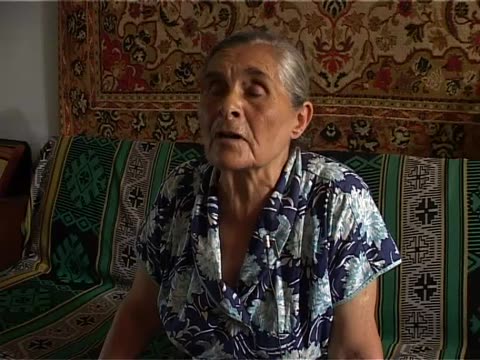
Bershadskaya talks about her family. Her mother was a seamstress and her father was a barber. She also touches upon her father's work. Bershadskaya grew up with two brothers and one sister.
From the machine transcript
Kerler asks about Bershadskaya's parents and siblings. Her mother was a seamstress and her father a barber who shaved and cut hair for peasant clients in the village, later working at a different job. She names her siblings and says there were four children; she moved to Bershad' at about thirteen.
names the siblings and her age at the move
Bershadskaya addresses her childhood memories of Chernyatka, including occupational structure. She then addresses prewar religious life in the village.
From the machine transcript
Bershadskaya recalls Chernyotka, where few Jews lived and several worked as tinsmiths, tailors and shoemakers serving the villagers. There was no synagogue, so people prayed in a private house, and kosher food and burials involved Bershad'. Kerler asks about the number of Jewish families (about fifteen) and about her friends, Jewish and non-Jewish.
mentions burials and kosher food in Bershad', and non-Jewish friends
Bershadskaya speaks about her family's life before the war. She explains that her mother moved to Bershad, so her daughter could be married off to a Jew.
From the machine transcript
Bershadskaya says that her mother moved to Bershad' before the war, in the late 1930s (?), because the village had few Jews. Kerler then explains the project's linguistic and historical aims, and a second voice comments on the difference between what is written and what is heard.
most of the passage is Kerler explaining the project
Bershadskaya speaks about prewar holiday celebration, including Sabbath and Passover. She mentions that her family bought matzos in Bershad and describes her family's Passover Seder.
From the machine transcript
Bershadskaya answers questions on Sabbath practice, such as sealing the oven for the cholent, and on Passover in Chernyotka and Bershad': matzo baking, pancakes made from matzo, and a small seder with guests. She remembers little of the seder songs, and recalls going to the Bershad' synagogue with her parents. A second voice asks about Hanukkah at the end.
details of the cholent oven and seder, and the synagogue in Bershad'
Bershadskaya talks about Hanukkah celebrations before the war. She then discusses religious customs at home. Bershadskaya states that her family celebrated holidays in a rented room in her home town and attended synagogue services in Bershad.
From the machine transcript
Bershadskaya talks about Hanukkah in Chernyotka, held in a rented house, including the dreidel and latkes made of potatoes. She says her father taught the children what they needed in Yiddish, and mentions that her mother died before the war. Kerler then leads into the war years.
mentions her mother's death before the war
Bershadskaya speaks about her life during World War II. They were imprisoned in the Bershad ghetto. Her childhood home burned down. Bershadskaya then describes daily life and violence in the ghetto. She describes how prisoners sold food in the market. Bershadskaya's father worked for a Christian and her brother sold the wood, his father chopped, in the market. Bershadskaya also describes the changing occupational forces, ranging from German to Romanian. She recalls a pogrom when the Germans returned to the ghetto, shortly before its liberation.
From the machine transcript
Bershadskaya says she was not evacuated and lived with her father and younger brother until they were driven into the Bershad' ghetto, where their house burned. She describes hunger, roundups, the Jewish market and selling food, and her father's wood-sawing work. She tells of the Germans' rule, then the Romanians, and a pogrom shortly before the Germans left.
Bershadskaya talks about her liberation and remembers bombing of Bershad. She then talks about her life after the war. Her family returned to her house, which was occupied by Christian neighbors during the war. Bershadskaya studied at a teaching college. She describes how her family fixed up the house and sold soap in the market.
From the machine transcript
Bershadskaya recalls the liberation of Bershad', when Soviet tanks entered in March, and bombing. After the war the family returned to their house, which non-Jewish neighbors had occupied and then left. She studied at a teaching institute, the family repaired the house, and she and her brother traded soap across a river by raft to get food.
adds the teaching institute and soap trade
Bershadskaya talks about food customs and shares her recipe of mămăligă, as well as her mother's recipe of gefilte fish.
From the machine transcript
Bershadskaya answers questions about food: how mamaliga is cooked, with milk or cheese, and how her mother made stuffed fish from local fish, and Sabbath meat dishes. Kerler asks about the term for Sabbath bread (challah) and other words.
Bershadskaya talks about prewar traditional weddings in her home village.
From the machine transcript
Bershadskaya answers questions about Jewish weddings in the village: dancing, a Jewish band playing freylekhs, and an outdoor shelter in summer. She cannot recall the chuppah or the entertainer's title. Kerler suggests words for the wedding jester (marshalek, badkhn).
Bershadskaya answers dialectological questions from the AHEYM Yiddish linguistic questionnaire.
From the machine transcript
Bershadskaya answers the dialectological questionnaire: Kerler gives Russian or Ukrainian words and sentences for her to render into Yiddish. They cover household and bodily words, weather and comparatives, pronouns, numbers, greetings, words for non-Jews, and short sentences to translate. She often says she has forgotten the word.
Bershadskaya addresses food customs on Sabbath. She then answers dialectological questions from the AHEYM Yiddish linguistic questionnaire.
From the machine transcript
Kerler asks about Sabbath food: the fish the mother prepared (gefilte fish) and how it was seasoned. The passage then moves to dialectological questions on words such as outsider/from another town, attic, bouillon, a rich man, tsadik and plural forms; the informant often cannot recall a word.
The catalogue names Sabbath food; the transcript also shows questions on words for wealth and tsadikim.
Bershadskaya talks about prewar Purim celebrations. She also addresses prewar Yiddish cultural life. She then continues to answer dialectological questions from the AHEYM Yiddish linguistic questionnaire.
From the machine transcript
Kerler asks about sending Purim gifts and whether Purim plays or klezmer musicians were known in Bershad'; the informant remembers little. The rest is questionnaire work on words and phrases, the difference between rav and rebbe and plural forms. S4 asks whether a rav could be Hasidic.
The transcript also shows klezmer musicians and the rav/rebbe distinction.
Bershadskaya speaks about prewar Jewish life in her home village. The team then concludes the formal part of the interview with Bershadskaya and the camera records footage of her apartment.
From the machine transcript
Kerler invites the informant to tell something or sing a song, but she says she has forgotten. He asks which languages Jews spoke and whether some wanted to speak only Hebrew; she says everyone spoke Yiddish. The interview is concluded with thanks, and other people mention a scholar and an archive. Vygodner (?) says he will show the apartment.
The catalogue says she speaks about her home village; the transcript shows mostly a question about Hebrew versus Yiddish and a phrase about a mythical town.
Vygodner and the team drive through Bershad, while he points out the former Jewish neighborhood.
From the machine transcript
A guide drives the team through Bershad' and points out the former Jewish street, houses where named people lived, and small old Jewish prayer houses. Two old Jews still live in one. Kerler asks about a street name (Red Street).
The transcript adds the named houses and the old prayer houses.