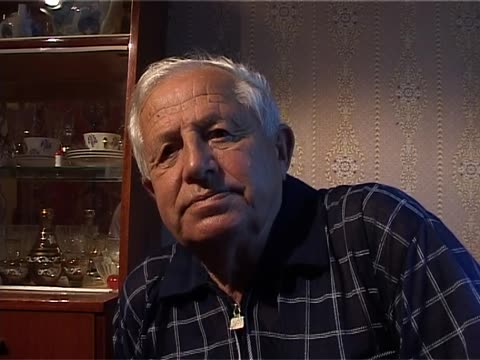
The first brief part of the tape includes an informal chat on the street with Mark Borisovich Lipkovich. Lipkovich talks about his family and mentions that he only spoke Yiddish with his grandmother.
From the machine transcript
In a street chat, a man says he has not spoken Yiddish for many years. His grandmother, who died about thirty years earlier, was the only person he spoke it with. He says that nowadays there is nobody to speak it with, and that people of his age understand a few words but do not speak.
The speaker attributes his Yiddish to his grandmother and says the language is no longer spoken around him.
The second part of the tape is a formal interview with Mikhail (Meyshe) Vladimirovich Kenin, born 1921 in Nizhyn. Kenin talks about his family and life today. He then provides personal information.
From the machine transcript
Kenin talks about his situation today: he lives alone, was seriously ill, and good friends have helped him. A daughter is mentioned in connection with selling the apartment. Kerler then records the date and place, and Kenin gives his Russian name and patronymic, his surname, his father's name Veli, his street address and his telephone number. He also gives his Yiddish name, Meyshe.
Gives his address, telephone number and Yiddish name.
Kenin talks about his family. His parents and grandparents were all born in Nizhyn. His father was a leather worker. Her mother was a homemaker, but learned tailoring skills from her father. Kenin grew up as an only child.
From the machine transcript
Kenin gives his birth year, 1921, and says that he, his parents and his grandparents were all from Nizhyn. His father, Avrom Volf, was a leather worker (kirzhner), and his mother, Khaye Beyle, was a homemaker who had picked up some tailoring from her father. He is an only child. He names his maternal grandfather, Nakhmen Yosef Dubinski, a tailor whom Jews held in high regard, and recalls his grandmother Mini.
Names his father, mother and maternal grandfather and gives his father's birth year (1894).
Kenin discusses his education. He attended the Yiddish school in Nizhyn for seven years. He finished his ten-year school education at a Russian school. After graduation, he studied at the Nizhyn Pedagogical Institute for three years, taking pedagogy classes. He was then drafted for his military service during the war. He returned to Nizhyn in 1945.
From the machine transcript
Kenin tells of his schooling. He attended the Yiddish school in Nizhyn for seven years, and it was the town's only Yiddish school. He then spent three years at a Russian school and went on to the institute in Nizhyn to train as a teacher. He studied there for three years before being called up for the war, and he came back to Nizhyn in 1945.
Kenin talks about his life after the war, supporting his parents. As a factory worker, he worked at a machine plant for thirty years.
From the machine transcript
Kenin says he returned after the war to a sick father and mother and a home with nothing in it, so he went to work to support them. He worked at one factory and then thirty years at a second one, Selmash, a machine-building plant in Nizhyn. He now has a pension as a first-group invalid.
Kenin discusses his childhood memories, including holiday celebration and Jewish life in Nizhyn. He lists different local synagogues, including Lubavitcher, 13:35, Schneersohn’s, and occupational synagogues. He was the brother of Shmuel and Yehuda Leib Schneersohn.
From the machine transcript
Asked about childhood, Kenin says the family kept the holidays and he went to synagogue with his father. He estimates there were eight to ten synagogues in town before the war. He names the Lubavitch synagogue and the one on the Harb hill, and mentions a synagogue of Rabbi Nakhum Schneersohn and a craftsmen's synagogue. He says there was no wooden synagogue.
Gives a count of synagogues and says none was of wood.
Kenin discusses holiday celebrations at home, including Sabbath and wine-making. He then recites a blessing.
From the machine transcript
Kenin describes Sabbath in his grandparents' home: nobody worked, and the family gathered at his grandfather's. He lists the food, including broth, kugel, tsimes and fish. He recalls his grandfather making his own wine and saying a blessing, and he then tries to recite a blessing, though he says he remembers none of them well.
Covers the Sabbath foods, the grandfather's home-made wine and an attempted blessing.
Kenin talks about his education at a religious school (cheder) until he was seven years old. His teacher (melamed) was called Simen Ash. He then recalls family religious customs and addresses holiday celebrations, including Sukkot.
From the machine transcript
Kenin says he attended cheder until about the age of seven, with a melamed named Simen Ash, and spoke Hebrew well then but later forgot it. He remembers his father reciting the evening Shema and singing Sabbath songs. He is asked about Rosh Hashanah, which he does not recall, and about Sukkot and his grandfather's sukkah. Kenin and a man present ask what the recordings are for, and Kerler explains the project and mentions how the team found him via the Hesed in Chernihiv.
Includes an exchange about the purpose of the project and how the team found him.
Kenin talks about prewar religious life in Nizhyn. He then addresses his education at the Yiddish school, including teachers. He recalls how he participated in theater productions and the school choir.
From the machine transcript
Kerler asks how the town's name was said in Yiddish, and about Hasidim and who is buried in the cemetery. Kenin says the Lubavitch rebbe and two other rabbis are buried there. He then describes the Yiddish school he attended for seven years, where all subjects were taught in Yiddish and Russian and Ukrainian were taught a little. He names teachers, including Malkin (mathematics), Simen (biology and chemistry), the director Dulchin and Kurachka (literature). He took part in plays and sang in the school choir.
Covers the Lubavitch rebbe's grave and the school's teachers by subject.
Kenin sings the beginning of a children song, he learned in the choir. He then recalls Yiddish writers, artists, newspapers, and clubs.
From the machine transcript
Kenin sings the beginning of a children's song about going to the forest to pick flowers, which he says he learned in the school choir. He recalls the Yiddish literature taught at school, including Sholem Aleichem, Bergelson, Itsik Fefer and David Hofshteyn, and says poems were learned by heart. He mentions a Yiddish actor who visited before the war and the newspapers read (Shtern, Der emes, and the pioneers' paper Zay greyt). He also describes the Yiddish craftsmen's club (Kusteri) in town, including the staged mockery of Passover.
Adds Yiddish writers and actors, newspapers and the craftsmen's club.
Kenin talks about prewar Jewish life Nizhyn with, according to him, approximately 6000 people. Kenin maintains that most synagogues were closed down in the late 1930s. He recalls a Jewish bathhouse with a mikva.
From the machine transcript
Kenin estimates that about six thousand Jews lived in Nizhyn before the war, working as tailors, shoemakers, furriers and other craftsmen. He recalls amateur Yiddish theater at the club, including a Sholem Aleichem play, and puts the closing of synagogues around 1937–38, though not all were shut. He says Jews went to a Jewish bathhouse with a mikveh, which he knows of through his mother.
Mentions amateur theater at the club alongside the population estimate, synagogue closures and bathhouse.
Kenin talks about holiday celebration, in particular Passover. His family requested matzos at a bakery. He then talks about contemporary Jewish life and his family. He raised a daughter, who lives in Israel.
From the machine transcript
Kenin recalls Passover in his parents' home: matzo baked at a bakery, burning the hametz, hiding the afikoman, and asking the four questions of his grandfather or father. He says Jews in Nizhyn now observe it poorly, though a seder is held. He speaks of expensive medicines and friends who help him. His daughter lives in Israel; she phones every Friday, worries about him, and left in September (year unclear).
Adds contemporary life, health and his daughter in Israel to the Passover memories.
Kenin answers questions about cultural terminology, before talking about Schneersohn’s synagogue.
From the machine transcript
Kerler asks about the meaning of a few words, such as dybbuk and golem, and Kenin and a man present give their sense. Kenin then speaks of Rabbi Nakhum Schneersohn, who kept a synagogue and fed poor Jews and was shot around 1937. He describes the synagogue as a study house for old Jews and says Schneersohn was a friend of the Lubavitch rebbe, not a Lubavitcher himself. Kerler ends by announcing a series of Russian-prompt questions.
Adds the dybbuk and golem questions and the fate of Schneersohn.
Kenin answers a series of dialectological questions from the AHEYM Yiddish linguistic questionnaire.
From the machine transcript
Kenin answers Kerler's dialectological questionnaire, translating Russian words and sentences into Yiddish. Items include words for build, belly, house, mouse, window pane, blue, grey and dove, as well as deaf, near, quick, skin, kitchen, ill, young and well. Further items cover verb forms and prepositional phrases, 'I walk in the street', 'all people', 'at the table', 'you will come or not', and 'he knows or not'. He is also asked who the Litvaks are and whether Kyiv or Vilna was closer to him.
The first part of the tape is a continuation of a formal interview with Mikhail Vladimirovich Kenin. Kenin answers a series of dialectological questions from the AHEYM Yiddish linguistic questionnaire and about food customs.
From the machine transcript
Kenin answers questions on Hanukkah food: latkes made of potato, buckwheat and wheat flour, and the Hanukkah song. He is then asked for Yiddish words for flower, shop, ceiling beam, bridge, 'back', face and 'ugly', 'probably', and dreidel, and for a pious person's wish for the dead.
Includes many individual vocabulary items beyond food customs.
Kenin talks about his traditional wedding in 1946.
From the machine transcript
Kenin recalls his traditional Jewish wedding with a khupe and a rabbi, held after the war in 1946. He remembers Jewish klezmorim, men who led the bride to the khupe, and a badkhn (named Slanimski, uncertain) who told stories, sang and danced on the tables.
The second part of the tape includes town footage of Nizhyn. The team talks in Russian to neighbors on the street about contemporary life and family.
From the machine transcript
Street footage in Nizhyn, with talk in Russian with a woman neighbor. They mention the burial place of a great rabbi and that Kenin has been interviewed and is in poor health. She speaks of her children and acquaintances in Israel, a coming trip there, and a very low pension and high prices. She says life is bad economically and morally.
Content is largely Russian street talk about pensions, prices and relatives in Israel.
The team visits with Lipkovich of the “Mitteler rebbe’s” grave (Dovber Schneuri).
From the machine transcript
The team goes to the grave (ohel) of the Mitteler Rebbe, with a local guide. Katz explains that he is named Dovber after the rebbe of Lubavitch. There is a prayer or chant at the grave and talk about leaving a note.
The transcript does not clearly show Lipkovich; the passage is largely garbled.