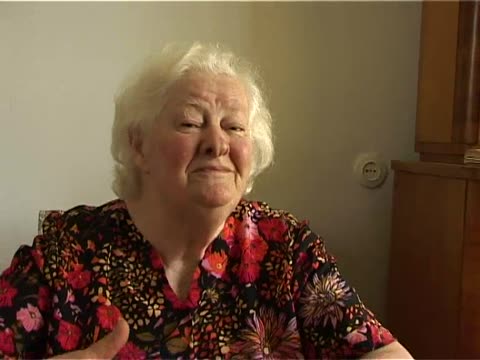
This tape consists of a formal interview with Sofia (Sonye) Moiseevna Palatnikova (b. 1927 in Teplyk) (part 1 of 3. See MDV 688 and MDV 689). She discusses prewar Jewish life in the Crimea, where her family moved in 1930, and in Teplyk, where she was born and to where her family returned in 1940. Before 1930, her father worked as a successful butcher. In 1930, the family was sent to live on the Lunacharka kolkhoz in the Crimea and Palatnikova describes what life was like there in her youth. She attended a Russian-language school in a nearby Tatar village and then a Ukrainian-language school once her family moved back to Teplyk. She also recites a fragment from the popular Soviet Yiddish song “Dzhankoye”.
From the machine transcript
Opening of the interview. After setting up and introducing the expedition, Kerler establishes the date and place (Teplyk, 17 July 2002). Palatnikova gives her name, address, phone and the origin of her name (after an aunt), and says she was born in 1927 in Teplyk. She recalls that her family lived in the Crimea from 1930, because her butcher father was sent out when he could not pay a tax. They worked on a state farm near Dzhankoy and returned to Teplyk in 1940, just before the war. She attended a Russian school in a nearby Tatar village and then a Ukrainian school in Teplyk.
Adds the long setup and introductions at the start, her address and phone, the origin of her name, and a mention of Sevastopol.
Palatnikova describes her family life, detailing how she spoke Yiddish at home with her parents and sister. Her grandparents and uncles moved to America in the early 1920s during the Petliura pogroms and used to send packages to her family, but she lost contact with those relatives long ago. Palatnikova further details kolkhoz life, discussing the work done in the fields and in the home. She emphasizes the widespread poverty, mentioning that children had to share a common pair of shoes.
From the machine transcript
Palatnikova describes her family. Her parents were Moyshe and Rachel, her sister is Tanya (Teybl) in Teplyk, and Yiddish was spoken at home. Her grandfather and uncles went to America in the early 1920s, around the Petliura pogroms, and sent parcels until 1975, after which contact was lost. She describes her mother as a housewife and recalls her father's apprenticeship as a butcher. She stresses the poverty of the prewar period: cold houses and children sharing one pair of shoes. A question about felt boots leads to a remark that her Yiddish is mixed with Russian. She ends by saying life improved under Soviet power, before the war and after it, and mentions the murder of Jews in Ukraine.
Adds her parents' names and ages, the sister, the American relatives and a question about the word for felt boots.
Palatnikova shares her experiences during the war years, detailing how she and her family were in different camps and ghettos, including Raygorod and Bratslav. Among other episodes, she talks about the establishment of a ghetto, forced labor in wintertime, the wearing of the yellow star by Jews, and the memorial that was later built on the site of a Jewish mass grave. She also relates a story of how her family, as well as many other Jews, was helped by two German soldiers.
From the machine transcript
Palatnikova tells of the war years under the Germans. An attempt at evacuation failed. Back home Jews were made to do forced labor, including clearing snow in winter, and the young were taken to camps. Jews were then confined to two streets and made to wear a mark on the arm. The ghetto was surrounded and its people shot; she mentions a mass grave and a memorial later restored with money from Teplyk emigrants. About forty specialists were kept alive to work. Her father was among them, helped by two Germans in the local administration, whose names are only partly clear in the transcript.
Adds forced snow-clearing in winter, the yellow armband marking, and the rebuilt memorial at the killing site.
According to Palatnikova, approximately 2000 Jews were killed in the area, including foreign Jews from Romania. She describes her experiences in the camps, the hard work and frequent encounters with death that constituted life there. She notes that she recieved help from non-Jews, and once escaped to Gaysin, but then was sent to the Bershad’ camp where disease and famine were widespread. Palatnikova also recalls how the rich Romanian Jews in the Bershad’ camp used their wealth to obtain food and assistance, building a “children’s home” inside the camp. She also details the specific strategies she and her family used to survive. Cities and towns mentioned on this tape: Teplyk, Dzhankoy, Simferopol’, Trenton (New Jersey), Odesa, Raygorod, Bratslav, Haysyn, Bershad’
From the machine transcript
Palatnikova estimates that about two thousand people were killed locally, among them Jews brought from Romania and Czernowitz. She describes the camp: hard labor in a quarry, regular inspections, and the killing of those who could not work. She escaped, helped by non-Jews, and reached Haysyn, where her father worked as a specialist. She was then sent to the Bershad' ghetto, which held many thousands of Romanian and Polish Jews, with hunger and disease. There wealthy Romanian Jews set up a children's home. Her father sent food parcels, partly through the German's help. Her family of four survived and was liberated in March 1944.
Adds the Haysyn episode, the parcels from her father, and liberation in March 1944.
This tape is a continuation of a formal interview with Sofia (Sonye) Moiseevna Palatnikova (b. 1927 in Teplyk) (part 2 of 3. See MDV 687 and MDV 689). She discusses prewar Jewish life, noting that holiday celebrations did not take place in the synagogue, but rather at home. She remembers how Passover was strictly observed with a different set of dishes. Reflecting on her father’s work as a butcher, Palatnikova discusses the differences between Jewish and non-Jewish consumption of meat before the war as it related to the kosher status of the meat and different kinds of fasts that non-Jews observed. She also comments on contemporary eating practices of chicken.
From the machine transcript
After a short exchange in which Kerler explains where the visitors come from, Palatnikova recalls prewar Jewish holidays kept at home rather than in the synagogue, and strict Passover observance with separate dishes. She relays what a grandfather told about kosher meat, the shoykhet, and non-Jews who did not buy meat at certain times because of fasts. She says Jews sent meat to be sold, and she explains why she eats chicken today. At the end she says she remembers no Passover songs.
Opens with Kerler introducing the visiting group, and the passage ends with a question about Passover songs.
Palatnikova shares a recipe for “gefilte fish,” mentioning regional differences in preparing the dish. She talks about holiday foods for Chanukah, Purim and Passover.
From the machine transcript
Palatnikova explains how she makes gefilte fish: skinning the fish, mincing with onions, eggs and matzo meal or crackers, and cooking it for hours. She contrasts her way with how non-Jews make fish cutlets. She also talks about her mother's holiday cooking for Hanukkah, Purim (poppy-seed hamantashen) and Passover, and about latkes and potato dishes. Kerler asks about the Yiddish names for these foods.
Includes talk of her birthday and a discussion of the Yiddish terms for latkes and potatoes.
Palatnikova also talks about Jewish religious life in Crimea before the war. She describes the practices of the “Gern,” who were ethnic Russians who followed the Jewish religion and learned to speak Yiddish, although their outward appearance remained non-Jewish.
From the machine transcript
Palatnikova answers whether her father went to synagogue, then talks about non-Jews who followed the Jewish religion, took up Yiddish, and kept Jewish practice more strictly than Jews. She names one such family (?) and tells a story about one man questioned by the authorities. She also answers Kerler's questions about the word for a Friday loaf of bread baked by her mother.
Adds the story about a man questioned by the authorities and the question about a baked-bread term.
Palatnikova briefly touches on the topic of sickness and healing, and mentions the variant of “gehakte,” of chopped fish, in contrast to "gefilte fish".
From the machine transcript
Palatnikova answers briefly about doctors and healers in Teplyk before the war, Jewish and non-Jewish, including a dentist. Kerler then asks about terms for chopped versus stuffed fish. She names the fish dishes, and says her mother chopped the fish with a hatchet-like knife. Kerler announces he will move to Russian prompts.
Includes the discussion of doctors in Teplyk and the Yiddish terms for chopped and stuffed fish.
The rest of the tape consists of the interviewee answering questions from the AHEYM dialectological and sociolinguistic survey.
From the machine transcript
Dialectological questionnaire: Kerler gives Russian words and phrases and Palatnikova supplies Yiddish equivalents. The items include household and body words (bed, headache), emotions and states, directions and place words, and weather and temperature. They also cover greetings and thanks, words for non-Jews, luck and fate, building and house words, birds, and religious terms such as gravestone and havdalah. Palatnikova comments on Russian and Belarusian influence and on her own Yiddish.
The recording begins with the continuation of an interview with Sofia Moiseevna Palatnikova (part 3 of 3. See MDV 687 and MDV 688). She discusses celebrations of Jewish holidays, particularly Tisha b'Av. She discusses contemporary life in Ukraine.
From the machine transcript
Kerler asks the interviewee about Tisha b'Av and the children's custom of throwing burs at the beards of adults, which she does not recall. He then asks a few vocabulary items, such as words for face and for "a lot". She describes her life today: illness, a heart operation in Vinnytsia that she could hardly pay for, her pension compared with German payments, and her great-grandson and grandson. She also mentions having been in a camp as a child and sharing a camp background with another woman. Short exchanges with other visitors follow, with Russian speech and some Hebrew.
The transcript adds her illness and operation, pensions and relatives, and vocabulary questions; the catalogue does not mention these.