People › Moisei (Moyshe) Miaskovskij › conversation

Moisei (Moyshe) Miaskovskij

Tomashpol' 28 May 2007 82 min · 2 parts on 2 tapes
Loading the player…
  1. MDV 702 0:00–1:02:33 · 62 min · not online — MCO
  2. MDV 703 0:00–19:11 · 19 min · not online — MCO
Passages
MDV 702 0:00–1:02:33

0:00

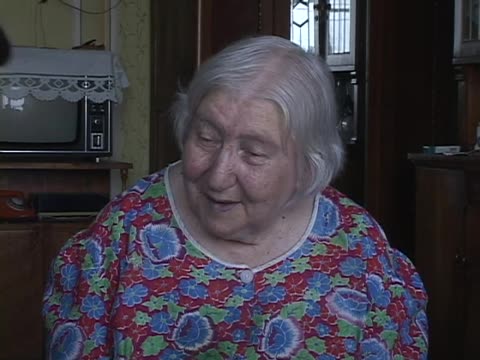
Continuation of collection of linguistic data from Manya (Mintse-Freyde) Izrailevna Gingold.

From the machine transcript

The questionnaire with the woman continues. Kerler and Lemster elicit Yiddish equivalents for Russian words: near and later, very, sick and sleepy, honest or religious, cross and Christian, peasant. They also ask for words for relatives, village and street terms, potatoes, shop, half and a liter, and sentences to translate. Along the way she talks about her father making wine, and she recalls a Jewish wedding in the 1950s with a chuppah and baked goods. She also says that no Jews remain on her street.

also covers her father's wine-making, a wedding and the absence of Jews on her street

36:11

Interview with Moisei (Moyshe) Miaskovskij.

From the machine transcript

Miaskovskij is interviewed after a move to another room. He gives his name and his father's name, and gives dates of death for both parents and for a sister. He tells an anecdote about a Soviet delegation and a KGB minder who understood no Yiddish. He says he finished ten classes in Tomashpol' in 1941 and then served at the front, with orders and medals. His father was a factory worker and his mother a seamstress; the family was once rich but lost everything after the revolution. He names childhood friends and other townspeople. He mentions that he wrote a poem and sets it to music, sings Tum balalaika and other Yiddish songs, and says his father's books are still in the attic. He studied at the Moscow institute and says he cannot read Yiddish.

adds the anecdote of the Soviet delegation, the family's loss of wealth, the Jewish community numbers, and a second singing

MDV 703 0:00–19:11

0:00

Continuation of interview with Moisei Miaskovskij.

From the machine transcript

Miaskovskij mentions a sister in Israel and answers Lemster's and Kerler's questions about prewar Jewish weddings in Tomashpol' and his father's house. The house is about a hundred years old and has a mezuzah on the door but not on the window frame; he explains what a mezuzah is for. He recalls his pious grandmother and speaks about the languages he used and his Ukrainian school. He says his mother died before the war and that his father hid during the occupation, with a ghetto mentioned. Kerler asks to see the father's books in the attic, but Miaskovskij says he cannot climb up.

Also covers the mezuzah, languages spoken, family deaths and the request to see the books in the attic.

9:09

Discussion with Vasili Mukha.

From the machine transcript

Kerler and Lemster talk with Vasili Mukha (b. 1933) about his Yiddish. He spoke it with Jewish friends as a child, has forgotten much of it, and is asked for songs and sayings. He says his father's brother was a Jewish shoemaker. In the war Jews slept in his family's house, with the transcript suggesting they were hidden. He is asked whether there were beautiful Jewish girls, about life after the war, the town's Jewish trades and streets, and his own work.

The passage is a doorway talk with Mukha covering his childhood Yiddish, hiding Jews in the war and Jewish trades.

16:48

Farewell exchange with Moisei Miaskovskij.

Informal MDV 703 · MCO
From the machine transcript

The team takes leave of Miaskovskij, with thanks and good wishes. They say they will come back to see the books and him. Some of the talk is muddled, with mention of a further trip, possibly to Vel'nitsk (?), and an unclear remark about a small cloth.

Questions put in this conversation

Items of the dialect questionnaire asked here; each link plays the moment.