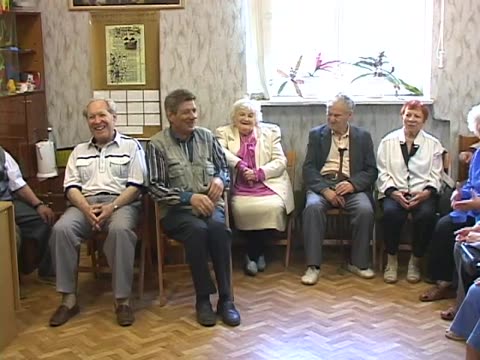
The team introduces the project. They then informally chat with community members.
From the machine transcript
Lemster introduces the AHEYM project to the community members present. It is a video archive of Yiddish speakers, with interviews in Ukraine, Moldova and Romania, and it aims to record memories of Jewish life before the war. He introduces Kerler and himself. A woman says she cannot speak differently from how her grandparents spoke, and the group chats informally about dialect and birth years.
Includes a woman's remarks on speaking dialectal Yiddish.
The formal interviews with Luminskaia and Goldshteyn begin. They provide personal information and then Luminskaia talks about her family. Luminskaia's father was a day laborer before the Soviet occupation and built furniture afterward. When the family moved to Vodvizhan 7:49, he was the directory of a factory department, which was later turned into an artel. Luminskaia recalls how non-Jews would speak Yiddish in the co-operative. She has relatives in America.
From the machine transcript
The formal interview begins with the date and place of recording (Bender, 5 June 2006). Luminskaia gives her Yiddish and maiden names and her birth year, and Goldshteyn gives his name and birth date. Luminskaia says she grew up in Chipovich and names her father, Yidl Mashkovits. He was a day laborer for an employer, then worked as a furniture maker after nationalization, and was later a department head in what became an artel. She recalls that non-Jews working there spoke Yiddish, names her mother and her maternal grandfather, a smith, and mentions relatives who left for America.
Adds Goldshteyn's birth details and her grandfather who was a smith.
Luminskaia talks about her family's life during the war. In particular, she mentions that her grandparents were taken into the woods. She then continues to provide information about her family. She grew up with a sister and a brother.
From the machine transcript
Luminskaia describes what happened to her grandfather during the war: he was taken to the forest by policemen and never seen again. She names her grandmothers and grandfathers, in part garbled, and says she had two brothers, one called Tsalik or Sasha.
Gives the fate of her grandfather and the sibling names.
Luminskaia talks about her life during the war. She worked in Biysk, Russia, at a sewing factory during evacuation. She then talks about her life after the war. After her family returned to Chipovich, Luminskaia finished her school education and had to discontinue her studies at an institute after one semester due to illness. She found work as the driver 16:13 for a library.
From the machine transcript
Luminskaia says that during the evacuation, at age fourteen, she worked in Biysk at a sewing factory making uniforms. After returning to Chipovich she completed school, started at an institute but left after one semester because of illness. She then worked for about sixteen years in a library, where she was in charge.
The transcript suggests she headed the library rather than being a driver.
Goldshteyn provides personal information and talks about his family. He grew up as an only child. His father was a merchant. After the war, Goldshteyn graduated from a technical institute and then became a medical assistant at a hospital.
From the machine transcript
Goldshteyn gives his birthplace, Kotyuzhany, and says his father Mordkhe was a grain dealer who worked for an employer. He names his mother Sara and his grandparents Hershl and Elke, who lived in Khotyn, and says he had no siblings. After the war he studied at a medical-assistant school and worked as a medical assistant in a polyclinic.
Luminskaia discusses her childhood memories and acitivies. She then talks about prewar Jewish life in Chipovich. Luminskaia remembers attending synagogue services with his grandmother. She also addresses holiday celebration and explains how she helped her mother baking matzos.
From the machine transcript
Luminskaia talks about her childhood in Soviet school and the pioneer camp, and her love of reading and performing. She recalls her grandfather praying with tefillin, going with her grandmother to the synagogue, and the holidays Purim, Hanukkah and Passover with the four questions. She also recalls helping her mother with Passover preparations and baking matzo.
Luminskaia talks about secretly baking matzos after the war.
From the machine transcript
Luminskaia describes how women secretly baked matzo together in a house with an oven in Chipovich, and how she, as a child, helped them.
Luminskaia recalls her grandfather's stories and describes prewar Jewish life and synagogues.
From the machine transcript
Luminskaia recalls her grandfather's stories of Esther and Hanukkah. She says Chipovich was a Jewish shtetl with a synagogue and, according to her mother, three prayer houses, one of them for the rich, which she visited once with her grandmother. She mentions hearing a cantor there.
Luminskaia discusses Yiddish songs and recalls how her mother would sing her songs about World War I.
From the machine transcript
Luminskaia talks about Yiddish songs and the sadness of Yiddish melodies. She recalls her mother telling her about the First World War and singing a song from that time, and begins to recite its words, about a wounded soldier writing to his parents.
Luminskaia sings a Yiddish song about a soldier who fought in World War I.
From the machine transcript
Luminskaia sings a Yiddish song about a soldier who writes to his parents that his right hand was shot off and he has been blinded, asking his mother to tell his bride not to wait for him. She sings it a second time at Lemster's request and then begins another song.
Goldshteyn discusses his childhood memories and education. He attended a Romanian school in the mornings and a religious school (cheder) in the afternoons. He describes his bar mitzvah and synagogue attendance.
From the machine transcript
Goldshteyn recalls his childhood before the war. He attended a Romanian school in the morning and a Jewish cheder in the afternoon, where subjects such as the prayer book, mathematics and history were taught in Yiddish and Hebrew. He describes laying tefillin at thirteen and his bar mitzvah, when the rabbi of Belz came, and attending the synagogue with his father on Sabbath. He also mentions children's games.
Goldshteyn talks about prewar holiday celebration, including Passover and Purim. According to him, people brought matzos from neighboring towns for Passover. On Rosh Hashana, Goldshteyn remembers the ceremony for repentance "shlogn kapores." He also recalls the practice of Tashlikh on the Jewish New Year and the holiday Simchat Torah. He then talks about Sabbath celebrations at home. Goldshteyn also recalls how his mother prepared gefilte fish and other holiday dishes.
From the machine transcript
Goldshteyn answers Lemster's questions about prewar holidays. He mentions Passover seders and matzo brought from a neighboring town, and the Passover dishes kept in the attic. He also recalls Purim with shalakhmones and masks, Shavuot, Rosh Hashanah including kapores, tashlikh, Simchat Torah and Hanukkah money. He then describes Sabbath at home, including candles, cholent, and his mother's gefilte fish, kugel and other dishes.
Covers many holidays and Sabbath in one stretch, with food details.
Luminskaia discusses prewar holiday celebration, including food customs. She describes how her mother cooked cholent and recalls the local kosher butcher.
From the machine transcript
Luminskaia describes what her mother cooked for holidays, including gefilte fish and a cholent baked in a Russian oven. She recalls the local ritual slaughterer, who was still active in the late 1920s. She mentions her grandfather's sons who went to America.
Luminskaia talks about her family and holiday celebration before the war. She had relatives in America who would send her family kosher wine.
From the machine transcript
Luminskaia says her grandfather's sons in America sent him kosher wine and other items. He kept separate kosher dishes in the attic and ate from them when he visited, while her mother kept the household kosher for the visits. She also says the family ate matzo at Passover.
Luminskaia explains her mother's recipe for gefilte fish. She then describes how her grandfather koshered meat. Goldshteyn also added how his family koshered meat.
From the machine transcript
Luminskaia describes in detail how she makes gefilte fish as her mother did, with fish cut and chopped with onion, egg and a little sugar, and cooked in the skins for two hours. Her grandfather koshered meat by soaking and salting it. Goldshteyn adds how meat was koshered in his family.
Includes the recipe details and Goldshteyn's addition.
Goldshteyn talks about life before the war and recalls non-Jews who told anecdotes in Yiddish. Luminskaia then talks about the "Jewish" artel, she spent time at during her childhood, where non-Jews spoke Yiddish. Goldshteyn then recalls the interactions between Jews and non-Jews during Passover and Easter.
From the machine transcript
Goldshteyn recalls that many non-Jews, including Gypsies, worked for Jews and spoke Yiddish with a Jewish accent, telling anecdotes and singing Yiddish songs. Luminskaia says that in the artel everyone spoke Yiddish. Goldshteyn also recalls that at Passover and Easter, Jews and non-Jews exchanged matzo and eggs.
Goldshteyn and Luminskaia address mixed marriages and interaction between Jews and non-Jews. They then mention Jewish occupational structure and professional life before the war.
From the machine transcript
Goldshteyn and Luminskaia answer Lemster's questions on mixed marriages, saying there were none before the war, and on the word meshumed. They then describe Jewish occupations before the war: tailors, shoemakers, tinsmiths and grain dealers who sold on credit. A break is called to change the cassette.
Goldshteyn discusses life before the war, in particular social interactions betweem Jews and non-Jews. He recalls his neighbor who was a priest.
From the machine transcript
Goldshteyn recalls his neighbor, a priest whose son studied with him at the Romanian school. The priest knew Hebrew well, and the families exchanged holiday food, with Jews sending matzo and gefilte fish. A short exchange follows about speaking Yiddish and Russian with a neighbor.
Adds the exchange of holiday food between the families and the Yiddish-versus-Russian talk at the end.
Goldshteyn addresses prewar Jewish life and halutzim. He recalls his uncle who prepared for aliyah. He then discusses the different occuaptional structure between Jews and Christians.
From the machine transcript
Goldshteyn answers Lemster's questions on Jewish organizations in the village. There was a cheder and a synagogue but no Zionist or Communist organization and no halutzim. A relative went to Palestine (Haifa) after learning the carpentry trade in Chernivtsi and Khotyn. He contrasts the occupations of Jews and Christians: Christians did the farm labor and Jews paid them. He also mentions about sixty or seventy Jewish families, Christian vineyards and wine-making.
Adds Jewish family numbers, Christian vineyards and wine-making, and a note that the Zionists and halutzim were absent.
Goldshteyn talks about prewar cultural life, in particular a library and theater performances. He remembers performances by Sidi Tal.
From the machine transcript
Goldshteyn recalls that books were available in the cheder building and that Yiddish theater troupes visited the village. A performer is discussed, with Lemster supplying that she died in Chernivtsi, and her later years in Chisinau are mentioned. The name Sidi Tal is recalled as a singer at weddings.
Goldshteyn talks about preware religious life, in particular his bar mitzvah. They then answer questions about cultural terminology, specifically "a guter yid" (a good Jew).
From the machine transcript
Goldshteyn says there was no rabbi in the village, only in Bălți; there he and his brother obtained tefillin at thirteen, learned the blessings, and had a bar mitzvah with a tallis and kippah. Lemster then asks about the term 'a gutter yid'. Both informants explain it as an honest man who helps the poor and also as a rebbe visited by Hasidim. The talk turns to terms such as 'Litvak', 'Galitsianer' and 'Bessarabian Jew'.
Adds questions on 'Litvak' and other regional-identity terms, and a rebbe's visit to a 'good Jew' in Ștefănești.
Goldshteyn and Luminskaia discuss traditional weddings and she sings the traditional song "Makhateyniste mayne" (My mother-in-law).
From the machine transcript
Goldshteyn and Luminskaia answer Lemster's questions on Jewish weddings. They recall the chuppah and its escorts, the food (strudel, lekach), the music and the weeping of the parents. Luminskaia then sings a wedding song in which a mother-in-law is asked to look after the bride. They discuss the groom buying out the bride and whether this was a Jewish or a Moldovan custom.
Adds descriptions of wedding food and music, and the debate over Jewish versus Moldovan customs.
Luminskaia recalls a traditional wedding carried out in secret at her uncle's home in the prewar Soviet period. Goldshteyn recalls gypsies performing at Jewish weddings. Luminskaia then describes a typical wedding she attended.
From the machine transcript
Luminskaia recalls a chuppah held secretly at home in Soviet times, with the groom and bride brought separately and glasses broken. Lemster presses on the difference between Jewish and Moldovan weddings. Goldshteyn recalls musicians, including Gypsies, who played Yiddish music at weddings. Luminskaia describes a wedding, mentioning the klezmer instruments and the seating. Goldshteyn speaks of wine rather than brandy in Moldova.
Adds the debate over Moldovan versus Jewish customs and the contrast of wine with brandy.
Goldshteyn discusses folk customs. Luminskaia then recalls how her grandfather applied healing customs to her, when she fell sick as a young girl. He then addresses the custom to avert the evil eye in his hometown.
From the machine transcript
Goldshteyn answers Lemster's questions about folk customs for averting the evil eye; he recalls charms and a non-Jewish woman who performed them. Luminskaia recalls that when she fell ill at the age of four, her grandfather covered her with a black prayer shawl and healed her, with a local healer also mentioned. She describes her affection for him. Goldshteyn then returns to the custom of dispelling the evil eye.
Adds a non-Jewish woman as the healer.
Goldshteyn and Luminskaia answer questions about cultural terminology.
From the machine transcript
Goldshteyn and Luminskaia answer questions on terms for a person: dybbuk, golem, a blessing at the cemetery and a curse (a wish that evil be kept away). They have not heard of the golem, and recall the other terms with difficulty. The passage ends with a question on whether other forms of the formula were used.
Goldshteyn and Luminskaia answer dialectological questions from the AHEYM Yiddish questionnaire.
From the machine transcript
Goldshteyn and Luminskaia answer the dialectological questionnaire, with Lemster often prompting in Russian and Kerler occasionally adding. Items include greetings, thanks and 'please', 'mouse', 'belly', house, window and glass, groats and colors, building and adjectives, and sentences with 'also' and 'everything'. Further items cover time and comparatives, 'to love', 'to flee from the Germans', 'honest', 'cross', 'convert', 'apostate', 'grandmother', headscarf and flowers.
Luminskaia discusses songs, she recalls from her mother. She then sings again a Yiddish song about the tragic fate of a World War I soldier.
From the machine transcript
Luminskaia talks about the songs her mother sang, including sad ones and a fine Sabbath song, and says the words stayed with her. She then sings a Yiddish song in the form of a letter from a wounded soldier to his parents, who has lost the use of his right hand and his sight. Kerler remarks that it was sung in three verses, and the two interviewers thank her.
The song is a soldier's letter to his parents, and the passage includes talk about her mother's repertoire.