People › Tsilya Bentsianovna Kleiner › conversation

Tsilya Bentsianovna Kleiner

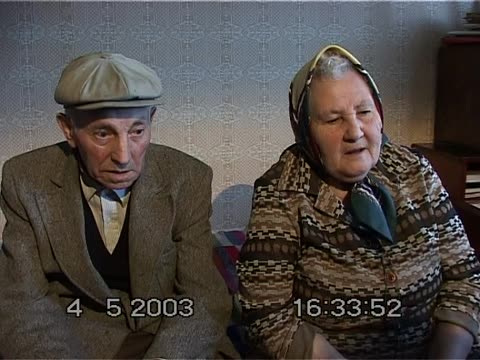
Shepetivka 4 May 2003 Interviewed by Dov-Ber Kerler, Jeffrey Veidlinger 2.0 h · 2 parts on 2 tapes
Loading the player…
  1. MDV 661 0:00–59:05 · 59 min · not online — MCO
  2. MDV 662 0:00–1:01:16 · 61 min · archive.org
Passages
MDV 661 0:00–59:05

0:00

Entering Kleiner’s apartment

Footage life today MDV 661 · MCO
From the machine transcript

Kerler is welcomed into Kleiner's apartment and the interviewers settle in. Kerler states the date, 4 May 2003, and that they are at the home of Tsirl and Bentsye (?) in Shepetivka.

0:53

Personal introduction and family

From the machine transcript

Kleiner gives her personal details to Kerler: her official name Tsilya (Yiddish Tsirl), her patronymic, her married surname Kleiner and her maiden name Burshteyn. Kerler asks about the meaning of the name and about her address.

8:59

Education

From the machine transcript

Kleiner says she studied in the Jewish school and finished seven grades, then attended a workers' faculty (rabfak) preparatory to an institute, which she names in garbled form. She completed the rabfak just as the war began.

9:56

Evacuation and family

From the machine transcript

Kleiner says she was evacuated to Novosibirsk and beyond, to a kolkhoz. She speaks of her aunt Khane, who raised her; two sisters died, leaving three children. Her brother studied at a military school in Barabinsk, and her younger sister finished seven grades when the Jewish school was closed and the upper classes were Ukrainian.

Gives details of siblings and the school's closure.

11:23

Earliest childhood memories and Jewish life in prewar Shepetivka

From the machine transcript

Kleiner explains that an aunt, who had no children, took her in at age two, and that this happened to other children in town. Her uncle was a tailor. She describes Shepetivka as a Jewish town with many trades, the closing of the cheder in the early 1930s and of the Jewish school later, the six synagogues, and Rabbi Shapiro, who was sent to Novosibirsk after the war; his son Shlomo lives in Baltimore. She also discusses a charitable society for the poor on October Street, the surviving synagogue, a Russian shoemaker's sons who attended the Jewish school, and children's games (forfeits, tag, hide-and-seek, sledding), with Kerler asking about terms.

Adds the poor-relief society, Rabbi Shapiro, the synagogues, children's games and the Russian shoemaker's sons.

24:23

Jewish school life and teachers

From the machine transcript

Kleiner describes the Jewish school: first lessons in a borrowed room, then the community built a floor and later a second one. The director was Jacobson, and she names teachers including Reizman, Gershman, Milshteyn, Brenner and Fok, and a German-language teacher. She lists the subjects and the language of instruction, the Yiddish literature taught, anti-religious teaching, Pioneer activities, school meals and the neighbour teacher Brenner, who taught her to read Yiddish at four.

42:04

Religious life before the war during Soviet period

From the machine transcript

Kleiner says that prayer in prewar Soviet times was hidden: windows were covered and someone kept watch for the militia. She mentions the ritual slaughterers (Khayim and Nesi), a mohel, and the observance of all holidays and the Sabbath, including the cholent put into the oven on Friday, and Kerler asks about the word for it.

46:00

Electricity

From the machine transcript

Kleiner remembers that, when she was about five or six, a single radio loudspeaker served the whole town; she cannot give the year.

Concerns the arrival of radio, not electricity as such.

46:53

Shabbat celebration and food customs

From the machine transcript

Kleiner describes Friday night and Sabbath at home: blessing the candles, challah, her uncle returning from synagogue and bringing poor men home for the meal. She lists the food, among them gefilte fish, chicken soup with beans, kugel and babke, baked goods, pirogi and Purim-like pastries, with Kerler asking about the difference between kugel and babke.

MDV 662 0:00–1:01:16

0:00

Holiday celebration and food customs

From the machine transcript

Kleiner describes Passover preparations in Shepetivka: making the dishes kosher, burning the chametz, and cooking Passover dishes such as potato and matzo-meal pancakes and kugels. She explains the term 'kuzlekh'(?) for berry-based kugels and says dairy was avoided on Passover. She says a special Passover cloth was put on the table and tells how the seder was held and who asked the questions. She and Kerler then move to Shavuot food (blintzes, green borscht) and a discussion of the sorrel/sour-dock plant.

Passover seder customs, Shavuot dishes and a discussion of the terms for sorrel/dock.

9:41

Jewish religious and geographical life

From the machine transcript

Kleiner answers questions about a Jewish library in town and the difference between a rav and a rebbe. She discusses plurals and the terms for Litvaks, Polish Jews and Galicians, and how Jews from other regions spoke. She says that anti-religious mock trials and Komsomol checks on synagogue-going and baking were held; she says there were no Hasidim in Shepetivka. She also describes the rabbi acting as judge in a Jewish court.

Terms for Litvaks, Galicians and Polish Jews, Hasidim and the rabbi as judge.

19:01

Food customs

From the machine transcript

Kleiner explains how gefilte fish was prepared and which fish was used, with questions about sweetness and pepper. She discusses latkes made from buckwheat flour for Hanukkah or from potatoes for Passover, her father's work as a sausage maker making kosher goose sausage, the removal of veins (trebern) and plum terms. She describes a baked dough dish with nuts, whether Jews drank brandy or beer, and homemade kvas.

Gefilte fish recipe, her father's sausage trade, plum, brandy and kvas terms.

27:26

Jewish wedding and medicine

From the machine transcript

Kleiner says she married in 1945, after the war, with a cantor writing the betrothal contract and a wedding canopy. She mentions that her son is a painter and her husband a military man, and recalls that she has no wedding photographs. She remembers prewar Jewish weddings, with betrothal contracts (tnoim), klezmer music and the breaking of a plate. She then answers questions about folk remedies such as milk with butter or honey, potato compresses, rubbing with turpentine, kerosene for worms, and cupping.

Folk remedies and prewar weddings alongside her own 1945 wedding.

31:57

Dialectology

From the machine transcript

Dialectological questionnaire. Kerler asks Kleiner about dybbuk and golem, then gives Russian prompts for Yiddish equivalents: greetings and replies, 'please', congratulations, 'late', 'earlier', 'cold' and comparatives. He also asks about 'where do you live', 'how', 'sick', 'beautiful', 'he likes me', 'ten', 'you are young', 'to pray' and 'grandmother'. Further items include 'book', 'mouse', 'pane', 'deaf', 'well', 'to make a mistake', 'many', 'various' and a standing prayer, and Kleiner often comments on the difference between spoken and written Yiddish and on Ukrainian or Russian influence.
Questions put in this conversation

Items of the dialect questionnaire asked here; each link plays the moment.