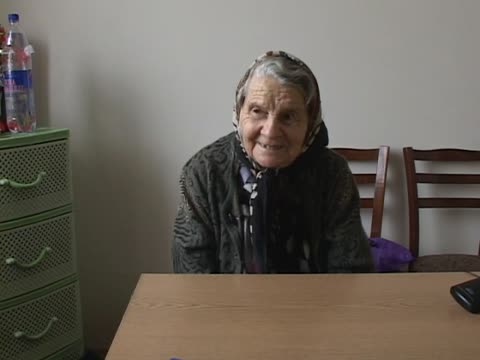
The second part of the recording is a formal interview with Malka Zelikovna Altman, nee Bluvshteyn, recorded in Bălți. She was born 1921 in Bălți. Altman provides personal information and talks about Jewish life before the war in Pervomaiscoe, Moldova. She recalls the kosher butcher and Avreymele, the mohel, the local fur factory, and Lipson’s mill.
From the machine transcript
Kerler introduces the interview with Altman, who was born in 1921 and whose maiden name was Bluvshteyn, in the Hesed building in Bălți. She cannot give her birth month. She recalls a neighbouring ritual slaughterer, Avreymele, who also performed circumcisions, and describes Kuznechnaya street, the fur factory on the site of Lipson's mill, and nearby synagogues and prayer houses.
Places her prewar life in Bălți, not Pervomaiscoe, and adds the street, the factory and the synagogues.
Altman discusses her childhood memories, in particular games. She grew up with three siblings. Her father was a baker. Altman never went through formal schooling. Her parents were born in Bălți.
From the machine transcript
Altman talks about her poor childhood and her father, a baker who worked nights for an employer. She grew up with three siblings and never attended school. She names her siblings and her parents, Zelik and Feyge, and says the family came from Bălți. She describes games played in Yiddish with friends, a blind-man's-buff or hide-and-seek game with counting to ten, and chasing games.
Altman discusses life after the war, when they returned from evacuation. Her parents died in evacuation.
From the machine transcript
Altman speaks about the aftermath of evacuation. When she returned her parents were no longer alive; she was told they died, and does not know when. Her father, left alone, was hidden by a neighbor. She says her husband came back from the army and later died in Bălți. Kerler then asks about prewar Bălți; she recalls a Jewish street with many Jews.
Shows she is unsure when and where her parents died and covers her husband and the Jewish street.
Altman remembers prewar Jewish life in Bălți. She recalls a non-Jewish woman speaking Yiddish. Her father prayed in different synagogues, such as the cobbler and 53: 45 synagogue.
From the machine transcript
Altman recalls a non-Jewish woman in a shop who spoke Yiddish and called herself a Jew. She says her father liked to pray and went to the cobbler's synagogue and another named synagogue. She answers Kerler's questions about Hasidim and about travelling to a rebbe, and begins to mention a rebbe in Ștefănești.
Altman describes an episode about her husband’s encounter of a rebbe in Stefanesti during his military service. Her husband stopped in Stefanesti for the night, on the way to the soldiers, to bring them food (cattle). A Christian woman advised him to go to the rebbe. The rebbe foresaw that her husband will not return to the front, which turned out to be true.
From the machine transcript
Altman tells how her husband, during army service, was bringing cattle to feed soldiers and stopped for the night in Ștefănești. A Christian advised him to visit the local rebbe, who received him, gave him supper and a bed, and told him he would not see the front again. She says this came true. Kerler checks what the livestock was for.
This recording is a continuation of a formal interview with Malka Zelikovna Altman. Altman continues telling the story about her husband Mordkhe and his encounter with the rebbe of Stefanesti. She then talks about prewar Jewish life and different synagogues 2:10, as well as Sabbath celebrations.
From the machine transcript
Altman finishes the story of her husband Mordkhe (Matye) meeting the rebbe of Stefanesti while on military duty. She then answers Kerler's questions about her father's synagogue, called the tailors' or Shmeshe synagogue, and a nearby synagogue with a nickname. Kerler asks about Havdalah and her mother's Friday-night candle-blessing prayer, which she says she does not remember. She describes what her mother prepared for Sabbath and mentions losing an eye and hearing in one ear during the war.
The catalogue sentence omits her father's synagogue and the Havdalah and candle-blessing questions, and the war injury already surfaces at the end.
Altman briefly addresses her life during the war, before she talks about her family. She raised two children. On the way to evacuation, she was thrown off the train and lost one ear. She then recalls life during the Soviet period. Before the war, Altman learned with a tailor. She and mother worked at the fur factory after the war.
From the machine transcript
Altman speaks briefly about her two children. She compares life under Romania and under Soviet rule, and finds the Soviet period better. She says she learned from a tailor, then worked at the mechanical plant, as did her husband. She gives prices of bread and sour cream from Soviet times and says she and her husband lived on one wage. She also mentions her neighbours and her dislike of quarrelling.
The catalogue mentions the fur factory and the train incident, which this passage does not clearly show. The transcript adds prices and wages, neighbours and her children.
Altman remembers a Yiddish saying (a patsh farreynt zikh, a vort gedenkt zikh - ), before she talks about life today and her education during the Soviet period before the war.
From the machine transcript
Altman recalls a Yiddish saying about a slap and a word, and talks about a dispute with a neighbour. Kerler asks about stories her parents told. She explains the expression for 'empty dreams' and says she cannot recall old tales. She speaks of her pious mother and of her children's Soviet schooling.
The transcript also covers the neighbour dispute, the meaning of a folk expression, and her mother's piety.
Altman discusses food customs and her mother’s recipes. She recalls a Viennese soup her mother would cook. Altman then talks about holiday celebrations and recites prayers. In particular, Altman addresses Purim and Passover celebrations and songs.
From the machine transcript
Altman answers Kerler's questions about her mother's cooking, including a Viennese soup. She recalls Yom Kippur fasting and the morning prayer, which she tries to recite. She talks about Hanukkah, with latkes and honey pastries, and about Purim: gifts of food and the Purim play, which she was ashamed to have her brother take part in. She recites Purim rhymes, describes Passover, including the four questions, and ends with a brief exchange about a fire brigade.
The transcript adds Hanukkah customs, the morning prayer, Yom Kippur fasting, and her brother's wish to join the Purim players.
Altman remembers cultural life and Yiddish theater after the war. She then talks about her life after the war and today.
From the machine transcript
Altman answers Kerler's questions about travelling theater troupes that played in Russian, and about the Yiddish theater in Beltz. She saw the play Tevye the Milkman there after the war, because before the war she had no money for the theater. She then talks about her earnings and sewing a dress for herself, and about her father's low wages and the hard life.
The transcript adds the travelling troupes, the title of the play, and her father's earnings and hardship.
Altman answers questions about cultural terminology. She then talks about prewar Jewish weddings. Altman recalls the violent Pesye.
From the machine transcript
Altman answers questions about the meaning of 'a good place' and 'a good Jew', and about the Yiddish of Baltic, Polish and Ukrainian Jews. She describes a Jewish wedding before the war: the canopy, music, dancing, and uninvited guests. She tells of a violent local man nicknamed Feyse Laber (?) who disrupted weddings and singing.
The catalogue's 'Pesye' appears in the transcript as a man's nickname, Feyse Laber (?); the passage also covers dialect differences among Jews of other lands.
Altman talks about prewar Jewish life and recites a few lines of the song “Beltz, Mayn Shtetele Beltz.” She then answers questions about cultural terminology.
From the machine transcript
Altman recalls a few lines of the song about Beltz, her little town, and describes running from synagogue after Sabbath services to a river. She and Kerler then go through the meanings of several words: a story about demons, a dybbuk, a golem, 'a taste of Sabbath', and a type of wooden clapper.
The transcript adds her Sabbath memory of the river and the word meanings asked by Kerler.
Altman answers a number of dialectological questions from the AHEYM Yiddish questionnaire.
From the machine transcript
Altman answers a long dialectological questionnaire. Kerler gives Russian words and sentences, and she supplies the Yiddish. Items include greetings and replies, the polite 'please' and 'thank you', household words such as house, room, window and wall, body parts, adverbs of time and speed, and sentences with 'also' and 'later'. Kerler notes that her speech is hard to hear. Russian interruptions about water glasses intrude.
The tape is a continuation of a formal interview with Malka Zelikovna Altman. Altman answers a number of dialectological questions from the AHEYM Yiddish questionnaire.
From the machine transcript
Opening exchange about the recording. Altman says she knows Yiddish as well as Russian, and Kerler compliments her Yiddish and asks what she remembers. She starts to say that her wartime evacuation experiences cannot be written down, and that she lost the sight of an eye. The transcript here does not clearly show dialectological questions.
The transcript shows talk about her Yiddish and the start of her evacuation story rather than clearly dialectological questions.
Altman discusses her life during the war, in particular the hardship of evacuating without her parents.
From the machine transcript
Altman recounts her evacuation. She was thrown off a train and became gravely ill, was taken to a hospital, and was separated from her parents when she went for bread. She describes how she refused a man's proposal because of her promise to wait for her husband. A friend cared for her in hospital, and a man who worked for the railway helped save her. Kerler asks who threw her off and who rescued her.
Shows her refusal of a marriage proposal and her hospital recovery, and that she was separated from her parents.
Altman talks about life after the war and the reunification with her sister and husband. She then talks about folk remedies.
From the machine transcript
Altman speaks about finding her sister and about her husband's reaction after the war. She had lost an eye, and he stayed devoted to her. She describes their good, modest married life. She also says she lacked only a year to reach one hundred and answers Kerler's questions about the evil eye and the folk remedy of quenching coals.
Includes talk about her husband's letters and marriage, and a Yiddish phrasing about aging.
Altman talks about postwar Jewish life and the difficulties practicing religion. She then answers a series of dialectological questions from the AHEYM Yiddish questionnaire. Altman also talks about life today.
From the machine transcript
Altman talks about postwar religious life, saying that Jews who tried to pray in a house were driven out, with prayer books burned. She then answers a long series of questions about Yiddish vocabulary and usage, including words for honest, pious, Hasid, convert, sick, 'please', street, river, well, bucket, vodka and flowers. In between she comments on non-Jews and prayer and expresses distress at news of violence in Moscow. She says people may speak Yiddish differently from her.
Shows a stretch where Altman reflects on violence in Moscow and on Jews and non-Jews, and a second voice joins briefly.