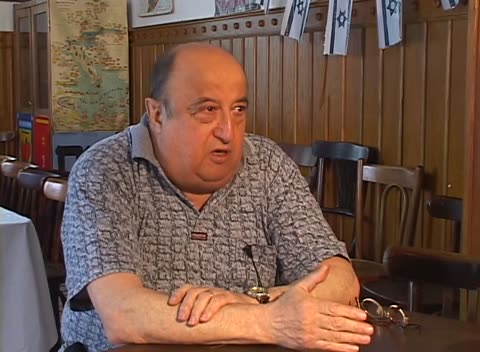
Finkelshteyn speaks about prewar cultural life during the visit of the Abraham Goldfaden memorial. The camera then collects footage of the memorial.
From the machine transcript
Speakers at the Goldfaden memorial in Iași talk, in garbled transcript, about a Jewish hospital or old-age home and Jewish theater, apparently with reference to Goldfaden and the Romanian theater. The camera is probably recording the memorial.
The transcript suggests talk of an old-age home and early Yiddish theater.
The formal interview with Abraham Shtaigman at the community center begins. He provides personal information and talks about his life after World War II. His family was deported to Transnistria in 1941 and returned to Rădăuţi in 1944. Shtaigman also speaks about his education. He attended a religious school (cheder), Romanian school and then studied in Bucharest for three years, before continuing in Iaşi for another two years. Shtaigman got married in 1966 and raised two daughters. Shtaigman worked as accountant at a local furniture factory for thirty years. For the past nine months, Shtaigman works as accountant for the community.
From the machine transcript
Kerler opens the formal interview, giving the date and asking how Jews say the name Iași. Shtaigman says he was born in Rădăuți in 1937, was deported to Transnistria in 1941 and returned in 1944. He attended cheder briefly, then Romanian school and lyceum, studied in Bucharest and Iași, married in Iași in 1966 and had two daughters. He worked about thirty years as a bookkeeper at a furniture factory and has been the community's bookkeeper for nine months.
Adds Shtaigman's studies in Bucharest and Iași and the lyceum.
Shtaigman speaks about contemporary Jewish and religious life in Iaşi. He also speaks about his family, including his parents-in-law.
From the machine transcript
Shtaigman describes the Iași Jewish community as well organized, with daily programs and a youth organization headed by his younger daughter. He tells about his wife's family, especially his father-in-law, who ran a kosher restaurant that was nationalized after the war, and about his in-laws' piety and emigration to Israel. His daughters do not speak Yiddish, though they understand it, and Kerler asks the family name (Gelberg?).
Adds the father-in-law's restaurant and the daughters' language.
Shtaigman briefly discusses his childhood memories of Transnistria. He also provides information about his family. His father was born in Rădăuţi and his mother in Frătăuţii. Shtaigman's parents were workers cleaning and fixing shoes. Shtaigman grew as an only child.
From the machine transcript
Asked what he remembers from before the war, Shtaigman says mainly Transnistria. He names his parents, Binyomin Leyb and Miriam (née Shnayder), his father born in Rădăuți and his mother in a nearby village (Frătăuți). Both parents worked making brushes for cleaning shoes. He recalls one grandmother who was in Transnistria with them, and Kerler asks where in Transnistria they were.
Adds the grandmother and the brush-making work of both parents.
Shtaigman speaks about his life during the war and explains how his family was deported to Transnistria via the river Dniester, Mohyliv-Podilskyy and a kolkhoz in Dzurin. He recalls how his father was beaten by a Romanian soldier. Shtaigman's family was confined to the Dzhurin ghetto and lived with local family. He then speaks about life in the ghetto for three and half a years.
From the machine transcript
Shtaigman describes the night-time expulsion of the Jews of Rădăuți and the march to the Dniester, where a gendarme struck his father over a cap. They were held in Mohyliv-Podilskyi, then briefly in a former kolkhoz and in the town of Dzhurin. There the family lodged with a Jewish tinsmith for over three years, all ill with typhus, and his father's heart was affected. They survived by selling gold teeth for food until the Russians arrived in 1944.
Adds the tinsmith's household and the typhus illness.
Shtaigman talks about the liberation of the ghetto by the Red Army in 1944 and his family's return. He explains that they were only able to go as far as Chernivtsi because the front line was still in Rădăuţi. Shtaigman continues that after six months staying in Chernivtsi, his family moved further to Mykhalcha, where his father passed away, and then they returned to Rădăuţi.
From the machine transcript
Shtaigman says Russian soldiers told them they could go home, and they travelled by train and truck to Chernivtsi, since the front was still at Rădăuți. They stayed about six months before moving to a place whose name is unclear (Mykhalcha?), where his father died in August 1944, at the age of thirty-two. He and his mother then returned to Rădăuți.
Shtaigman talks about his family's arrival in Rădăuţi in 1944. Shtaigman lived in Rădăuţi from 1944 to 1952. He mentions that his mother planned to make aliyah with him, but ended up remarrying instead. Shtaigman then talks about postwar Jewish life in Rădăuţi. Shtaigman moved to Iaşi in 1966.
From the machine transcript
Shtaigman recalls returning to Rădăuți and finding their small house and his mother's family dead in Transnistria. They lived there until 1952 and then sold the house instead of emigrating to Israel. His mother remarried a baker, a good stepfather who died in 1965. He attended school and lyceum in Rădăuți, where a few thousand Jews remained after the war, but they dwindled. After studying and working, he moved to Iași in 1966. He says Yiddish in Rădăuți was somewhat more Litvak-like (Polish-Jewish) than in Iași.
Adds the stepfather and the comparison of Yiddish in Rădăuți and Iași.
Shtaigman speaks about his Yiddish language and literature education in Rădăuţi after the war for approximately five years. He then addresses prewar war life in Rădăuţi and his life in the 1960s. In particular, Shtaigman remembers how a large majority made aliyah.
From the machine transcript
Shtaigman says he studied Yiddish for four or five years after the war with a lawyer and Yiddishist teacher who had a large library and taught Yiddish literature. His religious education was minimal, with a stepfather who was somewhat communist. He says Rădăuți was multilingual (German, Romanian, Yiddish, Ukrainian, Russian) and describes the prewar population of about eight thousand, mostly Jews. Most Jews left for Israel in the later 1960s, leaving few young people.
Adds the multilingual prewar Rădăuți and the figures on its population.
Shtaigman talks about postwar religious life in Rădăuţi, specifically active synagogues. He also speaks about his family, as well as a contemporary film project about the Jews of Rădăuţi.
From the machine transcript
Shtaigman describes postwar synagogues in Rădăuți: two large ones, a small one, and shoemakers' and tailors' synagogues. He visited Rădăuți often after moving to Iași, and his mother later came to help with the children. He discusses a film by an American about the Jews of Rădăuți and a photo album, mentioning that locals felt they were filmed unflatteringly, and the community bath was demolished. Kerler asks about the word for 'built' as used by old people, then returns to the Litvak speech question.
Adds a film project, the photograph album and a vocabulary question.
Shtaigman addresses Yiddish dialects and Jews from other regions.
From the machine transcript
Shtaigman explains that 'Litvak' speech in Rădăuți was like that of Polish Jews, with the vowel a pronounced differently, and Kerler gives examples of word forms. Polish Jews came to Rădăuți fleeing the Germans during the Second World War, and earlier Jews came from Austria and Czechoslovakia after the First. Kerler then turns to Transnistria.
Shtaigman talks about daily life in the ghetto, specifically obtaining food. His father was taken to forced labor in Sharhorod. He then speaks about prewar life in Rădăuţi and remembers positive relations between Jews and non-Jews. Shtaigman mentions that his non-Jewish neighbor, a police officer, warned his family about the imminent deportation.
From the machine transcript
Shtaigman describes daily life in the Transnistrian ghetto: obtaining food, buying from nearby villages, bread made from flour, potatoes, and aid sent from Bucharest through a woman named Albrecht (?). His father was sent for forced labor to Sharhorod for two years until a Romanian sergeant from Rădăuți sent him back ill. He says Jews and non-Jews in Rădăuți got on very well, and a neighbor who was a police officer warned them two days before the deportation.
Adds the forced labor in Sharhorod and the aid from Bucharest.
Shtaigman speaks about his life after the war and involvement in Jewish youth organizations, including Habonim Dror. He then speaks about his Jewish education after the war. Shtaigman states that he enjoyed Yiddish-language education until the end of his secondary school education. He also maintains that out 26 pupils 21 were Jewish in eleventh grade.
From the machine transcript
Shtaigman recalls going as a child to Jewish youth associations (Dror Habonim), where they sang and danced and spoke Yiddish and Romanian. He remembers Sholem Aleichem works (Tevye, Motl) from his Yiddish teacher but no poetry. He studied Yiddish in school until the lyceum, but few Jewish pupils were left, and in the last year 21 of 26 were Jewish. Kerler asks why the Jewish schools closed, and he adds that at the Iași furniture factory most of the staff were Jews.
Adds the Sholem Aleichem works read with his teacher.
Shtaigman speaks about his life and work in Iaşi. He maintains that out of 24 functionaries in the furniture factory, 23 were Jewish. Shtaigman then addresses postwar emigration.
From the machine transcript
Shtaigman says that almost all the functionaries at the Iași furniture factory were Jews, and that the last Jewish carpenter died a year before his retirement. Kerler asks why the Jews left; he says they went to Israel and Germany, Bukovinian Jews especially to German-speaking places because they came from Austria. Kerler then turns to food and fish.
Shtaigman speaks about food customs, in particular his mother's fish dishes. He then talks about postwar Yiddish culture, particularly amateur theater performances.
From the machine transcript
Shtaigman discusses fish dishes his mother made, boiled and chopped or stuffed (gefilte) fish, the sweeter taste and his wife's views on fish. He then talks about Yiddish theater coming to Rădăuți monthly after the war, including an actress Dina Chernik (?), and amateur performances by children organized by the democratic Jewish committee. He mentions seeing Yiddish theater in Kishinev in 1982 (?).
Adds fish dishes and touring actors.
Shteigman addresses postwar Purim celebrations, organized by youth organizations in Rădăuţi.
From the machine transcript
Shtaigman and S2 describe postwar Purim in Rădăuți: children dressed in masks and went from house to house, with Jewish families living close together. Kerler asks what they said and about costumes such as a chimney sweep, with a figure with a big nose, but they do not remember the greeting. They mention hamantashn that his wife is expert at making.
Shtaigman answers questions about cultural terminology. He also addresses folk and healing customs. Shtaigman mentions that his mother practiced cupping therapy.
From the machine transcript
Kerler asks questions about cultural terminology and Shtaigman answers, with some help from S2: the meanings of dibbuk, golem, a good Jew (pious man or good person, and a hasidic rebbe), a good place (a cemetery), the difference between a rov and a rebbe, and the expression for extinguishing coals (against the evil eye). They also discuss vodka at Purim.
The catalogue's mention of cupping therapy does not appear clearly; the transcript shows the dibbuk, golem and 'good Jew' questions and a coal-extinguishing expression.
Shtaigman talks about traditional weddings after the war. He states that his wedding in 1966 was celebrated traditionally. Shtaigman also addresses contemporary Jewish life and how the community obtains kosher meat.
From the machine transcript
Shtaigman talks about his wedding in Iași in 1966, held under a chuppah with a marriage contract and a rabbi who left in the early 1970s, after which only a shoykhet remained. Kosher meat now comes through slaughterers from Ukraine, perhaps Kyiv. He and S2 say klezmer music was played at weddings, often by Gypsies who spoke Yiddish, and mention a woman professor and poet from Rădăuți. Kerler then moves to the language questionnaire.
Adds the Gypsy klezmer musicians who spoke Yiddish and the woman poet.
Shtaigman answers dialectological questions from the AHEYM Yiddish linguistic questionnaire.
From the machine transcript
Shtaigman, helped by S2, answers questions from the dialectological questionnaire: greetings and thank-you forms, animal and body words, colors, adjectives and adverbs of time, speed and distance, kinds of illness, verbs of liking and running away, words for non-Jews, and a sentence to translate, with forms heard in Rădăuți. They compare Yiddish and German forms and note that he speaks more Yiddish since working at the community.
Shtaigman briefly speaks about Polish migrants to Rădăuţi in 1939. He then answers dialectological questions from the AHEYM Yiddish linguistic questionnaire.
From the machine transcript
Opens with a brief remark that many Jews came from Poland during the war and that the Russians came. Shtaigman then answers Kerler's dialectological questionnaire, with some prompts from Lemster. Items include kinship words (grandmother, midwife), shop and store, house and room, attic, hell, a rich man, enemy, face, spectacles, and numerals and measures such as one and a half. He also gives words for ceiling and floor, with some discussion of German versus Yiddish forms. He says which words he knows or has heard and which he has not.
The transcript shows the questionnaire running through kinship, household and numeral items, and the opening remark about Poland is brief and hard to follow.
The team concludes the interview with Shtaigman.
From the machine transcript
Kerler thanks Shtaigman and ends the interview. He hands over material describing the project and his address, and says something about the project's Romanian connection.