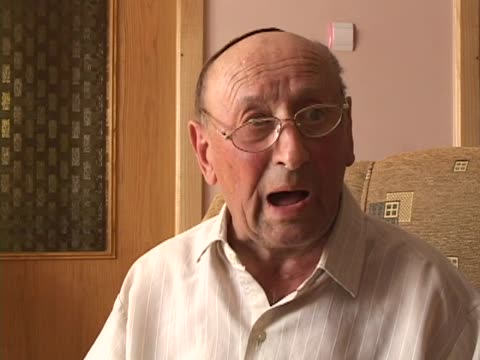
Nayman recites kaddish and other prayers that he learned from a Hassidic rebbe and cantor in prewar Klyachanovo. Nayman talks about his life in the Hungarian forced labor battalion in 1942, when he was "drafted" at the age of eighteen. His assignment was to build bunkers for the army. Then, Nayman was deported to the Mauthausen-Gusen concentration camp, from which he escaped. From Mauthausen, Nayman was sent to the Gunskirchen forced labor camp. He describes his experience there and explains that he was so hungry, he had to eat frogs. One of Nayman’s work assignments was to dig graves.
From the machine transcript
Nayman recites prayers, then answers Kerler's question about where he learned the prayer melodies, saying he prayed in the village synagogue. He recalls being taken into the Hungarian military at eighteen, in 1942, to dig bunkers, and then being taken to a camp in Austria (Mauthausen), from which he ran away. He describes a forest camp, hunger, eating grass, snails and a frog, being beaten, digging graves and surviving by playing dead. Kerler asks about the Yiddish words for some of these things.
Kerler asks the Yiddish names for food items such as grasses and snails; the recitations are only partly legible in the transcript.
Nayman recites prayers and recalls prewar Purim celebrations, including Purim shpiels. He then recites Sabbath songs (zemirot).
From the machine transcript
Nayman recalls how Purim was kept in the village before the war: he read the megillah, sent gifts (shalakhmones) and children performed Purim plays in the houses. He recites a rhyme from a Purim play and says it was about sixty years ago. He then recites Sabbath songs (zemirot) and other prayer texts, with Kerler naming the zemirot.
Includes Kerler's questions about the term for Purim gifts and Nayman's rhyme from a Purim play.
Nayman talks about his childhood memories and his family, in particular his father taking care of the cattle. He remembers different folk customs. Nayman then recalls the prayer books he studied with in cheder. He then recites prayers.
From the machine transcript
Nayman talks about his father's work with cattle, making cheese and carrying dairy goods weekly to his grandfather. He gives his own name and the added name Khayim given when he was ill, and answers Kerler's questions about folk customs such as extinguishing coals in water against the evil eye and spitting. He then speaks about learning to read Yiddish and Hebrew in cheder at about thirteen, the books he used, his Czech school, and some Hungarian, and recites prayers.
Adds the evil-eye customs, the discussion of languages he could read, and his name-change after illness.
Nayman talks about his family, in particular his father. Nayman helped his father carrying food items. He then talks about contemporary religious life.
From the machine transcript
Nayman recalls his father, who sometimes hit the cows, and how he himself carried dairy goods to be sold, with gendarmes sometimes stopping them. A talk follows, about an American Jew who came each year to pray at a grave, and cantors and teachers in a nearby town (the name is unclear), with names such as Yitskhok Eyzik Yankevitsh. Kerler questions him about prayer at various places.
Adds the American visitor who prayed at a grave and the cantors in a nearby town, beyond the father and the cart of goods.
Nayman talks about prewar Jewish life in Klyachanovo, including occupations and political organizations. He remembers book peddlers from Mukacheve. Nayman then discusses prewar holiday celebrations and remembers non-Jews who spoke Yiddish. Nayman then answers terminological questions and recalls food customs.
From the machine transcript
Nayman describes prewar village life: a stone synagogue, work on the land with cows and horses, two or three shoemakers and some tailors, doctors available only in Mukachevo, and a book and religious-goods peddler from Mukachevo. He also covers Zionist and other political groups, non-Jews who spoke Yiddish, and how Jews from different countries spoke. Kerler asks about terms for Hanukkah and Sabbath foods, Hebrew letters, wells, the oven, cemeteries, and the shoykhet, and Nayman recalls foods for Passover, Shavuot and before Yom Kippur.
Adds the Hebrew alphabet recited by Nayman, the shoykhet and teacher, and the many food and dialect terms elicited.
Nayman talks about childhood friends and Jewish life before the war. He remembers the Yiddish names of surrounding towns and answers questions about cultural terminology. Nayman then recites prayers.
From the machine transcript
Nayman and Kerler talk about a man named Lebovitsh (?) and his father Binyomin, who worked for Nayman's family and lived in a village near Munkács. Kerler asks about a rabbi from Romania who set up a prayer house and mikveh in Munkács. Nayman gives the Yiddish names of nearby towns (including Rakhiv, Khust, Berehove (?), Uzhhorod and Bila Tserkva) and answers questions on the dybbuk and the golem. He also tries to recall prayers.
Adds the dybbuk and golem questions and his attempts to recall prayers.
Nayman talks about prewar Jewish life, in particular the wedding of Rabbi Chaim Elazar Spira's daughter in Mukacheve. He then remembers his studies with the rebbe of Mukacheve and describes several prayer houses.
From the machine transcript
Nayman recalls the wedding of the Munkács rabbi's daughter, with many rabbis present and the groom's learning, and says it lasted a day. He describes studying under the Munkács rebbe, taking notes at lessons and having them checked. He then describes the synagogues, study houses and prayer rooms of Munkács, and how a shul, a besmedresh and a shtibl differ. He mentions the two parts of the prayer house in Klyachanovo.
Adds the distinction between shul, besmedresh and shtibl and the Klyachanovo prayer house.
Nayman talks about his return after the war and his family. He then discusses his life during the war. He was taken for forced labor in 1942.
From the machine transcript
Nayman describes coming home after the war to find his parents gone, not knowing where they were killed; he says Kaddish for them yearly. He gives approximate birth years for his parents and says he was taken into the military in October 1942. Kerler asks what he knew then of the killing of Jews; Nayman says he knew little and heard only of deportations to Germany.
Adds what Nayman knew in 1942 about the killing of Jews, and his parents' possible fates.
Nayman briefly talks about his life during the Soviet period. He owned a vineyard and produced wine. He then answers a number of dialectological questions from the AHEYM Yiddish questionnaire.
From the machine transcript
Nayman briefly says that after returning he got his vineyard back, made some wine and sold grapes. He then answers questions from the dialect questionnaire, including the Yiddish for 'cross', 'honest' and 'believing', words for mistake and certainly, a sentence translated from Russian, and 'who does this child belong to'. He also answers questions on 'cart', 'quick', 'sick' and 'barely'.
Adds the vineyard and wine production, and the kinds of items in the questionnaire.
Nayman recalls episodes from his life during the war, including hiding in a pit. He then talks about his liberation by the Americans. He explains how the first food they had was sugar. After his liberation, Nayman became sick with typhus and stayed at a hospital for one a half months. He then talks about the reparation payment he receives from Germany.
From the machine transcript
Nayman recalls hiding in a pit and sleeping on the ground in the camp. He describes the Americans arriving and the first food, sugar. He fell ill with typhus and was in a hospital, and later tracked down the German support he now receives. Kerler and Nayman compare this with his Israeli and Ukrainian incomes.
Adds the comparison of reparation payments from Germany with Israeli and Ukrainian incomes.
Nayman answers a number of dialectological questions from the AHEYM Yiddish questionnaire.
From the machine transcript
Nayman answers a long series of questionnaire items put by Katz and Kerler. The items include words for paradise and hell, shop, potato, bag and mouse, the greeting 'good day', 'please' and 'thank you', and 'to build'. He also gives words for near and nearer, window panes, sour, stone house, bricklayer, cold and colder, and high and higher. Several translations from Russian are involved, with S2 and S3 prompting in Russian or Ukrainian.