People › Moyshe Smelanskii › conversation

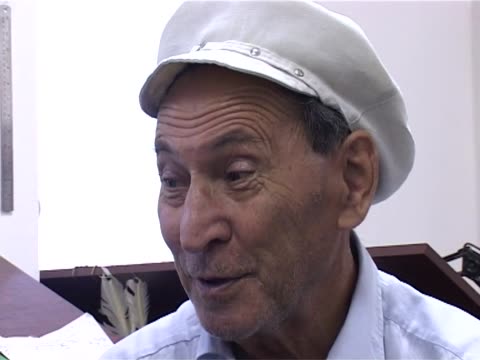
Moyshe Smelanskii; Natan Shapiro

Kyiv 7 July 2002 Interviewed by Dov-Ber Kerler, Jeffrey Veidlinger, Dovid Katz, Anatolii Kerzhner 4.0 h · 6 parts on 6 tapes
Loading the player…
  1. MDV 490 0:00–39:20 · 39 min · not online — MCO
  2. MDV 491 0:00–39:51 · 40 min · not online — MCO
  3. MDV 492 0:00–38:16 · 38 min · not online — MCO
  4. MDV 493 0:00–41:08 · 41 min · not online — MCO
  5. MDV 494 0:00–41:09 · 41 min · not online — MCO
  6. MDV 495 0:00–40:54 · 41 min · not online — MCO
Passages
MDV 490 0:00–39:20

0:00

Setting up the interview.

From the machine transcript

Setting up before the interview: arranging a room and a place to sit, with scattered talk among Kerler, Katz and the interviewee, partly in Russian. The speech is largely garbled; at the end the interviewee says they are meeting in the Brodsky Synagogue in Kyiv.

2:22

Education and family.

From the machine transcript

Smelanskii greets the interviewers, then talks about Yiddish schools in Smila from the 1920s to the mid-1930s, including a Yiddish technical school. He recalls a director and devoted teachers, classes up to the seventh grade, and moving afterwards to a Ukrainian school. He also mentions his maternal grandfather, who taught the grandchildren religion, prayer and Hebrew, and the grandfather's seven children, some of whom emigrated to America.

adds the grandfather's teaching and relatives in America

6:37

Family.

From the machine transcript

Smelanskii recalls his grandfather, a respected man in Smila to whom people came with questions, and the six or seven synagogues that stood until 1941. He lists uncles, aunts and cousins with their names, occupations and places (Moscow, Cherkasy, Kharkiv, Israel), says that relatives were evacuated or killed at Babi Yar in 1941, and mentions an uncle who ran the printing house of the Smila newspaper. He also says his father worked on the railway.

adds the extended family tree, relatives' occupations, the newspaper uncle and killings at Babi Yar

14:33

Early childhood memories.

From the machine transcript

Smelanskii answers questions about childhood games, saying there were none beyond street gangs and fights. He explains the difference between a lane and a street in Smila and describes the town's rivers, the old mill destroyed by the Germans, and the two sugar factories, one of which was wrecked in the war. He also tells how the town changed after the war, and Kerler starts asking about Yiddish newspapers.

adds the geography of Smila (rivers, mill, sugar factories) and the lane/street terms

19:02

Yiddish culture.

From the machine transcript

Smelanskii says Yiddish newspapers came from Kyiv and Moscow, and names classic writers such as Sholem Aleichem and Peretz, while saying no Yiddish writers visited Smila. He notes that young people left for institutes in the big cities before the war. He does not remember songs and says he was not a singer, and describes his work as a machine builder, with thirty-six years at one factory, and then as a dental-clinic mechanic making apparatus.

21:56

Education and work.

From the machine transcript

Short exchange in which Smelanskii says he made only the apparatus, not the teeth, in the dental clinic; Kerler then begins asking about the postwar years.

22:35

Life during the war.

during the war World War II (general) MDV 490 · MCO
From the machine transcript

Smelanskii tells of four years at the front, being wounded twice, and service that began in the infantry and continued as a machine-gunner and then in the artillery. He mentions the Donbas and the Caucasus, hospital after his second wound, and staying in the army until 1948. He says he has lived in Kyiv since 1984, and that his first wife died in 1983 and a second wife died after five years.

adds his move to Kyiv and the deaths of his wives

24:53

Dialectology and prewar cultural and religious life.

From the machine transcript

Answers questions about Smila's synagogues and prayer houses, saying there were six or seven because Jews could not walk far on the Sabbath, and Kerler asks about the sabbath limit (tkhum shabes). He also says there were klezmer musicians, with violin, flute and drum, who played at weddings, and recalls the chuppah, and that the 1930s brought some pressure on religion. Kerler then begins a question about Jewish–non-Jewish relations.

adds the reason for the many synagogues and the sabbath-limit question

29:18

Relations between Jews and non-Jews.

From the machine transcript

Smelanskii says many non-Jews in Smila spoke Yiddish. He tells of a Ukrainian priest near the monastery who knew the Jewish children, greeted Jews respectfully and had them pick apples in his orchard. Katz then asks about his earliest memories.

adds non-Jewish Yiddish speakers and the question that opens the earliest-memories passage

32:26

Earliest childhood memories and family.

From the machine transcript

Asked by Katz about earliest memories, Smelanskii says he cannot recall them, and does not remember his grandmothers. His paternal grandmother lived in Cherkasy, and a paternal aunt's children included a son killed in the war. He says his father built a small prayer house after the war on returning from evacuation, and describes how a minyan needed official permission and a list of members. Katz asks about prayer and Russian is spoken at the end.

adds his relatives and the permission and list needed for a minyan

37:00

Religious customs.

From the machine transcript

Katz asks about childhood prayers: the morning prayer modeh ani, the blessing over bread and the Passover seder with the four questions. Smelanskii recalls little and says he reads the Haggadah now. He mentions that he had asked someone about the Torah portions before the interview, and Kerler intervenes when the questioning sounds like an exam.

MDV 491 0:00–39:51

0:00

Reading prayers and holidays.

From the machine transcript

Katz and Kerler ask Smelanskii how things were said and done before the war: prayers read or sung, Passover songs, and a Passover play. He says he does not read them any more and recalls little. He recalls Hanukkah dreidels and small children being led into the synagogue with a flag and a red apple, probably on Simchat Torah. Kerler also asks about latkes made from rye flour or potato, and what the children threw at old men's beards. Katz then begins the Russian-to-Yiddish word questions.

The passage includes Hanukkah, Simchat Torah and latke questions as well as the reading of prayers.

4:02

Dialectology and explanation of AHEYM project.

From the machine transcript

A long dialectological questionnaire in which Kerler and Katz give Russian words and Smelanskii supplies the Yiddish, often commenting in Russian. Items include adjectives for sadness and joy, breathing and difficulty breathing, prophet and Elijah the prophet, "another story", one and a half, the afikoman, attic, potato, hen and rooster, blue, build, mouse, window pane, pigeon, soup, groats and deaf. He also contrasts how speakers in Smila and Cherkasy say some words. Near the end Kerler and others explain the archive project in Russian and Yiddish, as a video archive for scholars and students, and talk about consent forms.

The passage also contains an explanation of the archive's purpose and consent paperwork, and comparison of local Ukrainian usage.
31:22

Family and concluding the interview.

From the machine transcript

After some talk about water and apologies for the long questioning, Kerler and Katz ask about Smelanskii's family. His grandfather and earlier forebears were from Smila, his father from Cherkasy, and his mother from Smila. The father's and mother's names are given, but the transcript is unclear. Questions then turn to synagogue and blessing terms: the one who stands at the lectern, the cantor's place, a blessing after recovering from illness or returning from war, and the thanksgiving blessing.

The passage also includes a questionnaire on synagogue and blessing terms.

MDV 492 0:00–38:16

0:00

Dialectology.

From the machine transcript

Smelanskii answers Kerler's dialectological questionnaire, with Katz adding follow-up questions. The items include the present-tense forms of the verb 'to come' and the 'you are right' paradigm with its pronouns. Others are the plural of words such as wagon, rich man (gvir) and devil, and 'to give' versus 'to present' in the case of a book and a charity gift. Further items are words for a well, a well-sweep and a bucket, a spinning top and a strong gentile, rich and poor people, the world to come, hell and purgatory, the Purim food, and household words such as a mess, a floor and a fence. He frequently gives Russian or Ukrainian equivalents, comments in Russian, and sometimes says he does not remember or does not know a Yiddish word.

Beyond dialectology, the passage includes Purim food, charity gift terms, and talk of the world to come and hell.

33:55

General conversation and footage of synagogue.

InformalFootage MDV 492 · MCO
From the machine transcript

The questionnaire session winds down into informal talk, mostly in Russian, between the interviewers, Smelanskii and another person, about finishing the page and sitting for a few more minutes. There is also talk of a power socket for the equipment. Near the end Katz asks Smelanskii the year he was born and about the war years, and Smelanskii turns to a Russian conversation about a phone call to someone's son. The catalogue's footage of the synagogue is not evident in the transcript.

Shows the questionnaire winding down with talk about a power socket, and Katz's questions on birth year and the war years.

MDV 493 0:00–41:08

0:00

Dialectology.

From the machine transcript

Questionnaire work with Smelanskii. Kerler asks how to say the year of his birth and ordinal numbers, then a series of everyday words such as room versus small room, cheder, pencil and pen, and the Friday evening before Sabbath. He goes on to the difference between a rov and a rebbe, forms of the verb for speaking, and the names Samuel and Shmuel. The last part covers the siddur and tefillin, and whether there were Hasidim in his town; Smelanskii says there were several rabbis but no Hasidim.

The passage also includes personal-name forms, the rov/rebbe distinction and tefillin, and the statement that there were no Hasidim in his town.

14:46

Religious groups and synagogues.

From the machine transcript

Smelanskii talks about the religious groups and prayer houses in his town before the war. Each trade had its own synagogue: tailors, shoemakers and others. He also mentions a distinction between groups in prayer (the transcript is unclear on the details). At the end Kerler starts a new question about stories of love affairs opposed by parents.

The passage names trade-based synagogues and ends with Kerler's question about opposed love matches.

15:35

Dialectology.

From the machine transcript

Further questionnaire items put to Smelanskii by Kerler and Katz: words for bedbug, a branch or bough, spit, a pipe and the pair, going to court, and thanks. They also cover blessing someone for success, a doctor and a medical assistant, a flower, a shop and goods, and 'almost' and 'approximately'. Smelanskii often says he does not know or has not heard a word, and Kerler thanks him at the end. The last lines are partly Russian aside.

22:39

Contact information.

From the machine transcript

The team exchanges contact information. Business cards are given, and Katz and Kerler are identified by name for the informant, who wants to note their names. The conversation moves into Russian and the speech is largely garbled in the transcript. At the end Kerler brings up payment, in hryvnias or dollars.

26:58

Location of Smila.

From the machine transcript

Smelanskii addresses Jews in America with wishes for peace in the world and help for the Jews of Israel. Katz and Kerler then ask where Smila lies and what kind of Jews lived there. He says they were Ukrainian Jews, that he was born there, and that the town held ten to twelve thousand people, about thirty percent Jewish. He adds that few Jews remain and that many emigrated to Israel, and mentions his father's wish to see the Jewish land.

The passage adds that the numbers are about 10–12 thousand inhabitants, thirty percent Jews, and the present-day Jewish decline.

30:32

Israel.

From the machine transcript

Smelanskii talks about his visit to Israel. He was there for some years (the exact period is unclear in the transcript) and mentions Jerusalem, Haifa and a place called Kiryat Malakhi. He also met invalids there and compares farming and irrigation in Israel with his own surroundings.

33:30

Work and friends.

From the machine transcript

Smelanskii says he worked as an electrician. His father cast mines for the front during the war and before the war worked on the railroad clearing the tracks of snow, and after the war lived as a pious Jew on a pension. Katz then asks about close friends in Kyiv; Smelanskii lives alone but has friends at the synagogue. S2 begins a question about food in the town.

The passage adds Smelanskii's own occupation as electrician and his present friends and life in Kyiv.

36:00

Food customs.

From the machine transcript

S2 asks what was eaten and cooked in the town, and Smelanskii describes Sabbath food and everyday dishes such as homemade noodles, kasha and potatoes. His father was a shoykhet who slaughtered only fowl. Smelanskii himself learned shehitah, kept his father's knife after his death, and slaughtered for those who came to him. Knife sharpness is discussed, and the transcript is partly garbled.

The passage adds Smelanskii's own training as a shoykhet and his slaughtering of fowl after his father's death.

MDV 494 0:00–41:09

0:00

Food customs and life today.

life today FoodLife today MDV 494 · MCO
From the machine transcript

A second informant answers questions about food at weddings. He explains how a knife was sharpened on a nail, and says every Jewish household made a noodle kugel for the Sabbath. He recalls a Sabbath visit to a synagogue in Israel, where the rabbi sent a kugel to his home. The interviewers thank him and the interview closes with wishes for a reunion.

Also covers knife-sharpening, a visit to a synagogue in Israel, and the closing thanks.

2:33

Life and family today.

From the machine transcript

Shapiro thanks the interviewers for finding him in Kyiv and speaks of a letter he has from people who went to Israel. He talks about his grandchildren, one of whom has gone to America and is a computer specialist. He then begins to give personal details, saying he is one of ten children and naming his father.

Shapiro also gives his father's name and says he is one of ten children.

7:19

Family and teaching Yiddish.

From the machine transcript

Shapiro, the last surviving child of his family, describes how he brought a man named Levitas (?) into the Jewish society in Kyiv. He asked him for the chance to teach Yiddish and Hebrew in a synagogue hall, and says he taught on alternate days. Kerler asks about the years, and Shapiro places it perhaps thirty years back. He begins to speak of the family travelling to Odesa.

Also mentions the Kyiv Jewish society, the Soviet-period question from Kerler, and the family trip to Odesa.

12:07

Life during the Soviet period and family.

From the machine transcript

Shapiro says two of his brothers left during the Petliura time, and that his father was an elder of the synagogue in Vinnytsya. He speaks of the elders' society and the wish that its members live to a hundred and twenty. He ends by explaining the name Ilya to a man in the society.

Adds the elders' society and the brothers' leaving at the time of Petliura.

15:34

Life today.

life today Life today MDV 494 · MCO
From the machine transcript

Shapiro tells how he explained a name and a father's name to the head of an elders' society, and he sent a book of his own. He says the man later became editor of a Jewish newspaper in Ukraine and received an order. Kerler tells him the interviewers are interested in Shapiro himself and ask him to tell his own story.

18:51

Childhood memories and family/neighbors.

From the machine transcript

Shapiro says he wrote down in notes as a child which regime came to town, including Petliura. He says rabbis began to be shot under the first Soviet power. He recalls that his parents left Vinnytsya quietly in 1928 and went to Odesa, and he names his parents Yosef ben Yankev and Etele. He tells how his parents of ten children took in a refugee family from a pogrom in Kalinovka, since the house had five rooms. Kerler asks the names of his siblings, and he lists them: Yitskhok (Eyzik), Moyshe, Nakhmen (himself fourth), and the sisters Khaye Gitl, Leye, Rokhl, Rivke and Anele.

Adds the pogrom refugees in his parents' house and the full list of siblings.

31:29

Life today and booklet with family information.

From the machine transcript

Shapiro describes a questionnaire from a Jewish institute in Kyiv about his family, and the booklet he made with family information and photographs of old Kyivans. Kerler says the team is going to Vinnytsya the next day. Shapiro recalls that no pogrom occurred in his town. He shows photographs of his parents, siblings and sisters to the camera, with Katz and Kerler naming them. He says one brother is in Israel and another fell at Stalingrad.

Adds the Kyiv institute's questionnaire, a brother killed at Stalingrad, and photographs.

MDV 495 0:00–40:54

0:00

Showing photographs.

From the machine transcript

Informal talk over photographs. Shapiro identifies himself and his wife, who died not long ago, in a picture. There are exchanges about where people lived, one of them in English and Russian. Shapiro touches on his army service. Kerler then asks Shapiro to tell more about his childhood and earliest years and his kheyder teacher.

3:01

Childhood memories and religious life in prewar Vinnytsya.

From the machine transcript

Kerler and Katz ask Shapiro about Jewish life in Vinnytsya before the revolution, including holidays, prayer and observance. Shapiro recalls a Jewish town with five rabbis and five synagogues, among them the Sandagerska (?) synagogue with a separate women's section and the Krochyk synagogue with a children's choir. He describes Yerusalimka, the neighbourhood where he was born, and his father's search for a larger apartment in the centre. He mentions his late wife's written memory of a Vinnytsya wedding, and explains that his father Yosele was a dayan, who settled disputes and was more popular than the rabbi.

Gives the layout of the Vinnytsya synagogues and Yerusalimka, his father the dayan Yosele, and his wife's memory of a wedding.

11:19

Family photographs and family.

From the machine transcript

Shapiro shows family photographs, including relatives in Tel Aviv in the 1940s (?), and says one of them, a woman, studied piano and was a fine pianist. Kerler then asks about his kheyder and its teachers. Shapiro begins to explain why he ran away from it.

Moves from the photographs to the kheyder question.

12:55

Religious school (kheyder).

From the machine transcript

Shapiro tells how he left kheyder at age seven because he could not bear the rabbi's beatings. The teacher was not clever and hit the boys, and Shapiro climbed out of a low window and refused to return. He recalls praying to God and his grandmother telling his parents, and his father then took him to a craftsman, apparently a jeweller, to learn a trade. Shapiro dislikes it and later works as a woodturner and shows some turned objects. Kerler asks him about two kheyder pupils who became religious judges and about the names of things.

Gives the reason for leaving kheyder, the teacher's name (Azriel (?)), his apprenticeship and woodturner work, and a Yiddish word he is asked for.

23:08

Showing medals.

From the machine transcript

In part in Russian, Shapiro talks about his age at various points and mentions a document saying he was taken from Vinnytsya. Kerler asks about other prewar trades and tells him that interviewers trust the speaker more than papers. Shapiro says he was drawn away from Vinnytsya.

25:17

[missing details]

From the machine transcript

Shapiro says he was taken from Vinnytsya to a large factory in Kyiv, where he worked for some thirty years (?), and that a good reference praised his community work. He says he loved public work, was an idealistic communist, and was at the front during the war.

26:22

Red Army and life today.

during the warlife today Army serviceLife today MDV 495 · MCO
From the machine transcript

Shapiro recalls that during the war all officers were called out and told they must join the Communist Party, and he became a member. He mentions commanding a unit that built bridges and says he was given a large sum of money. He shows a small book and a document, partly read aloud in Russian by Kerler, praising him as an engineer and colleague for more than twenty years. Shapiro describes a recommendation for a better-paid post and a dispute about a trip to a place connected with Shevchenko. Kerler then asks about trades in Vinnytsya.

Covers his Party membership as an officer, his later engineering career, and a Russian testimonial read aloud.

32:03

Synagogues.

From the machine transcript

Shapiro and Katz discuss getting help to continue the interview, with Kerzhner of Kyiv suggested. Kerler asks about Jewish weddings in Vinnytsya, and Shapiro says his wife's sister told him about them. He recalls holding the wedding canopy poles as a child. He recounts that in his time two Jewish schools, Krupitsky's and Faynshteyn's, opened in Vinnytsya, and that in these schools many Jewish pupils were taught in Russian. One of them had a large hall where weddings were held. Kerler asks about the klezmer groups.

Adds the plan to get Kerzhner's help and the language of instruction.

36:28

Krochyk’s synagogue.

From the machine transcript

Shapiro describes the Krochyk synagogue before the revolution, with a choir of twenty and Yiddish singing, and funerals with a children's choir; Kerler and Katz question him about klezmer and music at weddings and burials. He says it was the finest synagogue, held services in Yiddish and was supported by wealthy members. Kerler and Katz ask him to sing a children's song, and he says he must prepare. He recalls being given a piano during the war by the wealthy Rabinovich, and being sent to Moscow to fetch an aeroplane and speaking with generals there. The passage ends as Kerler proposes a pause.

Adds the funeral choir, the piano gift, and the trip to Moscow.

Questions put in this conversation

Items of the dialect questionnaire asked here; each link plays the moment.