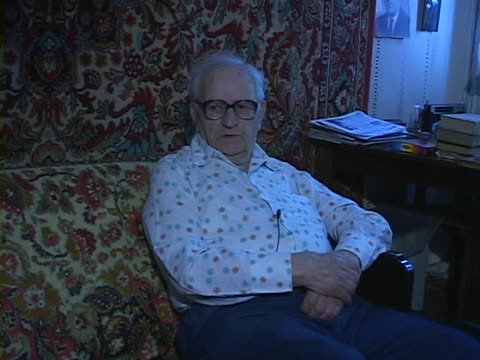
Sherman provides personal information and talks about his family. He attended secondary school in Orhei (Yiddish: Uriv). Sherman's father owned a leather shop. Sherman grew up with two sisters and two brothers. Sherman also addresses his family's fate during World War II.
From the machine transcript
Sherman gives his birth date and his parents' names and birth years, and says he lived in Telenești until the war and finished the lyceum in Orhei. His father had a small leather shop. He names his siblings, remembers his maternal grandmother, and tells how she stayed in Telenești and was killed with her son's family.
names the siblings and his grandmother's killing in Telenești
Sherman discusses his childhood memories of Telenești, particularly his education. He attended a religious school (cheder) from the age of five. Sherman describes the classroom. After his cheder education, Sherman attended a Moldovan primary school for four years before moving to Orhei for secondary education. Sherman graduated in 1938.
From the machine transcript
Sherman describes the cheder in Telenești, run by a poor rebbe with one wooden table, which he attended from the age of five. He then went to the Romanian primary school for four years and on to the Orhei lyceum. He answers Kerler's questions about his age at the time and says he finished in 1938 and took the baccalaureate in Chișinău.
Sherman speaks about his family. His grandmother owned a hardware shop. He then speaks about his life during World War II. Sherman describes his family's evacuation on a cart to Sineşti in 1941. They continued their journey on foot to the Grigoriopol district. Sherman explains that they crossed the Dniester river with the help of a Christian carter on a boot in order to get to Grigoriopol. Sherman eventually reached Stalingrad and evacuated further on a barge across to the Caspian Sea to Fort-Shevchenko, Kazakhstan. In Fort-Shevchenko, Sherman worked at a fish factory, before being drafted for his military service. In the Red Army, he moved to Almaty, Kazakhstan, where he repaired train cars. Sherman then moved from Tashkent, Uzbekistan, to Moscow, where he helped building a bridge. He then describes his daily life and work. From Moscow, Sherman moved to the Sverdlovsk district and then Dnepropetrovsk, Ukraine. In both places, he was working in bridge construction.
From the machine transcript
Sherman speaks briefly about his grandmother's ironware shop. He then recounts the 1941 flight from Telenești by cart, on foot, across the Dniester with the help of a Christian boatman, and by road to Stalingrad, then by barge on the Caspian to a Kazakh fishing settlement where he worked in a fish plant. Mobilized, he worked on railway-car repair in Almaty, then in a group from Tashkent on bridge-building near Moscow, and later in the Sverdlovsk and Dnipropetrovsk regions before being called back to Telenești.
Sherman speaks about his life after the war. He moved from Dnepropetrovsk to Bălţi, Moldova, where he worked as teacher. His family then moved to Chernivtsi and worked as chief accountant. In 1956, Sherman was married and moved to Chişinău. In Chişinău, he worked as chief accountant and then contract engineer. Sherman then speaks about his education. After graduation from high school, Sherman completed accountant courses and then studied at an institute in Moscow.
From the machine transcript
Sherman tells of his return after the war: his mother and sisters lived in Chernivtsi, where he took bookkeeping courses and worked as an accountant. He married and moved to Chișinău, where he became chief accountant and later an engineer. He also describes his further schooling: courses and a technical college in Moscow, and then an institute.
Sherman speaks about his life during World War II. He recalls how his hometown Telenești was set on fire by the Red Army. Sherman then addresses his religious school (cheder) education.
From the machine transcript
Kerler asks what games Sherman played as a child; he does not remember. He confirms that the Soviets set the road and the town on fire in 1941 to deny it to the Germans. He then describes the cheder: a poor rebbe, a plain table and the children learning Yiddish, Torah and blessings. He can no longer recall the prayers but says he reads Yiddish and Hebrew.
adds the questions about childhood games
Sherman shows his copy of a machzor (prayer book used on the High Holidays). He then reads excerpts from the prayer book.
From the machine transcript
Sherman shows the camera an old prayer book (a machzor, printed in Lemberg, with a date in the 1880s (?)) and explains that the Yiddish text in it was for women. He says he got it from a sister of his wife, and reads a little from it.
Sherman speaks about his life before the war. He explains how he frequently checked out books from the Yiddish public library and recalls discussion groups among the younger generation.
From the machine transcript
Sherman says he reads and writes Yiddish well and loved literature. He recalls the Yiddish library in Telenești, with works by Sholem Asch, Sholem Aleichem and translations of world literature. Young people read and met to discuss Zionism and communism; there were no formal debate evenings. The library was open to everyone.
Sherman reads "Unetanneh Tokef" (a liturgical poem part of the Rosh Hashanahh and Yom Kippur liturgy) from the machzor. He then returns to discussing the public Yiddish library.
From the machine transcript
Kerler asks whether Sherman knows Unetaneh Tokef; he recalls only part of it. Questions about the library follow: borrowing, whether books were paid for, and whether it held Romanian as well as Yiddish books. He says he read Tolstoy in Russian once he had learned it, and Sholem Aleichem in Yiddish.
Sherman speaks about his childhood memories. He recalls how his older sister read from Sholem Aleichem's books at home. Sherman then discusses Bessarabian Yiddish writers.
From the machine transcript
Sherman recalls how his eldest sister read Sholem Aleichem aloud at home to the children. Lemster asks about Bessarabian Yiddish writers: he met Moshe Pinchevski and mentions Eliezer Shteynberg, whose memorial inscription he has noted, and Bialik's poems read in Yiddish.
adds Pinchevski, Shteynberg and Bialik
Sherman addresses prewar Yiddish cultural life, particularly local drama circles. He also recalls performances by Sidi Tal. Sherman then talks about prewar religious life, particularly the synagogue structure in Telenești. Sherman also describes how he went to see a cantor in Orhei during his secondary education.
From the machine transcript
Asked about Yiddish theater, Sherman says local amateurs staged Yiddish plays and that Sidi Tal came to perform. Asked about synagogues, he says there was a large synagogue and separate shuls for shoemakers and tailors. His father's synagogue is not clearly identified, and he recalls the cantors' Yiddish prayers, which he went specially to hear as a gymnasium pupil in Orhei. He has recorded cantors on tape.
adds the synagogues of Telenești and his taped recordings of cantors
Sherman speaks about prewar religious life, specifically Hasidism. He recalls how his mother went to see a rebbe to get blessing for her home. He
From the machine transcript
Lemster asks whether Jews travelled to visit rebbes or righteous men; Sherman says they did when in trouble, and that his mother went to a rebbe, perhaps in Ștefănești (?), for a blessing on the home. Kerler and Lemster ask about folk healing and the evil eye; Sherman remembers nothing of it.
adds the questions about folk healing and the evil eye
Sherman talks about prewar holiday celebration, particularly Yom Kippur. He recalls how shopowners closed their stores to attend Kol Nidre services. Sherman then talks about Passover celebrations at home.
From the machine transcript
Sherman describes the Jewish holidays before the war: on Yom Kippur eve the shops on his street closed for Kol Nidre. At Passover his father led the seder, reclining on a couch and reading the Haggadah, with the children asking the questions. Sherman does not remember who asked.
Sherman addresses his father's observance and prayer customs.
From the machine transcript
Sherman talks about his father's prayer and observance: he knew the Jewish melodies well, prayed at home, and knew the prayers sung after the Torah reading. Kerler checks which prayers he means, and Sherman says the cantor chanted them to a melody.
Sherman speaks about food customs, including Sabbath and Purim dishes, at home. He then speaks about prewar Purim celebrations.
From the machine transcript
Sherman describes his mother's Sabbath and holiday food, especially gefilte fish (not peppery), sweet-and-sour meat, and a yellow cake at Purim; at Hanukkah children played with dreidels. He says there was no Purim play in Telenești, only the custom of noisemakers in the synagogue. When pressed he says amateurs staged Yiddish plays at Purim.
Sherman speaks about life before the war. He then speaks about prewar Zionist organizations, specifically meetings organized by Gordonia. Sherman recalls chalutzim. Sherman explains how chalutzim from Eretz Yisrael spoke at these meetings.
From the machine transcript
Sherman answers questions about non-Jews in the Telenești fire brigade (there was no organized brigade) and about prewar youth movements. Gordonia met in a hall for dances and heard speeches from visiting pioneers (chalutzim) from Palestine, and some friends emigrated. He also tells of clandestine communist literature smuggled in from Bucharest, in Yiddish translations, and of reading Freud.
adds the fire-brigade question and clandestine communist literature
Sherman speaks about his life before the war. He also speaks about his family. His parents were born near Telenești. Sherman then mentions how he met his wife in Orhei and was married before the war.
From the machine transcript
Sherman says his mother did not sing to the children, because life was hard and earning a living the main worry. His parents were born near Telenești, and his grandparents are said to have come from Poland. He met his future wife while studying in Orhei, through friends; they married before the war in a civil ceremony without a chuppah.
adds the grandparents' Polish origin and the civil marriage
Sherman talks about prewar traditional weddings in Telenești. He recalls Moldovan musicians. Sherman then answers questions about cultural terminology.
From the machine transcript
Sherman remembers that in Telenești weddings had a chuppah and music from a small klezmer band, with Jewish dances; the musicians were non-Jewish Moldovans who had learned the tunes. Kerler then asks terminology questions: the plural of rov and rebbe, and the meaning of a "good Jew".
Sherman shares a Hasidic anecdote about visiting a rebbe. He then continues to answer questions about cultural terminology and adresses Yiddish dialects.
From the machine transcript
Sherman tells an anecdote about a Moldovan who asked for the "good Jew" in a town, meaning the rebbe, and was told that all the Jews were good. Kerler and Lemster ask about the phrase "a good place" (meaning the cemetery), words for Lithuanian Jews and Galicians, Hasidim and misnagdim, Polish Yiddish and proverbs; Sherman answers only partly.
adds the questions on Lithuanian Jews, Galicians, Hasidim, misnagdim and proverbs
Sherman speaks about prewar Yiddish cultural life. He recalls performances of "The Dybbuk" in the local drama circle. Sherman then discusses prewar Yiddish press and talks about the Yiddish poet Itzik Manger.
From the machine transcript
Sherman discusses the Dybbuk, which local amateurs staged in the Telenești theater along with Sholem Aleichem. Questions follow on a dybbuk, the golem, the Baal Shem Tov and Hershele Ostropolyer, which he mostly cannot recall. He mentions receiving a Yiddish children's magazine from Bucharest and Itzik Manger's booklet of poems, and says Manger visited friends in Ploiești.
Sherman addresses prewar Yiddish cultural life and mentions a proverb by Herz Rivkin (Herzl Heisiner). He then returns to answering questions about cultural terminology.
From the machine transcript
Sherman quotes a saying he attributes to the poet Rivkin (?), a former colleague of an acquaintance, and describes how that man's wife visited after he was taken away. Lemster and Kerler ask whether he knows songs by Zelik Bardichever and other poets, and ask about a formula said after mentioning the dead.
adds Bardichever and the formula said after mentioning the dead
Sherman speaks about his family and life after the war. He mentions his collection of Yiddish songs. He then speaks about his education in cheder before the war.
From the machine transcript
Sherman talks about collecting Yiddish songs on records and cassettes from America and Israel, and offers to show his collection. He answers Lemster's questions about Jews who converted, then describes his cheder, with a poor teacher who taught only prayer, and how he taught himself to read Yiddish and read many books. Whether Telenești had a talmud torah is unclear.
Includes questions on converts and Hebrew teaching, and the point that he learned Yiddish reading on his own.
Sherman addresses prewar Yiddish press and writers in Telenești, before he talks about prewar Yiddish theater performances by Sidi Tal.
From the machine transcript
Sherman and the interviewers name Yiddish writers and press figures associated with Telenești, with some uncertainty about the names. He mentions a song noted down in Chernivtsi and a Yiddish theater there, with an actor named Sidi Tal (?) who also visited Telenești. He says he lived in Chernivtsi only after the war.
Names several writers; the Chernivtsi residence is after the war.
Sherman speaks about his life after the war and today. He also mentions his work as private mathematics tutor during his secondary education in Orhei.
From the machine transcript
Asked about life today, Sherman describes working and retiring with his wife, the collapse of savings after the Soviet era, and a pension that rose over time, with support from Hesed and the Jewish cultural center. He gives pension amounts and talks about the hard years of his youth, when he tutored mathematics in Orhei to support himself in school and then went to Chişinău for his baccalaureate with money his mother raised by selling silver spoons.
Gives pension figures and the mother's selling silver to pay for his baccalaureate.
Sherman discusses religious discourse.
From the machine transcript
Kerler asks Sherman about his views on God. Sherman answers that it is a delicate question and recalls a university-style lecture on God by a professor, speaking partly in Russian. Kerler then turns to the years of evacuation.
Adds a discussion of God and a remembered lecture, which the catalogue labels only generally.
Sherman speaks about his life during World War II in the labor unit of the Red Army.
From the machine transcript
Sherman recounts being mobilized during the war and moved with a labor unit by way of Central Asia (Almaty) to near Moscow, to Rzhev, and later to Karaganda. They built bridges, railway lines and barracks for workers; Bessarabians were not allowed to join regular units.
Names the places of the labor unit's deployment.
Sherman answers dialectological questions from the AHEYM Yiddish linguistic questionnaire.
From the machine transcript
Kerler puts questionnaire items, with Russian prompts, for Sherman to render in Yiddish: greetings and their times of day, requests and thanks, house, skin, mouse, color, pigeon, hill, tired, poor people, and to have a book. Lemster adds Romanian prompts. Sherman distinguishes Yiddish from learned vocabulary, and mentions reading Sholem Aleichem and Ansky as a child.
Sherman speaks about the Yiddish literature he would read during his childhood. He then answers more dialectological questions from the AHEYM Yiddish linguistic questionnaire.
From the machine transcript
Sherman speaks about the Yiddish books and translations he read as a child, including translated American writers such as Jack London. Kerler and a second voice put questions on translated authors and on funeral and condolence formulas. Sherman ends with a joke about a man's death.
Includes a joke and formulas said when someone has died.
Sherman shares an anecdote about Jewish life. He then talks about his family and his life before the war. Sherman's two brothers, sister and mother made aliyah after the war.
From the machine transcript
Sherman tells an anecdote about a man who died and the livelihood of Jews, then talks about his family. As a boy he studied with a teacher and his mother baked bread for the Sabbath; his mother, two brothers and two sisters all moved to Israel after the war and died there. He mentions relatives in Israel, including a niece's husband working for an American firm.
Gives details on the relatives in Israel, including their towns.
Sherman answers dialectological questions from the AHEYM Yiddish linguistic questionnaire.
From the machine transcript
Kerler and Lemster continue the dialectological questionnaire: words for being ill, dying, liking and disliking, walking with difficulty, an honest or religious person, cross and Christian, peasant, a headache, bed, threshing and breathing. Sherman translates from Russian and Romanian prompts and says when he does not recall a word from Telenești.
Sherman speaks about prewar Jewish life, including drinking and food customs. He then describes Sabbath food customs at home and mentions the family's Sabbath goy.
From the machine transcript
Sherman says Jews in prewar Telenești did not drink; the only drinker was the water carrier. He talks about wine at Passover and memorial days and describes Sabbath food: fish, meat, and cholent kept warm in the oven in a metal box, with a non-Jew called in to light the fire.
Adds Passover and memorial-day drinking and the neighborhood being almost entirely Jewish.
Sherman answers dialectological questions from the AHEYM Yiddish linguistic questionnaire. He then addresses prewar Jewish life, including occupational structure. Sherman then describes how locals traveled to Chişinău with Christian coachmen.
From the machine transcript
After a question on the word for flowers in Telenești, Sherman describes the hard prewar life of Jewish shopkeepers and traders, who waited a season for peasants to buy. He explains how people went to Chişinău and Iași, with a Christian coachman and horses, to buy goods, and mentions his father traveling this way. Kerler then returns to the questionnaire.
Sherman answers dialectological questions from the AHEYM Yiddish linguistic questionnaire. He also addresses prewar praying customs.
From the machine transcript
Questionnaire items on grammar and vocabulary: plural forms, such words as such, a ceiling, the floor, window panes, whose, perhaps, a man and woman, and wagons. Sherman also answers on the prewar prayer service, in which the cantor stands at the front, and says people disliked a bad cantor. Lemster asks about the Hanukkah dreidel.
Includes his remarks on the prayer service and cantors.
Sherman speaks about prewar Jewish life, particularly wealthy residents, before he continues to answer dialectological questions from the AHEYM Yiddish linguistic questionnaire.
From the machine transcript
Sherman says there were few wealthy Jews in prewar Telenești, naming one man with a cash register and cashier. The questionnaire continues with words for tailoring, attic and other household items.
Adds the shift back into the questionnaire.
Sherman speaks about prewar holiday celebration, particularly Tisha B'Av. He then continues to answer dialectological questions from the AHEYM Yiddish linguistic questionnaire.
From the machine transcript
Lemster asks about Tisha B'Av, and Sherman recalls children's customs of throwing burs. Kerler then puts more questionnaire items: face, appearance, return, suddenly, various, good head and enemy. Kerler thanks Sherman at the end and asks for a song.
Gives the children's burs custom.
The team concludes the formal part of the interview with Sherman. He then shows his copy of Sholem Aleichem's works.
From the machine transcript
Kerler closes the formal interview and a few lines of a Yiddish song are heard. Sherman shows a rare edition of Sholem Aleichem's works and says he reads and writes Yiddish well. He also shows a Russian-language book.
Adds a Russian-language book and a few lines of song.