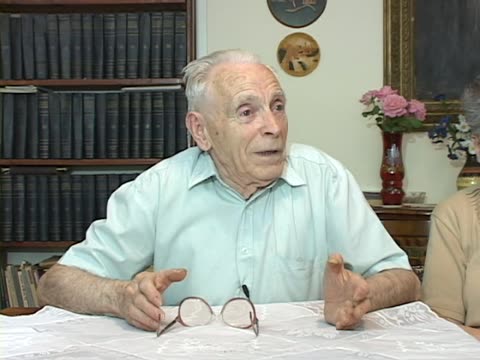
The next part of the tape is a formal interview with Ernest (Ari) Osipovich Halpert and Tubi Halpert in Uzhhorod (Yiddish: Ungver), born 1923 in Mukacheve. They moved to Uzhorod after the war. Ernest explains how they ceased to speak Yiddish after the war.
From the machine transcript
The interview with Halpert begins: he says he speaks Yiddish with difficulty, having spoken it with his parents and in Munkatsh, but not since the family moved to Uzhhorod after the war. Tubi is also from Munkatsh.
The formal part of the interview begins. Ernest discusses his childhood memories of Mukacheve, where half of the population was Jewish, as well as his family. He grew up with two sisters, who now live in Israel. He descended from a Hasidic family. His father taught at the yeshiva and his grandfather worked for the burial society (chevra kadisha). Ernest attended religious school (cheder) from the age of three until his bar mitzvah, at age thirteen. After his bar mitzvah, he worked in a factory. According to Ernest, work was hard, but it was sufficient to make ends meet. His father owned a small store.
From the machine transcript
The interviewers explain the project and the place name (Ungvar in Yiddish) and the spelling of the surname Halpert. Halpert then tells of his childhood in Munkatsh, where half the inhabitants were Jewish: Hasidic family, father taught at the yeshiva, grandfather in the burial society, cheder from age three until bar mitzvah at thirteen, then factory work. He had two sisters, now in Haifa, and a small family; the Hungarian occupation of the town in 1938 is introduced.
Adds the project explanation and place-name and surname discussion.
Ernest talks about his life during the war, under Hungarian (1938) and German occupation (1944). He explains that Jews were not murdered under Hungarian occupation. Only when Germany occupied Hungary in 1944, were Jews imprisoned in ghettos and then transported to Auschwitz. The youngsters were selected for forced labor in Germany, and so Ernest, his sisters, and his wife had more of a chance to survive. Ernest was imprisoned in a concentration camp in Austria, where he was liberated by the Red Army in March 1945. Although he was not entirely healthy, he was drafted into the Red Army to continue the fight against Germany. At the time, Ernest believed he would participate in the liberation of other concentration camps. He was not aware that most Jews were killed in Auschwitz.
From the machine transcript
Halpert recalls the war: under Hungarian rule Jews were not killed, but after the German occupation in 1944 they were put in ghettos and sent to Auschwitz, where the young were selected for labor in Germany. He and his sisters and wife survived, his parents were killed. He was liberated by the Russians in a camp in Austria and volunteered for the Red Army, hoping to free Jews, not knowing what had happened in Auschwitz.
Ernest discusses his military service. As soon as he was mobilized, the war ended. He returned home in 1947 from military service. He then talks about life after the war and about his family. Ernest and Tubi are childhood friends. Tubi returned to Mukacheve after she was liberated from the concentration camp to live with her sister. Ernest moved in with friends. They married in 1947 and have two children. Peter lives in Germany; his other son lives in Uzhorod and works in the communal support center (chesed). His grandchild lives in Israel. Ernest worked as engineer in a factory. According to Ernest, they lived well during the Soviet period.
From the machine transcript
Halpert talks about army service, which ended with the war, and demobilization in 1947. He and Tubi, long friends, married officially in 1947 and have two sons: Peter in Frankfurt, and another son in Uzhhorod who works with the Hesed; a grandson is in Israel. He worked as an engineer and says they lived well materially in Soviet times, but without a Jewish life.
Ernest discusses life today and mentions contemporary Jewish institutions. He then talks on the phone to help to set up interviews.
From the machine transcript
Halpert speaks about life today and Jewish institutions, and visiting his sisters in Israel since the Soviet period ended. During the passage he is interrupted by phone calls, mostly in Hungarian and Russian, arranging for the interviewers to meet other Jews, such as in a village. This is largely garbled, and a Jewish connection with an Ignats (?) is mentioned.
Adds the phone calls arranging further interviews.
Ernest talks about the difficult life during the Soviet period when he had to keep silent about his two sisters in Israel. According to Ernest, life for Jews improved under Gorbachev. They visited his sisters in Israel for the first time in 1988. He returns to discussing Jewish life today, including Russian-language Jewish newspapers and communal leadership under Menakhem Mendl Taykhman.
From the machine transcript
Halpert describes how hard Soviet life was, since he could not admit he had sisters in Israel. Under Gorbachev things improved and in 1988 they visited the sisters for the first time. He talks about Jewish life today: Hesed, children learning Yiddish and Hebrew, the prayer house, a rabbi from America and Chabad, Rabbi Menakhem Mendl Taykhman, Russian-language newspapers and contacts with the Israeli ambassador.
Ernest talks about his family, in particular his sisters. After they were liberated from the concentration camp, they continued to live in Karlovy Vary, Czechoslovakia until 1948. As soon as Czechoslovakia was about to become another Soviet satellite state, his sisters emigrated. He learned from his cousin that his sisters emigrated, because after his military service he was not allowed to communicate across borders. He was able to meet his sisters for the first time after the war in 1964 in Prague. However, until the collapse of the Soviet Union, he could only stay in touch with his sisters through his cousin who lived in Czechoslovakia. He communicates with his sisters in Hungarian. He only spoke Yiddish with his parents at home.
From the machine transcript
Halpert explains that his sisters stayed in Karlovy Vary after liberation until 1948, then emigrated to Israel when the communists took over. He kept contact only through a cousin who could write abroad, and first met his sisters in Prague in 1964 (?). He now speaks Hungarian with them and with Jewish friends; at home he spoke Yiddish only with his parents, so his Yiddish is now difficult.
Ernest remembers religious life during the Soviet period in Mukacheve. Jews, who had no official relations with the state, lived a religious life with a small study house (besmedresh).
From the machine transcript
Halpert answers Kerler's question about religious life in Soviet times: a small study house continued in Mukacheve for Jews not tied to state work, whereas before the war the town had seven. He notes that the war reached the area only in 1944, by which time the Jews had been deported or killed, that there was no rabbi, and that Jewish life began to revive under Gorbachev.
Ernest talks about postwar traditional weddings and today. He then discusses prewar weddings in Mukacheve with a wedding jester (gramer).
From the machine transcript
Halpert talks about weddings: the traditional Jewish weddings after the war were modest, but one in Munkatsh (with rabbis from Zhytomyr and Berdychiv, and Taykhman) was large. Kerler recalls attending one in the late 1960s (?). Halpert then remembers the prewar wedding jester (gramer) Asher Zelik (?) and his jokes, and says much was forgotten after the war.
Ernest remembers Jews who spoke a daytshmerish (interspersed with Germanic words) Yiddish. They then talk about how little they knew about the fate of Polish and Ukrainian Jews during the war. According to Ernest, Jews were by and large not oppressed under Hungarian occupation.
From the machine transcript
Halpert and the interviewer discuss the words for war (milkhome, shlakht, krig) and Jews in Munkatsh who spoke a Germanized Yiddish (daytshmerish). Asked what was known in 1941–44 about Jews in Ukraine and Poland, he says very little because of censorship. Under the Hungarians Jews could mostly still live Jewishly, with prayer houses and communities, despite some laws and Jews working as lawyers, doctors and factory owners.
Ernest talks about Jewish life under German occupation in general and how little they knew about the fate of the Polish Jews and how they had no knowledge of Auschwitz. He then talks about his life during the war and his imprisonment in a labor camp. He received a letter from his wife, who was imprisoned in Auschwitz. At the beginning of World War II, under Hungarian occupation, they set up the ghetto in Mukacheve and took young people to labor camps in Hungary. When the Red Army moved forward in Hungary, they resettled the labor camp prisoners to Germany and Austria, at end of 1944. Everyone else was sent to Auschwitz.
From the machine transcript
Halpert explains how little Jews under Hungarian rule knew of the fate of Polish Jews or of Auschwitz, which they took for a labor camp. He describes being taken as a young man from the Mukacheve ghetto to a labor camp, then to Austria at the end of 1944, and receiving a letter from his wife. The passage opens with a brief exchange about Hungarian and Tubi's father in the Budapest ghetto.
opens with talk about Tubi's father and Hungarian, and includes the Polish-Jewish refugees expelled from Hungary
Tubi talks about her life during the war, in particular the transport from the Mukacheve ghetto to Auschwitz. The postcard she sent to her husband from Auschwitz was supposed to include twenty-five words with the content that life is good in the sanatorium in Wannsee, near Berlin. Tubi arrived in Auschwitz on May 20, 1944. In the Mukacheve ghetto, Tubi worked at a sugar factory; before they were sent to Auschwitz in trains, loaded with eighty people in every car. Tubi stayed in Auschwitz for three months, before she and 150 other women were taken to a forced labor camp Reichenbach. In Auschwitz, they awaited work assignments. Tubi then talks about her arrival at Auschwitz with her brother and mother Hilde, and the initial selection. She and her brother were separated from their mother, who was taken away in a car. Every morning, she reported to roll call for two hours. Ernest’s two sisters were also sent to Reichenbach. Tubi worked in an electric factory for nine months until May 8, 1945. She recollects the terrible working conditions during winter.
From the machine transcript
Tubi describes the postcard she was told to write from Auschwitz, supposedly from a sanatorium, and her transport from the Mukacheve ghetto in May 1944 in crowded wagons. She tells of the separation from her mother Hinde at selection, the roll calls, and the three months at Auschwitz before about 150 women went to Reichenbach. There she made radio equipment for the army until the war ended in May 1945, in poor conditions.
the mother's name and age, and that the work was making radio equipment
Ernest returns to discussing life before the war in Mukacheve. In particular, he addresses his school years at religious school (cheder). The school was located in the courtyard of a study house (besmedresh). Rebbe Hayyim Eleazar Shapira/Spira of Mukacheve was an important figure in prewar Mukacheve and Ernest met the rebbe during shiraim esn (distribution of the rebbe’s leavings). Ernest met his grandson, who purchased his grandfather’s former hasidic court. They organized the Shpira’s great-grandson’s bar mitzvah there.
From the machine transcript
Kerler returns to prewar Mukacheve and Halpert recalls his cheder in the courtyard of a study house on a street whose name is given, with the melamed Reb Mendl, and how he stopped at bar mitzvah to work. He recalls the Shapira rebbe, whose leavings he went to eat, and the grandson who later bought the old court and held a bar mitzvah there.
names the melamed and the cheder curriculum
Ernest talks about life before the war under Czechoslovak rule in Mukacheve. According to him, Jewish life could flourish. He attended a Jewish Czechoslovak school. The language of instruction was Czech and a religious teacher would regularly teach classes. Ernest mentions the different level of religious education between boys and girls. Ernest recalls the place where the ritual slaughters worked (“shlogbrik”), where two or three shokhtim slaughtered chickens for hundreds of people Thursday afternoons in preparation for Shabbat. According to Ernest, Jews had a peaceful relationship with their neighbors before the Hungarian occupation. There were some young antisemitic Hungarians, but the situation remained stable overall.
From the machine transcript
Halpert describes Jewish life under Czechoslovak rule: full rights, religious instruction in the Czech school, and Jewish books in Czech. He talks about Sabbath preparations at the slaughterhouse and mikveh in the Jewish street, with shochets working on Thursday and Friday. He says Jews and neighbors lived well and that antisemitism came only with the Hungarians, among a few young fascists.
adds the mikveh, the slaughterhouse term and the contrast with Hungarian rule
Ernest talks about his name change, Ari, Arn (in cheder), Arnusht (Czech), Ernu (Hungarian), Ernest (Russian), Ari bácsi (uncle Ari, today among friends), Arn ben Yoshua (in the synagogue) under different occupations. He then talks about his family and prewar Hasidic life. His father Shi’ye (Yoshua) owned a small general store. His mother’s name was Pearl, nee Kalush, and was born in Kalush. His father’s family is descended from Mukachever Hasidim. Ernest remembers several rebbes, including the rebbe of Shpira, who blessed him. Ernest recalls the burial ceremony of the Mukachever rebbe, which the Shpira rebbe also attended. He also recalls the wedding of the Shpira rebbe’s daughter Frime to Borukh Rabinovich. The children from cheder were sent out to wave at them with small flags. After the wedding, people were celebrating for seven days. Rabinovich became the rebbe of Mukacheve.
From the machine transcript
Halpert explains the forms of his name in different settings (home, cheder, Czech and Hungarian school, Russian, the synagogue), and gives his birth year and his parents' names: his father Shiye ran a shop, his mother Perl was from the Kalush family. He recalls Hasidic life and rebbes in Mukacheve, the visit of the Spinka rebbe, and the wedding of the Shapira rebbe's daughter to Rabinovich, with a week of celebration and cheder children greeting the rebbe with flags.
adds the parents' names and origins, rebbes of Spinka and Belz, and the details of the wedding
Ernest describes a regular school day, focusing on his time at the cheder and punishment. In the morning, he went to cheder (6 to 8am), then school (8 to 12pm), then home for lunch, then school in the afternoon, then cheder until evening. He would also study with his father and grandfather.
From the machine transcript
Halpert describes a typical day as a boy: cheder in the early morning, Czech school until noon, lunch at home, then cheder again till evening. He recalls the strict melamed's Thursday examination, with beating for failures, and his fear of it, and studying with his father and grandfather on Sabbath.
adds the Thursday test with the stick as punishment
Ernest discusses his school days at the Czech school. He remembers how he spoke with his classmates in Yiddish and with the teachers in Czech. Ernest talks about Yiddish, Czech, and Hungarian literature and remembers one book in particular, written by his uncle Shloyme Moshkovich from Mukacheve called “A-do vos se gayt inter” (The place where things go down). He was able to purchase Yiddish books in religious bookstores.
From the machine transcript
Halpert describes the Czech school, where Jewish children spoke Yiddish among themselves and Czech with the teachers, who were not antisemitic. He talks about his reading in Yiddish, Czech, Hebrew and Hungarian, including Sholem Aleichem, Mendele and Wells, and a satirical Yiddish book on Jewish life by his uncle Shloyme Moshkovich of Mukacheve, whose family went to Haifa. Jewish bookshops in the Jewish street sold Yiddish and Hebrew books.
adds the languages read, the uncle's relation and Haifa, and the Jewish bookshop
Tubi and Ernest talk about prewar Purim celebrations, including Purim shpiels. Tubi quotes parts of a Purim play, she performed during her childhood.
From the machine transcript
Halpert and Tubi recall prewar Purim: the children's Purim-shpil going from house to house, with Tubi reciting verses of the rhyme, and shalakhmones, noisemaking and dancing in the street. Halpert recalls one long Purim play about Joseph sold to the Arabs, which he saw once as a child, and Kerler asks who played in these plays.
Ernest discusses his family, in particular his grandfather Paysekh, during holiday celebrations. He then sings Passover songs and remembers melodies.
From the machine transcript
Halpert recalls the family Passover seder, with his father in the kittel and the stealing of the afikoman, and the siblings' quarrel over it. Asked about songs, he mentions a few melodies and Hebrew and Yiddish songs, and Kerler asks about Mukacheve melodies.
the catalogue's mention of the grandfather Paysekh is not clear in the transcript; the afikoman story is the centre of the passage
Ernest explains the difference between a besmedresh and a synagogue. He then talks about prewar political movements in Mukacheve such as Mizrahi and Zionist organizations.
From the machine transcript
Halpert explains the difference between a besmedresh, which was Hasidic, and a shul, which was more modern, and answers Kerler's questions about prewar movements in Mukacheve: Zionist organizations, Mizrachi, the Jewish gymnasium, Hashomer Hatzair, Betar and others, and the absence of the Bund. The passage ends with drinks and a chat about Tokay wine and Jewish communities today.
adds the Bund question and the closing chat about wine and communities
The first part of the tape is a continuation of a formal interview with Ernest Osipovich Halpert and his wife Tubi Halpert. Ernest helps to set up interviews for the team on the phone in Hungarian.
From the machine transcript
Halpert speaks Hungarian on the phone and then in Yiddish about arranging the team's further interviews, giving an address and a phone number so that a local man, a former head of the Uzhhorod Jewish community who speaks good Yiddish, can be met. Kerler asks about local prayer times (minyan only on Friday night and holidays) and for more phone numbers; then Kerler announces he will put some sentences to translate from Russian.
Also covers local prayer times, and the move to questionnaire work at the end.
The team asks Ernest and Tubi a number dialectological questions from the AHEYM Yiddish questionnaire. They also remember childhood games at the beginning of this segment.
From the machine transcript
Halpert and his wife answer Kerler's dialectological questionnaire, with some input from Katz. The items cover greetings and replies, thanks, words such as groats, cholent, glass, ear, dumpling, and cat and mouse, a children's rhyme about a cat (which they recite), comparatives (cold, high, fast, near), honest, pious, converts, a gentile woman, forms of address (ir, zi), farewell blessings, numbers, and sample sentences. Their answers also show Hungarian-Yiddish usage, for example mizl for luck. They add that few Jews are left in the nearby place and that Halpert remembers better with help.
The catalogue sentence is accurate: the passage opens with games and then goes through the questionnaire; the transcript also shows a child's rhyme and a closing remark about few Jews.
The second part of the tape includes a tour through the former Jewish parts of Uzhorod with Nusn Leyb Naybauer, born 1924 in Velké Kapušany in today’s Slovakia. They drive to the three former synagogues of Uzhorod. Today the buildings are used as a concert hall, local phone company, and university building. His mother was born in Mala Dobron. His family moved to a village when Naybauer was one year old, where his father worked in an equestrian military facility. His father’s friend arranged work for him. His family lived in Mala Dobron until their deportation to Auschwitz.
From the machine transcript
The team meets Naybauer, who says he is the only survivor of six children. They look for a quiet place to sit and drive toward the centre, passing three former synagogues that are now a concert hall, a phone company building and a university building. Naybauer says he was born in a village near Uzhhorod where his father worked at a military horse stud, and that his father's family came from Mala Dobron (Kish Dobron), where they lived until they were taken to Auschwitz. He also mentions needing a visa to travel and recalls cheder and matzo baking in the area.
The transcript adds the introductions and the problem of visas for travel, and that the family's village home is unclear.
They stop at a former religious school (cheder). Naybauer points out the former matzo bakery, at today’s university of Uzhorod. Naybauer talks about prewar Jewish life.
From the machine transcript
At a former religious school and matzo bakery now used by the university, Naybauer says the Uzhhorod Jewish population before the war was ten thousand, and that many more (a figure he gives as fourteen or sixteen thousand) were taken from the ghetto, where he was from the first to the last minute. He says he was born in 1924.
The transcript adds the population figures and the ghetto deportations.
Naybauer talks about life during World War II, during his imprisonment in the Hungarian forced labor (i.e. "Munka Tabor") within the labor battalion of the Hungarian army. They arrive at the former Great Synagogue. Naybauer discusses religious life after the war. The Jewish community used the synagogue until it was closed down in 1948. When the former head of the Jewish community, Bergider, heard that the Great Synagogue was about to be closed down, he went to Moscow to speak with Golda Meir to prevent the closure. As soon as Bergider returned to Uzhorod, he was arrested and sentenced to twenty-five years in jail. Bergider was in jail for seven years and died two weeks after his release. Naybauer then briefly remembers prewar Hasidic life; before talking about holiday celebration today. Naybauer remembers that Jews hid their belongings in two synagogues, before they were forced into the ghetto. He then returns to talking about prewar Jewish life and institutions. Naybauer grew up as the oldest of five siblings. His father could not work for health reasons and therefore Naybauer had to help the “kosher sausage dealer “ carry meat.
From the machine transcript
Naybauer describes being drafted in 1944 into the Hungarian labor battalion and being kept in the ghetto instead. At the Great Synagogue, which he says served the Jewish community until the Soviets closed it, he tells how its head, whose surname is given as Bergida (the transcript is unclear), went to Moscow to see Golda Meir to stop the closure and was arrested and sentenced to twenty-five years. He mentions the removal of the Star of David, the many small prayer houses, Hasidic life, the cemeteries, and that in 1944 Jews hid belongings in the synagogues and used a trade school as a hospital. He then talks about his family: he was the oldest of six, his father Avrom was sickly, and he carried goods for a kosher sausage maker. He also notes the family name Neubauer and an uncle named Bookbinder.
The transcript adds the hospital in the commercial school, the cemeteries and a rich uncle in America, and the family names.
They enter the former Great Synagogue, which is now used as a music hall.
From the machine transcript
At the former Great Synagogue, now a concert hall, the team talks with the staff at the entrance, with Russian and Hungarian talk about whether they can look inside and that they have come from America.