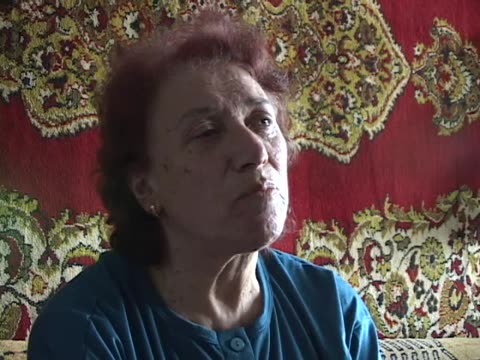
People › Mikhail Abramovich Zhovtis › conversation

Mikhail Abramovich Zhovtis

Bar 29 June 2005 – 30 June 2005 Interviewed by Dovid Katz, Dov-Ber Kerler, Jeffrey Veidlinger 2.3 h · 3 parts on 3 tapes uncertain
Loading the player…
  1. MDV 330 0:00–1:01:27 · 62 min · not online — MCO
  2. MDV 331 0:00–1:01:03 · 61 min · not online — MCO
  3. MDV 690 0:00–16:08 · 16 min · not online — MCO · a part of the tape
Passages
MDV 330 0:00–1:01:27

0:00

Life after the war and family

From the machine transcript

Vaynman explains that after the war her mother and she were allowed to travel only as far as Vinnytsia and could not go on to Lviv. Her mother, widowed, feared bandits (Banderites) there, so she stayed and found work in a kindergarten and later a factory, then remarried in Bar to a veterinarian. Vaynman gives her mother's maiden name Sandler and her father's family name. She says they came to Bar at the end of 1944, and discusses her Yiddish and its closeness to Polish and Lithuanian Yiddish.

Includes her half-brothers and her mother's remarriage and Yiddish dialect.

6:42

Religious life at home after the war

From the machine transcript

Kerler asks about the prayers her mother said at home after the war, which Vaynman says were from an old prayer book, in Hebrew and some Yiddish. Questions then turn to whether an old synagogue or its ruins survived in Bar; Vaynman says there was none when they arrived, only a ritual slaughterer. A Russian-speaking local joins in about the Turkish or Polish fortress and where synagogues once stood, with the Germans having destroyed Jewish buildings. Kerler asks for more about the postwar years.

Shifts to a discussion of old synagogue buildings in Bar, with a local helper speaking Russian.

10:14

Jewish life after the war in Bar

after the war Local Jewish history MDV 330 · MCO
From the machine transcript

Vaynman describes Jewish life in Bar after the war, when survivors returned and lived in the few remaining old Jewish houses, which Kerler asks about (white walls, benches outside). She says her mother observed the holidays, her stepfather less so, and that she herself still keeps Passover and eats no bread then. Kerler asks about her mother's songs and Yiddish songs known from childhood, and about stealing the afikoman at the seder.

Includes houses, Passover observance, and songs her mother sang.

15:09

Mother Rivke’s family

From the machine transcript

Vaynman recounts what her mother told her of her own family. Her grandfather returned from war on one leg and died, and her mother was the youngest of seven children, born after his death. She went to a Yiddish school and a Yiddish college. Her mother's brothers were all killed in the war, in a forest near Lviv, where a memorial stone was later put up. She names her grandmother and grandfather and recalls her grandmother's synagogue-going before the war.

Covers grandparents and murdered uncles, which the catalogue label only hints at.

20:48

Jewish life after the war

after the war Local Jewish history MDV 330 · MCO
From the machine transcript

Vaynman answers Kerler's questions on Jewish life in Bar after the war: returnees still spoke Yiddish but few could read it, and they came to her mother's home on holidays to hear her pray. She describes minyans held in houses, gathering ten men for funerals, a local man looking after the community, and how it faded as older people died. She says emigration to Israel began a dozen or so years before and discusses how many Jews were in Bar then and now, with a Russian-speaking local adding figures.

Adds minyans, emigration, and the size of the Jewish community.

26:58

Concluding the interview and Jewish magazines

From the machine transcript

Kerler thanks Vaynman for the interview and praises how she has kept her mother's Yiddish; she says she has no one to speak it with. Katz asks about Yiddish periodicals, and she says they receive them and a newspaper from Vinnytsia. Kerler describes the project and leaves her some paper about it.

28:27

Town footage of Bar

Footage MDV 330 · MCO
From the machine transcript

Footage of the team looking for the address of the next interview. Local helpers speak Russian and Ukrainian, asking people on the street for a house number on a street (Nechaia (?)), with some Yiddish exchanges about Vilna and a name that the transcript does not make clear.

31:20

Greeting of Mikhail Abramovich Zhovtis

Informal MDV 330 · MCO
From the machine transcript

The team arrives at Zhovtis's house and greets him at the gate. He says he understands Yiddish but speaks it poorly, and finds out Kerler is from Khmilnyk. Kerler explains the project and recording, and the interview is arranged.

33:28

Family

From the machine transcript

Kerler opens the interview with Zhovtis, a native of Khmilnyk, asking about his name and his childhood. Zhovtis gives his parents' names and says they were from Khmilnyk. He mentions a brother, a sister, and a grandfather with relatives in America, and that he finished seven classes.

35:45

Life under German occupation

during the war World War II (general) MDV 330 · MCO
From the machine transcript

Zhovtis tells in a long and hard-to-follow account of the German occupation. He describes the first killings of Jews and communists near Khmilnyk, and the roundup of Jews from the town and surrounding villages, including his mother, siblings and himself. He escaped while his mother was being beaten and was taken in by a non-Jewish villager, who gave him milk, but a local officer turned him in. He also describes forced labor for German and Romanian commanders, repeated escapes, and falling ill. He was taken to Mohyliv-Podilskyi. He names several places, but their spelling is not clear in the transcript.

47:24

Life after the war

after the war Daily life (general) MDV 330 · MCO
From the machine transcript

Kerler asks whether Zhovtis's parents survived. Zhovtis says that his family were taken to be shot in a village near Khmilnyk, and describes a collective farm there with Jews and Christians. Kerler tries to clarify what he has understood.

48:59

Life during the war and the invasion of the Red Army

during the war World War II (general) MDV 330 · MCO
From the machine transcript

Kerler asks Zhovtis to go through the occupation again and Zhovtis explains the killings in January and the forced labor on the roads and in a town. He describes his work, going to Zhmerynka and Murafa, harsh treatment, the dangers of bridge-building near Mykolaiv, being weak and ill, and being taken to the station and to Mohyliv-Podilskyi. When the Red Army arrived he left on foot for Khmilnyk, found no Jews left, and was then drafted. He served seven years, in the north near Murmansk, as the only Jew among many.

MDV 331 0:00–1:01:03

0:00

Life after the war in Litin? with family

From the machine transcript

Zhovtis talks about his military service and its end, and about coming back to Litin and Khmelnyk after the war. He tells of marrying in the 1950s and of working in a factory for some thirty years. He also mentions leading a group of families across a border, a bridge over a river and Romanian and German soldiers. He names his children and where they live, including one who is a doctor, and a visitor from America.

also covers the border crossing with families and Romanian soldiers, and his children and their residences

4:45

Living in Israel

From the machine transcript

Zhovtis speaks of relatives in Israel and of life there, mentioning Haifa and a place where people travel to work. He says his wife came from Lithuania and speaks Yiddish better than he does. He talks about a flat or plot bought for a large sum, and says he cannot travel because of his health and a daughter's death.

adds that his wife came from Lithuania and that his own health keeps him from travelling

7:15

Family

From the machine transcript

Kerler asks about family. Zhovtis says his mother was a dressmaker and his father worked in a factory. He also names his paternal grandfather as Yankl and his maternal grandmother as Sara. Details of the household furnishings are unclear.

9:01

Jewish life in Chmelnik before the war

before the war Local Jewish history MDV 331 · MCO
From the machine transcript

Asked about life in Khmelnyk before the war, Zhovtis recalls it as good and speaks of low prices. He recalls antisemitic insults, the fear he felt under the Germans and keeping quiet about being Jewish. In reply to Kerler he describes the synagogue, Sabbath and weekday prayer among older men, and not having seen a rebbe. Kerler then asks about Passover, and he describes koshering utensils with a stone and hot water, and pancakes or dumplings made of matzo meal.

adds Passover utensil koshering, antisemitic insults and the synagogue and Sabbath prayers

15:01

Passover celebrations and religious customs

From the machine transcript

Zhovtis answers questions about Passover food and the seder: potato and matzo-meal pancakes. His father did not lead the seder, and the household gathered at a relative's, but he does not recall the four questions. He says his father did not teach him the morning prayer, and tefillin are mentioned.

adds the questions about the seder and tefillin

16:59

Childhood memories and life in Israel

From the machine transcript

Zhovtis says he attended a Ukrainian school, and recalls childhood friends and speaking Yiddish before the war. He says he came to Bar in the 1960s (?) and talks about a club where Yiddish is spoken and a visit to a memorial to Holocaust victims in Israel. Kerler asks about the interviewee's life, including how the Sabbath was kept.

adds Ukrainian school, Yiddish-speaking club and a memorial visit

20:05

Jewish holidays before and after the war

before the warafter the war Other holidays MDV 331 · MCO
From the machine transcript

Zhovtis describes Sabbath in his parents' home: his father went to prayer, his mother blessed the candles. They talk of children's gifts at Hanukkah, fasting on Yom Kippur, and Purim and its sweets, and of the dreidel. He does not recall Shavuot customs, and Tisha b'Av is only vaguely recalled.

adds Yom Kippur, Purim, the dreidel and Shavuot

23:42

Non-Jews and life under German occupation

From the machine transcript

Zhovtis discusses non-Jews who spoke Yiddish, including Romanian soldiers, and their attitude to Jews. He recounts being beaten and the arbitrary violence under the occupation, and being made to wear a cross-like sign (?). There is talk of a mayor, of Purim fare and of Passover utensils, and of not eating pork.

adds food customs and Romanian soldiers who spoke Yiddish

30:21

Jewish food customs

From the machine transcript

Zhovtis answers Kerler's questions about kashrut: the use of fat, salting meat, the shoykhet and kosher slaughter. His account of the details is unclear.

32:27

Postwar Jewish life in Bar

after the war Local Jewish history MDV 331 · MCO
From the machine transcript

Zhovtis says he came to Bar in 1954 for work, and mentions Litin. He talks about the Jews who settled there and spoke Yiddish, and says there was no synagogue, so people prayed in a private room. Kerler asks about an old synagogue building, which Zhovtis does not know.

adds Bar's lack of a synagogue and the question about an old synagogue building

34:47

Dialectology

From the machine transcript

Kerler puts a long questionnaire of Russian words and short sentences to Zhovtis, asking him to translate them into Yiddish. Items include a book, house, hole, cat and mouse, window pane, colours, hearing and deafness, 'later' and 'earlier', being ill, 'where are you from', bed and 'please', numbers, thanks, midwife, taste, street and road, potatoes, Hanukkah pancakes, and 'we were seven'.

MDV 690 0:00–16:08

0:00

This tape is a continuation of a formal interview with Mikhail Abramovich Zhovtis (b. 1927 in Khmil'nyk) in Bar, Ukraine (part 3 of 3. See accession #09-010.02-F MDV 330 and MDV 331). He answers questions relating to sociolinguistics and dialectology.

From the machine transcript

The informant answers Kerler's questions about the wording of Yiddish items. These include measures of liquid, the attic, the verbs 'to come' and 'to come back', 'enemy', and the words for 'face' and 'foresight'. Kerler checks which forms he knows and which he does not. Some Russian is mixed in, and at the end Kerler asks him to tell what he remembers of his parents.

The passage opens with a street question and ends with a turn to the informant's parents, which the catalogue does not mention.

6:56

Zhovtis reports that there were no Yiddish-speaking non-Jews in his town. The Jewish children in the shtetl thus spoke Ukrainian to each other on the streets. He further comments on linguistic relations between different ethnic groups and shares his attitudes towards non-Yiddish-speaking Jews.

From the machine transcript

Asked about his friends, the informant says that at home he spoke only Yiddish, and tells a story about a Jew from the Caucasus who did not understand Yiddish. Kerler remarks that many Soviet Jews do not know Yiddish. The passage touches on attitudes toward Jews who do not speak the language. The transcript does not clearly show the claim that Jewish children spoke Ukrainian in the streets, and the details are partly garbled.

The transcript shows a story about a Caucasian Jew and Yiddish, and a question about the word for a measure (?), not the street-language remarks in the catalogue.

9:53

Zhovtis answers questions relating to sociolinguistics and dialectology.

From the machine transcript

Dialectological questions continue: the word for a measure (?), the words for digging or raking the earth, and a word meaning luck. Kerler and Katz then ask a closing question, and the informant sends good wishes to the Jews in America, thanking those who help and mentioning money sent for Passover. Kerler ends with thanks.

Ends with greetings and thanks to Jews abroad for their help.

13:48

The camera cuts to a tour of an unidentified town led by a Russian-speaking guide.

Tour MDV 690 · MCO
From the machine transcript

The camera records a walk through an unidentified town led by a Russian-speaking guide, who points out a church, an old wall and a river. Kerler, with some Yiddish from the second voice, remarks on the church and the view.

Questions put in this conversation

Items of the dialect questionnaire asked here; each link plays the moment.