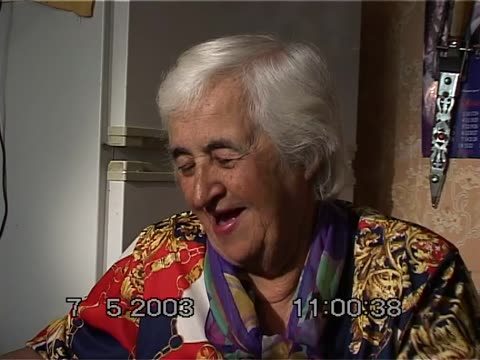
This tape consists of a formal interview with Sonia (Sure) Shevelevna Litvak. She begins the interview telling of a recent visit by a Chabad Rabbi and his wife.
From the machine transcript
Opening of the interview. Kerler sets up the microphone and explains the consent papers and his own work as a Yiddish researcher. Litvak says she mostly spoke Russian with her husband. She tells of a Chabad rabbi and his wife (named something like Shmilek and Sterna, unclear) who stayed with her one Rosh Hashanah and with whom she was photographed. She offers their address in America or Israel, and Kerler asks which name the town had, Zvil or Novohrad-Volynskyy.
Most of the passage is consent paperwork and microphone setup, and the rabbi couple's names and origin are unclear.
Before the war, Novohrad-Volyns’kyy, the town were Litvak was born in 1925, was mostly Jewish; she remembers only one non-Jew who lived on her street growing up. The town had two Yiddish schools that were both closed around 1937, one having been converted to a Russian-language school.
From the machine transcript
Litvak explains that the town was called Zvil and later Novohrad-Volynskyy, once a small town and now a city. Before the war the Jews lived in the town and non-Jews around it; her street was Jewish, with a single non-Jew on it. Two Yiddish schools, the first and the fifth, were closed, apparently in 1937, and one turned to Russian. Kerler then asks her to give her personal data.
Adds the town's earlier name Zvil and the mixed non-Jewish surroundings; the closure year is only roughly heard.
Litvak speaks about life before the war, focusing on the hardships of the 1933 famine, during which her brother Leybl was born. She also recalls swimming in the river in the summertime.
From the machine transcript
Litvak gives her name, patronymic and Rivne address and phone number, and says she was born in Zvil, which people called Novohrad-Volynskyy in speech. She recalls the river near her house, the very hard years of the 1933 famine when people died of hunger and her brother Leybl was born, and swimming in the river as children.
Adds her address and phone details, the street renaming, and the river memories.
Litvak gives a detailed description of her education in Soviet Yiddish schools, recalling the names of teachers and the interesting subjects she learned, including world history, geography, algebra, math, and Russian. In her Yiddish language and literature class, she read many stories by Sholem Aleichem, whose characters were referenced in everyday language.
From the machine transcript
Litvak describes her Yiddish school, the first school. She names Friedman as her history teacher and Novak as her Yiddish language and literature teacher, and lists the subjects: geography, history, algebra and mathematics, mostly taught in Russian, with no German. She recalls reading Sholem Aleichem, including Mendele-like characters and the story of Motl Peyse the cantor's son. She says she has Sholem Aleichem's works in Russian and some in Yiddish. Some of her words suggest she also reads Hebrew.
Adds Sholem Aleichem's works that she read and owns, and the remark on Hebrew.
Litvak still has many books in Yiddish, even though her husband did not speak Yiddish. She spoke Yiddish with her first son (b. 1950), who, she claims, has “not a drop of goyish in him”. He observes shabes (the Sabbath) and cares about Israel; “he has a Jewish heart".
From the machine transcript
Litvak says she has many Yiddish books though her husband, an officer, knew no Yiddish. She speaks of her two sons, born in the early 1950s, one living with her and one in Dnipropetrovsk. The elder son wanted to learn Yiddish and she tells of using it with him as a child. She says he keeps the Sabbath, is attached to Israel and has a Jewish heart. Kerler then returns to the family data.
The catalogue's birth year for the first son is not confirmed by the transcript; the dates heard there are unclear and inconsistent.
Her father, Sheylik, was born in Novohrad-Volyns’kyy. He used to say that their family originally came from Spain and then to Lithuania. Litvak’s paternal grandfather, Yerikhem, was also born in Novohrad-Volyns’kyy.
From the machine transcript
Litvak gives her father's name, Shilek, and her grandfather's, Yerikhem, both born in Zvil. She recounts a family tradition of coming from Lithuania, with ancestors expelled from Spain, and says the local rabbi and his wife tell her she speaks like a Litvak. Her father also told stories of the Civil War years.
Adds the remark that the local rabbi and wife hear a Lithuanian Yiddish in her speech.
Her father used to tell a story about the Russian Civil War in 1918: A soldier in Deniken’s army grabbed him by the river and tried to kill him, but another non-Jew intervened and saved his life.
From the machine transcript
This very short stretch holds one remark in the transcript: Litvak's father was a hatter (kirshner). The catalogue's civil-war story about him is not visible in the transcript.
The transcript shows only his trade, with nothing of the Deniken story.
Litvak’s father worked as a hat-maker and was sometimes paid in salt during the years of poverty.
From the machine transcript
Litvak says her father made hats and recalls that in the poor years he was paid in salt. Her mother, afraid, went alone to collect it and was told to take only what she could carry. People gave whatever they could. The family survived the famine when others died.
Litvak’s family survived the famine intact because they were able to hold onto her grandmother’s savings from her work as folk-healer despite harassment by White Army soldiers during the Civil War.
From the machine transcript
Litvak says her grandmother was a midwife and healer whose earnings helped the whole family through the hunger. She recounts the story of a White Army soldier who tried to take a felt cloak and beat the grandmother, who died two days later. This was the time of the pogroms, in 1918 (?). Kerler asks about the dates.
The grandmother's death after a beating is told, and the soldier is not necessarily from the White Army.
Before the war, Litvak’s aunt moved to America, from where she would send the family five dollars a month. Litvak’s mother cut off communication, however, as new Soviet laws made this a dangerous activity. Litvak recalls how her mother had to sell her silver Passover dishes for oil and grains.
From the machine transcript
Litvak says her mother's sister went to America and sent money each month, but the mother stopped corresponding out of fear. She recalls her mother selling the family's silver Passover dishes and jewelry for flour and groats, and the mother's prayers every evening. They baked matzah secretly at night with two other families. A brief exchange on a grain term follows.
Adds the exchange about the food term and the mother's evening prayers.
Litvak remembers how, when she was 14 years old, her family together with two other families would bake matzah for Passover in secret at night.
From the machine transcript
Litvak says she was about fourteen, in seventh grade, when the family secretly baked matzah. Kerler then asks about her grandfather Yerikhem's occupation.
Litvak then describes the professions of her grandfather, father and brother who worked in a tannery, as a hat-maker and as a tailor respectively. Her mother was named Leyke and her maternal grandparents were Leybl and Etl the folkhealer. Her paternal grandmother, Malke, was killed during the war in the town of Romaniv along with many other family members. Her siblings were: Etl, Nume, Dvoyre (who died at four years old during the Famine), and Leybe (Leybl). She notes that this was not a big family for that time. Her mother worked occasionally, as a freelance seamstress, which was illegal under Soviet law.
From the machine transcript
Litvak describes the trades of her grandfather, who worked in leather with several workers and had many children, her father the hatter and her brother the tailor, now in Netanya. She names her mother Leyke, her maternal grandparents Leybl and Etl, her paternal grandmother Malke, killed in Romaniv, and her siblings, among them Dvoyre who died in the famine. She says her family was not large for those days. Her mother sewed privately, which the authorities forbade, and was caught once.
Adds the brother's later life in Netanya and some of the dates of the parents.
In the post-war period, Litvak worked in various kindergartens as curricular administrator, and was also employed in a textile factory for some time. She also details her contemporary economic troubles.
From the machine transcript
Litvak says she worked as a kindergarten teacher and later in a textile knitwear factory, after living in Germany. She explains her husband's pension as an officer and her own small pension. She describes today's economic hardship, high rents and costly medicines, and says only the Hesed keeps her from hunger. She mentions her brother in Israel and her son, an ecological engineer. Kerler suggests returning to school.
Adds her Germany years and her son's work as an ecological engineer.
Litvak then returns to the topics of the Soviet Yiddish schools. She states that the students read more Russian than Yiddish literature, but they did study writers such as Y. L. Perets and Mendele Mokher Sforim.
From the machine transcript
Answering Kerler's questions, Litvak says she remembers little Yiddish literature from school. She names Peretz and the story of the pious cat, and Mendele, whose Hebrew words she found hard. She adds that school favored Russian writers and poets and that Yiddish literature and language came only twice a week. She says she reads Yiddish books and the Lekhayim paper. She mentions a visit to Chisinau and an acquaintance with Berman, and cannot recall the Yiddish term for exercises.
Adds the pious cat story, her Yiddish reading today, and the failed attempts to recall the term for exercises.
Litvak then tells a story about how she was sick after she had given birth to her first son, and she could only speak in Yiddish, even though her husband did not understand her.
From the machine transcript
Litvak says she can count and remember only in Yiddish. She recalls that after her son's birth she was ill with a high fever and could speak only Yiddish, though her husband, who knew no Yiddish, did not understand her.
Sonia Shevelevna Litvak begins talking about her former classmates from the Yiddish school who are still alive. She also shares her attitudes towards the Yiddish language and towards those Jews who do not speak the language.
From the machine transcript
Litvak mentions a former classmate from the Yiddish school with whom she now finds it hard to speak, and talks about Jews today who do not know Yiddish. Kerler asks whether Yiddish writers visited Zvil and whether Pepper or Hofshteyn were taught at school; she recalls no visits and does not remember Pepper, and says she has read Hofshteyn.
Also covers Yiddish writers (Fefer, Hofshteyn) and whether they visited the town.
Litvak further details the curriculum in the Yiddish schools: Russian language and literature was studied most often, while Ukrainian and Yiddish were learnt only two times a week. German was also taught, but very infrequently.
From the machine transcript
Litvak answers Kerler's questions about the school curriculum. Russian language and literature were taught every day, Ukrainian twice a week, and German only sporadically.
Litvak briefly discusses the four year period when she and her husband lived in Germany in the 1960s. During this time, she worked in the cultural department of the Soviet consulate.
From the machine transcript
Litvak says she spent four years in Germany with her husband, in the early 1960s. She got by with a little German, and Yiddish helped. She worked in the cultural department of the Soviet embassy after an interpreter judged her German adequate.
Adds that Yiddish helped her communicate in Germany.
Litvak recalls reading the journal Sovetish Heymland to which she had her own subscription. In the 1990s, she tried to continue this subscription for the then nascent Jewish community organization, but she received these issues.
From the machine transcript
Kerler and Litvak discuss the journal Sovetish Heymland: she subscribed to it and later paid to subscribe for the Jewish centre in the early 1990s, but no issues arrived. Kerler explains the closure of Yiddish institutions in 1948 and the shooting of the Soviet Yiddish writers. Litvak ends by asking whether Jews in America speak Yiddish.
Adds Kerler's account of 1948 and the executed writers.
Asking about the state of the language in America, Litvak speaks briefly about she perceives differences between various Yiddish dialects.
From the machine transcript
Kerler answers Litvak's question about Yiddish in America, saying the religious speak it. Litvak says she wrote letters to relatives there in Yiddish at their request, though she found it hard to put her thoughts into Yiddish. Kerler praises her Yiddish and her memory, and turns to the hunger.
Litvak briefly shares memories of mass arrests during the 1937-1938 period of the purges.
From the machine transcript
Litvak recalls the mass arrests of 1937 (?), when she saw columns of arrested people, mostly Jews, led through the street to the station. Her father warned her not to say anything against the authorities. Kerler then asks whether she knew of non-Jews speaking Yiddish, and she says she could recognise Jews by their faces.
Litvak remembers Non-Jews who spoke fluent Yiddish, especially those who lived on the Jewish Street. She also remarks on the change of societal values since then; Before the war, on the Jewish Street, people were concerned with community affairs and with helping their neighbors. Now, the attitude is more individualistic.
From the machine transcript
Litvak remembers non-Jews who lived on the Jewish street and spoke pure Yiddish. She contrasts the prewar neighbourly solidarity there with today's more individualistic attitudes. Kerler asks about non-Jewish converts to Judaism, which she did not know of before the war.
Litvak mentions how people today will go to both the synagogue and the church in order receive help. She does not understand how this is logically possible.
From the machine transcript
Litvak says some people today go both to the synagogue and to the church to get help, and she does not understand it. Kerler brings up the term meshumed (convert) for such people.
Litvak describes the conflict within her family during the postwar year when she decided to marry a non-Jewish man. Litvak herself, however, believes in G-d and that her marriage was bashert (destined). Thus, she has no regrets, despite the troubles. Her in-laws, she notes, always treated her well because her husband showed them that he loved her.
From the machine transcript
Litvak describes how her father opposed her relationship with her future non-Jewish husband and locked her in a room, from which he freed her. A sister also objected. She believes the marriage was destined and has no regrets. Her husband was a good man and his parents treated her well. Kerler refers to a story by Abramovitsh, mentioning the Petka and Golovan connection.
Adds a sister's objection and Kerler's literary references.
Litvak recalls how her family used a yidisher eyvn (“Jewish oven”) on shabes (the Sabbath), which kept everything warm from Friday night until Saturday evening. Her mother would bless the shabes candles and her father would go to the synagogue near the market until he grew too afraid in the Soviet period. The synagogue was closed in 1933, Litvak reports, after which a minyen (minyan) would meet in different private homes. This practice continued after the war as well.
From the machine transcript
Litvak describes the Jewish oven in which her mother kept the Sabbath meal warm from Friday until Saturday, and the Sabbath candles. Her father prayed at the synagogue near the market until it was closed, probably in 1933 (?). Afterwards a minyan met in private homes, and secretly after the war too.
In the pre-war period, according to Litvak, there was only one synagogue. It had a women’s section on the balcony. There was probably more than one synagogue, Litvak admits, but she only remembers one synagogue and one church in the town during those years.
From the machine transcript
Litvak recalls the fine synagogue in the middle of town, with a women's gallery upstairs, where her father went. She admits there were probably other synagogues, since many Jews lived there. Kerler then asks about Sabbath foods.
In the pre-war period, according to Litvak, there was only one synagogue. It had a women’s section on the balcony. There was probably more than one synagogue, Litvak admits, but she only remembers one synagogue and one church in the town during those years.
From the machine transcript
Litvak describes Sabbath dishes at home: broth with beans, and potatoes with meat cooked in the Jewish oven, with buckwheat kasha. Her mother made gefilte fish, though not every week. Kerler asks how she made it.
The catalogue entry on synagogues does not match; this passage is about Sabbath food.
She also shares a detailed recipe for gefilte fish.
From the machine transcript
Litvak gives a detailed recipe for gefilte fish, learned from her mother: carp, fried onions, matzo, pepper, sugar and salt, with the stuffing put back into the skins and boiled with the fish. Kerler asks about the taste, and she says it should be neither too sweet nor too salty.
Litvak does not like the sweet-tasting fish from America and Israel that is served in the contemporary community. She had never previously heard of people making sweet stuffed fish.
From the machine transcript
Litvak says she cannot eat the sweet gefilte fish that comes from America or Israel, and had never heard of sweet fish in Zvil. Kerler goes on to ask what the dish kept warm in the Jewish oven was called.
Litvak shares memories of other foods, including roast and tshulent (cholent).
From the machine transcript
Litvak describes her mother's Sabbath dishes: roasts, kasha with meat, and cholent with a stuffed intestine. Kerler asks about the Yiddish terms for these dishes, including the word for cholent and for roast meat.
Litvak did not learn any prayers, she states, because her parents were afraid to teach her.
From the machine transcript
Litvak says she was not taught prayers because her parents were afraid, and her mother covered the windows when she prayed and told the children to tell no one. Kerler links this to the Pavlik Morozov affair.
Litvak recalls the foods associated with various Jewish holidays. On shvies (Shavuot), her family would eat dairy products and green borscht. On peysekh (Passover), they would eat farlirtshikes (a kind of matzo ball made with eggs) and fish. Everyone avoided eating the fish’s tail, but everyone wanted the head or middle parts.
From the machine transcript
Litvak recalls Shavuot dairy dishes: green borscht and blintzes with cheese. At Passover her mother made farlirtshikes, matzo dumplings with a filling, which she describes by showing, and fish. Everyone refused the fish's tail and wanted the head or middle, and the father was given the head.
Her family had a Passover seyder, but only observed the first three days of the holiday as it would have been too hard to maintain a whole week. During these three days, they would eat matzo omelets, potatoes and other items.
From the machine transcript
Litvak says the family kept the first seder and observed only the first three days of Passover, since a full week without bread was too hard. Dishes during those days included matzo omelets and potatoes. She says bulbes (potatoes) is a Lithuanian-Jewish word.
Litvak sings the song Bulbes.
From the machine transcript
Litvak sings the song 'Bulbes', about potatoes served every day of the week. Kerler notes that the word bulbes is not Yiddish, and S2 says a Lithuanian Jew brought the song. Asked about Passover songs, she recalls Chad Gadya only vaguely.
Litvak describes how her younger brother would ask the fir kashes (Four Questions) at the seyders.
From the machine transcript
Litvak says her younger brother Leybe asked the four questions at the seder and her father answered. She says Passover at home was well kept until the war, but not after it, when her mother had died.
On sikes (Sukkot), her father would make a sike (sukkah) from cornstalks. Every house on the Jewish Street had a sike; even after this practice was not legally allowed, there were people, according to Litvak, who put them up.
From the machine transcript
Litvak describes how her father built a sukkah from cornstalks beside the house, with a bench and table inside. Every house on the Jewish street had one, and some people kept building them even after it was forbidden. Kerler asks for the Russian word for cornstalks.
Litvak discusses the role of anti-religious propaganda in the Yiddish schools.
From the machine transcript
Litvak answers Kerler's questions about anti-religious propaganda in the school, saying teachers spoke generally against religion, though the teachers were good and kept quiet. Some teachers ate matzo themselves. She recalls Shavuot and Purim foods but little of Rosh Hashanah and Yom Kippur.
On Purim, Litvak’s mother would make umentashn (homentashen) filled with poppy seeds. The family would also send shalekh-mones gifts to neighbors. On Chanukah, she and her siblings would receive one ruble each as khanike-gelt (Chanukah money) from her grandparents. The children would also "shpiln in nis" (a kind of game played with nuts) and eat fried potato latkes.
From the machine transcript
Litvak recalls her mother's Purim baking of poppy-seed hamantashn and the exchange of shalekh-mones. She recalls Hanukkah money from her grandparents, her father's warnings about playing with nuts, and the potato latkes fried at Hanukkah.
Litvak contrasts her childhood memories with a contemporary Passover that the community celebrated in a restaurant. For this meal, she was served meat with rice, which troubled her, since one is not allowed to eat rice on Passover in her view.
From the machine transcript
Litvak recalls a recent communal Passover meal in a restaurant, where she was served meat with rice, which she objects to as an Ashkenazi. Asked about Purim plays, she says there were none before the war, and mentions the phrase for a wicked person from her mother's sayings. Kerler asks about expressions such as 'a good Jew'.
Professor Kerler begins his sociolinguistic survey discussing cemetery terms and other concepts with the interviewee.
From the machine transcript
Kerler begins his dialectological questions with Litvak, on expressions for a cemetery (a good place, holy place), and the word for a non-Jewish cemetery. He asks what a Jew from Lithuania is called, and she says her father derived the Litvak family name from Lithuania and from expulsion from Spain.
Litvak explains how Jews always used to give nicknames to each other. Her father, for instance, was Sheylik der shvartser (Sheylik the Black/Dark) because of his and his family’s dark complexion. She then tells a few brief stories related to her family’s darker complexion, which her father said they had on account of their origins amongst the shvartse yidn (“black Jews”) of Spain.
From the machine transcript
Litvak says Jews always gave each other nicknames, and her father was called 'the dark one' because of the family's dark complexion. She tells how, in Berlin, a delegation of dark-skinned visitors made a fuss over her son. Her father believed the family descended from the 'black Jews' of Spain.
Litvak remembers that there were Hasidim in her town before the war, but cannot recall any details.
From the machine transcript
Litvak says there were Hasidim in town before the war and that people visited a revered rebbe or holy man, but she cannot remember details.
Professor Kerler returns to his linguistic questionnaire, asking about terms for various food items and other topics.
From the machine transcript
Kerler puts questionnaire items about fruit and food names to Litvak (tomato, plum, cherry, berries, among others) and the word for vodka. She supplies the Yiddish terms and some Russian or Ukrainian equivalents, and does not remember several.
Litvak recalls the Jewish baths in her town. Once a year, her mother took her to the mikve (ritual bath) that was attached to the regular Jewish baths.
From the machine transcript
Litvak recalls the Jewish bath in town and says her mother took the children once a year to the mikve, which was part of the bath. Her mother told her not to tell anyone.
This tape begins with a continuation of a formal interview with Sonia Shevelevna Litvak. The conversation begins with a discussion about how to make fludn and its differences with shtrudl (different pastries).
From the machine transcript
Kerler asks Litvak about a baked item, fludn, and she describes a dough with butter, eggs and sugar, with filling, that is cooked in the oven. She and Kerler sort out whether she means strudel, which has layers, or a filled pastry. Kerler then moves to folk remedies and charms.
Kerler also mentions a gift of a bag and Bershad (?) in passing.
Litvak shares the phrases one says when one mentions a loved one who has passed away. Litvak never learned folk remedies from her mother, but she does remember fragments of some of these spells, cures and charms.
From the machine transcript
Litvak recalls her mother, who died young in Stalinabad, and gives the sayings used for a dead person. She also gives a plea to God learned at home. She did not learn cures from her mother. Asked about folk remedies, she mentions cupping and recalls hearing an incantation against illness, and begins to recite a rhyme about three women.
Gives her mother's death at about 42 in Stalinabad and a saying learned at home.
Litvak shares a variant of the dray vayber [“three wives”] rhyming folk cure and describes how to take care of a rash in a traditional manner.
From the machine transcript
Litvak recites a version of the rhymed charm about three women sitting on a stone. She then tries to explain how a skin rash (a rose) was treated, with a red cloth, a candle or cotton wool and walking it around, but says she has forgotten the words. Kerler comments that such things are disappearing and then asks about singing.
Litvak loved to sing and dance in her youth, and fondly remembers participating in a Ukrainian-language theater production in her young years. Litvak now sings in the Jewish Choir set up by Hesed (Jewish communal organization), but complains that the other participants are all non-Jewish women.
From the machine transcript
Litvak recalls that she loved singing and dancing, and took part as a child in a Ukrainian-language play. She now sings in the Jewish choir of the Hesed, and complains that the other singers are non-Jewish women who do not know Yiddish. Kerler asks why they come and she says they have to.
Litvak took part in a Yiddish choir in her Soviet Yiddish school, and sings a fragment of a song about “My friend, the coat [kapote]”.
From the machine transcript
Asked about the Yiddish choir in her school, Litvak recalls a Soviet Yiddish song addressed to a coat or kaftan. She says she has forgotten the beginning. Kerler asks where it comes from, and they talk about Bessarabia and about remembering versus reading songs from writing. She goes on to start a text about a teacher, a melamed, in a cheder.
She sings a fragment from a song “A lamdn a bavuster” (A well-known scholar).
From the machine transcript
Kerler comments that her songs sound like literary or theatrical material, and asks about Soviet Yiddish songs such as Dzhankoye. Litvak answers in Russian with a song about a man called Pinya (the Russian lyric is partly rendered by the recogniser).
She then sings a Russian-language Jewish song from an unidentified Soviet film.
From the machine transcript
Litvak continues the Russian-language song about Pinya. She says it is about a Jew and was shown on film, though she doesn't recall the film. Kerler asks about a Jewish song that mentions Sevastopol.
Identifies the song as from a film but not Yiddish.
Litvak sings a fragment of the popular Soviet Yiddish song Dzhankoye.
From the machine transcript
Kerler tries to get Litvak to recall Dzhankoye and other Soviet-era songs. She says she doesn't remember them, and he then moves on to Yiddish theater before the war.
Litvak says she does not remember the song.
Litvak recalls going to see a production of Goldfaden’s Koldunye as a child, staged by a visiting troupe from Kyiv. She sings songs from this play as well as a rendition of Tum Balalaika.
From the machine transcript
Litvak recalls seeing Goldfaden's Koldunye two or three times as a child of about ten or twelve, when a theater came to Novohrad-Volynskyi from Kyiv. She recites lines of the witch's dialogue with the girl and sings songs from the play, including Tumbalalaika.
Litvak sings several lines from the song Lomir zikh iberbetn (Let's make up).
From the machine transcript
Litvak sings a children's or folk song, Lomir zikh iberbetn, with its verses about the window, the door and the samovar. Kerler adds another variant of the lines. He then asks what a dybbuk is and whether she saw the Yiddish film.
Also covers the word dybbuk and the film Der dibek.
Professor Kerler begins to ask questions from his sociolinguistic survey, to which Litvak replies in rich details, sharing some unique idioms.
From the machine transcript
Kerler begins his sociolinguistic questionnaire. Litvak says the Yiddish film Der dibek was not shown there, and recalls a song about a Jewish fiddler. The two then discuss words for tree and small tree and for cooking oil, the cross, and the idiom about a tzadik in felt. She also explains what going to slaughter means for people and for animals. She talks about the shoykhet and kosher meat, and about her mother, who would not eat meat unless a non-Jew made it kosher.
Covers the word for a tree, the cross, and the idiom about going to slaughter.
Litvak describes butcheries and kosher meat shops from the pre-war period.
From the machine transcript
Litvak describes the kosher butchers' shop by the market in her town before the war. Several men slaughtered all day, and everyone came before the Sabbath. Kerler then turns to his next group of questions, in which he gives Russian sentences to translate.
The researchers return to their survey of linguistics and dialectology.
From the machine transcript
Kerler puts Russian words and sentences for her to translate into the Yiddish of her parents' generation: polite requests, thanks, greetings, late, earlier, river, rich, cold and others. They discuss which forms are homely and which come from school or from writing. Litvak says she speaks like Sholem Aleichem and also mentions Belarusian speech. They also discuss the hun and the hin (hen) and the Litvak forms, and how Yiddish may be lost.
Covers Litvak speech, school-taught Yiddish and Sholem Aleichem's language.
Litvak shares her experiences about contemporary Jewish politics in the community, describing in the detail conflicts that arose around her teaching Yiddish. She also expresses her love for the language.
From the machine transcript
Litvak describes how she teaches Yiddish in the community with a conversational book and a grammar. Her classes met with objections: she was told to take only classes of at least twelve people, who would pay, or stop, and she said she took no money. She says she loves Yiddish as her mother's language. She also complains of Jews, one whose mother spoke Yiddish, who do not love it. Kerler comments on this, and asks whether Hebrew is taught.
Gives the Yiddish class dispute and Hebrew classes.
The tape concludes with further questioning relating to linguistics and dialectology.
From the machine transcript
Kerler continues the questionnaire. He asks for near and nearer, how and where, listen to me, very ill, and very beautiful, plus expressions such as a kapore (atonement) for someone, and the words for convert, Christian, a non-Jew and a peasant. Words he asks about include terms for collective farm, the Russian words for Jew, the verb for building, and sour. Litvak gives forms, and also recalls the curse about falling into Jewish mouths and gentile hands, and comments on how Jews got along before the war. The passage ends with Russian-to-Yiddish prompts for numbers, the road, bed, young and honest, and forms of all people and pious.
This tape begins in the middle of a formal interview with Sonia Shevelevna Litvak. It starts in the midst of the researchers asking questions from Professor Kerler’s linguistic survey.
From the machine transcript
Litvak answers dialect-questionnaire items from Kerler: words for belly, mouse, pigeon, broth, groats, deaf, blue and well, with discussion of which forms she heard from her parents. Kerler closes by asking to see her Yiddish books.
Names the specific dialect items asked, including the pronunciation variants discussed.
The camera then cuts to Litvak’s kitchen, where she explains how to use some of her mother’s old Passover cooking implements and shares some of her recipes.
From the machine transcript
Litvak describes how her mother made Passover dumplings from matzo and eggs and potato-starch dumplings, with Kerler commenting. She explains the quantities and method of the recipes.
Gives the recipes (matzo dumplings, potato-starch dumplings) rather than the implements.
The researchers then examine Litvak’s collection of old Yiddish books, consisting mostly of Soviet imprints.
From the machine transcript
Kerler looks through Litvak's Yiddish books and comments on editions, including Soviet printings from the 1940s, classics such as Sholem Aleichem, Peretz and Mendele, and a Polish-Yiddish author he knew. The recording is garbled and part of the talk is hard to follow.