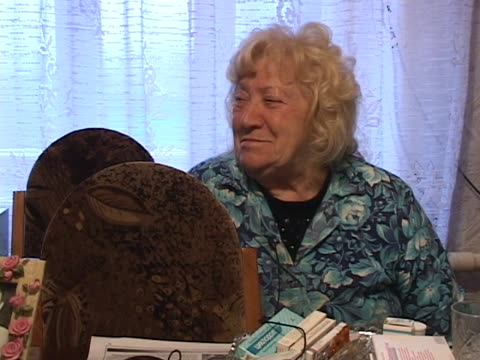
The third part of the tape is a formal interview with Iosif (Yosel) Matveyevich Shvartzman and his wife Raisa Aizekovna Shvartzman, born 1932 in Lipcani. The team sets up the interview with Iosif, born 1930 in Lipcani. He provides personal information and talks about his family. His father, a kosher butcher, and his mother, also a kosher butcher, were born in Lipcani. He grew up with three brothers and one sister.
From the machine transcript
Kerler and the team set up the interview with the Shvartzmans, discussing language and who understands Yiddish. Iosif gives his Yiddish name, Yosl, and says his father Matye, a butcher, and his mother Khave, who chopped meat, were both born in Lipcani.
Begins with the team setting up and a language discussion.
Iosif addresses his childhood memories and prewar Jewish life. He then talks about his education and discusses holiday celebration. He attended a religious school (cheder) and a Moldavian school. He recalls a class conducted in Yiddish twice a week.
From the machine transcript
Iosif answers Kerler's questions about childhood in Lipcani. He played with Jewish children in a town with many Jews and several synagogues, attended cheder under an old teacher named Shlomo, and later a Moldavian school with one Yiddish lesson several times a week. He says he remembers little of the holidays and foods, mentions Purim and Hanukkah money, and says he was too young for much.
Includes games and writers from Lipcani asked about.
Iosif talks about his life during the war. He was ultimately sent to the Bershad ghetto, where he was imprisoned for four years. Iosif explains how Jews from Lipcani were assembled in Briceni, sent to Ukraine for a few months, then Moldova for a few months, and finally to Bershad. He talks about how his father was shot in front of his eyes and his mother and brother died in the ghetto. Iosif was liberated in 1944.
From the machine transcript
Iosif tells of the outbreak of the war: Lipcani was burned, the family fled to Briceni, then moved through Ukraine and Moldova to the Bershad ghetto, where they stayed four years. His father was shot in front of his eyes by Romanian gendarmes, his mother and a brother died there, and he was liberated in 1944. Kerler also asks about a song about the Bershad ghetto.
Adds a question about a ghetto song.
Raisa talks about how she met Iosif, before he mentions his work as a sausage maker for forty years. He then talks about Jewish life after the war. Iosif recalls religious services and his traditional wedding in 1949.
From the machine transcript
Raisa says she met Iosif after both returned to Lipcani, and Iosif says he worked about forty years making Soviet-style sausage. Kerler tells them where the team members come from. Iosif describes how Jewish life continued after the war: a prayer house with a cantor, kosher meat, old people praying, and their traditional wedding with a chuppah and musicians.
Includes Kerler introducing the team's origins and the Shvartzmans' wedding.
Iosif returns to his life during the war. He recalls how his father was shot by a Romanian gendarme on the way to the Bershad ghetto. Iosif then explains how to play nuts and addresses non-Jews who spoke Yiddish.
From the machine transcript
Iosif returns to the war and says Romanian gendarmes beat the Jews in Bershad. He recounts that his paralyzed father was shot in 1941 on the way and that his brother Meir died there, naming brothers Meir, Velf and Shaps. He answers Lemster's questions about learning Yiddish, the game with nuts, and mentions that a non-Jewish master he worked with spoke Yiddish better than he did.
Includes the nut game and a non-Jew who spoke Yiddish.
Iosif talks about his traditional wedding and his work as a sausage maker. (41:00) He describes how he made “Jewish sausages.” Raisa then talks about their family and life today. They raised a son and a daughter. Their granddaughter lives in Israel.
From the machine transcript
Iosif is asked about his wedding food, then about making kosher and non-kosher sausages and pastrami; he keeps the recipe secret. Raisa tells of her children and the difficulties of life today, including fear of burglars and a daughter in Leningrad (?), a granddaughter in Israel, and a doctor son. Lemster discusses Yedinets and acquaintances with Iosif, and the team asks about the market.
Includes the sausage-making recipe talk and Lemster's chat about Yedinets.
Iosif talks about life before the war, in particular the market. He then talks about his family during the war and life in the Bershad ghetto. He remembers the beatings of Romanian gendarmes and how Ukrainians helped out the prisoners with food. He returned home from the Bershad ghetto with his sister and found their home burned.
From the machine transcript
Iosif describes the Lipcani market where Jews sold everything before the war, and the Bershad ghetto where Romanian and German guards beat Jews, but Ukrainians helped with potatoes and food. His mother died in the ghetto, and he returned to Lipcani with his sister Tsili to find their house burned. He mentions about ten thousand people in the Bershad camp, few of whom survived.
Adds the Lipcani market and the return home.
The formal interview with Raisa begins. She talks about her family during the war. She grew up with three sisters and brother. She lost family members in the Bershad ghetto and stayed on a pig farm in Obodovka beforehand. Raisa then talks about her life after the war. After her return to Lipcani, she worked as a cleaner until she got married at 17. She then describes Iosif’s work as a sausage maker.
From the machine transcript
Raisa begins her own interview. She recounts her family of five children, brothers and sisters who died in the camp or of hunger, and her father and brother shot by a German. She and her mother survived on a pig farm in Obodovka, and she describes the march to Bershad. After returning to Lipcani she worked washing floors and married at seventeen, and she describes Iosif's work making sausage.
Begins Raisa's interview.
Raisa talks about life today.
From the machine transcript
Raisa talks about life today: money lost in the currency changes, pensions, the children, and her son, a gynecologist, who runs a minibus business. Lemster then asks about Jewish holidays.
Raisa talks about prewar holiday celebration, including food customs, and her family. Her blind grandmother was burned in the ghetto. She then explains a recipe for gefilte fish and tzimmes, before Raisa talks about life today.
From the machine transcript
Raisa speaks about her mother and prewar home life; her blind grandmother Rivke was burned with other elderly people in the woods near the ghetto. She explains how to make gefilte fish (skinning, grinding with matzo meal, cooking two hours), cholent-like dishes and tzimmes with beans, and how Russian-speaking local intelligentsia came to eat at her home. She then talks about prices, pensions and the support she and Iosif receive from Hesed today.
Includes grandmother Rivke and the recipes for gefilte fish and tzimmes.
Raisa talks about life today and her husband’s accordion playing at non-Jewish weddings. They then discuss Yiddish songs and talk about religious life today. She mentions her son’s wedding with a canopy in Lipcani. The rabbi came from Bricani.
From the machine transcript
Shvartzman talks about her late husband, who played the accordion and sang at non-Jewish weddings. She sings a short Yiddish song and recalls courting in her youth. She mentions visiting the rebbe in Chișinău and her mother's piety (fasting, sending Purim gifts). She tells of her son's wedding, held with a canopy at home with a rabbi brought from Briceni.
Includes a sung song and her husband's wartime-hunger gifts of food, plus visits to Chernivtsi and Chișinău.
Raisa talks about the rebbe of Stefanesti and her plans to travel to Vyzhnytsya. She also addresses life today and folk remedies.
From the machine transcript
Shvartzman answers Lemster's questions about the rebbe of Ștefănești and says she has travelled to Sadagura (Sadhora) and wants to visit Vyzhnytsya. She explains her upbringing in a poor but observant home and her habit of giving food to anyone who comes in. Asked about folk remedies, she describes treatments for the evil eye and for fright, including quenching coals. She also tells a story about a husband who was unfaithful.
Adds her upbringing in poverty, her charity to non-Jews, and a story about a husband's behaviour.
Raisa recalls Yiddish proverbs and talks about Yiddish culture. They recall performances by Sidi Tal. Seymour Rechtzeit (Rexite), Dina Slotaye* after the war. Raisa then talks about history writing about Lipcani by Fekhtman.
From the machine transcript
Lemster asks Shvartzman for old Yiddish proverbs, and she cannot recall them. She remembers her mother singing to the children. Later the group discusses Yiddish concerts in Briceni, a singer who performed Yiddish songs, and a second person's memories of Jewish actors and singers. Shvartzman then recites a popular Yiddish song about the little town. She mentions the author Fekhtman and his book about Lipcani and tells how she lost her house.
Includes a sung song and the book about Lipcani.
Iosif talks about his life after the war. He was drafted for his military service at 19 and served for three years. Raisa then talks about life today.
From the machine transcript
Lemster and Kerler ask about her youth. The talk turns to her husband's army service, when he sent her parcels and money. She also talks about hunger and about a golden wedding. She recalls her son's wedding in a restaurant. Interviewers ask about Hasidim; she says she heard nothing about them. Katz explains that he teaches Yiddish in Vilnius, and a Russian phone call interrupts.
The catalogue speaks of Iosif's own army service. The transcript points to the husband's army service, with parcels and money sent.
Raisa answers questions about cultural terminology.
From the machine transcript
Shvartzman answers questions about cultural terms: dybbuk, golem, and a Jew who converted. She says she goes to the cemetery to ask for blessings and to light candles. She also mentions her mother's written blessings in Russian script.
Iosif recalls snippets of a prayer. They then answer a series of dialectological questions from the AHEYM Yiddish linguistic questionnaire.
From the machine transcript
A long run of dialectological questions follows. Kerler and Lemster ask Shvartzman for words and sentences, including terms for body parts, animals (cat, mouse), colours, the house and its parts, and verbs like to flee, to pray and to cry. They also ask for words for sick and healthy, honest and devout, peasant, river, sea, grandmother, midwife and vodka. A sentence to translate is also posed. Her answers are frequently mixed with Russian and with talk about her stay in Israel, and phone calls interrupt in Russian.
The catalogue mentions snippets of a prayer; this is unclear in the transcript at the start of the passage.
The first part of the tape is a continuation of a formal interview with Raisa Aizekovna Shvartzman and her husband Iosif Matveyevich Shvartzman. The Shartzmans answer a series of dialectological questions from the AHEYM Yiddish linguistic questionnaire.
From the machine transcript
The Shvartzmans answer dialectological questions from the questionnaire. Items include words for 'flowers', 'roses', 'face', 'attic', 'rafter', 'wealthy man', 'wagons', the form of 'whose', 'maybe', 'back', 'enemy' and a few sentences to translate. Kerler and Lemster ask whether the speakers have heard variant forms such as the words for flowers, and there is also talk of the prayer leader at the amud and of buying a seat in the synagogue.
The speakers also discuss synagogue seats and prayer leaders, and the Russian prompts are interleaved.