People › Dora Solomonovna Beigel › conversation

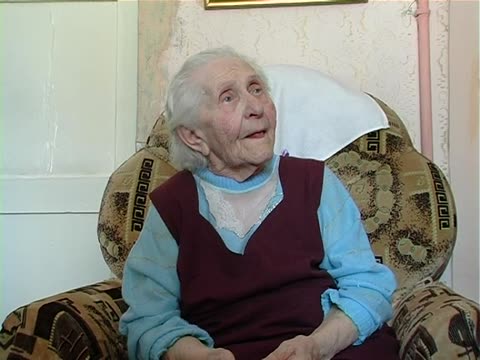
Dora Solomonovna Beigel

Hnivan' 23 May 2008 Interviewed by Dov-Ber Kerler, Moisei Lemster 2.3 h · 3 parts on 3 tapes proposed
Loading the player…
  1. MDV 441 0:00–1:01:41 · 62 min · not online — MCO
  2. MDV 442 0:00–1:01:54 · 62 min · not online — MCO
  3. MDV 443 0:00–14:24 · 14 min · not online — MCO
Passages
MDV 441 0:00–1:01:41

0:00

(Russian)

From the machine transcript

A formal interview, mostly in Russian, with an elderly woman from Odesa who says she knows no Yiddish. She recalls her grandfather's Passover seder and her father, who trained as a draftsman and architect in Odesa and studied in Switzerland. She also describes her private Russian gymnasium, antisemitism around Palm Week, and the hardships of revolution and civil war. She speaks of regretting not learning Yiddish, a Ukrainian husband who knew a few Yiddish words, and an episode at work in Bershad' when she could not understand a conversation in Yiddish.

20:21

(Not described)

From the machine transcript

Introductions with Beigel. She says she lives alone, with a son and grandchildren elsewhere. Her Yiddish name is discussed, and she says few Jews are left in the town. She gives her birth year, 1924.

22:26

Family and setting up the interview. Family

Informal Family history MDV 441 · MCO
From the machine transcript

Beigel gives personal information. She was born in Tyvriv, once a Jewish shtetl whose Jews were killed in the war. She gives her married surname (Beigel), her maiden name (Pansky) and her patronymic. Kerler and Lemster ask about her Yiddish name and the custom of double names, and about her son's name.

Adds discussion of how the town and the Yiddish name are said.

26:14

Childhood memories from Teberiv (Terov) and family

From the machine transcript

Beigel talks about her childhood in Tyvriv and the family's departure in 1932. She gives her father's name and birth year and his work, her mother Esther, and her siblings and grandparents. She remembers the hard life, and that the synagogue was closed in the mid-1930s so people prayed in private houses. She also mentions praying in private houses in Hnivan' after the war.

Adds the grandparents' names and occupations, and prayer in private homes.

33:15

Jewish holidays and religious customs after the war and family

From the machine transcript

Beigel remembers Passover seders and the prayer book she kept. She also recalls a wedding canopy at her own wedding in the 1940s, with scant food. She talks about her grandsons and what her son understands of Yiddish and Jewish holidays. She confirms that her parents were from Tyvriv, not far from a town whose name is unclear.

Adds her wedding, grandsons and her son's Yiddish.

37:33

Terov before the war

before the war Daily life (general) MDV 441 · MCO
From the machine transcript

Beigel describes Tyvriv as a Jewish shtetl with a center where Jews lived well, and Jews and their non-Jewish neighbors in the neighboring villages. The family fled a pogrom to Krasne, where they were taken in kindly, but after two years were sent back to Tyvriv and a ghetto.

Adds a pogrom, flight to Krasne and the ghetto.

39:01

food customs

From the machine transcript

Beigel speaks of the hunger and hardship in the ghetto, and says that no Jews remain in nearby Voroshylivka and only a few in Krasne and Tyvriv. The Jews left for Vinnytsya, America and Israel. At the end Kerler asks about the gefilte fish her mother made.

The catalogue entry names only food, but most of the passage is about the ghetto and the departed Jews of the region.

40:34

Life after the war in Teberiv

after the war Daily life (general) MDV 441 · MCO
From the machine transcript

Beigel answers questions about food customs. She makes gefilte fish herself as her mother did, with a little sugar, and she makes matzo kugels and potato latkes. Kerler and Lemster ask about the dish names and what the latkes were eaten with. She says she has already told them what she lived through.

Adds questions about food terms such as latkes, and the cooking of kugels.

43:09

Life after the war and family

From the machine transcript

Beigel recounts the war: the family went to her mother's parents but a week later killings began, so they fled to Krasne and were later sent back. The Dnister (?) river divided the German and Romanian zones. She was beaten in the ghetto. An elder of the community bought her out so that she would not be killed. She also escaped bandits and hid with a Pole, and three times escaped being killed.

49:16

Education and life after the war

From the machine transcript

Beigel and Kerler discuss a Yiddish blessing about long years and when it is said. She talks about studying at a technical college in Vinnytsya to be a medical assistant, and about a Jewish school in Tyvriv that she attended for a year before it closed, naming two teachers. She also mentions a fire brigade, a Georgian one (?), and the word for cotton wool, and does not remember non-Jews who spoke Yiddish.

53:03

Yiddish-speakers from the region

From the machine transcript

Kerler asks Beigel about a person from the region who knows Yiddish, and she names one woman (name unclear in the transcript).

53:31

Dialectology and religious customs after the war

From the machine transcript

Lemster asks Beigel for the meaning of Yiddish words such as dybbuk, golem, mesumad and others, and she gives explanations for some while unsure of others. She also talks about people of a religious sect who did not want to speak with her. The passage ends with a question about where the interviewers come from.

Adds the dialectology of dybbuk, golem and similar words.

55:56

Life during the war and dialectology

From the machine transcript

Beigel talks about Romanian words and the Romanian presence in her war memory. Kerler asks the Yiddish word for cemetery, which she calls a field. She says her parents went to a cemetery in Vinnytsya on anniversaries, and that she prays there in her own words. She says her father and mother prayed but she attended a Ukrainian school, and she describes herself as half Jewish. The passage ends with a question about the importance of Yiddish.

Adds the cemetery term, prayer and her view of her Jewish identity.

MDV 442 0:00–1:01:54

0:00

Religious customs and family

From the machine transcript

Beigel says the stories were not told because her parents were always working. She says Hnivan' was a non-Jewish town without Jewish weddings. She talks about her son living in Hnivan' and her two grandsons, lawyers in Kyiv, and describes how the family helps her. She says she is blind in both eyes with glaucoma and cataracts and cannot read or write. Kerler then starts the word questionnaire.

The passage shows her blindness and her sons and grandsons, which the catalogue's label does not mention.

3:56

Dialectology and friends

From the machine transcript

Long dialectological questionnaire in which Beigel gives Yiddish equivalents, often mixed with Russian or Ukrainian words. Items include words for the senses, greetings and wishes such as congratulations and thanks, everyday and household words, pronouns and verb forms, and religious terms such as praying, honest or pious Jew, and Christian. In the middle she tells at length about her youth and marriage. She mentions a Bukovina acquaintance who left for Israel, her husband's wartime imprisonment and later head illness, and her 46 years caring for him. She remarks on her failing memory and that the questioning tires her.

Beyond questionnaire work, she narrates her marriage and her husband's illness and refers to Bukovina Jews.

53:40

Beigel’s son enters the apartment

Informal MDV 442 · MCO
From the machine transcript

Beigel's son comes into the apartment while the interview is going on, and the conversation is largely in Russian. She explains to him that the interviewers are from America and Israel and are studying Yiddish words, and jokes that she has become a student in old age. The son brings her laundry.

55:27

Dialectology

From the machine transcript

Further dialectological questions put by Kerler, with Lemster joining in. Items cover grammatical forms (case endings, "on the road", plurals), a Hebrew-derived word for "probably", and words for orphan, wagon, face and proper form of verbs. Kerler also asks about customs vocabulary such as the bridegroom's praying and Hanukkah games, but she says she does not remember them.

MDV 443 0:00–14:24

0:00

Dialectology

From the machine transcript

Beigel answers Kerler's dialectological questions. He asks her to choose between variant forms of prefixed verbs and of words for 'many', 'back', 'somebody' and 'suddenly'. The talk then turns to what language was spoken in Bessarabia, mixed with Romanian and Russian, and she and Kerler switch to Russian about Chisinau and the Israeli ambassador. Beigel says she now mixes Yiddish and Russian.

Beyond the questionnaire, a talk about Bessarabian speech, Chisinau and Beigel's use of Russian.

5:15

Life today

life today Life today MDV 443 · MCO
From the machine transcript

Beigel talks about life today. She has a few younger friends in Hnivan' with whom she speaks some Yiddish, though mostly Russian. She discusses radiation and emigration, saying people stay where it is good, but that Jews are not loved here. She does not remember songs.

Also covers emigration, antisemitism, a friend from another town and Beigel's inability to recall songs.

7:30

Jewish weddings after the war and religious customs before the war

From the machine transcript

Beigel recalls Jewish weddings, at which people danced the freylekhs, and one after the war, perhaps her sister's daughter's. She and Kerler discuss the customs for the birth of a boy: the grandmother going out to distribute sweets to the children, and the naming ceremony. Kerler asks when a girl was named, and she says after a week.

The catalogue says the weddings were after the war and the religious customs before it; the transcript shows birth and naming customs, with the wedding mentioned only as dancing.

10:42

Life today

life today Life today MDV 443 · MCO
From the machine transcript

Beigel says she had no good years. The war began when she was a teenager and brought only hardship. Now she does nothing and her children help her. Asked about lullabies, she remembers none.

Beigel's wartime youth and lack of good years, and the lullaby question.

11:50

Concluding the interview and information about Yiddish speakers in the region

From the machine transcript

The interview winds down with joking about Kerler's status and a local young man who learned Yiddish. Kerler notes that a Christian cannot convert from Judaism. Beigel then discusses Jews in Kopaihorod and Sharhorod: none are left in Sharhorod, which had a ghetto. She mentions a book about it by an author now in Israel, which she read in Russian.

Adds the Sharhorod ghetto and the book about it, and the young man who learned Yiddish.

Questions put in this conversation

Items of the dialect questionnaire asked here; each link plays the moment.