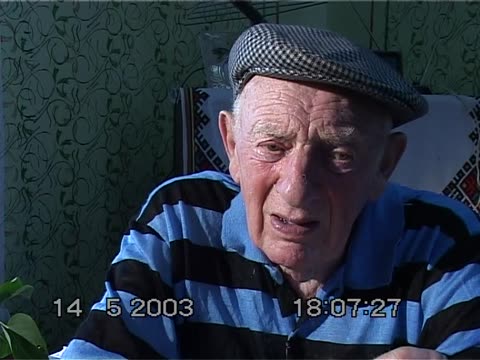
The second part of the tape includes a formal interview with Genrikh (Hersh bereb Moyshe akoyen, Hesye) Moiseevich Katz, born 1912 in Tlumach. Katz provides personal information and talks about prewar Jewish life in Tlumach with a population of 9000. In particular, Katz recalls cattle trading and two kosher butchers. His grandfather traded in cattle. He then recites a prayer.
From the machine transcript
Kerler begins the Katz interview. Katz gives his name, address, postal index and telephone number. Kerler locates Tlumach on a map; Katz says it is about 25 km from Ivano-Frankivsk. Katz describes prewar Tlumach, with 9000 Jews among a larger non-Jewish population, and its tailors, shoemakers and carpenters. He recalls the big fair and cattle trading, a butchers' cooperative, kosher and non-kosher meat, and two or three ritual slaughterers. He was born in 1912, was called Hersh (Tsvi in Hebrew) and is a kohen; Kerler asks him to show the priestly blessing gesture. He says he says Kaddish and prays at home with a prayer book.
Also includes the address and telephone details, the map search for Tlumach, and the priestly blessing gesture.
Katz talks about his family. He was the first-born and grew up with two brothers and four sisters. His parents and siblings were murdered during the war. His father worked in a distillery and was born in Horodenka. His mother was born in Tlumach. Katz then describes how he built sukkot with his grandfather.
From the machine transcript
Katz talks about his family. Both parents and most siblings were killed in the war. His father Moyshe, a distillery worker, came from Horodenka; his mother Gitl was a housewife from Tlumach, and her father was Gershon. He was named after his grandfather Hersh. He recalls his cattle-trading grandfather Gershon, helping him build the sukkah, and his grandmother's pet name for him. Kerler goes through his siblings' names (Rozia/Reyzl, Leyb, Klara, Mina/Menia, Kuba/Yankl, Nusia) and establishes that there were seven children, with Katz the eldest.
Adds the full list of siblings' names and the grandmother's nickname for him.
Katz talks about his life and education before the war. Katz attended a Polish school. He worked as a locksmith in Tlumach, after graduating from a handicraft school in Lviv for three years. Katz then discusses his childhood memories. His father was a Hasid of the Stanislav rebbe’s court and Katz talks about his father would visit the rebbe.
From the machine transcript
Katz says he was a locksmith before the war, after finishing seven classes of Polish school and a vocational school. Asked about his childhood, he says his father was a Hasid of the Stanislav rebbe. His father worked for a landowner, sent him with messages to the rebbe, and travelled to the rebbe about every two months to unburden himself.
Adds the father's work for a landowner and his visits to the rebbe.
Katz talks about his traditional wedding in 1940 with a wedding canopy set up in the rebbe’s court. He then discusses his education at the religious school (cheder) with two teachers and discusses his childhood memories, including swimming in the river and going to the bathhouse. At the Polish school, Katz also received Hebrew-language instruction.
From the machine transcript
Katz says his wedding canopy was set up at the rebbe's in Stanislav in 1940, because Soviet rule had arrived. He recalls cheder, where he learned to pray, and says some of his teachers used a whip. He then recites a prayer (Kaddish) and speaks of the four-class Polish school of Baron Hirsch, which had a Hebrew teacher. After that he describes his vocational training in Lviv and work for a private employer in Tlumach. He recalls a pond where children swam, the ritual bath and bathhouse, and its use before festivals and on Fridays; he also mentions his grandfather's death.
Adds the recited prayer, the pond, the mikveh and the grandfather's death.
Katz talks about Sabbath celebrations at home, including food customs, and shares childhood memories. His father would work in the distillery on Sabbath, taking care of the animals. Katz would help out his father. He then talks about holiday celebrations and food customs. Katz explains how the owner of the distillery owned a lake and would fish it dry once a year, providing his family with fish. When Katz discusses Purim celebrations, he recites a Purim shpiel.
From the machine transcript
Katz describes Sabbath and holidays at home. His father worked at the landowner's distillery on Sabbath, supervising the animals, and Katz sometimes helped with the production figures. His father prayed with tefillin and did not eat before praying. Katz names Sabbath and holiday foods: bread, challah, cholent and potato dishes. Kerler questions him about the potato dish called mandeburchenik, and about fish, which was expensive. The owner's lake was fished out once a year, giving a festive occasion and gefilte fish. Katz also mentions Hanukkah money, the dreidel and latkes. For Purim he describes beggars going from house to house and recites their begging rhyme twice.
Adds the potato-dish terminology, Hanukkah customs and the tefillin discussion.
Katz talks about his activity in the youth Zionist organization Hashomer Hatzair and Passover celebrations.
From the machine transcript
Katz mentions his membership in a youth organization, Hashomer Hatzair, but cannot recall Hebrew songs. Asked about Passover at home, he says his father, a Hasid, took little interest in the Four Questions. His father worked for a Polish landowner whose name is only partly clear in the transcript.
Adds the father's attitude to the seder and the landowner's name.
Katz discusses holiday celebrations, including Shavuot and Yom Kippur. He then talks about a Sabbath goy he remembers from home and food customs. Katz also addresses non-Jews who spoke Yiddish, antisemitism, football clubs, and drama circles. Katz then lists political organizations, including Hashomer Hatzair, Gordonya, Poale Zion, the Bund.
From the machine transcript
Answers Kerler's questions about prewar life in his hometown. Topics: Shavuot greenery and Yom Kippur fasting by Katz and his parents; the Sabbath goy who stoked the stove; Sabbath cholent baked in the bread oven; the word for beans. He then discusses non-Jews who spoke Yiddish, a woman living with a non-Jew, and antisemitism, which varied by period. He names the fire brigade, a Jewish football club, a drama club in Tlumach, Zionist and Bundist groups, and Polish and Yiddish newspapers from Lviv.
Adds the fire brigade, a mother who did not read the popular literature, and a question about the Yiddish word for beans.
Katz sings a Sabbath song and talks about prewar Yiddish theater plays and Jewish professions. He then discusses religious life.
From the machine transcript
Katz recites or sings a quoted Sabbath greeting and dialogue from a play he saw, and talks about the Yiddish and Polish dramas performed in the town. A play title about a madman in a hospital is mentioned, with a name (Barishev?) that is unclear. He then answers Kerler's questions about the town's craftsmen (carpenters, shoemakers, tailors, tinsmiths, brewers, butchers, three ritual slaughterers), the many prayer houses, and the town's rabbi. He says his father was a brewer. The young rabbi was killed by the Germans.
Adds Polish drama, a play title, the number of slaughterers, and the town's rabbi.
Katz answers questions about cultural terminology and recalls the play “The Dybbuk” performed by the Vilna troupe in Stanislav in 1924.
From the machine transcript
Answers Kerler's questions on cultural terminology. Topics: the difference between rov, rebbe and rabbiner, and their plurals; a good place as a name for a cemetery; a good Jew as a rebbe; Litvak; tsadik; Galitsianer; and Yiddish words for various types of person. He recalls a Jewish wedding. He also discusses the Dybbuk and the Vilna Troupe's performance with the Turkow brothers in Stanislav, which he attended in 1924.
Adds the Dybbuk and the Vilna Troupe performance, with the year; the catalogue mentions it in a different order.
Katz discusses his childhood memories and education. He studied 31:15 at a handicraft school in Lviv and took exams in lock smithy. Katz states that he was unemployed in Tlumach until the territory was occupied by the Soviets and he found work at 32:20. Katz also mentioned his traditional wedding at the rebbe’s house. He then talks about his life during the war. He was drafted into the Red Army and served in the labor battalion. Among other places, Katz was sent to a place eighty kilometers from Stalingrad, before his battalion arrived in Stalingrad. Katz continues that he became ill and worked in a factory for military goods eighteen hours a day. He was then sent to another factory in Kirov, Russia, where he worked until 1947. That year Katz moved to Ivano Frankivsk.
From the machine transcript
Katz talks about his schooling: seven classes at a Polish school, then three years at a trade school in Stryi, followed by a locksmith's exam in Lviv and a diploma. He was unemployed at home until the Soviet occupation, then worked in a ministry office and married at the rebbe's house in Stanislav. During the war he was in a labor battalion digging trenches near Stalingrad, fell ill with a high fever, and worked eighteen-hour days in a munitions factory. He was then sent to another factory in Kirov (?), where he stayed until moving to Ivano-Frankivs'k in 1947.
Adds the wedding in Stanislav and Katz's attendance at a ministry office; the transcript shows hunger in the labor battalion.
Katz talks about religious life after the war in Stanislav (today Ivano Frankivsk). Katz mentions his friends in Israel.
From the machine transcript
Katz confirms that his parents and siblings were killed, and Kerler lists their names. He then describes life in Soviet Stanislav (later Ivano-Frankivs'k) after the war: no synagogues, private prayer in homes, a closed city. He says he has no relatives abroad but had friends in Israel from the Hashomer movement. Kerler ends by announcing a set of words to translate.
Adds the family names Kerler lists after the war, and the closed-city status.
Katz answers a series of dialectological questions from the AHEYM Yiddish linguistic questionnaire.
From the machine transcript
Answers questions from the AHEYM Yiddish dialectological questionnaire. Kerler gives Russian words or sentences, and Katz translates them into Yiddish. Items include: everyday objects (book, glass, skin, pigeon, building, ear), colours, comparatives and adverbs (quicker, nearer), weather words, verb forms and prepositions (the dative and accusative), and sentences on health and travel. They also test words such as well, flowers, potato, and baba.
The first part of the tape is a continuation of a formal interview with Genrikh Moiseevich Katz. Katz answers a series of dialectological questions from the AHEYM Yiddish linguistic questionnaire.
From the machine transcript
Katz answers Kerler's questionnaire items. They cover Yiddish equivalents of Russian words and phrases (use or exploit, once, sometimes, suddenly, probably, a mistake, male) and a few Hebrew-derived words. Kerler explains differences in meaning, for example exploiting a person versus using a thing, and corrects Katz's reading of a Hebrew vowel sign. At the end Kerler thanks him for the help.
Besides the questionnaire, Kerler and the interviewee briefly discuss another interviewee who was a great help earlier.
Katz sings well-known Yiddish songs, including “Sha shtil” and “Afn pripichek.”
From the machine transcript
Katz sings parts of well-known Yiddish songs, including one about a rebbe and one set by the Pripet river. Kerler and others react and discuss a Polish song, and Kerler thanks him and gives his own contact details.
Also includes a Polish poem prompt and Kerler giving his address.
The second part of the tape includes footage of the Ivano-Frankivsk synagogue. The camera records outside footage of the synagogue, before the team enters the building and talks to Rabbi Moyshe Kolesnik. The camera then records the morning service.
From the machine transcript
The synagogue footage opens with Kerler talking about the building and the rebuilding of Jewish communal life, with old Hebrew books, a menorah on the wall and commentaries. He mentions a book printed in Vilna and the Jewish settlement of Stanislaviv, now Ivano-Frankivs'k. He compares this with a synagogue in Bershad' (?), and most of the rest is the filmed morning service with almost no recognised speech.
The transcript shows Kerler's talk about the building and its books; the service itself has almost no recognised speech.
The team speaks with a number of congregants, including Froim Kalmanovich Bukshtein, about Yiddish dialects and regions. A congregant from Proskurov (today Khmelnytskyy) talks about his family members that perished during the war. He also briefly addresses his education.
From the machine transcript
Kerler talks with several congregants about where they were born, the Yiddish they speak and the language of their region. One man from Proskurov (Khmelnytskyi) talks about the Jewish population there, the family members who perished in the war, and his Russian schooling. There are also remarks on Litvak Yiddish, on Yampil and on Jewish life in Proskurov today. Kerler explains that this is a short interview for an archive and that the recording will not be shown publicly.
Beyond dialects and regions, the passage includes a Moscow-born congregant, Yampil, Litvak Yiddish, Jewish life in Proskurov and the congregants' schooling.
The team continues informal conversations in Russian and Yiddish with the congregants.
From the machine transcript
Informal conversation in Russian and Yiddish with congregants. A Dagestani (Mountain Jewish, Tat) congregant talks about the Tat language and Jewish life in Makhachkala and Israel. There is also talk about a Yiddish theater coming to town, an Israeli relative, and comparative forms in Yiddish and Russian. Kerler mentions a book by the poet Avrom Gontar (?) and says the team is going on to Chernivtsi to record living people. Parts are in poorly recognised Russian.
Bukshtein reads stories from a Soviet Yiddish story book and discusses Yiddish newspaper articles; he received from France during the Soviet period.
From the machine transcript
One congregant, probably Bukshtein, reads aloud Yiddish poems from a Soviet Yiddish book, including one about children and pine trees and another about a telephone conversation. He then shows a Yiddish newspaper he received from France in Soviet times and discusses articles in Yiddish papers. Kerler asks how he got them and says he would like to read them. The talk turns to a story by Anatoli Kuznetsov (a Soviet writer who defected) and to Baba Yar (?).