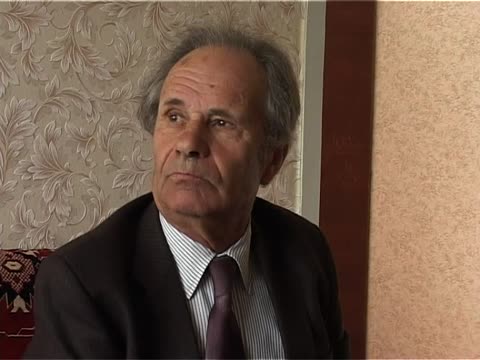
People › Boris Matveevich Gershtein › conversation

Boris Matveevich Gershtein; Ignat Petrovich Oykhovitch

Kovel' 9 May 2003 Interviewed by Dov-Ber Kerler, Jeffrey Veidlinger 3.0 h · 3 parts on 3 tapes
Loading the player…
  1. MDV 554 0:00–59:22 · 59 min · not online — MCO
  2. MDV 555 0:00–59:57 · 60 min · not online — MCO
  3. MDV 556 0:00–57:41 · 58 min · not online — MCO
Passages
MDV 554 0:00–59:22

0:00

Life during war.

during the war World War II (general) MDV 554 · MCO
From the machine transcript

Gershtein recounts his flight at the start of the war as one of four children. They reach Sarny, meet the Red Army in the woods, and a commander named Kuznetsov (?) arranges for them to reach the evacuation trains. A bombed bridge stops the train; they spend the night in a field, barefoot and with little clothing. A freight train takes them to Kyiv, where they are fed and put to work digging potatoes. He is then sent to Andizhan.

Details of the bombed bridge and the freight train to Kyiv.

5:05

Army service.

during the war Army service MDV 554 · MCO
From the machine transcript

Gershtein says he was drafted into the army in 1944 and served first as an infantryman and later as a sapper. He remained in service until 1949 and now lives as an invalid with a leg disability.

5:57

Return to Holoby after the war.

after the war Liberation and return MDV 554 · MCO
From the machine transcript

Gershtein describes his return to Holoby after the war to look for his parents. His house had been taken over and damaged, and lawyers told him he had no case. He then studied at a commercial cooperative technical school and worked for years.

6:49

Education and work after war.

From the machine transcript

Gershtein talks about his postwar work, including as a director of an office, and his move to Kovel' in 1968. He says no Jews returned to Holoby and someone told him his parents had been shot. In 1970 he learned that his parents and siblings were in America. He holds a diploma in commodity studies.

Move to Kovel' in 1968 and the discovery of his family in America.

8:18

Family.

From the machine transcript

Gershtein names his siblings who ended up in America, including a brother who served in the Polish army and was wounded in Warsaw. His mother survived, but his father's fate is unclear in the transcript. He tells how his mother's sister Chaye Sore and her husband Rakhmil (the uncle) and their three children were killed; the uncle chose to go to the shooting with his family rather than save himself.

Names and fate of his uncle Rakhmil and his aunt's family.

11:42

Prewar Jewish life in Holoby.

before the war Local Jewish history MDV 554 · MCO
From the machine transcript

Asked about the town before the war, Gershtein says many Jews lived in Holoby alongside Poles and Ukrainians. Until about 1936 people lived in peace and he did not know antisemitism. He mentions a non-Jewish man living nearby who speaks Yiddish and works as a journalist.

Mention of the Yiddish-speaking non-Jewish friend.

12:35

Yiddish speaking friend.

From the machine transcript

Kerler and Gershtein discuss contacting the non-Jewish Yiddish-speaking friend by telephone, and Gershtein phones him in Russian and Ukrainian to ask him to come. Kerler then asks about the words for corn and wheat.

The phone call to the friend and the exchange on corn and wheat.

15:01

Prewar Jewish life and childhood memories.

From the machine transcript

Gershtein describes Holoby's big synagogue and the ritual bath he visited with his father each Friday, and names two ritual slaughterers, Chaim Wolf Goldberg and Abba Sima. He says the nearby villages had only small prayer houses, and that the dead of Holoby were taken to Mel'nytsia for burial. He mentions a rebbe in Lutsk, childhood games, bathing in the river and a Polish ball game. His siblings were pioneers (khalutsim). He also recalls the Zionist youth club, where children danced and sang Yiddish songs.

Games, the youth club and burial in Mel'nytsia.

21:45

Yiddish and Polish songs.

From the machine transcript

Gershtein sings or recites a Polish song and a Purim song in Yiddish and explains that the children went from house to house as Purim performers to earn money.

23:21

Holidays and prewar Jewish life.

From the machine transcript

Gershtein recalls going from house to house in the Purim play in 1936–37, aged about ten, and earning a lot of money from the wealthy. He names the miller Matl and the miller David Katz, who each gave a coin, and describes the poor and the wealthy in town. His uncle Rakhmil Vitsnudl kept a dairy, and he remembers the wandering poor, a Sabbath meal for the poor, the Slikhes wake-up call and the slaughterers' homes.

Wealthy and poor families, the dairy and the paupers at the Sabbath.

32:16

Prewar religious life.

From the machine transcript

Kerler asks about clubs, social life and a Friday evening event, and Gershtein recalls going with his father to the synagogue for a Sabbath evening meal and prayers. He says he can read Hebrew prayers from the siddur, and Kerler asks him to read the Modeh ani and the Kiddush blessing.

37:05

Life today and postwar life in Holoby and Kovel'.

life todayafter the war Life todayDaily life (general) MDV 554 · MCO
From the machine transcript

Gershtein talks about medical care and the cost of living today, noting that as an invalid he pays nothing for the doctor. He says no Jews prayed in Holoby after the war and that it was forbidden. Kerler asks about the synagogue in Kovel' in the 1960s, and the interview is declared to be ending.

Medical care and post-war ban on prayer.

40:22

Friend entering.

Informal life today MDV 554 · MCO
From the machine transcript

Gershtein's non-Jewish friend arrives and is introduced to Kerler, and they talk in Yiddish and Russian. He is a correspondent for the Kovel' city paper, and he says he speaks Yiddish only a little. He speaks about a journalist for a news agency who came looking for a relative.

The friend's arrival and his work as a journalist.

44:12

Village Rozhyshche and childhood memories.

From the machine transcript

Kerler asks the friend about his home village of Rozhyshche, and he gives his name as Ignat Petrovich, surname spelled Olchowicz (?). He speaks about the town's Jewish population before the war, saying it was large and many were shot, and the Yiddish name of the town is discussed. Kerler asks how many synagogues there were, and the answer is one. The friend mentions a family named Pen and explains to the team that they are researchers recording interviews.

The friend's name, the village and the family of Pen.

50:32

Polish and Yiddish songs and nigunim.

From the machine transcript

Gershtein and the friend sing parts of Yiddish songs, including one about the street and the girl, and Gershtein sings Polish songs. They talk about Eddie Rosner and the popular Russian version of a song. Kerler asks about Hasidic melodies.

53:30

Holiday celebration.

From the machine transcript

Asked about holidays, Gershtein recalls Shavuot as the day the Torah was given and the foods eaten, including blintzes with cheese or meat and dairy dishes. He mentions the custom of putting greenery in the house and asks about Passover songs, including Khad gadya. He recites the four questions and says he asked the Passover questions as a child. A book on the Jews of Kovel' is also mentioned in Yiddish.

MDV 555 0:00–59:57

0:00

Holidays and food customs.

From the machine transcript

Kerler asks about Hanukkah: the candles, Hanukkah money and the foods eaten on Hanukkah, especially potato latkes, as well as other holiday foods. He also asks about food before Yom Kippur. The informant answers briefly and often cannot remember.

Yom Kippur pre-fast customs and the eating of kreplach are also covered.

2:42

Non-Jews and religious customs.

From the machine transcript

Kerler asks whether non-Jews converted to Judaism before the war, and the informant says there were such cases. They also discuss Jews who converted away from Judaism. Kerler then asks for the Four Questions of the Seder to be read, and they talk about Yiddish and Hebrew wording of some of the phrases.

Includes the Four Questions being read and a few Yiddish wording details.

5:48

Informal chat.

Informal MDV 555 · MCO
From the machine transcript

Informal talk about where the team has travelled and where they come from (Kyiv, Polonne and Izyaslav, Slavuta, Rivne, Lutsk and Kremenets), partly in Russian and Polish. Kerler tells a joke about a Jew asking for water, and a Polish song is mentioned. At the end Kerler asks about a sports club in the town.

9:10

Prewar cultural activities and Yiddish film.

before the war Cultural life (general) MDV 555 · MCO
From the machine transcript

The informants recall prewar cultural life in the town: a mixed Jewish and Polish football team, political movements (Bund, communists, Betar and Hechalutz), and visits by a Yiddish actor and singer named Shuster-Meyr (?) who performed songs. They discuss Jewish periodicals, books read (Sholem Aleichem, Peretz), and a Yiddish film given to a museum in Kyiv. The informant tries to retell the film's plot, and Kerler asks about a library and the cinema, which the informant says showed no Yiddish films.

Covers sport, youth movements, press and books, as well as the film.

18:11

Cultural terminology and dialectology.

From the machine transcript

Kerler asks about the terms rov, rebbe, melamed, Hasidic rebbe and their plurals, then expressions such as 'a good place' for a cemetery, beys-oylem, a good Jew, a tsadik, Galitsianer and misnaged. They then compare Lithuanian and local Yiddish pronunciation (sibilants and the r). Some Russian talk about the history of Yiddish is mixed in.

Rabbinic terms and dialect comparison are covered.

25:07

Jewish weddings.

From the machine transcript

Kerler asks about Jewish weddings before the war. The informant describes the chuppah, the rabbi, the blessings, the meal with wine and brandy, dancing and klezmer musicians. Kerler asks about wedding songs and the 'mitzvah dance'.

27:01

Food customs.

From the machine transcript

Talk about food customs: the taste of the mother's gefilte fish, how much salt and sugar it should have, and making it for holidays. Kerler asks about drinking brandy, wine, beer and kvass, and the father's birch-sap kvass. At the end he starts asking about folk remedies and charms.

30:34

Dialectology.

From the machine transcript

Kerler puts questions from the dialectological questionnaire in Russian for translation into Yiddish: greetings, please and thank you, mouse, belly, creeping, window, colour words, a pious person, an honest person, a headache, 'twenty', 'where are you from', pronouns, 'to be', 'I speak with mothers' and the phrase 'at father's'. The informants answer, correct and discuss the forms.

40:51

Concluding the interview.

From the machine transcript

The formal interview closes, with only a few words of thanks heard.

41:11

Town footage and war memorial service.

FootageService life today Memorials and commemoration MDV 555 · MCO
From the machine transcript

Town footage and talk about the team's route (Lviv, Drohobych, Chernivtsi, Stanislav, Podolia), then talk in Russian and Yiddish about a nearby former Jewish shtetl whose name is unclear in the transcript, with a tsadik's grave. Oykhovitch points out a building that once had Stars of David on its rings and balconies. The tape ends with the Victory Day memorial service, with Russian and Ukrainian speeches, a discussion of five honoured soldiers (one with a Jewish father), and the parade.

MDV 556 0:00–57:41

0:00

Dialectology.

From the machine transcript

Dialectological questionnaire: Kerler goes through everyday Yiddish words with Oykhovitch and others, checking Slavic-influenced forms against Yiddish ones. Items include flower words and the difference between two of them, 'cooking oil', 'well', 'potato', numerals, 'must/need', 'to arrange', 'to dig', 'to pray', 'grandmother/grandchild', 'beard', 'full of people' and 'return'. Songs and a few sentences to translate come up, and Oykhovitch mentions his Polish school and Polish relatives at the start.

30:28

Informal chat.

Informal MDV 556 · MCO
From the machine transcript

Informal chat with Kerler about a Hebrew song from Betar days and about Yiddish dictionaries, universities and academic degrees. Kerler talks about his own position as a professor. The talk moves to cheder and Tarbut schools, the melamed in Sholem Aleichem, and the Rothschilds. It ends with a toast of vodka, tea and a remark about someone who stayed home on Victory Day.

36:29

Proverbs.

From the machine transcript

Kerler recites or recalls a few Yiddish sayings and rhymes, including one about wine and brandy making a man drunk. He asks the men for a song and then for a word. He jokes about age, saying he is forty-five and has lost interest in young women.

39:01

Informal chat.

Informal MDV 556 · MCO
From the machine transcript

Informal chat as the recording winds down. Kerler asks for the men's addresses and tells them that the material will be archived and compared across places. He says that Professor Veidlinger is collecting material on history and memory. There is a remark about the Jewish origin of the surname Oykhovitch.

41:24

Town footage.

Footage MDV 556 · MCO
From the machine transcript

Town footage with Russian and Ukrainian talk among those present, partly about the former synagogue as a historical monument, its director and planned repairs of facades. They also discuss finds of buried gold coins and the state's share of them. Yiddish remarks by Kerler and Oykhovitch are scattered through the talk.

43:41

Restaurant and synagogue footage.

Footage MDV 556 · MCO
From the machine transcript

Restaurant and synagogue footage. There is Russian talk about a call from Zhytomyr and an upcoming Jewish festival in Vinnytsia, and a long garbled stretch that may involve a prayer or text. Kerler explains to a passer-by in Russian that the team is on its way to Lviv and is looking for old Yiddish speakers. The man remembers neither Yiddish nor Hebrew. They also discuss an old printing house, and the end is only scraps of Russian about addresses.

Questions put in this conversation

Items of the dialect questionnaire asked here; each link plays the moment.