People › Boris Matveevich Gershtein › conversation

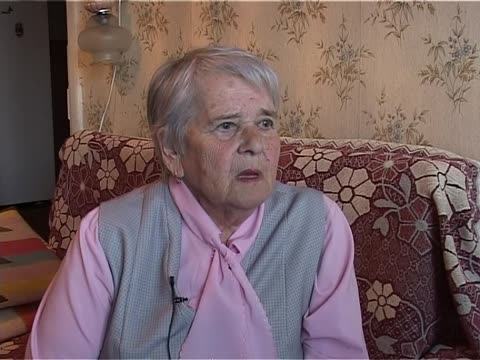
Boris Matveevich Gershtein; Evgeniia Abramovna Shvardovskaia

Kovel' or Luts'k 8 May 2003 Interviewed by Dov-Ber Kerler, Jeffrey Veidlinger 3.1 h · 3 parts on 3 tapes uncertain
Loading the player…
  1. MDV 553 0:00–1:02:29 · 62 min · not online — MCO
  2. MDV 576 0:00–1:00:34 · 61 min · not online — MCO
  3. MDV 577 0:00–1:00:01 · 60 min · not online — MCO
Passages
MDV 553 0:00–1:02:29

0:00

Dialectology

From the machine transcript

Long dialectological questionnaire session with a woman, led by Kerler, who gives Russian prompts and asks her to translate them. Items include words for house, room, table, bird and dove, body parts, adverbs of time and degree, and comparatives. Also covered are verb forms and prepositions, the numbers, 'right/correct', the words for 'many', 'other' and 'suddenly', and Hebrew-derived words. Kerler notes which forms are Polish, Belarusian or Lithuanian-Yiddish in character.

43:47

Concluding the interview

From the machine transcript

Short closing of the questionnaire session, with Kerler thanking the woman and some talk about the linguist Dovid Katz and Lithuanian versus Polish Yiddish. A Russian remark about someone's brother coming from America and being in Warsaw is also heard.

Besides closing, mentions Dovid Katz and Warsaw.

44:05

Setting up interview with Matveeich and memorization

Informal MDV 553 · MCO
From the machine transcript

Setting up the interview with Gershtein. He speaks of his brother in America, who was denied a visa for a visit, and of the search for Yiddish speakers in the region. Gershtein then shows his native village Holoby on the map. He says that thousands of Jews are buried in the woods near it, that he asked authorities in Luts'k for a memorial, and that many Jews lived there. Kerler begins filling in the personal-data form.

50:10

[undescribed content]

From the machine transcript

Kerler and Gershtein sort out Gershtein's address and telephone number for the record, with the digits spoken in Yiddish.

50:51

Family

From the machine transcript

Gershtein gives personal and family details. His Yiddish name is Avrom, and he was eighteen during the war years. His father Motke(?) was born in Holoby in the 1870s (?) and worked at a slaughterhouse. His mother Gitl sewed at home on a machine together with another woman. There were six children. Gershtein names several siblings, among them Shmuel, Khave and Yankl, and says some family members went to America and Israel after the war while he was in the army. His grandfather Moyshe Itskhok died in America (Detroit?). Gershtein also recalls his uncle, aunt and three children killed in the woods, and says the town was called Kovel in Yiddish.

59:00

Early childhood memories and education

before the war ChildhoodSchooling MDV 553 · MCO
From the machine transcript

Gershtein describes his childhood in Holoby. He completed seven grades of the school and for two or three years attended cheder in the synagogue under the old teacher Berl Shuster. The teacher beat pupils, girls included, with a whip for not studying. Shuster's son Bentsiye later taught Yiddish, and Gershtein mentions Poland's rule at the time.

1:00:53

Escape at the beginning of the war

during the war Hiding and rescue MDV 553 · MCO
From the machine transcript

Gershtein tells how, in June 1941 (?), when the war began, he fled with two friends and a girl, Roze Prager, who later died in America. They left their parents and travelled at night by horse-drawn carts. He was thirteen at the time. On the road they saw German aircraft, and he describes the group's flight.

MDV 576 0:00–1:00:34

0:00

Entering Shvardovskaia’s apartment

Informal life today MDV 576 · MCO
From the machine transcript

The interviewee and Kerler settle in at the start of the recording. The Yiddish is mostly garbled, with a Russian remark about where to sit. She mentions that she spoke Yiddish with older people but has no one to speak it with now.

1:22

Life today.

life today Life today MDV 576 · MCO
From the machine transcript

She says she speaks Yiddish to herself at night, and Kerler explains the project: recording the real spoken Yiddish of the shtetl, prewar life and the war, and the decline of Yiddish. He records the name of her town, Sofiyivka in Polish and Trokhenbrod in Yiddish, and she says she had a private teacher at home since there was no Jewish school. They discuss the district around Luts'k, with Kerler looking at a map, and she gives her married and maiden names and her father's name.

The passage is mainly Kerler explaining the project and mapping her region, not only life today.

10:34

(Not described)

From the machine transcript

She gives her street address and phone number in Luts'k and her birth in Trokhenbrod. Kerler asks about the town index and the family name, and she says her father's family was Teper, with her grandfather's name given as Shimen.

12:53

Family

From the machine transcript

She talks about relatives named Teper in America and recalls an uncle who left with the Reds in 1919. She names her parents, Avrom the merchant and Sara (called Sulke), their birth years, and her grandmothers, and says her grandfathers died young. She was the eldest of seven children, naming siblings including Shimen, Malke, Shmerl, Brokhe and Bashe; two survived and some froze to death in the forest during the war.

20:08

Early childhood memories and prewar Jewish Sofievka

From the machine transcript

She recalls her childhood in the shtetl, where the family had land, orchards and fields, and describes the Polish police and school, the Catholic church and the four synagogues. She talks about the weekly Friday visit to the bath house and the mikveh. Kerler asks about the synagogue buildings and colour words, and she recalls her mother's blessing over the Sabbath candles. She says she can speak and write Yiddish well after all these years.

Adds the bath house and mikveh, the church, and the colour-word questions.

28:07

Religious education and religious customs

From the machine transcript

She says a teacher, Fishl der Krimer, came to the house to teach her Yiddish and Hebrew for two or three years. She was also taught blessings and prayers, though she says she has forgotten most. She talks about her mother lighting the Sabbath candles, the Friday challah, and her father taking the children to the synagogue. Her mother and grandmothers could not read, and she says the teacher was later killed.

Adds the Sabbath candles, challah and father's synagogue habits, plus the teacher's killing.

32:53

Holiday celebration before the war

before the war Other holidays MDV 576 · MCO
From the machine transcript

She answers questions about holiday customs at home, with Shavuot dairy food such as cheese blintzes and Passover food. She says the family bought matzo in quantity for their large household. She describes the town as a Jewish one where life was cheerful and Jews felt at home.

37:16

Holidays celebrations

From the machine transcript

She answers questions about the holiday cycle, including Purim with baking, gifts and costumes, Hanukkah with money, candles and latkes, and Sukkot, the sukkah and her birth on Sukkot. She also discusses the fast, the meal before Yom Kippur and chicken soup, and Kerler asks Yiddish and Polish month names. The questions mix customs with terminology.

46:04

Jewish professions before the war

before the war Work and trades MDV 576 · MCO
From the machine transcript

She tells of non-Jews, mostly Poles, who spoke Yiddish and Hebrew, including a postmaster's son, and says they lived on good terms. She recalls a Jewish–gentile intermarriage and a case of conversion, which the town condemned. She lists trades and professions: tailors, builders, shoemakers, teachers, pharmacists, a barber, and doctors in Luts'k. She says her father dealt in lumber and travelled to Luts'k by horse and wagon. She mentions folk healing by her grandmother and a midwife.

Adds non-Jewish Yiddish speakers, intermarriage and conversion, and the father's lumber business.

55:24

Youth movements and cultural life

From the machine transcript

Kerler returns to the Zionist youth movements, and she describes Betar and the sports ground in the forest where football was played and Jews gathered on the Sabbath. She talks about debates, libraries in the clubs, and a local amateur theatre where she took part in a Hasidim dance created by a young man, later in Israel. She also talks about klezmer musicians at weddings and briefly begins a song.

MDV 577 0:00–1:00:01

0:00

Prewar cultural life

before the war Cultural life (general) MDV 577 · MCO
From the machine transcript

Talks with Kerler about prewar cultural life in her shtetl. She comments on differences of speech between streets and on a proverb, and on the term for an older grandmother. She names Warsaw Yiddish periodicals (Moment, Der Shtern) that were read, and recalls klezmer and singers coming from Luts'k to perform. She also remembers the first car in the street, a Jewish teacher who taught singing, a strongman, and touring actors, though she was a small child then.

Includes dialect remarks on street speech and kinship words, the periodicals read, and memories of the first car and a Jewish singing teacher.

5:20

Prewar religious life

From the machine transcript

Answers Kerler's questions about prewar religious life: whether there were Hasidim, and yeshivas (young men studied in Rivne rather than locally). She is asked what rov, rebbe, rabiner and a 'good Jew' mean, and the term 'gut ort' for a cemetery. Her answers are brief and in places uncertain.

7:30

Dialectology and terminology

From the machine transcript

Dialectological questions with Kerler: plural forms of rov and rebbe, and what Jews from Belarus, Lithuania, Galicia and Volhynia were called (litvak, galitsyaner, volynyaner). She is also asked the meaning of tsadik and misnaged. She says her community had no Lithuanian Jews and does not know the word misnaged.

10:05

Weddings

From the machine transcript

Answers Kerler's questions on Jewish weddings before the war: the khupe and rabbi, the matchmaker who brought the couple together, and the written engagement terms (tnoim). She is asked about the mitsve-tants, the broyges-tants, in which the two mothers mime a quarrel and make peace, and the badkhn. She knew these customs by name but did not see them herself.

12:54

Food customs and life today

life today FoodLife today MDV 577 · MCO
From the machine transcript

Food and drink terminology with Kerler: how her mother made gefilte fish and whether it was called chopped fish, with the seasoning and the onions and a little sugar. She names fruits that grew locally, and is asked the Yiddish for vodka, tomatoes, grapes and raisins. Kerler explains that he is looking for speakers from near Kovel. She gives him the whereabouts of a Luts'k-born friend living in Lviv, whose wife is from her shtetl.

Adds a sidetrack in which she names a friend in Lviv as a possible further informant for Kerler's dialect survey.

18:53

Medical habits

From the machine transcript

Talks about folk and other remedies: blessings for health, the question of children's games with several local names for an item, and her grandmother's cures. She recalls a Jewish doctor from Luts'k who treated her family, and a brother's facial growths treated on his advice, which included eating raw calf's lung. Kerler also asks about spoken charms against evil, and she mentions wiping off with the tongue and wiping the forehead.

23:19

Terminology and Jewish funerals

From the machine transcript

Terminology and beliefs around death: the dybbuk and the golem, the angel of death, Jewish funerals (the bier carried by several men, and crying), and Yiddish words for a cemetery. They discuss this world and the next, and the word for hospital (balnitse versus the older, Polish-derived shpitol). She is also asked formulas used when mentioning the dead, such as a wish that the dead person plead for the living and a wish for a bright paradise.

Adds the dybbuk, golem and angel-of-death questions and the hospital-word discussion to the funerals.

29:54

Life during the war

during the war World War II (general) MDV 577 · MCO
From the machine transcript

Shvardovskaia, asked by Kerler to speak of the war, describes first the Polish period, then two years of Soviet rule with closed shops, and the arrival of the Germans in 1941. Jews were confined as in a ghetto, forced to hand over valuables, and the first skilled Jewish worker was killed at once. She describes Jews thrown into pits and shot, her escape and flight into the woods, and a Ukrainian acquaintance who hid her in an attic, where her father and a sister joined her for three months. Later they hid for a year in the forest, fed at night by Ukrainians, escaped a second shooting, moved between villages, and finally joined Russian partisans. She mentions that her father and brother were killed; the details are unclear in the transcript.

Adds the Polish and Soviet periods before the Germans, and an uncle and aunt hiding in another village.

48:09

Life after the war and work as a nurse

From the machine transcript

Briefly recounts what happened after the war. After the partisans she went with her unit to the Carpathians and worked in a hospital for wounded soldiers, and the military commissariat then assigned her to a military hospital. Kerler remarks that his mother also became a nurse. She reflects on how the survivors felt, wild and unlike normal people, and on her age.

51:24

Serving in the army and family

From the machine transcript

Continues with her army service in hospitals in Poland, Czechoslovakia and Hungary. She did not know that her sister had been evacuated to Kharkiv, and she found her there. She returned to Luts'k, married, and worked as a nurse for 55 years. She has a son in Luts'k with three children, and a granddaughter in Israel; her husband has died. She moved to Israel to be near family, in Bat Yam, but pined for Luts'k and came back, and she is now unsure whether to help the granddaughter who wants to return. Kerler ends by saying he has language questions to ask in Russian.

Adds that she found her sister in Kharkiv without knowing she was there, her husband's death, her son's family in Luts'k, and that Kerler turns to Russian-language questions at the end.

Questions put in this conversation

Items of the dialect questionnaire asked here; each link plays the moment.