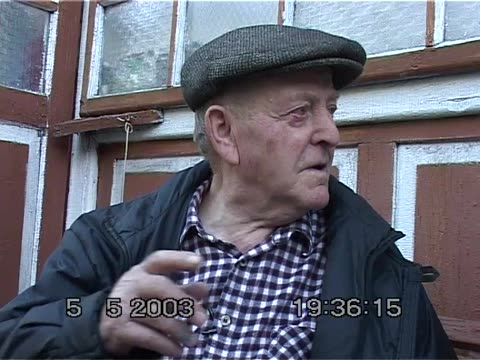
This tape begins in the middle of a formal interview with Isaak Grigorievich Vainsheinboim in Slavuta. It begins with Professor Kerler asking questions related to Yiddish linguistics.
From the machine transcript
Kerler asks Vainsheinboim about the difference between a rav and a rebbe, including the Hasidic rebbe (a 'good Jew' whom non-Jews also visited), and about their plural forms. Vainsheinboim answers briefly, and Kerler then turns to his war years.
Mainly questions on the terms rav and rebbe and their plurals, plus non-Jews visiting a rebbe.
Vainsheinboim describes his wartime experiences as a tank mechanic/driver on the Belarusian front.
From the machine transcript
Vainsheinboim recalls his war service as a tank mechanic and driver on the Belarusian front. He describes a long mortar bombardment near Berlin, a mortar crew member collapsing from exhaustion, and a later mortar hit that killed comrades. He mentions repeated recommendations for decorations and his pension today.
Gives specific battle episodes near Berlin and mentions his pension.
Vainsheinboim mentions that he participated in battles in and around Stalingrad and describes the difficulties there during the winter. He also speaks of his many awards and medals given for his service during the war.
From the machine transcript
Vainsheinboim speaks about Stalingrad: washing in the Volga in winter, hauling water and running naked to a tent heated by a stove, and daily fighting. He says he has fifteen to seventeen medals and three orders.
He ended the war in Berlin, and talks of liberating German cities along the way. He spent six months in Berlin after the war.
From the machine transcript
Vainsheinboim says he ended the war in Berlin, took part in a parade, and mentions Brandenburg. He stayed in Berlin six months after the war.
Vainsheinboim does not remember any converts to Judaism in his shtetl, but he does recall Jewish converts to Christianity. When he was young, he and his friends would throw stones at them.
From the machine transcript
Asked about converts to Judaism in Ostroh, Vainsheinboim says there were none, but remembers Jews who converted to Christianity. He and the other boys would run after them and throw stones as they rode to the monastery.
Mentions the stone-throwing at converts.
He describes the singing of zmires on shabes and shares a fragment of kol mekadeysh shvi.
From the machine transcript
Kerler asks about Sabbath songs (zmires); Vainsheinboim hums or sings a fragment of one and says that after the war he did not go to pray because it was not allowed. Kerler also prompts for other melodies, and Vainsheinboim comments on how prayer is done in America versus Ostroh.
Vainsheinboim shares his views on language and how loshn-koydesh words have changed change in modern Israeli Hebrew.
From the machine transcript
Vainsheinboim gives his view of how Hebrew words, such as shabes and the Bible, have been changed in modern Israeli Hebrew. Kerler adds his own remark about the Zionists' word for an orphan and then asks about synagogues.
He speaks about the sixteen synagogues in the shtetl, divided by profession. Some of these buildings were made from brick.
From the machine transcript
Vainsheinboim talks about the synagogues of Ostroh: the large Krasnohirka (?) synagogue, brick buildings rather than wooden ones, and about sixteen small prayer houses, including a tailors' and a shoemakers' synagogue.
He shares his memories of various Jewish holidays, including: how to build a sike with string and skhakh on Succoth; eating humentashen, sending shalkeh-munes and seeing pirimshpiln on Purim, as well as the pirim-bal parties for rich Jews; eating corn, buckwheat and potato lotkes and receiving khanike-gelt on Chanukah corn.
From the machine transcript
Vainsheinboim describes the sukkah with a roof raised by a rope, and Purim balls for the wealthy. For Hanukkah he recalls potato, buckwheat and corn latkes and giving Hanukkah money. Kerler also asks about shalakhmones and Purim plays, and the family seder where Vainsheinboim was the youngest.
Includes Purim balls and being the youngest asking the questions at the seder.
Vainsheinboim also remembers reciting the fir kashes, or Four Questions, at Passover and recites the first kashe for the researchers.
From the machine transcript
Kerler asks Vainsheinboim to sing the Four Questions and other Passover songs; he says he has forgotten most of them. The passage then moves to Soviet school and whether he belonged to a youth movement or the Party, which he does not remember.
Includes questions about Soviet school and youth movements.
Vainsheinboim describes the sheve-kikh in his town, a kind of cafe where he drank hot chocolate with rolls
From the machine transcript
Vainsheinboim describes a 'shive-kikh' (?) in Ostroh, where children were given rolls with cocoa. Kerler asks who organised it and when, and then asks about a fire brigade.
He also briefly mentions going to the Jewish library in Ostroh, which carried both Yiddish and Hebrew book.
From the machine transcript
Vainsheinboim says there were Jews in the fire brigade, with Soviet people, and then answers Kerler's question about the Jewish library in Ostroh, which held Yiddish and Hebrew books.
Professor begins asking questions from his sociolinguistics survey. Vainsheinboim in this context shares his perceptions of Lithuanian Jews and their hard to understand Yiddish, and explains several concepts, such as gefilte fish, the definition of dibek, different words relating to funereal practices and other topics.
From the machine transcript
Kerler puts a long sociolinguistic and dialectological questionnaire to Vainsheinboim. Items include the word for a Lithuanian Jew and how Litvaks spoke Yiddish, misnagdim and maskilim, and gefilte fish and its taste. They also cover tomato, vodka, dibek, golem, words for a cemetery, and many Russian sentences and words for him to put into Yiddish, among them comparatives, 'sick', 'run away', 'cross', 'house', 'head hurts', 'grandmother', 'breathe' and 'all Jews'. A bottle of zubrovka is also brought up.
Covers lexical items, sentence translation and the Ostroh dialect boundary.
The researchers purchase and share a bootle of alcohol with Vainsheinboim. As everybody drinks, he toasts lekhayem veloy lemuves! (To life and not to death!)
From the machine transcript
Kerler and the others share a bottle of vodka with Vainsheinboim and drink together. Kerler offers toasts to life and good health, and there is some talk about the camera and film.
Includes a toast and talk about the filming.
Professor Kerler returns to his dialectological questionnaire.
From the machine transcript
Kerler continues the dialectological questionnaire with Vainsheinboim. Items include words for 'half', 'attic', 'blue', 'belly', 'mouse' (singular and plural), 'house', 'pigeon', 'groats', 'rich man', 'ditch', 'boy' and the word for a shpilke. Kerler repeatedly asks for forms as said in Ostroh, then wraps up.
The camera cuts to the research team being shown an old wooden synagogue to which brick walls have been added.
From the machine transcript
At an old wooden synagogue, Kerler and Fish and others discuss the building and what survives inside. They note that the original wooden structure is hidden behind brick walls, and Kerler hopes that Jews will pray there. Fish says that Jews were a large share of the population in the region and that they were all killed.
The tape then switches to a formal interview (Part 1 of 2 See MDV 640) with Moisei (Moyshe ben Zalmen) Zelmanovich Fish b. March, 1922 in Rivne. He talks about how towns and villages in the area were heavily Jewish before the war, but most of his family was lost during the war. His son lives in Russia, near Finland. He can read and write in Yiddish.
From the machine transcript
Fish gives personal information in his interview: he has no relatives in Saransk (?) and in Rivne only his sons, and his middle son lives in Karelia in Russia. He gives his name as Moyshe ben Zalmen, his surname and address, and his phone number and postal code, and says he was born on 13 March 1922. Kerler notes the date of the interview as the sixth of May 2003, the first in Rivne.
Includes the interview date, Fish's address and phone number, and his birth date.
Fish begins to discuss his family life in the pre-war era. His father was known as Zalmen der Miler (b. 1883 in Koloniya Olizarka) since he worked as a house-builder and brick-layer, a profession called miler in that region. Fish remembers his father being called to the Torah in synagogue as Zalmen ben Reb Shleyme-Khayim haLeyvi. His mother, Khaye, was born in 1887 in Zholuds’k, a nearby town. His parents moved to Rivne at the start of World War I in 1914. Since birthdays were not celebrated in his youth, he does recall the day his parents were born, but only the years. His mother worked as a balebuste and raised the family’s five children, of whom he was the youngest. His siblings included: Etl-Raytsl Gratsh (b. 1904), who was married to Pinkhes-Refuel, and with she had three children. The first of these children was named Berl (b. 1925) at birth, but as he was a sickly child, he was brought to the Rovner Ruv, who renamed him Alter [This short story is found at 00:58:42-00:59:32]. The other two children in this family were: Peretsl (b. 1935) and Gitele (b. 1941). This whole family was killed in the early years of World War II.
From the machine transcript
Fish describes his family before the war. His father was Zalmen der Miler, a bricklayer and house builder, born in Koloniya Olizarka (?), and his mother Khaye was from Zholuds'k. The family built a house in Rivne in 1932 and had five children. He gives the names of his eldest sister and her children, including a nephew renamed Alter because he was sickly, and says they were all killed in the war.
This tape begins in the middle of a formal interview with Moisei Zelmanovich Fish. He further describes his pre-war family life. His siblings further included: Mordkhe-Yoyne (b. 1909), who worked as a tailor. He was married to Rukhl (b. 1915); they had one child: Gitele (b. 1939). Fish had two more sisters: Genye-Leye (b. 1913), who married Ayzik Bednyi (b. 1912) (both killed); and Miryem (Mirl) (b. 1918), who married Berl Plotnik (b. 1910) seven days before Germans entered Poland. Fish states that he had approximately one hundred relatives before the war, but does not remember them all.
From the machine transcript
Fish continues listing his siblings and their fates: a brother who was a tailor, with his wife and a small daughter, and two sisters, one married shortly before the German attack on Poland. All the family were killed, and Fish says he had more than a hundred relatives. Kerler and Fish discuss the dates of the outbreak of the war and the Soviet and German entry into Rivne. A mention of a cousin in Israel and a visit to Yad Vashem opens the passage.
Also includes the discussion of the date of the German invasion and the cousin in Israel.
Fish shares his memories about his childhood, early education and pre-war Rivne. He started going to a kheyder at 3.5 years of age where he learned how to pray. According Fish, pre-war Rivne had a population of 40,000 people, 85% of who were Jews. There were 44 synagogues in the town, which were always packed during holidays.
From the machine transcript
Fish describes his early childhood in Rivne. He began kheyder at about three and a half, with a private teacher of the Yedlen (?) family, and learned to pray. He gives the size of prewar Rivne and the Jewish share of its population, mentions the many synagogues that were crowded at the major holidays, and says the family lived on Dombrovska Street.
Names the kheyder teacher's family and the street where the family lived.
One synagogue remained opened during Soviet times on School Street, but this institution was closed in 1955. Fish also speak in more detail about the establishment of Soviet authority in 1939.
From the machine transcript
Fish answers Kerler's questions about when the last synagogues in Rivne were closed under the Soviets, giving the mid-1950s. He says there were no Jewish schools under Soviet rule, only state schools in Russian, and that in 1939–41 the Soviets merged all schools without setting up Jewish ones.
The School Street synagogue is not clear in the transcript; the passage focuses on Soviet schooling.
Education: Fish went to kheyder until age five. At the age of five-six years old, his father got him a personal teacher, who for an hour a day in the afternoon would teach him how to pray. There were approximately 20-30 kids in kheyder. He would learn liturgy, the hagode, the fir kashes for Passover and other religious texts. Fish then recites a fragment from fir kashes from memory, but reports he could do it better if he had the text to read in front of him.
From the machine transcript
Fish returns to kheyder and the private teacher who came to his home daily for an hour in the afternoon. He recalls learning to pray, and the Haggadah and the four questions before Passover. He tries to recite them, says he knows prayers by heart, and notes that he is a leader (gabbai and cantor) in the Jewish religious community.
He is a leader/cantor [gabe un aleyn a khazn] in the local Jewish religious community.
From the machine transcript
Kerler asks whether there is anyone in Rivne who can lead prayers and whether the term for a prayer leader was used; Fish does not recall it. Kerler then begins to ask about friendships in his youth.
The catalogue gives Fish's role as gabbai and cantor, but this passage is mostly Kerler's questions.
Fish continues to describe his education: at the age of seven he began to attend a “shule,” a Polish-language Jewish school for seven years. There the students spoke Polish to the teachers (who were ethnic Poles) and Yiddish among themselves (only Jews).
From the machine transcript
Fish describes attending a seven-class Polish state school from age seven. The pupils were all Jews, the teachers were Poles, and the pupils spoke Polish to the teachers and Yiddish among themselves. Kerler asks whether the teachers knew any Yiddish.
There were a few individual non-Jews who spoke Yiddish. Fish yells a story about one ethnic Russian who spoke Yiddish “exactly like a Jew” to him in the post-war period. He had grown up in a village populated almost entirely by Jews and the children played among themselves in Yiddish.
From the machine transcript
Fish speaks about non-Jews who knew Yiddish. After the war, the manager of a restaurant, a Ukrainian woman, spoke pure Yiddish to him, having grown up in a small town with many Jews. He says Poles and Ukrainians did not learn Yiddish, and that streets with twenty or thirty houses had only one or two non-Jewish ones. A second voice asks about children's games.
The catalogue calls the speaker ethnically Russian, but the transcript suggests a Ukrainian woman working in a restaurant.
Fish then remembers his own childhood games: football (soccer) played with a ball of rags, volleyball, handball and checkers.
From the machine transcript
Asked about children's street games, Fish recalls playing football with a ball made of rags in a sack, volleyball, handball and checkers. Kerler asks for the Yiddish word for ball and about a game called kaldovane (?), which Fish does not know.
Adds Kerler's questions about the Yiddish word for ball and the game name.
In the 1930s, he would participate in Shomer Akiva, a socialist youth group, where young people learn how to work, dance and singing. He then sings a fragment of the movement’s anthem in Yiddish [starting 21:20]. At the club, the young people learned Jewish history, as well as different songs in Yiddish and Hebrew.
From the machine transcript
Fish talks about the Zionist-socialist youth movement Akiva in Rivne, where members studied Jewish history and sang in Yiddish and Hebrew, without observing kashrut. He sings a fragment of the movement's song, names its leader as Khayim Mekel (?), and mentions the Hatikvah. He then recites a rhymed Yiddish–Hebrew word list he knew from childhood.
Adds the Hebrew-Yiddish rhymed word list that begins at the end of the passage.
Fish then sings a Yiddish-loshn koydesh rhyming song, which he learned from his mother.
From the machine transcript
Fish continues the rhymed Yiddish–Hebrew word list, naming pairs such as dove, fire, water and meat, and ends with a toast. He says he learned it from his mother, who died in the war, and that Soviet life made people forget much of what they knew. He adds that he did not feel badly under the Soviets, being a chief bookkeeper.
Fish briefly comments on the difficult realities of Jewish life in the Soviet Union and why his children do not speak Yiddish.
From the machine transcript
Fish briefly comments on the state of Jewishness in the Soviet years and says his children do not know Yiddish because it was spoken less at home. He then mentions finishing the seven classes.
After 7th grade, fish a entered Polish-language Jewish gymnasium, where he learned Jewish history, Hebrew language and bookkeeping. He finished in 1939 three months before war, and worked for two months before war started. After the war, he completed a higher Soviet accounting institute.
From the machine transcript
Fish describes the Polish-language Jewish commercial gymnasium he attended after the seven classes, where he studied bookkeeping, Jewish history, religion and Hebrew; the teachers were Jews and the director's name is given as Yosefsberg (?). He finished a few months before the German attack, worked three months, and after the war completed a Soviet trade institute.
Names the gymnasium director.
He then describes his experiences during the war years: He relates how and his brother’s wife’s brother ran on foot to Kotsk at the former Soviet-Polish border, eventually being officially evacuated to a Korean kolkhoz in Kazakhstan. There, he worked in rice fields, and then in the bookkeeping office. He wanted to serve in the army, but was sent back because he was a former Polish citizen and did not speak Russian well. He wanted to be closer to the front to know what was going on in the occupied territories and so moved to Stalingrad to work in a war-factory for two months and was finally mobilized and sent to front in 1942.
From the machine transcript
Fish tells of fleeing Rivne on foot with his brother's wife's brother, just before the Germans entered, heading east. He describes the chaos, trains via Novograd-Volynskyi and Kyiv, evacuation to a Korean kolkhoz in Kazakhstan where he worked in rice fields and bookkeeping, and being refused army service as a former Polish citizen. He then went to Stalingrad to a war factory, and was mobilised in 1942 into the sappers; he describes the siege, the encirclement and the winter, and the move to Kursk.
Adds the Kyiv leg, the Voronezh stop and the Kursk front, beyond Kotsk and Stalingrad.
Fish then details the final years of the going through Belarus, Poland and Germany, where he was wounded in the leg by grenade shrapnel. He moved back to Rivne in 1946 and found a job as the head account in Restaurant Ukraine, where he worked until 1982. In 1946, Fish married a Jewish woman from Kalinindorf, one of the Joint-supported Soviet Jewish kolkhozy, where she attended a Yiddish school. Fish and his wife had three sons: the middle son lives in Russia, andthe others live in Rivne.
From the machine transcript
Fish follows his army service from Kursk through Belarus, Poland and Germany, where he was wounded in the leg and later took part in the battle for Berlin. After a short officer course he was demobilised and, after a stay in a Moscow hospital, returned to Rivne in February 1946, where he found his house occupied. He began work as chief bookkeeper at Restaurant Ukraine, studied at an institute, and married Ida from the Jewish colony Kalinindorf; they have three sons and six grandchildren, and one son lives elsewhere.
Adds the Berlin battle and the Moscow hospital stay.
He describes the early post years in greater detail and tells about how he met his wife, Ida. They were quickly married in the ZAKS (Official Marriage Registration Bureau) then had a religious ceremony later.
From the machine transcript
Kerler asks about his first days back in Rivne. Fish recalls finding his father's house occupied, meeting friends at the market and staying with them, and trying to recover documents. He then describes meeting his wife Ida; they registered the marriage at once, without a wedding, and had a religious ceremony months later. She lived with him forty-eight years.
Also covers the occupied family house and his friends' help.
Fish also reflects on how he and his wife prepared to immigrate to Israel, but could not go in the end because of his wife’s health.
From the machine transcript
Fish speaks about his wife's illness and how he thought of emigrating to Israel with her but could not. He continues recalling his first days of work, being offered the job of bookkeeper at a restaurant, and the high food prices in the early postwar years.
Adds the early postwar food prices and the job offer.
This tape is a continuation of a formal interview with Moisei Zelmanovich Fish.
From the machine transcript
Fish describes his housing in Rivne: the father's house on a side street had no running water, and he had an operation in the 1940s that left him unable to carry water or fuel. He later moved into a cooperative house and bought into it, and says he worked throughout. Kerler then turns to questions about the prewar bathhouse.
Fish talks about his own housing and health, and Kerler introduces the bathhouse topic.
Fish describes the pre-war Jewish bathhouse and swimming in the town’s rivers.
From the machine transcript
Fish describes the prewar Jewish bathhouse in Rivne, where there was no shower or bathtub room. Before the Sabbath the family heated and carried water for the bathhouse, and he went there with the hired non-Jewish attendant. He also covers the ritual bath and the separate women's section. In summer the children swam in the river and at a lake outside town, where they sunbathed and rested, but nobody bathed in winter.
Besides the bathhouse, the passage covers the ritual bath and summer swimming at a lake outside town.
Fish then reminisces about the Jewish sports stadium Hasmeneye and its famous, successful Jewish teams.
From the machine transcript
Fish recalls the stadiums of prewar Rivne. A Jewish stadium (whose name is given in the transcript as Hasmoneia, doubtful) stood on one side and a Polish stadium on the other. He speaks of the famous Jewish and Polish teams, which the children followed, and of newspaper coverage of them.
The passage also covers the Polish stadium and the children's following of the players.
He then talks about Yiddish and Polish-language Jewish newspapers from before the war.
From the machine transcript
Fish speaks about prewar newspapers: Jewish papers in Polish, some brought from Warsaw. He cannot recall a Rivne Yiddish paper, and he mentions the very low prices of papers and bread in Polish times.
Fish also mentions the low prices of the time.
Fish explains the concept of a Git Yid (Good Jew), as he understands it, not connected to Hasidism or tsadikim, but to particularly generous people.
From the machine transcript
Fish says he knew nothing of Hasidim or rebbes in Rivne. He explains a "good Jew" as someone who gives help and charity to the poor. As an example he describes a Rivne cloth shop whose owner gave small coins monthly to long lines of poor people, and he mentions that he worked briefly as a bookkeeper there after the gymnasium.
Fish gives an example of charity from a Rivne cloth shop and mentions his own bookkeeping job.
He describes the differences between a Rabbi, who certified marriages in the pre-war period, and a tsadik, who was a very learned man, immersed in the “kleyne eyselekh” (“in the fine print,” i.e. the details of Jewish religious law).
From the machine transcript
Fish distinguishes a state-appointed rabbi, who issued birth, marriage and death documents before the war, from an ordinary rebbe, who could be a teacher or pray in a synagogue. A tsadik, he says, is very religious and learned, knows the fine details of the law and can interpret the Torah.
The passage also covers the state-appointed rabbi who issued documents.
Fish then elaborates on the concept of erlikh (piety/decency/honesty) and relates it to debates on assimilation in America and global Jewish politics.
From the machine transcript
Fish explains the word for an honest or pious person (erlekher) as meaning someone who prays daily and keeps the laws, and says that in Rivne it was treated as the same as a religious one. Kerler and S2 ask about other terms, which he does not know. Fish then reflects on assimilation, the Jewish population in America and Israel, and mixed marriages.
Fish also gives views on assimilation, mixed marriage and population figures; S2 joins the questions.
Fish describes the Jewish youth clubs of pre-war Rivne.
From the machine transcript
Fish says Jewish youth clubs in prewar Rivne included the Shomrim, and that he himself attended a club for a few years. His friends all belonged to the same club, which met in the evening on Shkolna Street, and he recalls the club's location near the bathhouse. Kerler then asks about the fire brigade.
The passage also locates the club on Shkolna Street, near the bathhouse.
Jews were not members of the fire brigade, police department or state bureaucracy, according to Fish, but did hold highly respected positions in Soviet times as doctors, lawyers, or in the army.
From the machine transcript
Fish says no Jews were in the police or the state bodies before the war. In Soviet times there were Jewish prosecutors, lawyers and generals. The Soviets ruled for two years before the war and closed Jewish schools and organizations. S2 joins in with comments.
Fish adds the closing of Jewish schools and organizations by the Soviets.
Professor Kerler begins his survey of sociolinguistics and dialectological questions, in which context Fish discusses his attitudes towards “Askhenazi vs. Lithuanian” Yiddish, gefilte fish recipes, gefilte fish, and Jewish drinking practices.
From the machine transcript
Kerler begins a questionnaire on language and customs. Fish discusses Lithuanian, Galician and Ukrainian varieties of Yiddish and the accents of different regions, and says he prefers the Yiddish his mother spoke. He answers questions about gefilte fish (stuffed and not too salty or sweet) and gives Yiddish words for several foods such as tomatoes, sausage, plums and grapes. He also answers about filled pastries and strudel, and about Jewish drinking, such as vodka at a minyan.
The questionnaire includes the dialect varieties, food terms and drinking customs.
Fish compares Jewish weddings from before the war (with their klezmer musicians, specially hired cooks, and a special person hired to greet the guests at the door of the wedding party), to those in Soviet times and weddings today.
From the machine transcript
Fish compares prewar Jewish weddings with Soviet-era and later ones. Before the war a big wedding had hired klezmorim and cooks, someone to greet the guests, and a proper chuppah, whereas after the war weddings were held in restaurants, often in Russian. He mentions his brother's and sisters' marriages but cannot recall the title of the greeter.
Fish adds family details (his brother and sisters) and the shift in wedding language to Russian.
Before the war, according to Fish, Rivne had its own Yiddish theater. After the war, Nehama Lifshitsaite and other Yiddish performers came to the city.
From the machine transcript
Fish says that after the war some Yiddish artists, including a Lithuanian woman singer and an accordionist, still came to Rivne, but Jewish audiences had dwindled. He mentions the Hesed. Kerler asks about prewar Yiddish theater, and Fish recalls a Yiddish theater under Polish rule that his brother took him to as a child.
Fish also mentions the Hesed and the prewar Yiddish theater.
Fish briefly reflects on different Jewish holiday celebrations.
From the machine transcript
Fish answers questions about Purim and Shavuot. He says a Purim play might have been held in the Jewish gymnasium but he did not see one. He says Shavuot food was dairy, with cheese and blintzes (terms discussed).
Fish also answers about Shavuot dairy food.
Professor Kerler continues with his linguistic questionnaire.
From the machine transcript
Kerler continues the questionnaire with the word dibbuk. Fish explains it as a spirit entering a person, describes the exorcism by rabbis, and recalls the Yiddish film The Dybbuk and its song, shown in Rivne.
Fish also recalls the Yiddish film Der Dybbuk and its song.
Fish sings a fragment of a variant of Yidl mitn Fidl and mentions a movie theater in Rivne that showed some Yiddish films as well as silent films with Polish intertitles.
From the machine transcript
Fish sings a fragment of a song about Yidl mitn fidl and recalls the Yiddish film of that name. He describes the cinemas in Rivne, where Yiddish films were shown, a theater behind the bridge, and silent films with Polish intertitles. He says Yiddish titles were not available because Jewish youth studied in Polish schools.
Fish describes the cinemas of Rivne and the language of silent-film titles.
The rest of the interview consists of further questioning related to linguistics and dialectology.
From the machine transcript
The rest of the tape is Kerler's dialectological questionnaire. Fish gives Yiddish words and phrases for kinship (father-in-law and mother-in-law, grandmother, grandfather), adjectives such as sick and ill, words for building and for deserters, and numbers. He also translates sentences about walking on, across and along the street, and often explains in Russian. Kerler also discusses a Polish word for settlers in the Rivne area.
The questionnaire includes kinship terms, sentences with prepositions of place, and sentences about illness.
This tape begins with a continuation of a formal interview with Moisei Zelmanovich Fish.
The sound turns on. Fish describes old photographs of his family.
From the machine transcript
A speaker, probably Fish, identifies old family photographs for Kerler. The photographs show his father, mother, sisters, a brother and nieces. They were taken in Rivne in the late 1920s (?). Kerler then says he will see all the medals, and Fish is asked to change his jacket.
Names several relatives and says the photograph was taken in Rivne.
Fish changes his jacket to display and explain his many medals.
From the machine transcript
Fish, in Russian and Yiddish, names and explains his medals and orders. They include the Order of Glory, a Ukrainian order, the Zhukov medal, a medal for the defence of Stalingrad and a victory medal. Kerler comments on a long-service award.
Medals are named one by one in Russian.