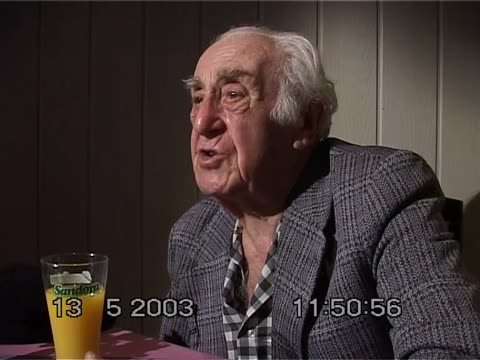
The interview with Meler begins. They talk about a Torah scroll. He then speaks about his family, who did not survive the war. Meler was drafted into the Polish Army in 1940.
From the machine transcript
The Meler interview starts, with Kerler talking with Meler about a Torah scroll and whether it is ritually fit, and about a local rabbi. Meler says that before the war his father, mother, three sisters and grandmother all perished and that he alone survived, having been taken into the army in the 1940s. He now has a new family and is going to see his daughter in Latvia. Russian side talk from others intrudes.
Also covers the discussion of Torah scrolls and Meler's family lost in the war.
Meler addresses cultural institutions during the postwar Soviet period, before mentioning acquaintances.
From the machine transcript
Talk in the postwar Soviet period, about a museum of religion and atheism in L'viv with many Torah scrolls. Meler and Kerler then discuss shared acquaintances, including Tsilye and Grisha (the interviewer's own family connection) and Kerler's stay in Vorkuta as a child.
Meler provides personal information and talks about his life before the war. He was named after his mother's family, although he explains that at first his surname was Volf. His father's name was Samselik. Meler's family moved from Glina Navariya to Lviv in the early 1930s. He then describes prewar religious life in Glina Navariya. Meler has relatives in America.
From the machine transcript
Meler says he was born in Glina Navariya, near Donets (?), and that his family moved to Lviv, where his father got a share of the family's land sale. He describes the town as poor with a stone synagogue and cemetery, and a Belz rabbi's grandson. Kerler records the interview date and Meler's name, spelled Isaak, and Meler explains how the surname Volf became Meler, and that his father was Samselik. He also mentions relatives in America and his heart problems.
Also covers name changes, the town's synagogue and the Belz rabbi's grandson.
Meler provides personal information. He speaks about name changes at the beginning of the Soviet occupation in 1939. Meler then talks about his family and talks about the move from his hometown to Lviv for economic reasons. Meler grew up with three sisters. He mentions that he went into a merchant apprenticeship at the age of fifteen.
From the machine transcript
Meler gives his Yiddish name and describes how his name was changed to Isaak and his patronymic to Mozesovich in 1939 after the Soviet arrival. He names his parents, his mother Sarah, and his father Moyshe, and says he was born in 1919. He explains that the family moved to Lviv in the early 1930s, for economic reasons, after his grandmother sold land. At fifteen he was apprenticed to a merchant. He had three sisters and names two (Brani (?) and Khaye), whose trades were fashion and sewing.
Also covers the move to L'viv, siblings' names and trades, and the 1939 renaming.
Meler addresses prewar religious life in his hometown, particularly the synagogue and the local rebbe. According to him, approximately forty Jewish families lived in Glina Navariya. Meler then speaks about prewar occupational structure. His father and grandfather were kosher butchers.
From the machine transcript
Meler describes prewar religious life in Glina Navariya: a synagogue, a bes-medresh, a mikveh and the grandson of the Belz rebbe. Hasidim travelled to Belz. He says forty (or thirty-five) Jewish families lived in the town, with Ukrainians around the centre. His father and grandfather Rakhmiel were kosher butchers who bought calves in villages and sold the non-kosher hindquarters cheaply. Meler and Kerler discuss the term for the forequarter and hindquarter and removal of the sinew.
Also covers the term for the hindquarters and the removal of the sinew.
Meler speaks about his family and childhood memories, particularly education. Meler explains how his mother paid for his religious school education with food. Meler then describes his work as apprentice and remembers poverty within his family.
From the machine transcript
Meler answers questions about his father's livelihood and the town's shochet. He recalls his cheder teacher, who used a whip, the large class and the mother's payment in kind. He describes his apprenticeship in L'viv shops, his wages and the family's poverty and hunger.
The cheder teacher's whip and the apprenticeship in L'viv shops are added.
Meler speaks about Jewish life, including charity organizations. He also mentions the Lviv cemetery and describes how it was destroyed in the postwar Soviet period.
From the machine transcript
Meler talks about the prewar Jewish community in L'viv, its hospital and orphanage, and a holy site tied to a woman called the Golden Rose. He describes how Khrushchev had the old cemetery destroyed to make a market. He tells about an acquaintance who survived the war.
The Golden Rose and an acquaintance who survived the war are added.
Meler talks about his family. His father worked odd jobs, including with sausage dealer. Meler also speaks about prewar Jewish life, including occupational structure.
From the machine transcript
Answering Kerler, Meler explains that his grandmother held a few hectares of land and the father had no steady work. The father sometimes worked for a Jewish sausage maker. He also names Jewish firms in L'viv, including a chocolate factory.
Land measures and the L'viv chocolate firm are added.
Meler speaks about his hometown Glina Navariya and its geographic location. He recalls the bath house and mill. He also discusses his childhood memories.
From the machine transcript
Meler places his hometown as a railway station of that name about eleven kilometres from L'viv. He describes the bath house, the mikveh by the cemetery, a mill and the mill owner's heirs. He recalls catching carp in the pond as a child.
The mill, the mikveh and the carp fishing are added.
Meler speaks about his childhood memories, specifically how he caught fish for his mother's cooking for Sabbath. He also describes how his mother prepared dry fish for the winter season, as well as how she cooked cholent.
From the machine transcript
Meler recalls catching fish on Friday for his mother's cooking. He describes how she dried fish in straw for the winter, how the Sabbath bread was baked, and how cholent was prepared in the oven sealed with clay. The cholent included a calf's foot and beans, and the names for the dishes are discussed.
Dried fish and the sealed-oven cholent are added.
Meler continues talking about Sabbath food customs and mentions non-Jewish neighbors, who were his family's Sabbath goys. Meler then speaks about prewar Hasidic life in his hometown.
From the machine transcript
Meler talks about the Sabbath goy and the neighbours, who spoke some Yiddish, and about school fights. He describes cholent leftovers and cold dishes. He then recalls the Hasidic rebbe's table at the bet midrash, where herring and gefilte fish were served, and visits to the rebbe of Belz.
The rebbe's herring and gefilte fish at the bet midrash and the visits to Belz are added.
Meler addresses prewar holiday celebration, including Sabbath and Purim.
From the machine transcript
Meler describes Sabbath at home in his parents' house, with handwashing and blessings, and says he cannot recall the blessings he was taught. He then discusses Purim, when the Jewish households of the town exchanged gifts of food.
Meler speaks about prewar cultural life, including Zionist organizations that organized plays. Meler lists youth organizations, including HaNoar HaTzioni, Hashomer Hatzair and the Bund. Meler's step-brother made aliyah with a group of local halutzim. Meler then talks about local libraries.
From the machine transcript
Meler talks about prewar cultural life, including plays by Zionist groups and the Bund. He lists youth movements and says his step-brother went to Palestine with pioneers after farm training. He also answers questions about the town's libraries.
Meler addresses Shavuot celebrations, including food customs. He then shares an episode about a local resident, before talking about Jewish life today.
From the machine transcript
Meler answers questions about Shavuot, when dairy foods such as cheese pastries were eaten, and about Hanukkah latkes. He then tells of an antiquarian who found a parchment in the L'viv archive recording a killing of Jews by Khmelnytsky. He talks about a kosher kitchen next to a synagogue today.
The archive document about Khmelnytsky and the kosher kitchen are added.
Meler talks about food customs, specifically sharing his recipe for gefilte fish and floden (large cake or bread with raisins).
From the machine transcript
Meler describes how he himself prepares gefilte fish and gives the recipe. He answers questions about floden, vodka and drinking customs.
Meler answers questions about cultural terminology, before addressing prewar traditional weddings.
From the machine transcript
Meler answers questions about the meanings of a dybbuk and a golem, and the plural of a fool. He then addresses prewar Jewish weddings in the town, with drink and musicians: he does not recall klezmers, who might have come from L'viv.
Meler answers dialectological questions from the AHEYM Yiddish linguistic questionnaire.
From the machine transcript
Kerler starts the dialectological questionnaire, asking how Meler would say words such as table, belly and house in his parents' Yiddish. Some of the exchange concerns Russian.
Meler talks about his family and life today. His daughter married a non-Jew.
From the machine transcript
Meler talks about life today, including a problem with travelling to visit, and about visa and border trouble. A daughter, said to have a non-Jewish husband, is mentioned, and he speaks of a son-in-law, money in the bank and the difficulty of the bus journey. He regrets that there is little time left.
The visa and travel difficulties and the daughter's husband are added.
Meler continues to answer dialectological questions from the AHEYM Yiddish linguistic questionnaire.
From the machine transcript
Kerler continues the word-list questions, asking for the Yiddish words for mouse and groats. The two discuss the difference between large and small mouse-like animals.
Meler answers dialectological questions from the AHEYM Yiddish linguistic questionnaire.
From the machine transcript
Meler answers questionnaire items from Kerler's Russian prompts. They cover household and building words (window panes, wall, wooden and stone buildings), colours and adjectives, adverbs of time and speed (earlier, later, quick, near, higher), and verbs of liking and hearing. He also supplies words for belief and piety, a cross, and a convert. Meler comments that a form is typical of Galicia, and at one point they discuss Galician Yiddish as a literary language. Kerler also asks whether the shtetl told stories of Gentiles who became Jews.
Includes an aside on the Galician dialect and its standing as a literary language, and a stray exchange about a hotel in L'viv.
Meler speaks about prewar life and continues to answer questions from the AHEYM Yiddish linguistic questionnaire.
From the machine transcript
The questionnaire continues with sentence translation and word elicitation: pronouns, verb forms, numbers, prepositions of place, and words such as well, midwife, flowers, potatoes, shop, cantor's place at the lectern, rich man, and the burrs thrown at Tisha b'Av. Meler mentions in passing a tragedy in his shtetl in which two lovers killed themselves, and that his shtetl said one word for shop. Kerler and Meler also discuss where a word is Polish or Russian rather than Yiddish. The passage ends with Meler tired.
Beyond the questionnaire, it includes a brief account of a tragic suicide of lovers in the shtetl and items on midwives, wells and the synagogue.
The team concludes the interview with Meler.
From the machine transcript
Kerler ends the interview, thanking Meler for coming and promising to pass on Meler's greetings to colleagues, whose names are only partly clear. Meler mentions that he has health problems.