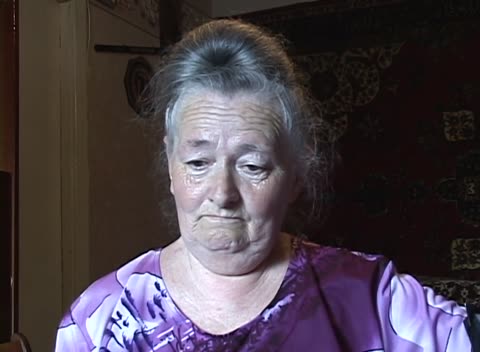
The second part of the recording includes a formal interview in Yiddish with Polina (Perl) Enikovna Loyf, nee Shayn, born 1938 in Dzegovka. (Part 1 of 2. See MDV 387). The team greets Loyf in front of her home and then they go inside in order to set up the interview with her. Loyf, Polina Enikovna. Interviewed by Dov-Ber Kerler, Moisei Lemster. 6/8/2007. Ukraine, L'vivs'ka Oblast', Boryslav.
From the machine transcript
The team greets Loyf and another woman at her home. They sort out which language to speak and agree on Yiddish. Kerler says he lives in America.
Frida Moiseyevna Pustilnik presents a kiddush cup to the team and Loyf remembers her son's circumcision. Pustilnik briefly provides personal information. She was born in Yampil and moved to the village of Yire 10:26 (twenty kilometers from Yampil), where her grandmother lived. Pustilnik lived in Mohyliv-Podilskyy after the war. Loyf, Polina Enikovna. Interviewed by Dov-Ber Kerler, Moisei Lemster. 6/8/2007. Ukraine, L'vivs'ka Oblast', Boryslav.
From the machine transcript
A second woman (Pustilnik per the catalogue) shows a kiddush cup and the talk turns to a circumcision, with small silver items mentioned. She says she is from Yampil and that her grandmother lived in Yire (?). Some of the group are shown to speak little Yiddish. The transcript is garbled.
Gives details of the kiddush cup exchange and Yampil, but the transcript is garbled.
The formal interview with Loyf begins. She provides personal information and talks about her family. Her father was a merchant and died during the war. She states that her maternal grandfather was persecuted during Stalin's purges in 1937. Loyf grew up with two sisters, one of whom lives in Israel. Loyf, Polina Enikovna. Interviewed by Dov-Ber Kerler, Moisei Lemster. 6/8/2007. Ukraine, L'vivs'ka Oblast', Boryslav.
From the machine transcript
Loyf gives personal details: her name and passport name, her maiden name Shayn, and her Yiddish name. She was born in Dzegovka in Vinnytsia oblast. Her father died in the war after going to the front at age 23; her mother Yente and the maternal grandparents are named, with the grandfather working at an oil mill, and a grandmother who had twelve children of whom two survived. Her father's father was taken away and never seen again, and she grew up with two sisters, one of whom is in Israel.
Gives the Dzegovka birthplace and names of parents and grandparents; the catalogue's 1937 purge date is not clearly heard.
Loyf discusses her life during the war, when she was imprisoned in the Dzegovka ghetto. Her mother would tell Loyf about this period. Loyf maintains that without the protection of the Romanian soldiers, they would not have survived. Loyf, Polina Enikovna. Interviewed by Dov-Ber Kerler, Moisei Lemster. 6/8/2007. Ukraine, L'vivs'ka Oblast', Boryslav
From the machine transcript
Loyf says that during the war she lived with her mother, grandmother and grandfather in the Dzegovka ghetto. Her mother told her that the Jews were driven out to a square and were nearly killed, until the Romanians came. Many Jews were driven there from surrounding villages.
Loyf speaks about life before the war and the fire in 1912. She then talks about her life and education after the war. Loyf finished her school education at a Ukrainian school. Loyf explains how she wanted to switch to another school after seventh grade when moving to Boryslav. According to her, the school in Boryslav would not accept students from her region. Loyf had to work instead and found work at a 21:30 factory until her retirement. Loyf, Polina Enikovna. Interviewed by Dov-Ber Kerler, Moisei Lemster. 6/8/2007. Ukraine, L'vivs'ka Oblast', Boryslav.
From the machine transcript
Loyf relates her mother's account of a great fire in Dzegovka and how people rebuilt afterward. She says she herself went to a Ukrainian school there, since no Yiddish school existed. After seventh grade she tried to enroll elsewhere in Boryslav but was turned down because of her region, and went to work in a factory.
The 1912 date of the fire is not clearly heard.
Loyf talks about her son's circumcision in 1957 in Dzegovka and addresses postwar religious life. Loyf, Polina Enikovna. Interviewed by Dov-Ber Kerler, Moisei Lemster. 6/8/2007. Ukraine, L'vivs'ka Oblast', Boryslav
From the machine transcript
Loyf talks about her son's circumcision in Dzegovka after the war, with the year not clearly heard. She describes the Jewish town with its one synagogue and the Jewish houses, and says no non-Jews lived in the town. She recalls the church gold hidden before the Germans came, and her mother's fear of speaking about her grandfather in 1937. She also notes that her mother, raising three children alone, had little time to tell stories.
Adds the single synagogue, the absence of non-Jews, and the mother's fear.
Loyf speaks about her family. She then addresses prewar Jewish life and childhood memories of Dzegovka. She recalls the frequent synagogue attendance of her mother. Loyf, Polina Enikovna. Interviewed by Dov-Ber Kerler, Moisei Lemster. 6/8/2007. Ukraine, L'vivs'ka Oblast', Boryslav.
From the machine transcript
Loyf and Lemster discuss her father's age and her parents' marriage; her mother told her nothing of her father. Loyf recalls her mother's frequent synagogue attendance and taking the children along, and says she wanted her daughter to know Jewish things. She also remembers childhood games with Jewish children in Dzegovka.
Loyf talks about holiday celebration and food customs at home. She then speaks about Jewish life after the war. Loyf moved to Boryslav in 1953 and got married Dzegovka in 1956. Loyf, Polina Enikovna. Interviewed by Dov-Ber Kerler, Moisei Lemster. 6/8/2007. Ukraine, L'vivs'ka Oblast', Boryslav.
From the machine transcript
Loyf describes Passover customs in Dzegovka: neighbors gathered to bake matzo, and a non-Jewish woman did tasks on Sabbath. She says her mother prepared Sabbath food, and she reconstructs her move to Boryslav in 1953 and marriage in 1956 (dates discussed back and forth). Her husband came from Podkova (?).
Adds the Sabbath and Passover customs, the neighbors baking matzo, and where her husband came from.
Loyf addresses her traditional wedding. Loyf, Polina Enikovna. Interviewed by Dov-Ber Kerler, Moisei Lemster. 6/8/2007. Ukraine, L'vivs'ka Oblast', Boryslav.
From the machine transcript
Loyf describes her wedding in Dzegovka in the 1950s. It was held under a chuppah with Jewish music from local players, a big meal and dancing, though no one knew the traditions anymore. The talk turns to her husband, who does not speak Yiddish, and to his time in the army.
Loyf talks about his family, in particular her husband. She also speaks about contemporary Jewish life and literature. Loyf, Polina Enikovna. Interviewed by Dov-Ber Kerler, Moisei Lemster. 6/8/2007. Ukraine, L'vivs'ka Oblast', Boryslav.
From the machine transcript
Loyf continues about her husband's family and the deaths of his mother and her own mother, who died in Israel. She says she spoke Yiddish at home and read in Russian and Ukrainian rather than Yiddish, and gets Yiddish booklets from abroad. She mentions trips to Ivano-Frankivsk and Ternopil for Jewish gatherings. She also talks about her mother's older brother.
Adds her reading habits and the Jewish gatherings she attends.
Loyf speaks about prewar Jewish life, specifically food customs. She describes how her mother koshered meat. Loyf, Polina Enikovna. Interviewed by Dov-Ber Kerler, Moisei Lemster. 6/8/2007. Ukraine, L'vivs'ka Oblast', Boryslav.
From the machine transcript
Loyf recalls the shoykhet in her town, whom people visited on Fridays, and how her mother koshered meat, though she cannot recall the blessing. She says her mother baked bread in an oven every Friday and worked hard all week, resting only on Sabbath.
Loyf talks about her family and postwar Jewish life. She recalls Yiddish theater performances and describes Jewish occupations. Loyf, Polina Enikovna. Interviewed by Dov-Ber Kerler, Moisei Lemster. 6/8/2007. Ukraine, L'vivs'ka Oblast', Boryslav.
From the machine transcript
Loyf says she speaks Russian or Ukrainian with her husband, and her children do not speak Yiddish. She recalls Yiddish theater coming to Dzegovka twice and lists local trades: a wigmaker, a carpenter, a pharmacist and rich Jews. She tells of the good spring water the townspeople used for washing and cooking.
Adds the spring water and her children's lack of Yiddish.
Loyf talks about food customs and shares her mother's recipe for gefilte fish. She also adds more recipes. Loyf, Polina Enikovna. Interviewed by Dov-Ber Kerler, Moisei Lemster. 6/8/2007. Ukraine, L'vivs'ka Oblast', Boryslav.
From the machine transcript
Loyf describes how her mother made gefilte fish, stuffing the fish skin, and other dishes, answering Lemster's questions about terms such as meat in vinegar and potato pancakes. She gives a recipe for onion and potato dishes, and one for semolina dumplings in bouillon that she learned from a butcher in Boryslav. Some questions on Yiddish names for dishes are also raised.
Loyf speaks about postwar Jewish life in Dzegovka. She then addresses contemporary Jewish life and food customs. Loyf, Polina Enikovna. Interviewed by Dov-Ber Kerler, Moisei Lemster. 6/8/2007. Ukraine, L'vivs'ka Oblast', Boryslav.
From the machine transcript
Loyf discusses postwar Jewish life in Dzegovka: there was Jewish life but few Jews remained, many Jewish women married non-Jews, and the synagogue in Drohobych was repeatedly looted. She says kugel (made of matzo or potatoes) and other dishes such as potato kugel and tsimes were made. Lemster also asks about her mother's cooking and her stay with her sister in Mohyliv-Podilskyy.
Adds intermarriage and food terms such as kugel and tsimes.
Loyf talks about her family. She raised a daughter and a son. Loyf, Polina Enikovna. Interviewed by Dov-Ber Kerler, Moisei Lemster. 6/8/2007. Ukraine, L'vivs'ka Oblast', Boryslav.
From the machine transcript
Loyf says she has a daughter in Israel and a son in Berehove, Transcarpathia, who has two daughters. She sorts out when she married and when the son was born, and that he was circumcised in Dzegovka by someone she cannot name. Her grandchildren are not Jewish. Lemster asks whether her mother told Jewish stories, but she says there was no time.
Loyf addresses postwar Jewish life in Boryslav. According to her, 13,000 Boryslav Jews were killed during the war. Loyf, Polina Enikovna. Interviewed by Dov-Ber Kerler, Moisei Lemster. 6/8/2007. Ukraine, L'vivs'ka Oblast', Boryslav.
From the machine transcript
Loyf addresses Jewish life in Boryslav after the war: when she came there were few Jews, since the war had taken many, with around thirteen thousand Jews killed (as she says). Her father married a Jew who returned from the war. The talk drifts to very old Jewish informants Lemster has interviewed.
Loyf answers questions about cultural terminology. Loyf, Polina Enikovna. Interviewed by Dov-Ber Kerler, Moisei Lemster. 6/8/2007. Ukraine, L'vivs'ka Oblast', Boryslav.
From the machine transcript
Lemster asks Loyf about terms such as dybbuk, golem and goylem, which she does not know in that sense, and about the word for cemetery, to which she gives 'holy place' (heylik-ort) and relates it to a field in Dzegovka. He then prepares to read Russian words for her to translate.
Loyf answers dialectological questions from the AHEYM Yiddish linguistic questionnaire. Loyf, Polina Enikovna. Interviewed by Dov-Ber Kerler, Moisei Lemster. 6/8/2007. Ukraine, L'vivs'ka Oblast', Boryslav.
From the machine transcript
Loyf answers questions from the dialectological questionnaire, including greetings used in Dzegovka (good morning, good week, good yontev), and she is asked to translate a request such as 'give me this book'. She is unsure of some forms.
Loyf answers dialectological questions from the AHEYM Yiddish linguistic questionnaire. Loyf, Polina Enikovna. Interviewed by Dov-Ber Kerler, Moisei Lemster. 6/8/2007. Ukraine, L'vivs'ka Oblast', Boryslav.
From the machine transcript
Loyf answers questions from the dialectological questionnaire. Lemster prompts, often with Russian words and sentences, and she gives her Yiddish equivalents or says she does not remember or has not heard them. Items include animals, colours, building and household words, adverbs of time and place, adjectives, and sentences to translate. Also covered are words for a convert, a person who marries out, a Jewish collective farm, and praying in the synagogue. Later items are words for an enemy, case and pronoun forms, and parts of a house. At times she remarks that people forget Yiddish and other languages.
The passage is not only questionnaire work: it includes short digressions on converts and intermarriage, on Jewish collective farms, and on prayer.
Loyf addresses her life today and prayer customs. Loyf, Polina Enikovna. Interviewed by Dov-Ber Kerler, Moisei Lemster. 6/8/2007. Ukraine, L'vivs'ka Oblast', Boryslav.
From the machine transcript
Loyf says there is little to tell and that no Jews live any more in a place whose name is unclear in the transcript. She says she does not travel to the graves of ancestors. She mentions that her grandmother Blime and a sister are buried here, and that she prays to God in Yiddish for health and peace in the world and for Israel. She says few Jews remain here or in the villages. Lemster thanks her at the close.
The transcript adds her grandmother and sister buried here, the lack of Jews, and the content of her prayers.