Dorfman speaks about the contemporary community and explains exhibits in the synagogue. The camera then collects footage of the synagogue .
From the machine transcript
Dorfman talks, partly with the interviewer, about a woman scholar with theater connections and the work of the local community. They make arrangements to meet someone by mobile phone and ask about a toilet. The passage is mostly practical talk at the synagogue; the transcript does not show an explanation of exhibits clearly.
mostly arranging a phone call and practical chat
The team and Dorfman walk around the former Jewish neighborhood, while he talks about prewar Jewish life. Dorfman also shows books about Jewish Lviv.
From the machine transcript
The group walks through the former Jewish quarter, stopping at a building numbered three with an old Polish inscription for a barber. Dorfman explains that this area was the big market where Jews made their living in small shops, and that Jews settled outside the ghetto after the Austrian reforms of the 1860s. He also shows English and Russian books about Jewish L'viv, which Kerler wants to buy, with a price mentioned in dollars.
the books are for sale, with a price in dollars
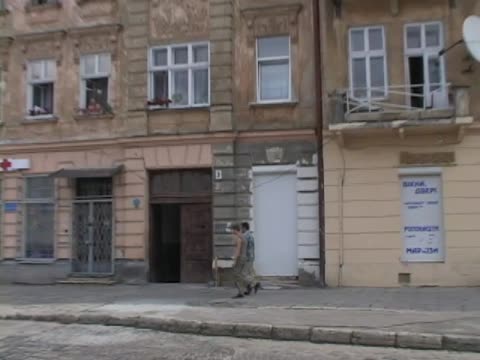
The team and Dorfman drive around Lviv, while Dorfman points out former Jewish buildings, including the Yiddish theater, the building, where Sholem Aleichem lived and the old cemetery.
From the machine transcript
Driving and walking through L'viv, Dorfman points out former Jewish sites: a Yiddish theater, the street named for Meir Balaban, where Sholem Aleichem lived (marked by a monument), the two synagogues on a former Jewish street, the old cemetery and Jewish hospital. He also names the Jewish community building, the Bnai Brith house, the gymnasium and other institutions. Parts are in Russian and Polish with the driver, and Kerler asks about street names and the end of the Yiddish theater in 1947 (?).
names the cemetery, hospital, Jewish gymnasium and community building as well as the theater and Sholem Aleichem's house
Dorfman speaks about Jewish and non-Jewish relations in the sixteenth century. Jews funded the building of a church. The team and Dorfman continue their tour on foot along a former Jewish street, before the camera collects town footage.
From the machine transcript
Dorfman tells of the Golden Rose synagogue site and a Jesuit church (St Paul's), which the Jews were said to have helped fund, a story involving a dispute over a courtyard. The date is given as the sixteenth century (the year is unclear). The group then continues on foot along a former Jewish street, passing the Armenian church and a former cemetery, with comments on Chmielnicki, a blood libel story and modern shops.
adds the Armenian church, the old cemetery and blood libel talk
The team chats with Dorfman and Brandler about life today.
From the machine transcript
Dorfman, Brandler and Kerler chat in a car or street about people in the community: a veterinarian, a woman poet who reads in Russian at the Hesed, a visiting American professor, and the Hesed meeting. Kerler says he will interview Brandler. A man named Brandler (Natan, born 1919 (?)) is discussed, and books on Lviv Jews and a Yiddish book by Golda Meir are mentioned.
mentions the Hesed, a poetry meeting and a possibly related Natan Brandler
The formal interview with Brandler begins. He provides personal information.
From the machine transcript
The formal interview begins. Kerler states the date and place and asks Brandler for his Jewish name, his official Russian or Ukrainian name and patronymic, and the spelling of his surname. Brandler gives Khaim Samsonovich Brandler, and Kerler asks for his address.
Brandler provides personal information. He explains that he was born the year a rebbe from his hometown died and therefore was given the rebbe's name as middle name.
From the machine transcript
Brandler explains that he was born in 1921 on the day the rebbe of Mostiska, Khaim Nakhum, died, and so was given that name as his middle name. He then gives the name of his town in Russian, Polish and Yiddish, and its distance from Przemyśl and from L'viv.
Brandler addresses his childhood memories and education. He attended religious school (cheder) at the age of three and recalls how his father emphasized religious education at home. Brandler then describes his teachers (melamdim) and his experience as student. Brandler's father passed away in 1934.
From the machine transcript
Brandler recalls cheder from age three, his father Shimshon's piety and a cabinet of holy books at home, and his three melamdim: Reb Godl, Reb Mendl and a Lithuanian who taught Gemara and beat the pupils. His father died in 1934 when Brandler was thirteen, aged sixty-eight; he said kaddish for a year and then stopped going to cheder after a beating, supported by his sister. He also mentions his grandfather Itsik Meir, a melamed who never hit pupils, and that he did not pray for seventy years (?).
Brandler talks about his leisure activities before the war. He states that he frequently checked out Yiddish books from the local library. Brandler then recalls visiting Yiddish theater troupes.
From the machine transcript
Brandler talks about his reading before the war: he borrowed as many books as possible from the town library in Yiddish and Polish, including Sholem Aleichem, Mendele and Peretz and Polish classics, and Russian authors in Polish translation. He recalls visiting touring theater troupes, perhaps from L'viv or Przemyśl, and an amateur Russian-language production in which his sister and a melamed's son acted, probably in the 1930s.
Brandler sings parts from theater songs.
From the machine transcript
Brandler sings fragments of songs he remembers from the theater and a Sholem Aleichem song, repeating the ending at Kerler's request. He says he would remember more if he saw the words written down and asks Kerler to write them out.
Brandler speaks about his education and family. He attended a Polish school for seven years. Brandler's father worked as egg packer and traveled to Germany often. Brandler explains how he wanted to become a baker and his parents suggested cobbler instead. Brandler completed a tinsmith apprenticeship. During the prewar Soviet period, Brandler learned to be a tractor driver in the village Pokhortsi (51:43), Sambir region. Brandler worked as instructor until 1941.
From the machine transcript
Brandler recalls seven years at a Polish school and his father's work packing eggs for export to Germany from the Mostiska egg factory. He wanted to be a baker, was steered to cobbling, which he could not do because of a shaking hand, and trained as a tinsmith. Under the Soviets he trained as a tractor driver in the village of Pokhortsi (?) in the Sambir district and stayed on as instructor until June 1941. He also speaks of Ukrainian neighbors and good relations with them.
adds Ukrainian neighbors, language use and the Soviet-era tractor training
Brandler speaks about prewar Jewish life and relationship with non-Jews. In particular, Brandler addresses his neighbors, before describing the town's occupational structure.
From the machine transcript
Brandler describes prewar Mostiska: about five thousand inhabitants under Poland, around six hundred Jewish families living in the center, mostly among Poles and Ukrainians. Jews worked as smiths and also as farmers with fields and livestock, and Ukrainian villages in the district spoke Ukrainian at the fair. He mentions nearby small towns and that the Germans occupied Mostiska in 1939.
adds Jewish farmers and the number of Jewish families
Brandler talks about his life during World War II. He describes his life during the German occupation, which started in 1939. Brandler remembers how people were sent to forced labor. Brandler describes his escape to Ostroh.
From the machine transcript
Brandler tells of the German arrival in 1939; they got as far as L'viv but could not take it. His mother and sister told him Jews were driven to hard labor, so he fled alone to Ostroh on the old Polish border, near Rivne and Slavuta.
Brandler speaks about his life during World War II. He escaped toward the Soviet Union.
From the machine transcript
Brandler recalls September 1939, when the Red Army crossed the border into western Ukraine, which he does not call Poland. He describes tanks crossing a river where the bridge broke under the first tank, and says the Polish army surrendered and was taken to a camp. He then returned toward Mostiska.
Brandler describes the Soviet entry in 1939 and the Polish army's surrender, before the escape described in the catalogue.
Brandler talks about his return toward his hometown Mostiska during the war. He then describes the journy by train first from Hodovytsya to Hosyatin and then further east to Bobrynets, Kirovohradsky province. Brandler remembers German plane attacks and injured people. In Bobrynets, Brandler was drafted into the labor battalion division of the Red Army in 1941. In his division, Brandler went to the Rostov region. Brandler describes the different kinds of assignments he had throughout the war. Brandler was then drafted for combat in the Red Army and fought at the front in 1944. He points out that he was only drafted because he forgot his identification documents at home. He was wounded on Crimea. In 1945, Brandler left the infantry for the artillery, where he was injured for the second time, by a boy. Brandler was demobilized in 1946.
From the machine transcript
Brandler describes his wartime route from Mostiska by foot and train to Husiatyn, where German planes bombed the platform, and on to Bobrynets in the Kirovohrad region. He was taken into a labor battalion digging anti-tank trenches and worked in the Rostov area and in a coal mine. In 1944 he was drafted into the army, fought as a mortar man, and was wounded and hospitalized. He later served in the artillery, was hurt again, and was demobilized in 1946. Kerler also asks how Yiddish speakers in his area said words like trench and dugout.
Kerler interrupts to ask how Yiddish speakers said trench and dugout, and Brandler describes the Slovak towns liberated by his unit.
Brandler talks about his life after the war. He returned to Mostiska and then to Sudova Vyshny, joining his sister. Brandler then moved to Lviv, where he was trained at the municipal collection office. Brandler worked as supervisor in municipal offices in Peremyshlyany for thirty years. He then describes his work as tax collector during the Soviet era.
From the machine transcript
Brandler talks about his postwar career. His sister sent him to L'viv for courses, and he trained for a post in the financial office. He then worked for about thirty years in tax offices in villages, assessing and collecting taxes. He tells how he spared a poor priest by not recording the man's horse, and describes a case involving a priest accused of taking money from the monastery. Kerler asks about words for priest and church.
Anecdotes about taxing priests and how he spared them.
Brandler talks about his life after the war. After his retirement, Brandler worked in an insurance office. He shares episodes from his work and recalls peaceful work relationships.
From the machine transcript
Brandler continues about his work among villagers, saying he never carried a gun and no one bothered him. After retiring he worked a few more years as an insurance agent. He gives an example of a life-insurance case that ended with the widow collecting the payment, and Kerler asks the terms for insurance and for a well.
The insurance episode, and Kerler's questions about the terms for insurance and well.
Brandler speaks about his family. He was married in 1948 and raised a son and a daugther, who passed away. Brandler moved from Peremyshlyany to Lviv in 2003, where his son lives.
From the machine transcript
Brandler says he worked in Peremyshlyany for about forty years (?) and liked going to the forest alone to pick mushrooms. He married in 1948 and had a son born in 1949 and a daughter born in 1952, who died abroad in an accident. His wife died in 2002, and since then he has lived with his son in L'viv, at a street address he names. He attends the Hesed and the Sholem Aleichem society in L'viv, which he says he has lived in since 2003.
Brandler mentions his daughter's death abroad and his attendance at the Hesed and the Sholem Aleichem society.
Brandler speaks about postwar antisemitism in Peremyshlyany. Brandler moved to Peremyshlyany in 1958. He also mentions how he and a friend preserved the local cemetery. Brandler then recalls a close friend, who fought the Germans as partisan. Brandler also speaks about other friends' life during the war.
From the machine transcript
Kerler asks about Jewish life in Peremyshlyany. Brandler discusses the postwar Jewish presence there and how he and the partisan commander Shimon Zisser saved the cemetery and the small hall holding the tsadik's grave. He names the tsadik as Reb Meir (?) and compares him to the Belzer rebbe. He tells of Zisser's wartime partisan unit, and of a survivor named Kirzhner who escaped a shooting, along with other friends, and of Jewish police betraying people in hiding.
Brandler also tells of Jewish police informers and the survivor Kirzhner, and Kerler asks about the town's Yiddish name.
Brandler speaks about his life before the war, particularly his cheder melamdim. He then speaks about his family. In particular, he addresses his father's obervance. Brandler's mother sold milk bottles to merchants for a living.
From the machine transcript
Brandler answers Kerler's questions about his cheder teachers: one taught the alphabet, the second taught Yiddish writing and Humash, and a third taught Gemara. They discuss his dialect and the Litvak teacher's origins. He describes his father as a devout Jew, but not a Hasid, who never visited a rebbe, and his mother Hanna Rachel (?), who sold milk to customers for a living. He says he was called Khaim, with Nakhum added for the Torah reading.
Kerler's dialect questions about the Litvak teacher and Brandler's explanation of his own name.
Brandler reads prayers, after addressing Yiddish dialects.
From the machine transcript
Brandler says he can still read Hebrew and recites the names of the letters of the alphabet as he learned them. They talk about Polish Jewish pronunciation, and Kerler asks him to read prayers from a book. Brandler reads out words and short prayer passages with some difficulty, and Kerler asks how he says a few of them.
Brandler addresses a performance of the play "Dos groyse gevins" (the big prize) by Sholem Aleichem. His sister participated in the play.
From the machine transcript
Brandler recalls a Sholem Aleichem play (Dos groyse gevins) in which the tailors' troupe, with his sister taking part, sang a song about potatoes through the week. Kerler asks what potatoes were called at home.
Kerler asks about the word for potatoes at home.
Brandler answers questions about cultural terminology. He then speaks about his family and the their view on his sister's acting. Brandler's father was married twice. Brandler grew up with three half-siblings and four siblings.
From the machine transcript
Brandler answers a question about a word for potatoes, then discusses his sister's acting in a prewar amateur production and how his parents reacted. His father and mother did not attend, and a hasid is mentioned objecting to Sholem Aleichem. He explains that his father had two wives, the first with several children, and that his own mother had eight children, of whom only he and his older sister Ester survived. Ester acted in theater and was a communist.
Brandler's father's two marriages and his sister Ester's name; also the hasid's remark about Sholem Aleichem.
Brandler speaks about prewar Jewish life and communists. He states that communists were frequently arrested on Christian holidays. Brandler then mentions prewar organizations, including Poale Zion, before addressing the Israeli Yiddish journal "Lebensfragn" (life questions).
From the machine transcript
Brandler says nearly all communists in the town were Jews, and that they were taken to the police on Polish holidays. He lists other interwar parties and organizations, including left and right Poale Zion and a Zionist society, and says there was no Bund in the town. He then talks about reading an Israeli Bundist Yiddish journal and objects to its view of Israel as occupying territory. Kerler turns to youth movements at the end.
Brandler's discussion of the Israeli political stance of the journal and his sister's influence on his own political path.
Brandler talks about his life before the war. During his childhood, he attended a Zionist summer camp in Krościenko, Poland. Brandler then sings part of "Hatikvah."
From the machine transcript
Brandler recalls going as a boy to a Zionist summer camp in Krościenko in Poland, where they studied, lived in a village and sang. He recalls Hatikvah and sings some of it, then says it is sung somewhat differently in Israel. He also mentions a group visiting Peremyshlyany to whom he showed the Holocaust grave. Kerler then moves on to libraries.
A later visit by a group to Peremyshlyany who sang Hatikvah at the Holocaust grave.
Brandler addresses prewar cultural life, specifically libraries. He lists popular Jewish and Polish writers.
From the machine transcript
Brandler talks about prewar libraries in the town. There was a Ukrainian library and a Zionist library with Polish and Yiddish books, among them Bialik. He lists authors he read in Yiddish translation, such as Tolstoy, Trotsky and Jack London, and says books could be borrowed but not read on the premises. He also names Polish popular writers and an Polish book on sexual questions.
Specific authors and the lending practice of the library.
Brandler talks about prewar holiday celebration at home. In particular, he addresses food customs on Sabbath, including cholent and gefilte fish.
From the machine transcript
Brandler describes holiday and Sabbath food at home before the war. His mother made raisin wine and challah, and fish was a must, including fish dumplings; his mother's fish was not sweet, unlike his grandmother's. On Sabbath there was kugel and cholent, which he carried to and from the baker. He recalls an incident when the ritual slaughterer declared a fish treyf, and that the family ate plain food then.
Questions on the sweetness of the fish, fish dumplings and the baker's oven for cholent.
Brandler speaks about his family, before addressing the occupational structure in prewar Mostiska. He also mentions a local fire, before talking about Jewish prewar press.
From the machine transcript
Brandler confirms that his grandmother came from Mostiska, and lists the town's occupations: tailors, shoemakers, watchmakers and merchants, and porters who carried passengers from the station four kilometers away. He recalls Polish army maneuvers in the 1930s and a large fire that burned several houses. He then discusses Jewish and Polish newspapers read before the war, naming a few titles and an editor who left for America.
Polish army maneuvers and the train station porters; Kerler's questions on newspapers.
Brandler talks about prewar Purim, Rosh Hashana and Yom Kippur celebrations. He recalls how the synagogue caretaker symbolically hit the congregants on Yom Kippur. Brandler then addresses prewar religious institutions and continues describing holiday celebration during his childhood. Brandler recalls fasting.
From the machine transcript
Brandler recalls prewar holidays in Mostiska: a childhood Purim in costume, being given liquor at a brit, tashlikh on Rosh Hashanah, and the beadle whipping men symbolically before Yom Kippur. He describes the town's synagogue, two small prayer houses and study houses, a mikveh, Simchat Torah and Hanukkah candles, building the sukkah and antisemitic harassment of it. He also gives the word for the ruffians who threw things, and says he fasted on Yom Kippur and Tisha b'Av.
Distinction between shul, kloyz and beys-medresh, Hanukkah, Sukkot, and antisemitic harassment.
Brandler addresses postwar Jewish life in Peremyshlyany.
From the machine transcript
Brandler answers whether prayer was possible in Peremyshlyany after the war. The synagogue was burned by the Germans, and nobody prayed except a doctor, Fridman, who went to L'viv. He talks about the lack of kosher meat and about a trip to L'viv to bring a Torah for a rabbi in Husakiv. Kerler compares this with the Carpathians, where kosher meat could be had.
Kosher meat, the Husakiv Torah, and the doctor Fridman who prayed in L'viv.
Brandler answers questions about cultural terminology. He then speaks about the use of gravestones for construction.
From the machine transcript
Brandler answers questions about the meanings of the words dybbuk and golem, calling the first a bad person and the second a legend of a robot made in Prague. He gives terms for a non-Jewish and a Jewish cemetery. He then explains that after demobilization he found gravestones used as paving stones in Mostiska, and notes how few remain.
Terms for cemetery and golem legend in addition to the use of gravestones.
Brandler answers dialectological questions from the AHEYM Yiddish linguistic questionnaire.
From the machine transcript
Brandler answers dialectological questions: words for everyday things (book, house, groats, cut skin, blue, dove, build, greetings and replies, thanks, the grace after meals), adverbs and adjectives (early, late, cold, high, near, fast), and sentences to translate with pronouns, 'I like it/I don't like it', 'ill', 'beautiful', 'come', 'escape'. Many items are asked in Russian or Ukrainian and the transcript is garbled in places.
Brandler answers dialectological questions from the AHEYM Yiddish linguistic questionnaire.
From the machine transcript
Answers questions from the dialectological questionnaire about words for a convert and a non-Jew, a monastery, a peasant or field worker, a convert to Judaism, and the terms for 'local' and 'from there'. Kerler and the informant also compare Polish and Russian equivalents.
Brandler speaks about prewar Yiddish theater performances and proverbs, before he continues to answer dialectological questions from the AHEYM Yiddish linguistic questionnaire.
From the machine transcript
Begins with a recollection of a prewar amateur performance in the shtetl, with a large club with a stage somewhat outside the center, near Przemyśl. Kerler then continues the questionnaire with words for bed, flowers, vodka, numbers and money, kinship terms and household words such as cellar, attic and beams. He also asks about sentences with prepositions and plurals (the way, the wagon), words such as enemy, trouble, face and 'fooled', and a few Polish loan words.
A prewar theater recollection opens the passage before the questionnaire resumes.
The team concludes the interview with Brandler, before conducting an informal interview with Dorfman. They speak about contemporary religious life and the community.
From the machine transcript
The interview with Brandler ends and an informal talk with a second man (probably Dorfman) begins. He talks about the contemporary religious community in L'viv, its rabbi and shoykhet, the people who attend, the American connections and the two small synagogues. Kerler asks how the shoykhet learned the trade.