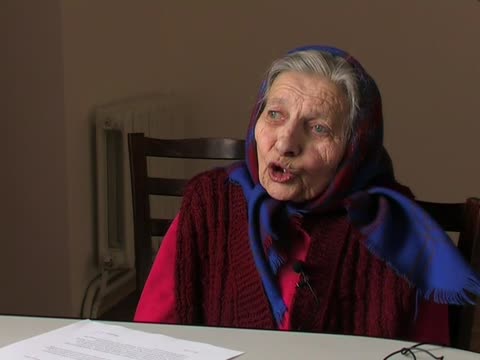
Reizman provides personal information and talks about her family. Her father was born in Rascov and worked as a cobbler. Her parents died of starvation in Makhachkala, Russia, in evacuation. She grew up with four brothers and two sisters. Her sister’s three year-old son also died of starvation in Russia.
From the machine transcript
Reizman gives her maiden name, her birth year and her birthplace Tighina (Bender). Her father Herts was a cobbler from Rascov (?), and her mother's name was Sarah. Both parents died of hunger in Makhachkala during the war, as did her sister's small son. She names her four brothers and her sisters, but cannot recall birth years or her grandparents.
names her siblings and mentions her mother's work; gives details of her sister's child's death
Reizman talks about her life before the war. She worked in a sewing factory. Reizman then talks about games, she played as a child, before she addresses prewar Jewish life, in particular Sabbath celebrations.
From the machine transcript
Reizman says she worked as a seamstress in a sewing workshop and cannot recall childhood games beyond dolls and swinging. She says Yiddish was spoken at home, with Russian and Moldovan outside, and describes her father putting on tefillin. Asked about Jewish life, she mentions the old and new synagogues in Tighina. She says her mother did not cook on the Sabbath and that she lit the candles herself.
Reizman talks about her education. She studied at a Romanian school for two years. Her sister attended a religious school (cheder). Reizman recalls her sister praying during Sabbath and Sabbath celebrations, including food customs, at home. Reizman then talks about her family. Her son, who worked as a chauffeur, was killed in Bălți.
From the machine transcript
Reizman says she attended Romanian school for only two years because her elderly parents could not afford clothes and books. Her eldest sister went to a Jewish school, read and wrote Yiddish and prayed. She describes Jewish life as mostly work, and recalls her mother's Sabbath arrangements, a primus stove to warm food, and gefilte fish. Lemster asks how the fish was prepared, and she describes it. She then says her son, a driver, was killed.
gives the gefilte fish preparation and the death of her son
Reizman talks about her life today and observing religious customs today and before the war. She then mentions food customs for holiday celebrations. Reizman then explains how her family was not able to support her and her sister’s religious education, whereas five of her siblings were able to enjoy religious education. Reizman recalls the custom of “bdikes khumets” (ritual removal of the last crumb of leavened bread before Passover).
From the machine transcript
Reizman says she attended Romanian school, not a Soviet one, and started work afterwards, as did all her siblings. She says she lights Sabbath candles only sometimes now and cannot recall Yiddish songs. She says women did not go to the synagogue regularly, then names Jewish dishes such as borscht, varenikes and krepelekh, and describes a meat dish. Lemster asks about kapores before Yom Kippur, the shoykhet, and cheder. She says the family could not afford religious schooling for the younger girls. She also covers Hanukkah money and latkes, and Passover customs including burning the chametz and the dishes kept in the attic, then Purim dishes.
adds Romanian schooling, borscht and other dishes, kapores, and Hanukkah and Purim food
Reizman recalls Purim celebrations and music. She then discusses holiday celebrations, including food customs.
From the machine transcript
Reizman recalls Purim, when masked musicians visited houses, and describes her father's Hanukkah lamp made from a hollowed potato that burned eight days. She describes Shavuot dairy food and then the fast day Tisha b'Av (?), including what was eaten before and after the fast and the greetings exchanged.
Reizman remembers non-Jews who spoke Yiddish, before she discusses Jewish occupations and culture before the war. Reizman recalls a wedding and aspects of prewar religious life. She then answers a number of questions about cultural terminology.
From the machine transcript
Lemster explains the aims of the dialect project and asks what 'pure Yiddish' means to her. She says many non-Jews spoke Yiddish and that many Jews lived among Christians. He then asks about words, among them 'meshumed', Lithuanian and Bessarabian Jew, and a 'good place' for a cemetery, 'Jewish field' being the answer she gives. Other topics are the town's trades, Yiddish papers and books, theatre, concerts and cinema, which she says were expensive, klezmer, a wedding with a rabbi, hasidim and a 'good Jew'. She says she knows few of the terms.
mostly questionnaire-style terminology and prewar Jewish culture rather than Yiddish-speaking non-Jews alone
Reizman talks about her traditional wedding in Tighina before the war. She then discusses food customs, in particular for gefilte fish and stuffed stomach.
From the machine transcript
Reizman says she married in Tighina under a chuppah, and her husband was a painter. She describes the wedding food, the match and the way she met him. Lemster then asks about dishes: sweets, flodn at Purim, chopped and gefilte fish, matzo dishes for Passover, kishke, stuffed stomach, stuffed ducks and bread. She says her mother baked at home, with a cholent of beans, while they bought white bread.
gives food terms asked by Lemster and the details of how she met her husband
Reizman discusses folk remedies and recalls an episode where she was healed from a dog bite. She then answers questions about cultural terminology, before she briefly talks about prewar burials and birth customs.
From the machine transcript
Reizman discusses the evil eye and how Jewish women cured it, including a healer who treated her after a dog scare, with a knife and spoken charms. Lemster asks about dybbuk, golem, a Jewish funeral with a washing hut, a lullaby and a cradle, and she answers a few terminology items. She says she does not remember songs from her youth.
adds the questions on dybbuk, golem, funerals, a cradle and lullabies
Reizman mentions prayers.
From the machine transcript
Reizman says she prays for peace and asks the dead for their intercession. Lemster asks about words used to ward off the evil eye, and she says she knows none.
Reizman talks about her life during World War II. She first evacuated to Tiraspol, Moldova, where she stayed with fellow Jews for a month. She then evacuated further to a town eighteen kilometers from Rostov, Russia, and stayed there for two months. Reizman continues that as the front drew closer and she reached Rostov, her family could not find transportation. They had to evacuate further on foot and walked eighteen kilometers to the next train station, where they got on a train to Makhachkala, Russia. Reizman describes her family’s journey. Her family stayed there for one month, until sent further to work on a kolkhoz. Reizman describes their home on the kolkhoz. They lived there during the winter. The following summer, her family evacuated further to Buynaksk, Russia. In Buynaksk, they worked in a canned food factory until the end of the war. She then returned to Tighina with her older sister.
From the machine transcript
Reizman recounts the war: with her parents she was evacuated from Tighina to Tiraspol and then further as the front approached, and when no transport was provided they walked to a station. She describes her sister's small children and a Christian woman's help. They reached Makhachkala, where they ate fish heads and were sent to a poor kolkhoz with a mud-floored room. She then worked at a canning factory until the war ended. Her parents died of hunger in Makhachkala, and she returned with her older sister. The Russian and Yiddish words for a rack or cart are discussed.
adds the kolkhoz and canning factory; the transcript does not clearly confirm Buynaksk or Rostov
The tape is a continuation of formal interview with Beila Naftulevna Reizman. Reizman talks about her life after the war, after she returned to Tighina. Three of her brothers died at the front. She explains that her home was destroyed and non-Jews stole her family’s possessions. Reizman rented out a place from her neighbor for two years. When Reizman began working at the 2:09, her and her sister were given an apartment.
From the machine transcript
Reizman recalls the time after the war. Three of her brothers fell at the front, and nothing remained of the family home, since non-Jewish Moldovan neighbours had carried off the belongings. A neighbour rented the family a small room for a year or two, after which Reizman worked at a workplace (name unclear) and she and her sister were given an apartment. She comments that Jewish life continued but was not what it had been before.
Adds the neighbours' rented room and Lemster's questions about how long she lived there.
Reizman discusses postwar Jewish life. According to Reizman, every synagogue was destroyed, but a kosher butcher worked in town.
From the machine transcript
Reizman answers questions about Jewish life after the war. The synagogues were wrecked and everything taken out of them, though people might gather privately to pray. A ritual slaughterer came later, but she does not remember who he was or where he came from. Lemster also asks whether she lives alone now.
Adds the question about her living alone today.
Reizman talks about her parents and remembers her father kissing the mezuzah.
From the machine transcript
Asked about Yiddish sayings and curses, Reizman says she remembers none, and recalls her father kissing the mezuzah, praying in a tallis and being buried in his tallis. She says her mother did not sing and that she herself remembers no Yiddish songs, jokes or wise sayings. Lemster repeatedly prompts for anything she heard from her parents.
Adds the burial in the tallis and the failed prompts for songs and sayings.
Reizman answers a number of dialectological questions from the AHEYM Yiddish questionnaire.
From the machine transcript
Reizman answers a long Yiddish dialect questionnaire from Lemster, who gives Russian words and phrases and asks for the Yiddish. Items include greetings, thanks and requests, household and building words, taste, comparatives and adverbs of time and speed, illness, flowers, trees, body parts, numbers and pronouns of address, and some religious terms. She frequently says she has forgotten the Yiddish and answers partly in Russian, with a second person occasionally prompting her. The passage also touches briefly on her family and on the Germans.