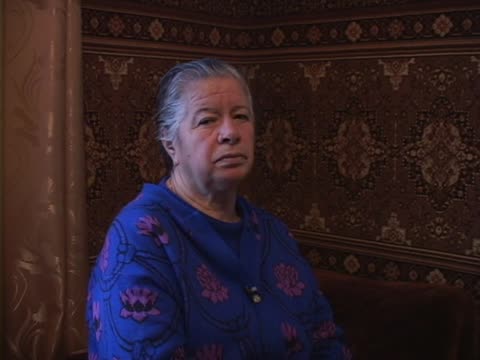
The second part of the tape is a formal interview with Maria (Manye) Leibovna Kleyman, recorded in Lipcani. Kleyman, nee Shnayder, was born 1928 in Starye Karkushany, twelve kilometers from Lipcani. She talks about her life after the war. Kleyman was imprisoned in a ghetto for three years and then returned home with her parents after the war. She got married in the village, before moving to Lipcani in 1953. Her younger son was born in 1959 and Kleyman’s parents moved sold their house in the village and joined her family in 1961.
From the machine transcript
Kerler opens the interview in Lipcani on 13 December 2005. Kleyman gives her name, her maiden name Shnayder, and her Yiddish first name Manye. She was born in 1928 in Starye Karkushany, twelve kilometers from Briceni, and lived in the village before the war. She spent three years in the camp, returned to the village, married in 1953 and came to Lipcani. Her parents later died here and are buried here.
Adds that her parents died and are buried in Lipcani.
Kleyman talks about her family. Her mother was born in Secareni* (21 15 21 26) and her father in Starye Karkushany. She raised two sons (one lives in Germany) and one daughter (lives in Ukraine). Kleyman’s father was a trader in machines and her mother worked as a modiste (milliner). She grew up with a sister.
From the machine transcript
Kleyman talks about her family. Her father Leyb dealt in machinery brought from Romania and her mother Reyze was a seamstress. Her mother was born in Secareni(?) and her father in Karakushan, and she had one sister. Of the original family only a few remain and her three children live apart: a son in Germany and a daughter in Ukraine. She says she and her sister were in the camp and returned in 1945 and recalls her grandmother Feyge and her mother's sisters.
Adds that she talks about her grandmother and the relatives of her mother abroad.
Kleyman talks about Jewish life before the war. In particular, she explains how people visited the rebbe of Stefanesti to consult about antisemitism. Kleyman then shares an episode about how her mother-in-law consulting the rebbe.
From the machine transcript
Kleyman talks about prewar Jewish life, in particular a holy rebbe in Stefanesti (Romania) who foretold a slaughter of Jews on one night. A neighbour is said to have believed the story. She tells of her mother-in-law's visit to the rebbe about where to live, and of the mother-in-law's deathbed warning not to leave the house, which had been blessed. She also tells of her husband, who was taken from the camp to the front.
Adds the story of the mother-in-law's visit and her deathbed warning about the house.
Kleyman talks about her husband and his life during the war. In particular, she addresses his charity work.
From the machine transcript
Kleyman talks about her husband and his war years in the camp, then gives the names of his father, grandfather and mother. She tells that her husband was buried as a Jew, with his daughter bringing him home in ten days. The passage ends with Kerler asking about her childhood.
Kleyman discusses her childhood memories and prewar religious life in Starye Karkushany. According to her, there were forty Jewish families out of four hundred inhabitants. She then talks about religious service with rabbis from surrounding cities. Kleyman then talks about contemporary holiday celebration. She visited Chernivtsi for Sukkot celebrations. Kleyman briefly describes prewar holiday celebrations at home and talks about life today.
From the machine transcript
Kleyman talks about Jewish life in her childhood village. About forty Jewish families lived among some four hundred people; services were held in the house of her aunt (Khantse), where Jews from Belts and Chisinau sometimes came. She describes her mother lighting Sabbath candles, her limited Jewish schooling, speaking Yiddish with Jewish children and Moldovan with Christians. She tells of a Jewish mother and a Ukrainian father whose children did not learn Yiddish. She also tells of a trip to the rebbe in Chernivtsi at Sukkot and a conversation with Christians about guilt for the death of Jesus.
Adds Kleyman's trip to Chernivtsi and her talk with Christians about guilt for the death of Jesus.
Kleyman talks prewar Hasidic life and rebbes, before she discusses her childhood memories. She then remembers an encounter after the war with a former boss of her father’s on a kolkhoz. Kleyman returns to the rebbe of Stefanesti and recalls another episode of an encounter with him. She then talks about the history of Jews in Stryy, Ukraine, during the war.
From the machine transcript
Kleyman talks about a holy rebbe in Stefanesti and another in Boyan, where people still go and light candles. She recalls a childhood game in Yiddish, then an encounter after the war in Ukraine with her father's former boss at a kolkhoz, who wept when she said she was his daughter. She returns to the rebbe and the grandmother who had been to America. She then tells the story of eight thousand Jews in Stryy, killed by the Germans, and of a holy man who spoke before being shot.
Adds a childhood game memory and a visit to a former kolkhoz chief of her father.
Kleyman discusses food customs for holidays. She then talks about holiday celebrations.
From the machine transcript
Kleyman answers Kerler's questions on food and holidays: her mother baking Sabbath challah, Sabbath dishes such as cholent, fish (kulen, chopped and gefilte fish), vinegar meat and the meal before Yom Kippur. She also recalls Hanukkah money, Purim noodle kugel, and baking at Passover in the oven. She remembers little of the Purim reading and the seder, and speaks of her sister asking the four questions and her mother lighting candles. Lemster and Kerler exchange words with a man from Israel about food terms.
Adds that Kleyman remembers little about Purim and the seder.
Kleyman talks about prewar Jewish life, in particular occupations. She talks about Jews who worked the field and answers questions about cultural terminology. Leibovna Kleyman.
From the machine transcript
Kerler asks what village Jews did for a living. Kleyman says there were few craftsmen, only some tailors, and that many Jews worked the land and threshed alongside others. She mentions her family's poverty and her father's aunt, who left many daughters. Kerler then asks terms for a peasant, a tsadik and a rabbi, and Kleyman discusses how Yiddish differed between Latvian, Ukrainian and Bessarabian Jews.
Also covers a terminology exchange about peasant, rabbi and tsadik, and comparison of Yiddish dialects.
Kleyman discusses traditional weddings. She then recalls what her mother-in-law told her about prewar Jewish life in Lipcani. She also addresses Jewish culture. about cultural terminology.
From the machine transcript
Kleyman discusses traditional Jewish weddings, which she says were the finest, including a wedding she attended as a girl in Briceni. She describes the wedding pastries and the flodn, and explains a flodn ingredient. She recalls what her mother-in-law said about Jewish merchants in Lipcani before the war. Katz asks about writers, theatre and the film or cinema in Lipcani, and Kleyman says she was a child then. Kerler ends by asking about folk remedies against the evil eye.
Also includes wedding food and the flodn recipe, and Katz's questions about writers and theatre.
Kleyman discusses folk remedies and tells stories about averting the evil eye and leshn koyln. She then returns to traditional weddings.
From the machine transcript
Kleyman answers questions on folk healing: a spoken charm against the evil eye, used by non-Jews, and a Jewish woman's story about asking a rebbe to perform one. She tells how her infant sister fell ill after a wedding and was cured when a non-Jewish woman performed a charm and quenched coals. Kerler then returns to wedding customs, asking about the entertainer and the songs her mother sang.
Also includes the story of her infant sister's cure and the wedding entertainer.
Kleyman talks about her life during the war. She was imprisoned in the Bershad ghetto. She describes her life after the beginning of World War II. She came through Balanivka on the way to Bershad. She recalls that many people were forced to work Mykolaiv and Tulchyn. Kleyman states that whoever was sent to work under German command did not return. Kleyman explains how they were under German command and sent to the Kasarulitser* forest, Moldova, where she escaped a mass shooting.
From the machine transcript
Kerler asks Kleyman to tell her war experience. She describes being driven to Balanivka and then Bershad, where they were in the ghetto. Many were taken to work in Tulchyn and Mykolaiv and did not return. She also recalls a forest where Germans on one side and Romanians on the other, at a bridge, had people sent to a shooting. Her brother-in-law was a gymnasium graduate. The transcript is partly garbled.
Adds Kleyman's brother-in-law and her comments on Germans and Romanians at the forest bridge.
Kleyman talks about the hardships of contemporary life.
From the machine transcript
Kleyman talks about hardship today: the small quarterly payment from Germany that Jewish survivors receive, her expenses for soap, utilities and gas, and aging acquaintances who are sick or paralysed. She complains that non-ghetto survivors get nothing and contrasts Germany's treatment of Jews with the poverty here. Her son went to Germany six years ago and is an immigrant there. Katz questions her about the sums.
Kleyman talks about her life during the war in the Bershad ghetto, where she was imprisoned for three years. She was liberated in 1944.
From the machine transcript
Kerler asks about the war years and a camp, and Kleyman says she was in Balanivka for a year, then Bershad ghetto until the war ended; she returned home in 1944 or 1945 (unclear). She names three villages near Bershad. Kerler asks about a song on the Bershad ghetto and then moves toward the dialect questions.
Also includes Kerler's question about a ghetto song and the names of nearby villages.
Kleyman answers a series of dialectological questions from the AHEYM Yiddish linguistic questionnaire.
From the machine transcript
Kerler and Katz run the dialectological questionnaire. Kerler gives items in Russian and Kleyman translates into Yiddish. Items include household objects, animals and body parts, adjectives and adverbs, sentences, numerals and months, and religious and moral terms. Also covered are praying and a convert, rivers and place names, potatoes and flowers, and a few forms of 'we' and 'you'. Katz adds terms for fields and a fence, a face, and the Hebrew-derived words for gehenna and wealthy man.
The first part of the tape is a continuation of a formal interview with Maria Leibovna Kleyman. Kleyman answers a series of dialectological questions from the AHEYM Yiddish linguistic questionnaire.
From the machine transcript
Kleyman discusses her monthly pension in dollars and what she can buy with it, and answers a short question about a word for an enemy and the number two. Katz then asks whether she remembers a Yiddish song.
The passage also contains talk about her pension.
Kleyman talks about life today, before she talks about her life in the ghetto. In particular, she addresses the period in the Kasarulitser* woods, where her family stayed for three days to wait for her mother to recover. Kleyman explains how only people who could walk were allowed to cross over to Ukraine, whereas sick people were shot in the woods.
From the machine transcript
Kleyman says she remembers no songs, discusses how much money is needed to live decently today and compares it with her pension. Asked by Lemster about prayer in the camp, she recounts how her very ill mother was taken to Briceni, how the family waited three days in the Kasarulitser woods, and how only those able to walk could cross the bridge to Ukraine while the weak were shot. She tells of her grandmother Feyge's dream, which advised her mother on what to eat to survive, and of the cheap food they made.
Also covers her pension and cost of living today, and the grandmother's dream about what to eat.
Kleyman talks about her family and life today. She raised two sons and a daughter. Her husband was the breadwinner in her family. She then talks about “Jewish houses” in Lipcani and how Kleyman’s mother-in-law reclaimed her house after the war.
From the machine transcript
Kleyman explains that her grandmother used to lead the women's prayers and read from a women's Bible. She talks about her husband, a disabled veteran, and the children she raised, two sons and a daughter, and about her pension and loneliness today. She tells how after the war her mother-in-law reclaimed the family's Jewish house from the authorities after returning from the camp.
Includes grandmother's role as women's prayer leader.
The second part of the tape shows town footage of Lipcani. The team visits the old Jewish cemetery.