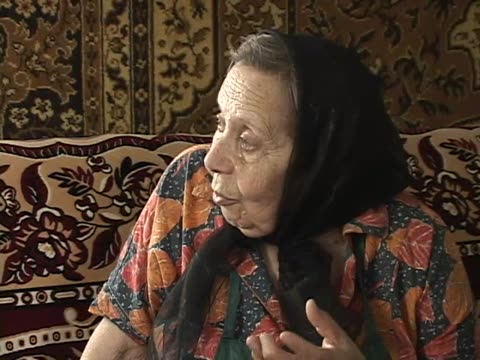
The team greets Kipervaser and sets up the interview with her. She speaks about her family.
From the machine transcript
The team arrives in Slavuta, greeted by Kipervaser and a second woman (Leah), and sits down to set up the interview. Kipervaser says her husband Moyshe died about three months earlier. Kerler introduces himself and Lemster, and asks her to speak Yiddish. She says her parents were Jews who attended synagogue and that she was born in Berezdiv, a shtetl near the Donetsk (?) area, with many Jews.
Adds the recent death of her husband and her birthplace Berezdiv.
The formal part of the interview begins. She provides personal information and speaks about her family. Kipervaser's father, who worked at a Jewish kolkhoz, was born in Velykyy Pravutyn and her mother was also born in Berezdiv.
From the machine transcript
The formal part begins with the date and place of the interview in Slavuta. Kipervaser gives her name and family: her father was Yankl Milshenker and her mother Yente, from Berezdiv. Her father was born in nearby Velykyy Pravutyn (?). He had no special trade and worked on a Jewish kolkhoz until the war. She was born in 1924 and grew up in Berezdiv. She also says the Kipervaser family were from Berezdiv.
Adds her birth year and her husband's family also from Berezdiv.
Kipervaser discusses prewar Jewish life, including holiday celebration, in Berezdiv. She also talks about her family, particularly her husband. Kipervaser met her husband at school in Berezdiv.
From the machine transcript
Kipervaser describes prewar Berezdiv: everyone had a trade (shoemakers, tailors), people got along and knew each other, and the synagogue was near their home. She remembers a chuppah. Her parents kept a kosher home, and her grandmother lit Sabbath candles. Her husband, also from Berezdiv, went to cheder; they studied together at school. He was called up in 1940, served at the front and ended up in Germany, and learned German. They keep Yiddish books, observe holidays and light memorial candles. Their son speaks Yiddish and knows the holidays.
Adds her parents' kashrut, her grandmother's Sabbath candles, and her husband's army service.
Kipervaser speaks about prewar holiday celebration, in particular Purim and Sabbath. She also recalls the family's Sabbath goy and addresses food customs. Kipervaser then explains how to kosher meat.
From the machine transcript
Kipervaser speaks about prewar holidays and Sabbath in her parents' home. At Purim they baked pastries with poppy seed, sang, danced and exchanged gifts. On Sabbath nothing was done and a non-Jewish woman came to milk the cow and heat the stove. She also mentions Friday evening candles and the Sabbath bread, and she explains how meat is koshered by soaking and salting. She does not remember the Purim play.
Adds Purim pastries and the cow-milking Sabbath helper.
Kipervaser recalls traditional weddings and synagogues before the war. She then addresses postwar religious life, including private services in 1944 and how the community rebuilt the synagogue after the war. Kipervaser helped to collect money, she explains.
From the machine transcript
Kipervaser recalls weddings and the synagogues of Berezdiv. There were two or three, including a workers' synagogue and an intelligentsia one. After the war there was no synagogue, so in 1944 people prayed in a house for the holidays. The community then rebuilt the synagogue, and she went round town collecting money. Kerler asks whether it was wooden. She speaks warmly of a rabbi, Itsik Libersohn (?), who helped everyone, and of his daughters.
Adds the rabbi who advised the community and his daughters.
Kipervaser talks about her husband's family and fate during World War II. She then speaks about her and Jewish life in Slavuta after the war. She moved to Slavuta (Yiddish: Slovita) in 1944. Kipervaser then speaks about her daughter's education.
From the machine transcript
Kipervaser speaks about her husband's family, whose three sisters and other children were killed; she says that she and her husband mark their yahrzeit every year. After the war they did not return to Berezdiv, as no Jews were left there, and came to Slavuta in 1944. She says the Yiddish name of the town is Slovite (?). She talks about Yiddish at home, a child named Itsik who died, and the Jews who came back from evacuation. Her daughter completed an institute. Lemster asks whether a Yiddish theater came to Berezdiv.
Adds the yahrzeit custom and the child who died.
Kipervaser speaks about prewar cultural life in Berezdiv. She then speaks about her education. Kipervaser attended a Yiddish school for seven years and then finished her school education at a Ukrainian school.
From the machine transcript
Kipervaser answers questions about cultural life in Berezdiv. She says there was no Yiddish theater after the war and that people sang Russian songs. The library had a few Yiddish books, and few people could read them, including her husband and the rabbi's daughter. She finished seven classes at a Yiddish school, as did her husband, and the Yiddish schools were later closed and the pupils moved to a Ukrainian school.
Adds the library with Yiddish books and the closing of Yiddish schools.
Yiddish school education.
From the machine transcript
Kipervaser says the school subjects were taught in Yiddish by Jewish teachers, including a director from elsewhere and his wife, whose name she cannot recall. She remembers that the pupils studied well and that discipline was strict. She then turns to her memories of Sabbath at home.
The teachers (a director and his wife) are discussed and the passage moves to Sabbath.
Holiday celebration and food customs.
From the machine transcript
Kipervaser recalls a non-Jewish woman who came to light the Sabbath lamp, and what her mother said at the end of the Sabbath. Kerler asks about a prayer to the God of Abraham. She mentions men who worked in shops and prayed for a livelihood, but says her father did not.
Sabbath customs, the non-Jewish helper and a prayer for a livelihood.
Family and dialectology.
From the machine transcript
Kipervaser says her mother could read and write Russian and Yiddish and wrote letters in Yiddish to her brother and sister in America. She mentions family in Brooklyn. Most of the passage is a dialectological questionnaire from Kerler and Lemster, with many Russian asides: words for animals and household things, greetings, adjectives, verb forms and comparisons, numbers, words for Christians and peasants, Hanukkah and the dreidel, parts of a house and the face. She also sometimes switches into Russian or Ukrainian.
The catalogue's 'family' is only the brief mention of the mother and the American relatives; the rest is a long questionnaire.
Informal chat.
From the machine transcript
After the questionnaire, Kerler and Kipervaser chat about language and about the team's search for a wooden synagogue in Slavuta. She asks whether they have been to the synagogue, and she and Kerler discuss whether it is wooden.