0:00
Personal introduction and family.
From the machine transcript
Opening of the interview. Lemster gives the date and place, Zhytomyr, and Nibulskaia gives her name and patronymic. The passage ends with a question about her address.
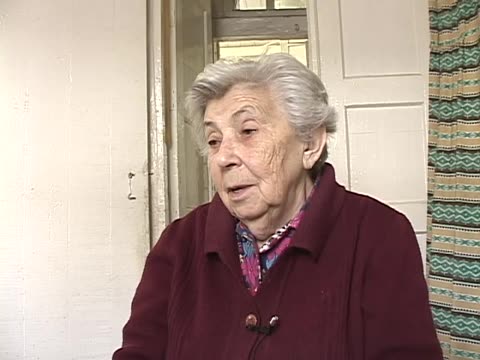
Personal introduction and family.
Opening of the interview. Lemster gives the date and place, Zhytomyr, and Nibulskaia gives her name and patronymic. The passage ends with a question about her address.
Education and family.
Nibulskaia gives her family background. Her father was born in Fasova near Korosten, worked as a kabl (?), and has the surname Segal (?). Her mother, Feyge Reyve, was born in Selets, and she names her grandparents. She had three siblings, the brother David and the sisters Mindl and Genia; two died in the war, and she describes how one sister was lost during the evacuation.
Education.
Nibulskaia talks about her schooling. She attended the Yiddish school in Korosten, then moved to Novozlatopil' during the famine and finished seven grades at the Yiddish school there. After that she completed the Russian school in Korosten, studied at the institute in Berdychiv until the war, and finished her training in Zhytomyr after the war.
Life in 1930s.
Nibulskaia describes the hardship of attending school in the 1930s. The family lived on a kolkhoz, and she walked seven kilometers to school in Novozlatopil' every day. In winter she lodged near the school, with her bed by the window and snow on her head. She says she nevertheless studied very well.
Yiddish school.
Answers questions about the Yiddish school: the subjects, the director, and the Yiddish writers read, among them Sholem Aleichem and Mendele. She says she has forgotten much, including the songs learned there.
Kolkhoz in Novozlatopil’.
Nibulskaia describes the kolkhoz near Novozlatopil': two rows of eighteen houses, with her father working as a kabl (?) and her mother as a cook. Her younger sister attended a two-class school in the nearby settlement and studied at home, while she herself struggled with school. A Yiddish theater company used to visit them.
Lemster's remark at the start about a conversation in Odessa is unrelated; the passage also covers the visiting Yiddish theater.
Yiddish cultural life.
Nibulskaia says she remembers little of the plays staged by the visiting Yiddish theater. She took part in a choir and a circle where people danced and sang. She cannot recall the repertoire.
Religious life and family.
Nibulskaia says there was no synagogue in the kolkhoz village, but her father, a very observant man, always went to the synagogue in Korosten, where he had a place of honor (?). She does not remember her grandfathers, only from stories.
Holiday celebration and food customs.
Nibulskaia recalls the holidays at home, with her father leading the Passover seder, and the food her mother cooked, including a sour-sweet meat dish, borscht, and Passover kugel and latkes of matzo meal. She mentions Purim without masks, since it was a Soviet land. She also recalls a good teacher at the Yiddish school who played the fiddle, and says her children do not speak Yiddish.
Jewish life in Korosten.
Nibulskaia talks about Jewish life in Korosten. There were many Jews and a large Yiddish school with parallel classes, and a few Jews remain today. She describes being a pioneer and Komsomol member, and says everything at school was in Yiddish, though no Hebrew was taught.
AHEYM project and relatives abroad.
Lemster explains the AHEYM project and its interviews. Nibulskaia says she has a relative on her mother's side in Brooklyn who telephones her because she herself cannot afford to call. Lemster then turns to the evacuation.
Life after war.
Nibulskaia says she completed two courses before the war and the institute after it, and worked at a Russian school with an extremely heavy load, taking on extra duties as class leader and reading to children in a hospital. Her father worked in a cooperative and her mother stayed at home. Lemster then asks about the Yiddish library.
Yiddish library in school and Yiddish press.
Answers questions about the Yiddish library at her school and about Yiddish reading. As a child she read Sholem Aleichem in Yiddish; after the war she read only Russian and read no Yiddish press or books. She does not remember the prewar journals (the periodical Shtern is suggested), and she says the teachers at the Yiddish school in Novozlatopil' were good and Yiddish faculties existed after the revolution.
Kolkhoz.
Nibulskaia says that on the kolkhoz everyone worked in the fields, sowing and planting, and her father worked in the smithy. Lemster then asks about the war years in the Chelyabinsk region.
Life during the war.
Nibulskaia recalls the war years in the Chelyabinsk region, where she and the schoolchildren worked in the coal mines on their days off, enduring hunger and hard labor. Children had few books and wrote between the lines of old ones. Her father worked at a smithy and her mother did not work.
Life after war and family.
After the war Nibulskaia returned to her sister's village. The sister, a teacher, had been saved from the Germans because her Russian husband said she was not Jewish. Her brother-in-law brought her to teach in Pulyny (Chervonoarmiysk), where she met her husband without a matchmaker and they married. They lived in Pulyny until 1977 and had three children; two now live in Zhytomyr and one in Kyiv, and a grandchild is on a kibbutz in Israel.
Adds her sister's rescue by her husband, her meeting her husband, their children and a grandchild in Israel.
Food customs and family.
Nibulskaia discusses her mother's cooking: sweet-and-sour meat for Sabbath, with onions, sour and sweet flavoring, and no tomato; fried and ground gefilte fish, carp, and kugel. She did not attend cheder. She says her daughter in Kyiv lights Sabbath candles every Friday, while she herself does so only sometimes.
Lemster compares recipes, e.g. gefilte fish; she also notes her daughter in Kyiv lights candles.
Jewish life after war.
Nibulskaia talks about Jewish life in Zhytomyr. Her father went to synagogue every day until his death in the 1950s (?), and baked his own matzo at home before it began to be baked at the synagogue. She says he was a strongly observant man while she and her siblings were nonbelievers.
Husband.
Nibulskaia describes the synagogue in Zhytomyr with its shames and gabbai, then talks about her brother David, who went to the front and had a wife and child, probably in Moldova. She gives her husband's biography: evacuated with his parents, he studied at a pedagogical technical school and an institute, and later taught drawing. They lived poorly with three children, moved to Zhytomyr in 1977, and she taught math for 39 years.
Her brother David's wife and child; her husband's education and the family's finances.
Dialectology.
Dialectological questionnaire in which Lemster gives Russian words and Nibulskaia answers in Yiddish; her husband helps at times. Items include greetings and thanks, body and animal words, colors, building and wall words, comparatives of adjectives, and verbs and phrases such as breathe, escape, and be sick. They also cover religious terms such as devout, honest, and cross, with the words for a convert and a ladder. She explains in the context of a convert that her sister married a non-Jew.
Dialectology.
Dialectological questionnaire session in which Nibulskaia gives Yiddish equivalents for Russian prompts from Lemster. The items include words for non-Jews and peasants (goy, Christian), and a baby-nurse/midwife term. They also include everyday vocabulary (head, street, river, well, potatoes, flowers, shop, wagon, floor, face, back, ceiling, tree, vodka) and pronouns and forms of address. Further items cover sentence translation (illness, 'where are you from', 'I ask you', 'three days', 'in 1914 or 1915', 'you will come or not'), plus phrases and verbs such as 'to pray', 'to make order', 'to return', 'suddenly' and 'various'. She sometimes cites how her mother spoke, and at the end says she can no longer sit and the questioning stops.
Concluding the interview.
Items of the dialect questionnaire asked here; each link plays the moment.