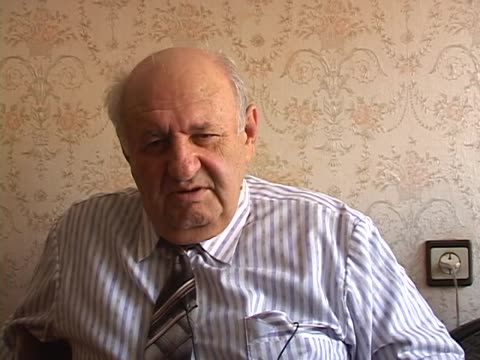
Roif talks about contemporary Jewish life and financial support. He also addresses his work in community service and the relationship between the community and the Romanian state.
From the machine transcript
Roif talks about the present day: speaking and losing Yiddish and Hebrew, his daily unpaid community work, help to sick and elderly Jews through a German sponsor, and payments made to homebound people. He then speaks about Romania's official recognition of the Holocaust, the denial of it by ordinary Romanians, and the estimated numbers of Jews killed in Bessarabia. Kerler asks which government recognised it, and a passage on Jews without citizenship follows.
The passage also covers the number of Jews killed in Bessarabia and the status of Jews without citizenship.
Roif speaks about the fate of regional communities during World War II. He then addresses his life during the war in the Obodivka ghetto. Roif explains how he was saved by a priest.
From the machine transcript
Roif speaks about the shooting of Jews from Bessarabia, Bukovina and Chernivtsi, and says he and his wife spent three years in the ghetto and camp at Obodivka. A priest and his wife saved them from being shot while they were locked in a small building. He describes the Jewish badges they wore. Kerler asks about the priest's name and where the ghetto was; Roif places it in Ukraine, near Bershad'.
The transcript also includes an exchange about Bershad' and Kerler's Moscow origin.
Roif speaks about contemporary Jewish life and presentations about life during World War II. He then speaks about his family and briefly touches upon his life during the war. Roif's father was an American citizen and worked there on a cow farm and sold products in the city for six years, until 1929. Roif grew up with one brother and his father was born in Pererita, Moldova. Roif's mother was also born in Duruitoarea. Roif explains that his family was well off with his father's earnings in America and they ran a family homestead farm.
From the machine transcript
Roif first mentions planned commemorative events, then answers questions about his family. His father Avrom worked in America for six years on a dairy farm outside New York and returned in 1929. His grandfather Khayim was a rabbi in the area of Briceni (Britshan) and Lipcani (Lipkan), and his mother Rive came from Duruitoarea. The family was wealthy from the father's American earnings and kept land, livestock and servants.
The passage also covers Roif's grandparents and his mother's family.
Roif speaks about prewar Jewish life in Duruitoarea, where Jews lived in a colony spread across three villages. He mentions that his father supported the village synagogue. According to him, 160 families lives there.
From the machine transcript
Roif speaks about prewar Jewish life in Duruitoarea: a commune of three villages with a single synagogue (klois) supported by his father, and about 160–170 families (the number is not fully clear). He begins to say that the Romanians started shooting from their first day.
Roif speaks about his family's life at the beginning of the war, when the Romanians occupied Duruitoarea. Roif recalls shootings upon arrival of the Romanian army and explains how his escaped with the help of a priest in 1940. He then describes how he went through various camps, including a camp, located twenty-five kilometers from Rîşcani (for three months), a cowshed in Transnistria (for two years), a cowshed on the Dubyna state farm as forced laborer (for two years). Roif remembers looting, but also mentions a Romanian soldier who brought food on a weekly basis to the first ghetto. Roif then describes the living conditions during the winter, as well as diseases in the cowshed. He then addresses life and starvation on the state farm.
From the machine transcript
Roif describes the arrival of the Romanians and how a priest rescued the family from a gendarme, then a camp near Rîșcani, the Transnistria cowsheds, and forced labour on the Dubyna state farm. A good gendarme chief who shared out food is mentioned, as are looting and the harsh winter, disease and death in the cowshed. He also speaks about hunger on the farm, Antonescu's order of 1943 to count the Jews, and the Jews who survived.
Roif speaks about Jewish collaborators.
From the machine transcript
Roif speaks about a Jew who informed for a Romanian gendarmerie chief in Obodivka and was later sentenced. He adds that every people has its faults.
Roif speaks about his life in the Dubyna forced labor camp between 1942 and 1944. He describes religious life and his bar mitzvah in the camp. Roif mentions that he visited the camp and addresses memorialization.
From the machine transcript
In answer to Kerler's question, Roif talks about religious life in the Dubyna camp, where he turned thirteen and had his bar mitzvah, and about two rabbis there, a makeshift prayer room and a Torah scroll later in Israel. He says he laid tefillin and was called to the Torah, and that he still has the tefillin. He mentions plans to visit the camp and the importance of remembering.
Roif speaks about his family's fate during the war. His family was also imprisoned in the Dubyna forced labor camp. Roif remembers how his father snuck out from the camp at night to provide food for his family.
From the machine transcript
Roif says his wife and parents were in the same camp, with his wife's mother ill. His strong father crawled under the wire at night to find work in the village and bring food, and the family counted bones before eating them.
Roif describes the living conditions in the forced labor camp and recalls singing and song writing.
From the machine transcript
Roif describes sleeping on straw in the Dubyna camp and the singing there, including new songs composed about their sufferings. Kerler asks about the song "Oy vey, tsores". Roif says his wife may remember songs, and they briefly discuss how the recording will be archived.
Roif provides personal information. He then speaks about prewar Jewish life in Duruitoarea, as well as his education. Roif attended a Romanian school and religious school (cheder), which was located in the local synagogue. Roif learned in cheder, except for the winter months, until the outbreak of World War II.
From the machine transcript
Roif answers questions about his name Shabs and its variants, and about his prewar education: the Romanian school and a separate Jewish school (cheder) held in a rented house and supported by his father, taught by hired teachers. He did not attend in winter, studied Hebrew and the alphabet, and mentions the form of address to the teacher. He and Kerler also discuss the Hebrew of the region and Shraybman.
Roif addresses prominent Yiddish writers, including Yekhiel Shraybman, Yankl Yakir and Vaysman, and their persecution during the postwar Soviet period. His father subscribed to "Sovietish Heymland." Roif speaks about his encounters with Yakir and Vaysman.
From the machine transcript
Roif speaks about Yiddish writers who visited or came from the area: Yekhiel Shraybman, Yankl Yakir, who was arrested after the war in the campaign against Jewish writers, and Vaysman. His father subscribed to Sovetish Heymland. He describes Yakir's son visiting his kolkhoz, knowing Vaysman in Israel, and the shoykhet Ari Meir.
The passage also covers Roif's work as a kolkhoz chairman and the shoykhet of a neighbouring village.
Roif discusses his childhood memories. He explains how his father arranged transportation to the neighboring village, where Shraybman lived, to invite him for Sabbath celebrations at Roif's home. He then addresses his father's financial support of the local community and describes prewar Jewish life and occupational structure in Duruitoarea.
From the machine transcript
Roif recalls how his father sent a cart to a neighbouring village on Fridays to bring Shraybman for the Sabbath and helped him. He also describes his father's generosity to poor Jews, prewar poverty among craftsmen such as shoemakers and tailors, a Jewish tavern keeper and the rich Jew Tuve Vinkelshteyn, who with his father helped others.
Roif discusses his life and work after the war. He ran a kolkhoz in Duruitoarea for twenty years, where he built a chicken factory. He talks about the workers and describes his achievements. Roif left the kolkhoz in 1976.
From the machine transcript
Roif talks about the years after the war, when he ran a kolkhoz for over twenty years. He describes choosing his own specialists, the workers' trust in him, building a processing and drying factory with technology he learned of in Bulgaria, and the profits and orders he received. He also recalls buying timber in Russia, the old Soviet prices, and how hard conditions are for farmers today.
Gives details of the factory built with Bulgarian technology, buying timber in Russia and today's farm hardship, beyond the chicken factory the catalogue mentions.
Roif addresses prayer customs before the war. He then speaks about prewar holiday celebration and food customs.
From the machine transcript
Roif says he no longer remembers the blessings he once learned, and Kerler asks about prayers. He then answers questions about prewar Purim, with baking, visiting and going to synagogue, and says holidays were kept before and after the war. He remembers Purim plays and house-to-house performances that lasted until the war.
Roif says he has forgotten the blessings; also covers Purim plays and house visits.
Roif speaks about his life during World War II. He explains how his family returned home and Romanian soliders already occupied their home. According to Roif, the soldiers permitted his family to live there as well. He then describes how the Romanians assembled local Jews for deportation to a camp near Rîşcani; before Roif addresses the living conditions in the camp. Roif continues by describing the journey to the Dubyna camp, via woods near Cosăuţi, Romania.
From the machine transcript
Roif describes his family's wartime ordeal. He mentions a wealthy local mill owner, Winkelstein (?), and his father's house built with money earned in America. The gendarmerie took over the house, then gathered the Jews of the village in the yard of a neighbor's house and took them to a camp at Rîșcani, where they spent three months. He describes the hunger, disease and lack of water, then the forced march toward Dubyna. Near Cosăuți the marchers were shot into pits, and Roif spent a night in a pit after falling in with a doomed group. He also recounts atrocities he witnessed, including the shooting of a pregnant woman.
Roif mentions the family home built with America money and the Winkelstein mill owners, and adds the shooting of a pregnant woman and a night spent in a pit.
Roif discusses his childhood memories of Jewish Duruitoarea. He recalls Hasidic visitors and describes how his father visited the Ştefăneşti rebbe when his mother was ill. Roif explains how the rebbe called for the doctor, who already gave up on his mother. The doctor eventually cured Roif's mother, according to him.
From the machine transcript
Roif answers Kerler's questions about prewar books and Jewish life in Duruitoarea, saying there were few religious books and no library before or after the war. He recalls Hasidim visiting the villages and his father's visit to the Ștefănești rebbe when his mother was gravely ill. The family doctor, also from Ștefănești, had given up on her; the rebbe summoned him and asked him questions, and she recovered and lived to ninety. Roif also mentions his father's work for the landowner Burski (?) before his emigration to America.
Roif adds that his father had worked for a landowner and the absence of a library or Yiddish books, and mentions the destruction of Torah scrolls; the family reached Yampil on the deportation road.
Roif returns to describing the march to the Dubyna camp, via Yampil. He describes how they arranged transportation for his mother in Yampil.
From the machine transcript
Roif continues the march toward the Dubyna camp, near Yampil. His mother, barefoot and exhausted, collapsed, and the family refused to leave her. They paid for a cart to carry her, and Roif and his brothers continued on foot, tied to a brother. Their father was briefly lost on the road and rejoined them to great joy.
Roif answers questions about cultural terminology. He then describes the living conditions in camp near Rîşcani during winter. Roif describes how people buried the corpses underneath snow and planned to bury them during spring. Roif recalls people savaging the corpses.
From the machine transcript
Kerler asks about the term for a good Jew and the Yiddish name of a cemetery, which Roif gives as a holy place; Roif describes the winter in the camp near Rîșcani. People froze, starved or died of disease. The bodies could not be buried in the frozen ground and were left under snow, where dogs ate them. He then recalls a nearby site at a station where a Russian colonel was friendly and thousands of Jews from Bessarabia and Bukovina were shot.
Begins with questions on the meaning of 'a good Jew' and the term for a cemetery, and adds a site where thousands of Jews were shot near a station.
Roif addresses regional Yiddish dialects. He also mentions Adrian Popovich, who rescued Jews from Chernivtsi, and historians of local Jewish history during the war.
From the machine transcript
Kerler asks whether Bukovina Jews spoke differently, and Roif says they spoke a Germanized Yiddish. He mentions Traian Popovici, the mayor of Czernowitz who kept some twenty thousand Jews from being sent to Transnistria. He talks about the Romanian historian Lya Benjamin, whom he met, and her volumes of anti-Jewish decrees, and says fewer were killed in Romania proper.
Roif adds the Romanian historian Lya Benjamin and her volumes of antisemitic orders, beyond Popovici.
Roif speaks about prewar Jewish life and traditional weddings in his home village. He also mentions matchmakers.
From the machine transcript
Roif answers Kerler's questions about prewar weddings in Bessarabia. He stresses that Bessarabian Jews were strictly observant and ate only kosher food at weddings. He talks about wedding music, the master of ceremonies (a kind of guide), matchmakers and their fees, the engagement contract, and the difficulty poor girls had in marrying.
Gives details on kosher wedding food, music, the master of ceremonies and the engagement contract, which the catalogue does not list.
Roif speaks about his life after World War II. He served in the Red Army for five years. Roif then answers questions about cultural terminology. He then speaks about contemporary Jewish life and memorialization.
From the machine transcript
Roif jokes about his own wedding after five years of service in the Black Sea fleet, and says he has been married over fifty years. Kerler then asks about terms like the seven blessings, a Lithuanian Jew, dybbuk, golem, and about Hebrew in Yiddish. Roif talks about the decline of Yiddish among Ukrainian and assimilated Jews, intermarriage, and today's meetings and monuments to those shot. A Russian aside by another person intrudes.
Roif tells a comic anecdote about his marriage and describes the Joint-run community gathering, and the passage includes a Russian aside.
Roif answers questions about cultural terminology. He also speaks about contemporary Jewish life.
From the machine transcript
Kerler asks how Roif's Yiddish speakers talk about the dead, and Roif gives several set phrases for the deceased and for blessing. They discuss whether a grandfather is said to intercede with God on behalf of the living. Roif also remarks on troubles in Israel and tensions with Arabs.
Roif answers linguistic questions about his Yiddish, as well as dialectological questions from the AHEYM Yiddish linguistic questionnaire. They also discuss Jewish languages and linguistics.
From the machine transcript
Kerler puts questions on words Roif used, including some Moldovan-influenced words, and on terms for 'tied up' and 'rough', and some dialectological items. Roif says he is not confident speaking Yiddish, and they discuss Yiddish speakers in the area, Ukrainian Jews, the Hebrew and German components of Yiddish, and Ladino. Roif also mentions a Soviet dictionary from Birobidzhan. Lemster joins briefly to say that he and Roif came from neighboring villages.
Adds the discussion of Ladino and the Birobidzhan dictionary and Lemster's remark about neighboring villages.
Roif speaks about the contemporary community and his support. They also speak about the Yiddish writer Yankl Yakir and his family.
From the machine transcript
Opening exchange about a Soviet-era word list and the loss of Yiddishkayt, then Roif on his role as a patron for a community charity. He mentions sponsors, including one in Germany, and helping some forty-odd Jews. He also speaks of the writer Yankl Yakir, who visited the village before the war, and Yakir's son, an engineer who did practice in the kolkhoz and later published books in Israel. The talk moves to a writers'-union commemoration and to historians writing about a pogrom, with a death toll given as forty-nine (?). Much of this part is in Russian or garbled.
Adds Yakir's visits and his son, the writers'-union event and the pogrom death toll.
They discuss Jewish history and local figures.
From the machine transcript
Discussion of the history of a pogrom and the Jewish hospital. Roif cites Slutski's booklet, written by an eyewitness, with a count of forty-three Jews killed (?). Lemster mentions a 1905 pogrom in a town whose name is unclear in the transcript, with fifty-two Jews affected (?).
Names the booklet by Slutski and the pogrom casualty counts.
Roif speaks about prewar Jewish life in Duruitoarea. In particular, he mentions a girl who converted to Christianity. He then remembers a Yiddish song about this topic and local Christians who spoke Yiddish.
From the machine transcript
Roif and Lemster discuss a Jewish girl who converted to Christianity, the Yiddish song about her, and the terms for a convert. Roif says his wife cannot sing it and instead retells it: the mother pleads with her daughter to come home. Kerler then asks about non-Jews who spoke Yiddish, and Roif recalls a Christian servant named Natasha who did. The talk turns to Jews as farm workers and to the humane side of relations with neighbors.
Adds the terms for a convert and Lemster's remark on Jewish farm workers.
Roif answers dialectological questions from the AHEYM Yiddish linguistic questionnaire.
From the machine transcript
Roif asks Kerler for a booklet and wonders whether Yiddish will die out or be strengthened. Lemster explains that Kerler is a professor at an American university, and Kerler asks Zelda to sit down and sing the song about a convert. This is conversation about the recording, not the questionnaire.
The transcript shows no questionnaire; it is Roif's question about the future of Yiddish and arranging for Zelda to sing.
Roif's wife Zelda joins the conversation and sings the earlier mentioned Yiddish song about a girl who converted to Christianity. She then explains where she learned the song.
From the machine transcript
Zelda sings the song about the girl Sanyele who converted. Her mother begs her to come home, while the Christian tempts her with shoes and dresses on condition that she wash Jewish linen. She says she learned it from a relative called Sroel/Israel from Edineț and remembers it from about seventy years earlier (?). Kerler and Lemster ask why the girl would wash the linen, and there is talk of Kerler's university in New York.
The song's performance and its source in a relative from Edineț.
Zelda sings a Yiddish song about the request to be human. They then discuss the community.
From the machine transcript
Zelda sings a song urging people to be human, to live and let live, and to help the poor. Kerler asks her to repeat the first four lines and then asks whether such songs were sung in the camp. Roif and Zelda go on to relatives, a Beyle who was Mendl's wife, and an anecdote about Moyshe Vinkelshteyn the tailor and which Moyshe was meant.
Adds the repeat of the first lines at Kerler's request and the Vinkelshteyn tailor anecdote.
Roif addresses prewar Jewish life and sense of community in his home village.
From the machine transcript
Roif describes the strong sense of community among Jews in prewar Bessarabia, contrasting it with Ukraine. He says that rich and poor met as equals at festivals and in the synagogue, and that a Jew was simply a Jew whatever his clothes or work. Lemster recalls a childless man from the village.
Zelda speaks about her family and addresses her family's friends.
From the machine transcript
Zelda speaks about her family: a cousin or sister and her relatives who died in the camp, Feyge and Beyle, and Israel, who lived in Edineț and was in a different camp. Lemster and Zelda sort out Feyge's family, who lived in Beltsy, and how one of them died in an accident. Kerler asks about Purim plays, and Lemster asks whether she knows camp songs; she says she has not retained them.
Adds the names of relatives, Beltsy, and the Purim-play question.
Zelda sings a Yiddish song about life in the camp and longing for a life back home, she learned in the Dubyna camp.
From the machine transcript
Zelda sings a Yiddish song of the displaced and homeless, scattered through the kolkhozes and called Bolsheviks. It is a song about longing for home, mother and the old house. Lemster then asks whether she remembers anything else, but the passage does not show where she learned the song.
The transcript does not show the Dubyna camp as the source.
Zelda sings a Yiddish song about a bad pupil in religious school (cheder). She then sings a Yiddish song about a drunkard. Zelda then describes from whom she learned the songs in Edineț.
From the machine transcript
Zelda sings two songs. The first is about a cheder pupil, Motl, who is beaten by the rebbe and complains to his father; the second is about a drunkard in a tavern who threatens his wife. She says she learned them from Sroel/Israel of Edineț, a relative of Lemster's, but does not recall how they were taught. Lemster mentions that he held his bar mitzvah in Edineț, where musicians played.
Adds the identification of Sroel from Edineț as Lemster's relative.
Zelda talks about prewar traditional weddings. She then speaks about her family in America.
From the machine transcript
Zelda recalls weddings in Edineț, including Israel's wedding at a house of someone named Luka, and Lemster and Kerler discuss a Romanian and a Russian term for the best man (?). She then tells about a relative in America who studied at a Jewish university, married a Belarusian-born man who is now a rabbi, and went through immigration paperwork. The woman is observant. Kerler adds his own airport baggage-search experience, and Lemster explains a word for the evening search.
Adds the relative in America, her marriage and the discussion of visas and a baggage search.
They answer linguistic questions. Zelda then addresses prewar Passover celebrations and her family.
From the machine transcript
Lemster and Kerler ask about words, such as a measure, a coin name and mazl, before the talk turns to Passover before the war: storing and kashering vessels, and an attic chest. Lemster recalls his grandmother dyeing wool to fund his bar mitzvah. Zelda and Lemster then sort out relatives in Edineț, including a sexton and tailor, Abraham Gendelman, Malke, Shlomo and Grisha, some now in Israel.
Adds the Edineț relatives and Lemster's grandmother.
Roif and Zelda share the episode about how they met. They then discusses acquaintances and friends.
From the machine transcript
Roif and Zelda are teased by Lemster about how they met and why she chose him; Roif had served five years in the fleet. They go on to acquaintances and relatives, including people in Israel, a Rîșcani book in Yiddish by someone named Yozik (?) and a relative who left as a halutz in the 1930s. At the end Lemster and Kerler elicit a word of Moldovan origin (written as skapet) for something dropped or lost.
Adds the Rîșcani book, relatives in Israel and the word elicitation.
Roif speaks about religious life after World War II. In particular, he addresses food customs for Passover celebrations within his family.
From the machine transcript
Roif and Lemster talk about Passover food: fattening geese, using goose fat, and potato dishes. Roif recalls his father making basturma and a visiting official who came to his kolkhoz to eat geese and fish. Roif was a kolkhoz chairman for many years. Lemster and Kerler ask how the geese were marinated and smoked, and Kerler asks for the Yiddish term for what is left after rendering fat, with griven and an unclear word offered.
Adds the kolkhoz chairman's guest and the terminology elicitation.
Roif speaks about life today. He then continues to answer dialectological questions from the AHEYM Yiddish linguistic questionnaire. Roif also briefly addresses his religious school (cheder) education.
From the machine transcript
Roif touches briefly on life today and on a radio presenter who asks him to speak Yiddish. He then answers a long run of questionnaire items from Kerler: everyday words, adjectives and adverbs, words for honest and religious, and Hebrew-derived words. He also gives cheder-related Hebrew phrases and speaks of knowing no Hebrew practice. A woman present joins in, and a charm against the evil eye comes up.
Includes talk of Hebrew words in Yiddish, a charm story and words for non-Jews and Christians.
Zelda and Roif talk prewar Jewish life in their hometown. In particular they recalls their homes. Roif then continues to answer dialectological questions from the AHEYM Yiddish linguistic questionnaire. Roif also speaks about his visits of the church on the kolkhoz, he ran.
From the machine transcript
Roif and a woman present describe the rooms of houses in their prewar home. Kerler continues the questionnaire with items such as numbers, vodka, tenses, and words for grandmother or midwife. Roif also says he used to visit a monastery or church and explains how Christian worship differs from Jewish prayer. He answers items on the street, lake and river, potato, flowers, and a family of seven.
Adds Roif's church or monastery visits, which the catalogue ties to the kolkhoz he ran, and the house-room descriptions.