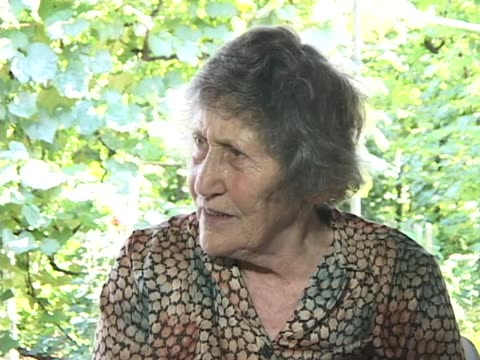
The team travels from Vinnytsya to Vynohradiv to the next interview with Perl Meirovna Nayman, born in 1925 in Turya-Bystra. After the team arrives, they set up the formal interview with Nayman.
From the machine transcript
The team travels to Vynohradiv and sets up for the next interview; the speech is mostly garbled, with a recogniser loop. Near the end, the speakers introduce themselves as the team doing Yiddish work and name the interview with Perl Nayman.
Nayman, nee Shvarts, provides personal information and talks about Jewish life before the war. According to Nayman, thirty families resided in Turya-Bystra, where she lived until she was deported in 1944. She provides information about her family. Her father was a blacksmith and a Cohen. She grew up with one brother, who helped out in the smithy, one sister and four more brothers. Her mother gave birth to eleven children. Nayman then talks about her education. She explained that she would listen in on classes held for boys in a religious school (cheder). Nayman then addresses childhood memories. She and her mother would help the non-Jews work the fields with their horse. Her own family owned and worked a plot of land of two hectare and animals.
From the machine transcript
Nayman gives her birth year, 1925, and birthplace Turya-Bystra, a village with only a few Jewish families, where she lived until the deportation in 1944. She names her father, a blacksmith and kohen, and her grandfather, and describes the beit midrash with separate women's and men's sections. She talks about her mother, the family's animals and kosher practice, listening in on cheder lessons without paying, and working the fields and the family's land.
Adds her father the blacksmith and kohen, the family's animals and fields, and the beit midrash.
Nayman talks about Jewish life before the war, in particular matzo baking. She then recites prayers and talks about her “unofficial” cheder education.
From the machine transcript
Nayman briefly mentions how matzo was baked and later bought, then recites long stretches of prayer, much of it garbled in the transcript. She explains how the cheder teacher taught the boys translations of Hebrew words and how she learned unofficially. She says she prays in the morning now, and the passage closes with a remark about synagogues and local Jews.
Adds the recitation of prayers and a description of her present-day prayer habits.
Nayman remembers how she sang Sabbath songs with the cheder boys before talking about her family. She then talks about life after the war. Nayman explains that her family was preparing a circumcision for her brother, who was born in 1914, and when her father was about to begin to read from the prayer book, he was drafted into the army. They received news that he had died at the front during World War I. After her mother received the note of her husband’s death, she moved in with her parents in Turya Polyana. They lived there for six years. During that time, her father returned unexpectedly.
From the machine transcript
Nayman recalls singing Sabbath songs with the cheder boys and her father not letting her take part in some customs. She then tells a story of the family during World War I: her father was drafted before a circumcision, was reported dead at the front, and her mother moved in with her own parents for six years. He came back unexpectedly one evening, and the mother and grandmother fainted from surprise. She names her siblings, born over the following years, and says the mother had many children, some of whom died.
The catalogue's 'life after the war' is the World War I story of her father's supposed death and return.
Nayman talks about her family, in particular her daughter. She then discusses prewar Purim and Passover celebrations. Nayman explains that she would dress up for Purim and go to relatives’ houses. She then recalls her childhood, when she did not have time to play with friends and helped out her family instead. Her father, who grew up as an orphan, was born in Verkhnya Solotvyna. Nayman then recalls the folk customs of opshprekhn a gut oyg (avert the evil eye) and leshn koyln.
From the machine transcript
Nayman talks about her daughter and granddaughter and about Purim: dressing up, going to relatives, and a Purim rhyme. She recalls Passover at her father's table. She says she had no time to play, since she helped her mother and herded cows. She names her grandparents and says her father came from near Uzhhorod and her parents were both Shvarts but unrelated. She describes two cases of the evil eye, her mother's death in Auschwitz, and how coals are extinguished to cure it, with Kerler asking about wording.
Adds Passover seder memories, her grandparents, and detailed evil-eye stories and the coal-extinguishing cure.
Nayman discusses prewar Jewish life and recalls her father visiting rebbes in surrounding towns. She then talks about a Zionist organization from Uzhhorod, which came to her home town. Her father would not allow her and her brother to attend the meeting. She remembers how her father punished her for putting on makeup. Nayman then talks about Sabbath celebrations at home and recites Sabbath prayers (God of Abraham), before she discusses Hanukkah celebrations. Nayman recalls a few words in biblical Hebrew.
From the machine transcript
Nayman says her father was a Hasid who visited rebbes in nearby towns such as Korets (?), Strebetshi (?) and Munkacs. She talks about Zionist emissaries from a neighbouring town and her father forbidding her and her brother to attend. She tells how he punished her for using makeup, and describes Sabbath at home with her mother baking challah, cholent and the Sabbath-evening prayer. She also covers Hanukkah customs and food, the dreidel and other terms, and a few Hebrew words, with Kerler and Katz asking about the terminology.
Adds Hanukkah food and game terms discussed with Kerler and Katz.
Nayman talks about religious life today and customs, before she remembers Sukkot celebrations before the war and today. Nayman then recalls names for non-Jewish holidays. She then discusses her relationship with non-Jewish neighbors before the war. Nayman then talks about life after the war in Studenyy (her husband’s home town), where she and her husband lived for thirty years. According to Nayman, eighty Jewish families resided there before the war. Her husband was imprisoned in a concentration camp in Poland from 1941 to 1945. She talks about his life during the war in a concentration camp, and about his escape.
From the machine transcript
Nayman answers questions about Simchat Torah and Hoshanah customs, the sukkah, and pre–Yom Kippur food, and names the Christian holidays. She says relations with non-Jewish neighbours were good. She describes Studenyy in the Mizhhirya district, where she lived for thirty years after the war and where there were eighty Jewish families and three synagogues before the war. She tells how her husband was in camps and in Poland from 1941 to 1945 and how he escaped.
Adds Sukkot and Yom Kippur eve food, names for Christian holidays, and details of her husband's escape.
Nayman talks about her husband’s life during the war and his return home. He was imprisoned in several concentration camps and ghetto. He was liberated in Auschwitz. Nayman then talks about her life during the war. Nayman was imprisoned in Auschwitz and talks about her difficult life there. Nayman was selected for forced labor in another camp in the woods. She worked at a factory in town, welding metal during the day for three months until the camp and factory was bombed by the Red Army. She was then forced on a death march for five days. When she reached another town, she was sent to forced labor in a field, building trenches to prevent tanks from crossing over.
From the machine transcript
Nayman tells of her husband's and his family's arrest by Hungarian gendarmes after he hid at home, their time in camps, and the later deportation of the whole community to a ghetto and then to Auschwitz. At Auschwitz she tried to save a small child from the crematorium selection and a German soldier intervened. She describes the overcrowded barracks and starvation food, selection for labor in a camp in the woods, welding work at a factory, the bombing of the town, a march lasting five days and trench digging in a field, and says she was liberated on 9 May.
Adds the husband's hiding and arrest by Hungarian gendarmes and the attempt to save a child at Auschwitz.
Nayman talks about life after the liberation. She remembers people dying from typhus and from eating too much after living on starvation rations for so long. Nayman talks about her life in a DP camp among Germans. Nayman then discusses her observance of religious customs, which she claims to have kept up during the war.
From the machine transcript
Nayman describes how liberated prisoners died of typhus after eating too much rich food, and her stay with an old German woman in a town after liberation. Kerler asks whether she believed in God in Auschwitz; she says she did and still does, and she describes her prayer book and psalm book.
Adds the old German woman and the prayer book and psalm book.
Nayman then talks about prewar Jewish life and her school education in Turya-Bystra. She then talks about contemporary Jewish life in Vynohradiv (Yiddish: Selish). Nayman moved there in 1978 and remembers that none of the congregants could read the prayer book except for her husband. She then talks about non-Jews speaking Yiddish in her home town, in particular a housemaid.
From the machine transcript
Nayman answers Kerler's questions about the religious books in her parents' home, the Czech/Russian word for a school satchel, and the Jews of her husband's village. She and S3 discuss the village prayer house in Turya Bystra, and she recalls Vynohradiv in the 1970s, where she says no one but her husband could read the prayer book. She gives the Yiddish name of Vynohradiv and recalls non-Jews who knew Yiddish, such as a neighbor who worked for a Jewish shop owner.
Adds the books in her parents' home, the school satchel word, and the Yiddish name of Vynohradiv.
Nayman answers a number of questions about cultural terminology from the AHEYM Yiddish questionnaire. Nayman then talks about her family.
From the machine transcript
Questionnaire work with Kerler and Katz on Yiddish vocabulary, including a word for a handsome man, words for lying and deceiving, thanks, memory, and counting families by prayer shawls. They also ask about words for non-Jews and for a blind-night term for the eve of a holiday. The talk then turns to making a video copy for Nayman's family and to the interview she gave on Soviet television about the war, ending with mentions of her daughter in America and grandchildren.
Nayman discusses prewar religious customs of female magicians. Her daughter Hendshe explains that the custom “rolling an egg” was only practiced by non-Jews. Nayman then answers questions about cultural terminology and reads from the tsene-rene (women’s bible), from Perek Shlishi.
From the machine transcript
Kerler asks about beliefs and terms: casting spells, a dybbuk and a golem. Nayman then reads aloud and explains passages from a Yiddish religious text, which she identifies as the women's Bible (the catalogue says the third chapter), on conduct, Torah study and divine judgment. The recogniser garbles much of the reading, and Kerler occasionally asks her to explain individual words.
Adds the questions on dybbuk and golem before the reading.
Nayman answers a number of dialectological questions from the AHEYM Yiddish questionnaire. She then discusses Yiddish songs and remembers song snippets, before talking about life today.
From the machine transcript
Kerler asks more dialect questions about words for ill-behaved or released people, and for a snack or an extra course after a meal, and Nayman gives a few answers. She recalls fragments of Yiddish riddle songs and a Purim rhyme, and says her mother did not sing. They discuss a planned visit to the Munkacs rebbe and Nayman's memories of him. Nayman says she does not care for theater but recalls school plays. The tape ends with talk, with S2 and Katz, about sending a cassette or DVD of the interview to her daughter, mentioning Spielberg and the earlier interview.
Nayman and her daughter Hendshe talk about life today. The camera films several towns on the map, before Nayman talks about her life under Hungarian occupation in 1939.
From the machine transcript
Opening conversation, partly with a second woman, about Carpathian Yiddish versus Polish Yiddish and about the interviewers' family backgrounds, languages and birthplaces. Nayman says her granddaughter knows Yiddish and can read Hebrew prayers but not speak Hebrew. Nayman then tells of Hungarian rule, when gendarmes questioned a girl about her name and Hungarian and accused the Jews of not liking them. Kerler closes by saying he will ask some questions.
The transcript shows much talk about Carpathian Yiddish and the interviewers' backgrounds, and a story of gendarmes questioning a girl; the catalogue mentions towns on a map and life today.
Nayman answers a number of dialectological questions from the AHEYM Yiddish questionnaire.
From the machine transcript
Nayman answers a long sequence of dialectological questionnaire items from Kerler, with some follow-ups from Katz. Items include household and building words (house, floor, window pane, bed, attic, beam, bridge, yard), the body and ailments, adjectives and adverbs of degree, kinship and midwife terms, and numerals and dates. She is also asked about forms of address (singular, plural and honorific), verbs and grammar, a few religious terms (cantor, prayer, rich man, wishing the dead rest), and example sentences. Along the way she explains words, tells a short proverb about a pious man and a cross, and mentions that her father died in the First World War. At the end the interviewers thank her.
The team concludes the interview with Nayman and the camera collects footage of her courtyard. The team travels to the old Jewish cemetery of Vynohradiv.
From the machine transcript
The interview ends with thanks and farewells. Others present talk, partly in Russian and Polish, about contacting someone and conveying greetings. The garbled speech makes the content of the later part unclear.
The transcript shows the camera and the courtyard footage only through the conversation; it shows no clear sign of the trip to the cemetery.
The team arrives at the cemetery and camera records gravestones.
From the machine transcript
At the old Jewish cemetery, Kerler and Katz read and discuss gravestone inscriptions, deciphering names, dates and Hebrew abbreviations. The words are largely garbled.