People › Sara Yankelevna Gvinter › conversation

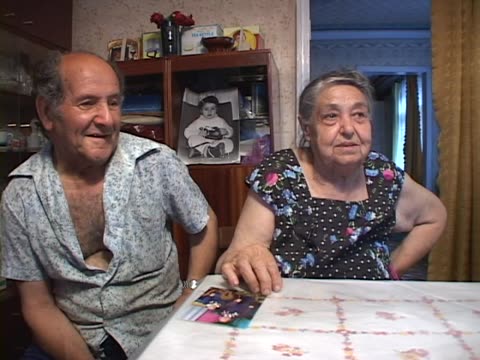
Sara Yankelevna Gvinter; Musya Moiseevna Vaynshteyn

Bershad' 11 May 1903 – 8 June 1904 2.0 h · 2 parts on 2 tapes uncertain
Loading the player…
  1. MDV 376 0:00–1:00:39 · 61 min · not online — MCO
  2. MDV 602 0:00–1:01:42 · 62 min · not online — MCO
Passages
MDV 376 0:00–1:00:39

0:00

Gvinter continues to share her recipe for strudel. She then talks about Hanukkah celebrations before the war, including food customs. Gvinter also addresses Shavuot baking customs, as well as other dishes.

before the war FoodOther holidays MDV 376 · MCO
From the machine transcript

Gvinter explains how she makes a baked pastry, with details of the dough, the filling and the oven. She then answers Kerler's questions about what was eaten at Hanukkah, including latkes made from potatoes, and about dishes made for Shavuot with cheese and potatoes. The talk then moves to salads, pickled vegetables (sauerkraut) and other food, with S2 and S3 chiming in.

Also covers Shavuot dishes, salads and pickled cabbage, and S2's and S3's comments.

8:33

Gvinter addresses Passover dishes and matzo ingredients. She then speaks about other holiday dishes, as well as her contemporary cooking. Gvinter then discusses food terminology.

From the machine transcript

Gvinter describes Passover dishes made from matzo, with details of the ingredients, and says what was eaten before the Yom Kippur fast. Kerler and others talk over a food offer, and she discusses preparing salad in Bershad' today. Kerler then asks for the Yiddish words for green onions, potatoes and eggplant, and how she cooks eggplant.

Includes food terminology (green onions, potatoes, eggplant) and a Yom Kippur fast meal.

14:05

Gvinter speaks about postwar holiday celebration at home. She also talks about her family.

From the machine transcript

Asked about Jewish holidays after the war, Gvinter says she was always at work, and that her mother was still alive and kept them for her until her death. She says her mother did not sing but wept; the year of her mother's death is given in the transcript. The passage ends as Kerler asks about Jewish weddings after the war.

Gives her mother's death and family details (mother as a young widow with children).

15:45

Gvinter speaks about her wedding celebrations in 1955 and 1959. She also speaks about her family in Israel. Gvinter's daughters made aliyah. Gvinter also mentions why she decided not to move to Israel.

From the machine transcript

Gvinter says she had a large wedding of about three hundred guests and a second one a few years later, and mentions a grandchild's name. She explains why she did not emigrate to Israel: her husband's parents, her own parents and a brother are buried in Bershad'. She also describes her daughters' lives and work in Israel, and a grandson working in a restaurant there.

20:25

Gvinter talks about her family, particularly her mother. Gvinter also states that her sibling died of black pox, before she was born. She then answers questions about cultural terminology.

From the machine transcript

Kerler asks whether her mother taught her folk remedies; Gvinter says her mother was a housewife who did not know such things. She mentions a child of her parents who died of smallpox before she was born. Kerler then asks the meanings of a series of words and phrases (such as a dybbuk, a golem and the Yiddish for a cemetery) and sayings used when speaking of the dead.

Starts with her mother and the child who died of smallpox before turning to the word questions.

24:28

Gvinter answers dialectological questions from the AHEYM Yiddish linguistic questionnaire.

From the machine transcript

Gvinter answers Kerler's dialectological questionnaire: greetings and polite phrases, words for house, window, colors and household objects. It also covers words for adverbs of time and comparison, verbs, and grammatical forms with pronouns and prepositions, with sentences to translate. S2 and S3 sometimes help. Briefly she speaks about an American interview and videocassettes of her daughter's wedding. Kerler also asks about words for Jewish religious and everyday life, such as the cemetery, a convert, a midwife, a shop and the prayer leader.

MDV 602 0:00–1:01:42

0:00

Dialectology

From the machine transcript

Kerler asks Gvinter dialectological and terminology questions. They cover words for a rich man (gvir), a Hanukkah top (dreydl), paradise after 120 years, and 'then'. Further items are words for a ship, husband/wife, perhaps/probably, planks and fence, Tisha b'Av, a woman's looks, rooms, 'suddenly', 'various things', enemy and curses. Gvinter answers with her own forms, and a few other voices comment.

13:25

Anecdotes and proverbs

From the machine transcript

Kerler asks for anecdotes and sayings from before the war or from older people. They talk about Nukhem, an old Jew from Chechel'nik who wore a sheepskin and bathed in the river in winter. He lived in the synagogue, and the details of the story are only partly clear.

identifies Nukhem as an old man who lived in the synagogue and bathed in winter

16:15

Dialectology

From the machine transcript

Kerler returns to dialectological questions. They cover 'sun' and 'husband', words for non-Jews (narelim (?), 'olam') and for thieves and boasters. Gvinter answers, with occasional comments from others, and Kerler then asks her to sing again.

21:45

Singing "Vinter teg" (Winter Days) and "Afn yidishn beys-oylem" (At the Jewish Cemetery)

From the machine transcript

Gvinter sings two songs at Kerler's request, a winter-days song about travelling and a ghetto/camp setting, and a song about the Jewish cemetery. Kerler asks about words in the first song and about its history, and she says she has forgotten more.

25:51

Addressing American Jews

From the machine transcript

Kerler asks Gvinter what she wants to say to American Jews and to students of Yiddish culture. She wishes that they never know the troubles she has known, that the surviving Jews multiply, and that the younger generation lives in health. The passage ends with her offering food.

28:07

Synagogue in Bershad

From the machine transcript

Partly garbled conversation at the wooden synagogue in Bershad, with Russian remarks. The speakers seem to discuss the building and Yiddish books found there. The detail is unclear.

mostly unclear talk with Russian asides

31:27

Footage of the grave of Nahman of Bratslav

Footage MDV 602 · MCO
From the machine transcript

Camera footage in which a voice prays at length, in Hebrew-Yiddish with repeated invocations of mercy. This is probably the Hasidic prayer at the grave in Uman'. No interview is in progress.

41:43

Greeting and setting up interview

Informal MDV 602 · MCO
From the machine transcript

The team arrives at Vaynshteyn's house in Nemyriv and she greets them outside and invites them in. Kerler explains that they want to record how she speaks Yiddish and what she remembers. She says she learned some Yiddish from her parents. Kerler gives the date and place of the recording.

43:40

General introduction

From the machine transcript

Vaynshteyn gives personal information: she was born in Dzhurin, about ninety kilometres from Sharhorod, and now lives in Nemyriv. She gives her name, patronymic, address and telephone number, and her birth year, 1935.

46:12

Prewar Jewish Dzhurin and family

From the machine transcript

Vaynshteyn talks about Dzhurin before the war, a Jewish town smaller than Sharhorod with a Jewish school. She finished seven classes, studied at a technical school and worked in Moldova. She names her father Moshe, a native of Dzhurin, her mother Sara, a housewife from Kryzhopil', and her grandfather Ayzik and grandmother Kheyke. She recalls Simchat Torah with children and the grandfather's morning prayer with tefillin.

52:49

Early childhood memories and siblings.

before the war ChildhoodFamily history MDV 602 · MCO
From the machine transcript

Vaynshteyn recalls her childhood in Dzhurin, including Jewish classmates and a mezuzah on the door of the house. Non-Jews speaking Yiddish in Sharhorod are mentioned, and the brothers are discussed, one of them born during the war and the other in Israel. She describes the Sabbath at home, with no heating on Saturday, cooking in the oven on Friday, and her mother baking. Kerler asks the word for challah.

Questions put in this conversation

Items of the dialect questionnaire asked here; each link plays the moment.