People › Sura Melekhovna Bivson › conversation

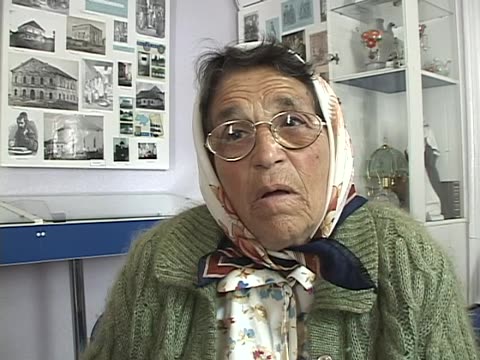
Sura Melekhovna Bivson

Starokostyantyniv 27 May 2008 Interviewed by Moisei Lemster 89 min · 2 parts on 2 tapes
Loading the player…
  1. MDV 477 0:00–26:52 · 27 min · archive.org
  2. MDV 676 0:00–1:01:59 · 62 min · archive.org
Passages
MDV 477 0:00–26:52

0:00

This tape is a continuation of a formal interview with Sura Melekhovna Bivson (née Frierman, b. 1926 in Polonne) conducted in Starokostyantyniv. Dr. Lemster asks Bivson questions from the AHEYM sociolinguistic and dialectological survey. Bivson also briefly discusses wedding and culinary customs from her youth.

From the machine transcript

Bivson answers Lemster's dialectological questionnaire. Items include the words for a top, a rich man, a wagon, a machine, an attic or floor, a ceiling, a face, a beard, a room, a cheder, a mouse, a kiss, a rabbi and rabbis, a Litvak's speech and a convert. Many answers are garbled or glossed in Russian. Near the end Lemster asks briefly about matchmakers and weddings in the shtetl and about a baked item (?) the mother made. Bivson then speaks of her age and says there is little to tell.

Includes talk about a Litvak's way of speaking and about conversion.

16:20

Bivson shares her views on what it means to be a Jew, stating that Jews are morally decent people, who have love and pity for other people and animals. Dr. Lemster then returns to the linguistic questionnaire.

From the machine transcript

Bivson answers what it means to be a Jew: having pity for everyone, loving animals, and being honest and good. She mentions her two cats and a dog and her flowers. Lemster returns to the questionnaire with items on flowers and a flowerbed, a Yiddish expression, 'come', and the word for book. She then speaks of her age, the war and the people she lost, and of her forty years as a telephone operator, including calls from Israel.

Adds her work as a telephone operator and the people she lost.

22:32

Bivson describes the atmosphere of her childhood home and how it continues to influence her attitudes and actions today.

From the machine transcript

Bivson describes the peaceful, Yiddish-speaking home she grew up in, with a good mother and a father who worked and handed over his earnings, and says this is why she is as she is. She recalls her mother's lighting of Sabbath candles and her own custom of lighting candles for a year after her mother's death. Lemster asks about prayers and songs she knew, and she says she does not remember them. She hopes that Lemster's students will be good people and will know Yiddish, and Lemster thanks her.

Adds her mother's candle-lighting, her own candle-lighting after her mother's death, and Lemster's closing explanation of the recording.

MDV 676 0:00–1:01:59

0:00

Personal introduction and family.

From the machine transcript

Bivson gives her name, address, Yiddish name, and birth year 1926 in Polonne. She names her father, whose work was paving clay floors, and her mother Frume, who worked in a rag-processing factory. She says she remembers no grandparents and names her two older sisters, Mindl and Khaike. She then starts to speak about her Yiddish school.

5:37

Childhood years and holiday celebration.

before the war ChildhoodOther holidays MDV 676 · MCO
From the machine transcript

Bivson describes the good if not wealthy life of working people among many Jewish neighbors in Polonne. She recalls her father making prayer books and the Passover seder: opening the door for the Messiah, the festive food, and Passover dishes kept in the attic. She also describes Purim, with baking, gifts to the poor, singing, dancing and masks, all in Yiddish.

8:43

Yiddish school and food customs.

before the war SchoolingFood MDV 676 · MCO
From the machine transcript

Bivson says she studied six grades in a Yiddish school and could write Yiddish. She does not remember a Purim song. She speaks of the good prewar life of her whole family, of which she is now the only survivor. She mentions Hanukkah gifts and latkes, then explains how her mother made gefilte fish and how she still prepares it herself.

15:00

Life during the war.

during the war World War II (general) MDV 676 · MCO
From the machine transcript

Bivson begins to tell about the war years, when she was evacuated to Birobidzhan. She describes the hard journey on an open platform in the rain and says she survived on hardship. She traveled with her sister Khaike and her parents to her older sister Mindl, who lived in Birobidzhan.

16:15

Family and evacuation.

From the machine transcript

Bivson says her sister Mindl had studied at a Yiddish pedagogical institute and worked as a teacher or educator before the war. She recalls the long trip to her in Birobidzhan and the hunger there: green borscht, little bread, and cards.

The sister's education (a Yiddish pedagogical institute, a transcript detail) is only partly clear.

17:48

Yiddish press and library.

From the machine transcript

Bivson answers questions about Yiddish reading, a library in her school and in town, and the writer Peretz, who she says was from Polonne. She recalls Yiddish theater visits and applauding until her hands hurt, but remembers no actors' names.

Names the writer (Peretz) as someone she claims is from Polonne.

21:41

Work and religious life after war in Starokostyantyniv.

From the machine transcript

Bivson says she worked as a telephone operator for forty years. She describes postwar Jewish life in Starokostyantyniv, with a rabbi, a synagogue, a minyan and a shoykhet who came from Khmelnytskyi. She also answers Lemster's question about the Yiddish name of the town.

Also covers the Yiddish name of Starokostyantyniv and her move there.

24:02

Life today.

life today Life today MDV 676 · MCO
From the machine transcript

Bivson regrets that so many people were killed and speaks of the son she lost, a physics and mathematics teacher who had finished an institute. She mentions a holy place and a monument, which she says are worth visiting. Lemster then turns to weddings.

25:31

Jewish weddings and religious customs.

From the machine transcript

Bivson recalls Jewish weddings with klezmer, a chuppah, gefilte fish and kosher food, and challah baked on Fridays. She answers questions about the word getoyg and about women who exorcized the evil eye (opshprekhn) with coals, saying she does not remember the formulas.

Includes the term getoyg and the coals used in healing.

29:16

Life today and Yiddish-speaking non-Jews.

From the machine transcript

Bivson says she wanted to go to Israel and longs for her friends from Donetsk and Starokostyantyniv. She answers questions about dybbuk, golem and geshmad, and says she knows no Christians who speak Yiddish, though some elderly people understand it. She says she knows a Hebrew prayer and recites or speaks a Yiddish prayer for the cemetery. She also talks about her grandchild, her son who spoke Yiddish, and her Jewish wedding.

Adds the cemetery prayer, Israel, grandchildren, and the answers about dybbuk, golem and geshmad.

35:06

Dialectology and prewar synagogue service.

From the machine transcript

Lemster gives Russian words and Bivson answers in Yiddish: greetings, everyday words, colors, adjectives and adverbs of time and place, and verbs in sentences. Many items are garbled. She also says that before the war only boys went to synagogue, while girls knew a holiday was coming because of the festive food. The tape ends with her saying she did not go to synagogue after the war.

Questions put in this conversation

Items of the dialect questionnaire asked here; each link plays the moment.