People › Raisa Rusakovskaia › conversation

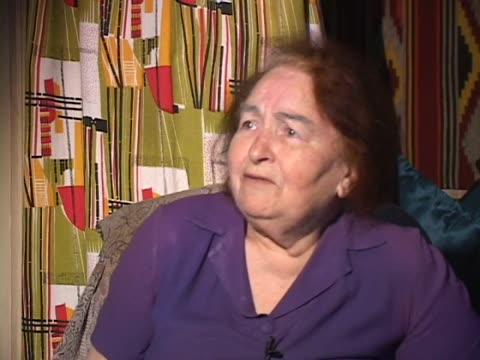
Raisa Rusakovskaia

Kyiv 22 June 2005 Interviewed by Dov-Ber Kerler, Jeffrey Veidlinger 2.3 h · 3 parts on 3 tapes
Loading the player…
  1. MDV 510 0:00–1:02:16 · 62 min · not online — MCO
  2. MDV 511 0:00–1:01:21 · 61 min · not online — MCO
  3. MDV 512 0:00–12:10 · 12 min · not online — MCO
Passages
MDV 510 0:00–1:02:16

0:00

Personal introduction and discussion of “Raisa”.

From the machine transcript

Rusakovskaia explains that she has two first names, Rakhil (Rokhl) and Raisa. At work, among non-Jewish colleagues and clients, she was called Raisa, while her passport says Rakhil. She says her parents called her Rakhilke or Rakhele, gives her patronymic and surname, and states that she was born in Chornobyl'.

Also gives her birthplace and the form of her name used at home.

3:24

Family and religious life pre-/post-war.

before the warafter the war Family historyReligious life (general) MDV 510 · MCO
From the machine transcript

Rusakovskaia describes her parents. Her father went to the synagogue daily and on Sabbath and holidays, and her mother went on holidays. After the war the synagogue was taken away, Jews gathered in private homes, and the police fined them for it. She describes the prewar synagogue with its two floors, with men below and women above reading from prayer books. She gives her father's name as Isaak (Shloyme) and her mother's maiden name as Shepelski, with her first name given as Malke. Her father was a carpenter and her mother a housewife who raised three daughters.

Gives the parents' names and trades and the building of the synagogue.

10:34

Early childhood memories of home and school education.

From the machine transcript

Rusakovskaia talks about the family house with its garden and her mother, who ran the household. She names her two sisters and tells what became of them. The eldest, Polia, became a dentist in Kyiv and died in a hospital in 1975 (?). Beba worked as a bookkeeper and has been dead for some years. Rusakovskaia mentions her own illness and operation, and the family's cow Manke.

Covers the sisters' fates, her illness and the cow, beyond early childhood and school.

15:50

Beginning of war and evacuation.

during the war Evacuation MDV 510 · MCO
From the machine transcript

Rusakovskaia describes preparing for evacuation at the start of the war. She led the cow Manke out to the field. A barge loaded with salt was dumped into the Prypiat river so that people could leave Chornobyl', and her father hung the key on the house, expecting to return. Almost all their things stayed behind.

17:41

Religious life in Chornobyl' and holiday celebrations.

From the machine transcript

At the request of a second voice for more about the synagogue, Rusakovskaia describes how Jews went to synagogue on all holidays and how her mother prepared for them at home. At Passover her father led the seder from the prayer book and neighbors without a husband joined the family at the table. Kerler asks about the four questions, but her father read alone.

19:21

Yiddish school.

From the machine transcript

Rusakovskaia says she finished four classes of the Yiddish school in Chornobyl', which was then closed, probably in 1936–37. The pupils were transferred to a Ukrainian school, where they studied until the war. She says her older sister finished seven classes in the Yiddish school. She can still read, write and speak Yiddish, and reads Yiddish booklets from her library. Kerler then asks about the Chornobyl' rebbe, about whom she remembers little.

Includes the question on the Chornobyl' rebbe.

21:45

Charity and prewar religious life.

From the machine transcript

Rusakovskaia answers questions about what makes a 'good Jew'. She recalls her mother helping people in need and collecting money for them at the synagogue. She describes the separate Jewish and non-Jewish cemetery fields in Chornobyl', where her parents are buried. Only gravestones with Hebrew inscriptions remained after the war. Visitors from Kyiv came to the graves of their parents, and Jews gave money for memorial prayers. She describes women reading in the upstairs part of the synagogue and shows her father's handwritten copy of the prayer book.

Adds the cemetery, memorial visits and her father's handwritten prayer book.

27:05

Childhood memories.

before the war Childhood MDV 510 · MCO
From the machine transcript

Rusakovskaia talks about her childhood friends from the street, whose names she gives. They spoke Russian when small, and in kindergarten there was no Yiddish. In the Yiddish school they spoke Yiddish. She describes the club, where schoolchildren recited, told stories and sang in Yiddish. She cannot recall poems from school.

28:50

Yiddish school and cultural life.

From the machine transcript

Asked by Kerler which Yiddish writers were studied, Rusakovskaia remembers Sholem Aleichem and Peretz and agrees about Markish but recalls no others. She says Yiddish actors came from Kyiv to perform at the club. Her friends were taught in the Russian school, so after the transfer the children spoke Russian, which was hard at first.

Names the writers studied and adds the language the children spoke.

31:40

Father’s work as a carpenter and food customs.

From the machine transcript

Rusakovskaia says her father the carpenter made windows and doors with fine decoration. She then describes Passover food, especially fish, and discusses with Kerler the terms for fried, chopped and stuffed fish (gefilte). In Chornobyl' fish was made without sugar. At Passover the shoykhet came, and after the war, when he died, one came from Ovruch.

Adds the fish terminology and the kosher slaughter of chickens.

34:51

Passover preparation and holiday celebrations.

From the machine transcript

Rusakovskaia talks about the shoykhet before and after the war, and about the 'Khabne seer' (?) whom people visited. Kerler asks about Hanukkah, and she recalls gifts of Hanukkah money from relatives, latkes, and her mother's fattening geese. She also describes Friday night with Sabbath candles and cholent in the Russian oven. Kerler asks for terms such as 'believer' and 'honest', and she tells about Tisha b'Av and children's games, including nuts at Hanukkah.

46:35

Converting to Judaism and Purim.

From the machine transcript

Kerler asks about converts to Judaism. Rusakovskaia says she did not hear of any before the war, since mixed marriages did not occur in the town. On Purim she recalls the baking of hamantaschen. Asked about a Purim play, she says only that the Yiddish school staged performances while it existed.

49:20

Yiddish school and non-Jews speaking Yiddish.

From the machine transcript

Rusakovskaia says the school celebrated Soviet holidays rather than Jewish ones, and was open on Sabbath, with Sunday as the day off. She says many non-Jews in Chornobyl' spoke Yiddish freely, because Jews and non-Jews lived mixed together on one street. Jewish women spoke Russian poorly. She also describes a street of Jewish families.

Adds Soviet holidays at school and the Jewish street.

52:11

Dialectology.

From the machine transcript

Kerler asks about the word 'Litvak', and Rusakovskaia describes her father's speech, from Ivankovtsy, and her mother's, from Chornobyl'. She gives examples of their pronunciation, such as the word for feathers, and says they could understand each other, and that in school she was taught to say 'kumen'. Kerler begins to ask words for translation and moves on to relations with non-Jews.

55:12

Relations between Jews and Christians before and after the war.

before the warafter the war Jewish–non-Jewish relations MDV 510 · MCO
From the machine transcript

Rusakovskaia says relations between Jews and non-Jews were normal and friendly, though her close friends were all Jewish, from her street. At school pupils from the Yiddish and Russian schools mixed. After the war there were fewer Jews. She worked in a bank as the only Jewish employee and used the name Raisa, and later as a bookkeeper in a collective with a Jewish director and mostly Jewish staff, where Yiddish was sometimes spoken.

59:12

Healers and terminology.

From the machine transcript

Asked about folk remedies, Rusakovskaia says medicine was in hospitals and polyclinics. She then describes Jewish old women healers in Chornobyl'. She recalls a healer curing an erysipelas of her leg after the war with black berries, which doctors had failed to cure. Kerler and others then ask the meaning of the words dybbuk and golem, and whether she knows stories about them.

Adds the terms dybbuk and golem put to her.

MDV 511 0:00–1:01:21

0:00

Religious customs.

From the machine transcript

Kerler asks about customs for remembering the dead: yahrzeit, charity given in memory of a parent, and set wishes such as that the deceased be a good advocate (beter) in heaven. Rusakovskaia answers which of these she knows and says she gives money at the synagogue. He then asks where she was during the war.

The passage is largely a questionnaire on mourning formulas and wishes, and ends with the lead-in to the war question.

2:41

Evacuation.

during the war Evacuation MDV 511 · MCO
From the machine transcript

Rusakovskaia recounts the family's evacuation. They left Chornobyl' and were turned back at Kyiv by the crowds, but her father insisted on going on with the children. In Dnipropetrovsk a friend related to Kaganovich took them on a special train. They worked on a kolkhoz near Stalingrad, left when the planes began shooting, and her father repaired another family's wagon. They were then sent east to a town with a military factory in the Chkalov region (Sol'-Iletsk), where they worked until the war ended. She also says when they came back to Ukraine.

Gives the Chkalov region and a town name (spelling uncertain) as the place of evacuation, and says they returned straight to Chornobyl'.

9:53

Return to Chornobyl.

after the war Liberation and return MDV 511 · MCO
From the machine transcript

Rusakovskaia describes the return to Chornobyl', where their own house was no longer standing and the family lived with others. Her father, a carpenter, then bought a ruined house (the word is explained to Kerler) and rebuilt it into a fine one. She says she moved to Kyiv in 1967.

11:49

Dialectology.

From the machine transcript

Kerler puts a few questionnaire items: greeting expressions such as 'good morning' and 'good day', the phrase for asking someone to hand over a book, and the word for 'please'. Rusakovskaia gives her forms, sometimes after hesitating and with Russian asides.

13:25

Weddings.

From the machine transcript

Asked about Jewish weddings in Chornobyl', Rusakovskaia recalls a Jewish wedding after the war, where her father brought in a few Jewish boys to say a prayer. She also remembers a childhood wedding where the children were kept in another room, with games and a guitar and fiddle for music. Kerler then asks for congratulation formulas and for the word 'thanks'.

Contrasts a wedding after the war with her childhood memory, and ends with greeting words put by Kerler.

15:56

Dialectology.

From the machine transcript

A long dialectological questionnaire led by Kerler, with Rusakovskaia giving her Yiddish equivalents and often commenting in Russian. The items include animal and everyday words (mouse, house, window glass, dove), colors and adjectives, comparatives and adverbs of time, verb forms and short sentences to translate, numbers, kinship and family terms, words about faith and the countryside, 'honest', 'sick', 'beautiful', 'all/everybody', and terms from the synagogue and house. She also comments that she misses having anyone to speak Yiddish with.

MDV 512 0:00–12:10

0:00

AHEYM project.

Informal MDV 512 · MCO
From the machine transcript

Kerler explains the AHEYM project to Rusakovskaia as an archive of interviews that will be used for books and for Jewish readers. The project will have centres in Vilnius and in America holding the same materials. He says a colleague will join the team the next day, and that they will travel together as far as Lviv and perhaps into the Carpathians.

The passage also covers the team's travel plans to Lviv and the Carpathians and the planned centres in Vilnius and America.

1:46

Dialectology.

From the machine transcript

Kerler asks Rusakovskaia about the meaning and use of Yiddish words, and she sometimes explains in Russian. The items include the word for a lot or full, a verb meaning to leave a wife and children, and a word for 'back' or 'ago'. Kerler also asks which forms she uses for suddenly, various, and the agreement of 'good head', and for singular and plural of 'enemy'. Kerler thanks her at the end.

The passage is a questionnaire session on word meanings and forms, with Russian explanations from the informant and mention of Ovruch and Korosten usage.

5:59

Showing Yiddish and Hebrew books.

From the machine transcript

Rusakovskaia shows Kerler her Yiddish books and her father's prayer book. Her father copied out by hand the pages that had gone missing from it. She says she sometimes feels like reading in Yiddish, and describes her father as an honest man who valued his Jewishness. Kerler offers to send her a Yiddish book and thanks her.

The passage adds her father's handwritten replacement pages and Kerler's offer to send her a Yiddish book.

Questions put in this conversation

Items of the dialect questionnaire asked here; each link plays the moment.