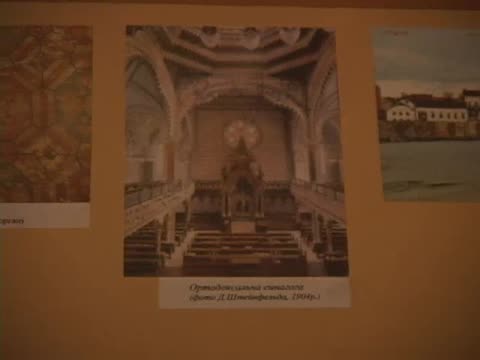
The camera collects footage of the former Great Synagogue, which is now used as a concert hall. Naybauer talks about the architecture of the synagogue. Naybauer explained that he used to pray in the Great Synagogue after the war until it was closed down in 1948. A plaque was put up in 1989 commemorating the concert hall’s history as a synagogue, but was taken down soon after by hooligans.
From the machine transcript
At the former Great Synagogue, now a concert hall, Naybauer and a guide (Russian-speaking) describe its architecture, including the women's gallery, the pseudo-Moorish style and the hall's acoustics. The hall was built in 1904 (per the Russian). Katz and Kerler ask about the layout of the men's synagogue, the ark and the bimah. Naybauer says he prayed here for some years after the war until it was closed. He regrets that no plaque marks it; one was put up and taken down after a few days, and the guide dates this to 1989. The guide recalls American rabbis offering to buy and dismantle the building, and talks about musicians who played there. Kerler thanks the staff and the group moves on.
The guide speaks in Russian about the concert hall's acoustics and the American rabbis' offer.
Naybauer continues the tour through town and points out a former Jewish theater and they walk along the former Jewish street. Naybauer talks about his observant family. His parents and siblings were killed in Auschwitz. He then talks about a typical Sabbath afternoon in Uzhorod before the war, explaining how people would stroll through town. He discusses the religious school education he received until the age of thirteen. They arrive at another former synagogue, now used by the local telephone company. In this building, Jews hid their belongings before being forced into the ghetto. The former mikva is now used as a cafeteria for students. Naybauer tells as tory about how his uncle was murdered by the police. Naybauer moved to Uzhorod in 1935.
From the machine transcript
The tour continues past a former Jewish theater and along the former Jewish street, where Naybauer points out Jewish shops, the rabbi's house and a bridge destroyed in the war. He says his father was a very pious man and that his parents and siblings died in Auschwitz. He describes the Sabbath afternoon promenade, going to cheder until thirteen, and the former mikveh and shoykhet's house. He recalls that Jews hid their belongings in a former synagogue before the ghetto and tells how a policeman or soldier threatened his uncle. He also mentions his grandmother's death in 1935 and the word the Jews used for non-Jews. The garbled stretches make the details uncertain.
Includes the word for non-Jews, the Sabbath promenade and his grandmother's funeral, which the catalogue does not mention.
The team meets Ernest Osipovich and Tubi Halpert on their tour. Halpert remembers the Talmud passage he read at the Mukachever yeshiva, when he was studying with the rebbe of Shpira. Naybauer then talks about his working life before the war. He went into apprenticeship with his uncle, who was a tailor. After the war, he successfully worked as a tailor for forty-five years, specializing in suits, and had a variety of business contacts in Moscow. He then talks about family, before talking about life today. He has two children in Uzhorod.
From the machine transcript
The group meets two local men on the street; one is a former yeshiva student. They talk in Yiddish about Hungarian versus Yiddish at home and the yeshiva. Naybauer then talks about his working life: he learned tailoring with his uncle, later made suits for the intelligentsia including professors from Moscow and Budapest, and worked forty-five years. He also talks about his late wife, his children and grandchildren, a kidney operation by Professor Polansky (?) in Kyiv, and the economic hardship of pensions and rent today. He says he was in a concentration camp at the age of twenty. He ends by pointing out the site of a former Jewish mill.
Adds details on grandchildren, his wife's death, the Kyiv operation and the former mill.
They approach the third building of a former synagogue. Naybauer talks about prewar Jewish life in general.
From the machine transcript
Naybauer and the group approach a former synagogue building and discuss neighboring buildings, including a former large restaurant that employed many Jews, a shop owner, and a house of Dr. Neumann (?). He talks about the Jewish market and the community's size of about ten thousand. He says the Czech period was a good time, followed by Hungarian rule. He also talks about a Jewish bank director who sent money to America.
The team begins the formal interview in a restaurant. Naybauer talks about his family. His father and sister perished in Auschwitz. Naybauer then talks about his childhood memories of Mala Dobron, in particular his father Avrum, who died of the flu in the 1930s. He then lists several Jewish families who lived in Mala Dobron and discusses prewar religious life.
From the machine transcript
In the restaurant, the formal interview begins with Naybauer's family, whose parents died in Auschwitz. He describes his childhood in a poor family in Mala Dobron (Kis Dobron), where he was born in Natkapash (?). His father, from Dubove, died when Naybauer was ten or eleven, after a failed shipment of cabbage; Naybauer then helped support the family. He talks about his grandfather and uncle, lists the Jewish families of Mala Dobron and describes its stone synagogue, rabbi, shoykhet and mikveh. He also mentions receiving compensation in Budapest and being liberated by the Americans.
Includes his grandfather Moshe Preyz, the Dubove origins and a list of local families.
Naybauer talks about life after the war. When he was liberated by the Americans, he stayed in a DP camp in the former Salzwedel women’s concentration camp. He signed up for moving to America, but missed the transport. The refugees then came under Russian command.
From the machine transcript
Naybauer talks about being liberated by the Americans after four hospital stays and his stay in a displaced-persons camp in a former women's concentration camp at Salzwedel. He says he registered to go to America but missed the transport, and was then handed over to the Russians.
Naybauer talks about life in the immediate postwar period in a DP camp. Naybauer had to move to another camp once the Russians took over. When they arrived, he encountered a Jewish official in charge of the camp. The official told them there is no room for them in the camp and sent Naybauer and his brother-in-law to stay in a sugar factory, where they were brought food regularly, before moving further to Prague. There they received money to travel to Budapest. They set up their camp near a former girls’ school. Naybauer explains that he would go to the school building every day in order to check the list of camp returnees. Naybauer signed up for moving to Palestine.
From the machine transcript
Naybauer recalls the days after liberation: the Russians carried him and his brother-in-law on their vehicles, and a Jewish Soviet officer in charge of a camp had no room for them and sent them to a sugar factory where they were fed. He then went on to Czechoslovakia and Prague, where a Czech soldier recognised him and gave him money. In Budapest he registered near the synagogue, signed up for Palestine and checked the lists daily. A girl, a relative, embraced him and told him his mother was looking for him.
Includes a Czech soldier who recognised him and gave money, and an exchange with a relative.
Naybauer talks about a Yiddish language book on the history of Uzhhorod. He continues his recollections of life in the DP camp. He explains that he met a cousin, who had been in the same concentration camp as his mother, and who told him that his mother was still alive and was looking for him. In the hopes of finding his mother, he decided to purchase a train ticket to Uzhhorod instead of going to Palestine. Naybauer then talks about the reunion with his uncle and mother.
From the machine transcript
Kerler and Naybauer discuss a Yiddish handwritten book about the Uzhhorod Jewish cemetery. Naybauer mentions the chevra kadisha gabbai who made gravestones and his son in Israel. He then returns to his time in Budapest, where a cousin told him his mother was alive and searching for him; he gave up Palestine and took a ticket home. At the train station he met his uncle Mendl, who led him to his mother.
Begins with a book (apparently in Yiddish script) on the cemetery, and the gravestone-maker and his son.
Naybauer talks about life after the war in Uzhhorod. He then turns again to his experiences in the ghetto under Hungarian occupation. He was forced to work in the woods in Czechoslovakia for the German war effort. Naybauer worked transporting weapons. He was then sent to several other camps, such as the labor camp Auschwitz III or Monowitz-Buna, Gleiwitz (a sub-camp of Auschwitz), and Mittelbau-Dora (subcamp of Buchenwald concentration camp). Naybauer recalls the experience in Monowitz-Buna as more bearable due to work assignments and regular food supply. Naybauer recalls the difficult conditions in the camps and the deadly conditions in the transports, during which the prisoners were deprived of food and water.
From the machine transcript
Naybauer describes returning home and his mother's remarriage, then goes back to the ghetto under the Hungarian occupation. He hauled munitions for the Germans and prepared a hospital for wounded soldiers. He recalls Auschwitz-Monowitz, the starvation transport to Gleiwitz and then Dora, and the deaths of his brothers, naming David and Mordechai.
Includes his mother's remarriage, a wealthy village family that emigrated to America, and the deaths of two brothers.
Naybauer talks about his brothers and one sister, who perished in the concentration camps. He then recalls the arrival at Auschwitz in June 1944, where they were led to different camps. Naybauer explains that as soon as he reached the central camp, he was forced to go to Dora. He speaks about the food rations they were provided with.
From the machine transcript
Naybauer names his brothers and sister killed in the camps. He recalls arriving at Auschwitz around Shavuot in June 1944, the separation from his father and youngest siblings, the tattooing, and being driven to Monowitz and Gleiwitz. He describes Dora, the hospital barrack, the work details and the meager food, and the daily marches.
Focus on siblings' names, selection on arrival and camp conditions at Dora.
Naybauer talks about the death marches that took place in the last months of the war, before he was liberated by the Americans. He stopped in the Wieda camp, before being transported to another camp by train. When they reached the other camp, Naybauer explains that they were forced to march into the woods for a mass execution, where ultimately 1,200 people were killed. Naybauer survived the massacre and escaped with a Polish Jew. In detail, Naybauer explains their escape, search for food, and liberation by the Americans.
From the machine transcript
Naybauer tells how the camp was bombed in the last weeks of the war and the prisoners were moved to the Wieda camp and then by train. About 1,200 prisoners were marched into a forest and shot; he survived with a Polish Jew and hid in bushes. He tells of searching for food and meeting American soldiers, who fed and clothed him and sent him to a hospital.
Gives details of the escape and the Americans' arrival.
Naybauer returns to talking about the massacre in the woods. He was shot in the foot and escaped.
From the machine transcript
Naybauer returns to the woods shooting, saying a bullet hit his left foot. He lay in the woods, then went to a village and town and was taken to a hospital. There he met an American Jewish doctor from Berehove, and describes his liberation at the end of April.
Adds the American doctor from Berehove.
Naybauer talks about life before the war. His father fell ill when Naybauer was 13 years old, and Naybauer had to support the family.
From the machine transcript
Answering Kerler, Naybauer says he did not know of the killing of Jews, even in Auschwitz. Kerler asks about his work as a boy after his father fell ill. He describes carrying goods from villages to town in the ghetto period and an episode on Passover; the passage ends mid-sentence.
Adds a Hungarian-era Passover episode and ghetto episode.
Naybauer discusses life before the war, in particular holidays like Purim. He frequently attended Purim shpiels at a neighbor’s house. Naybauer remembers plays in his home town, as well as in Uzhhorod.
From the machine transcript
Naybauer first tells of a rich neighbor's family and a priest who was sentenced after the war. Asked by Kerler about Purim before the war, he describes Purim customs: drinking, a Purim play put on like a theater, and children going from house to house reciting the play in the morning and bringing shalakhmones in the afternoon. The play was staged in a widow's house and the children were taught by their cheder teachers. He tells a joke about a matchmaker and a rich man. He recalls the roles of Haman and Esther. He also answers questions about Purim in Uzhhorod.
Adds a story about a rich neighbor and a priest, a matchmaker anecdote and the widow whose house hosted the play.
Naybauer discusses prewar antisemitism, before addressing contemporary religious life. He then recites prayers, before discussing religious life after World War II. Naybauer got married in 1957 and his son was circumcised in 1959. His mother agreed to bring Naybauer’s son to the mohel and was sentenced to three years in jail, but with the help of Jewish journalists she could evade the sentence. Naybauer then talks about synagogue activities after the war.
From the machine transcript
Naybauer speaks about the start of antisemitism and the pressure on observance, then recites a few prayers when Katz asks. He recounts that he married in 1957 and that his son was circumcised in 1959. The KGB harassed the family for half a year, and his mother, accused of arranging it, was sentenced to three years but escaped the sentence through Jewish journalists and acquaintances. He then discusses the synagogue after the war, including which buildings were returned, a small prayer house and a mikveh.
Adds a brief prewar antisemitism passage and how the synagogue was returned after the war.
The team briefly asks Naybauer a number of dialectological questions from the Yiddish AHEYM questionnaire. The camera cuts to the outside of Naybauer’s home. He shows the team a number of family photographs and other documents.
From the machine transcript
Kerler and Katz ask Naybauer a few questionnaire items, among them the word for 'fast' and for 'willingly', and the name for Yom Kippur and Rosh Hashanah. Then there is talk about where to sit and the practicalities of the visit. Naybauer confirms he was born in 1924, and the team looks at a document or photograph connected with a gravestone maker and a chevra kadisha official. After the cut, Kerler announces that he will ask for Russian words and phrases to be rendered into Yiddish.
Adds the photographs and documents, including one linked to a stonecutter and the birth date, and the practical talk.
The team continues to ask Naybauer a number of dialectological questions from the Yiddish AHEYM questionnaire.
From the machine transcript
Kerler, with some input from Katz, continues the dialect questionnaire with Russian prompts for Naybauer to translate. Items include greetings and replies, thanks, parts of the body, colors, animals, house and building words, food, terms for non-Jews and Christians, and comparatives of adverbs. Further items include words for people (the fool, the honest man, the peasant), time words, a few sentences with personal pronouns, and verbs of hearing and knowing. Naybauer also gives some remarks on dialect, such as jokes about the Berehove and Mukachevo Jews. Near the end he mentions failing eyesight and not having shown the ghetto site.
The first part of the tape is a continuation of a formal interview with Nusn Leyb Naybauer. The team continues to ask a number of dialectological questions from the AHEYM Yiddish questionnaire.
From the machine transcript
Naybauer answers dialectological questionnaire items from Kerler and Katz. They cover number and plural forms (counting family members, 'wagon(s)'), words for attic, beam, bridge and floor, names such as Nisn, and expressions such as 'wealthy man' and 'various things'. Near the end he talks about helping visitors find graves in the Uzhhorod cemetery, a book of graves kept by a Reizman, and the age of the oldest gravestones. Kerler then thanks him and closes the interview.
Beyond questionnaire items, he talks about the cemetery, its graves and the book of graves.